Three More Mariners Non-Roster Pitching Prospects to Watch in Spring Training

Non-World Baseball Classic pitchers and catchers reported to Peoria on Wednesday, Feb. 11, marking the beginning of Spring Training as the baseball offseason concludes. While much of the news for the Mariners revolved around the additions to the major league team, there are quite a few prospects looking ahead to Spring Training as a showcase of their skills.
This is the third part of a series of four articles detailing some of the non-roster invites (NRIs) that will make appearances in the Mariners’ Spring Training this year; the first two parts can be found here and here. Unlike part two, which went over some of the higher-end pitchers in the Mariners’ system - who are expected to be starters - this piece goes over hurlers further down in the organization’s depth, mostly expected to slot into a relief role.
1. RHP Teddy McGraw, 24 years old, High-A.
[caption id="" align="alignnone" width="1465"]
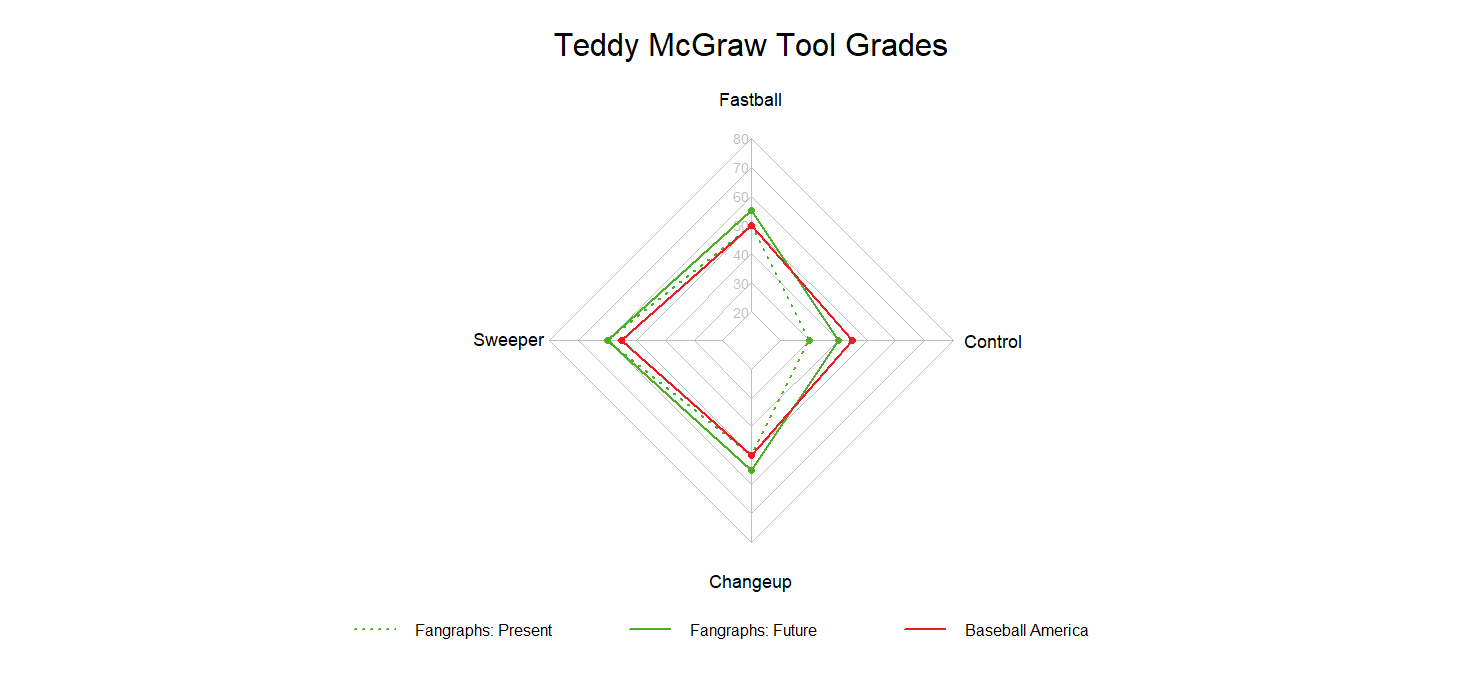
Teddy McGraw has a FanGraphs “future value” of 40 and a Baseball America “adjusted value” of 35 based on a 55 potential value with extreme risk. [/caption]
McGraw has the stuff to reach the majors in some capacity, but a laundry list of injuries over his time in the minors have made it uncertain whether he is still on track to become a big league starter. In any case, his pitch profile - a running sinker combined with a sweeper and a four-seamer - suggest he might fit best as a reliever.
Over 19 ⅓ innings for the High-A Everett AquaSox in 2025, McGraw had a 3.26 ERA (150 ERA+ where 100 is league average and higher is better), 2.26 FIP (216 FIP+), 1.448 WHIP, 24 strikeouts, and four walks. However, that’s the most he has thrown for any one professional team in a season, as his injury issues have limited his reps.
Not only does his FIP - fielding independent pitching, which takes into account solely homers, walks, strikeouts, and hit by pitches as to try to eliminate fielding bias [1] - suggest he has more improvement in the tank, so too does his .426 opposing batting average on balls in play (BABIP). While BABIP is stickier for pitchers than for hitters, that high of a tally suggests a lot of luck going the hitters’ way. His 58.2% ground ball rate, 97th percentile among all High-A pitchers with 10 or more innings, also suggests his opponents will get less hits when he has better fielders behind him.
Spring training will be a chance to see how McGraw uses his pitch mix, whether he will increase the usage of his changeup, and what kind of role will best suit him going forward. While he’s almost certainly going back to High-A to start off 2026, his Peoria performance could change expectations for his trajectory.
2. RHP Charlie Beilenson, 26 years old, Double-A.
Unlike McGraw, there’s no debate about Beilenson’s future usage: he’s a reliever. Beilenson threw 62 ⅔ combined innings between High-A Everett and Double-A Arkansas in 2025, all of them in a combined 44 relief appearances. His 28 ⅔ Double-A innings came in 24 appearances, where he had a 4.08 ERA (87 ERA+), 3.90 FIP (91 FIP+), and 1.395 WHIP with 27 strikeouts and four walks.
Beilenson’s topline numbers may be unimpressive, but there’s a fair bit under the hood that suggests he might end up as a solid big league reliever. Out of 21 fly balls he gave up in Double-A, four became home runs: a 19% home run to fly ball rate (HR/FB%) that was higher than 97% of all Double-A pitchers with 20 or more innings. HR/FB% tends to be essentially random from a pitcher’s point of view, and controlling for it - replacing the home run component of FIP with fly balls multiplied by the league average HR/FB% - turns FIP into expected FIP (xFIP), where Beilenson has a respectable 3.01 and 118 xFIP+.
This is buoyed by his pure stuff and control profile. He has a five-pitch mix, with a four-seamer, sinker, cutter, sweeper, and changeup; and that arsenal has two out-pitches: the sweeper with a foot and a half of horizontal break and a changeup with good drop, giving him a good shot against both lefties and righties. He walked just 3.2% of hitters for the Double-A Travelers, showcasing his strong control (graded 55 by Baseball America), and his 51.1% ground ball rate is 90th percentile among all Double-A hurlers with at least 20 innings.
However, all of that has to come together at some point. Getting a sense of his feel in Spring Training will be a guide to how the Mariners might deploy him in 2026 and whether he starts the year off in Double-A or Triple-A. If Beilenson puts all the pieces in place by mid-season, a September callup (or earlier as injury cover) isn’t out of the question.
3. RHP Tyler Cleveland, 26 years old, Double-A.
Unusual is useful when it comes to pitching, and for guys like Tyler Cleveland who don’t have the velocity, deception can be one of the only tools remaining. He tops out at around 90 miles an hour on his four-seamer, but he delivers it submarine style. He also has a slider/sweeper that he compared to Tyler Rogers’ rising slider and an occasional changeup and cutter.
Cleveland pitched in High-A and Double-A in 2025, racking up 51 ⅔ combined innings. Over his 20 ⅓ innings in Double-A, he had a 0.89 ERA (400 ERA+), 3.65 FIP (97 FIP+) [2], and 0.934 WHIP.
That titanic difference between ERA and FIP is likely the result of a couple things: one, that Cleveland's 49.1% ground ball rate - 86th percentile among Double-A pitchers with 20 or more innings - meant good things for the contact he did give up; and two, that he doesn’t strike out many batters. Still, given that he gave up zero home runs in Double-A, his xFIP was significantly a higher 4.76 that gave him a 75 xFIP+,
Perhaps a good sign comes from Cleveland’s High-A performance, where he put up a similar 0.86 ERA (568 ERA+) and 2.43 FIP (201 FIP+) inside the confines of a much cozier and more hitter-friendly ball yard. Still, seeing how the better hitters of Spring Training go up against his pitching style will be a good barometer as to how much the Tyler Rogers comparison holds up. I wouldn’t be surprised to see him at the very least hover around the outside edges of reliever depth for 2026.
[1] It’s ((13*HR + 3(BB+HBP) - 2*K)/IP) + x, where the x = league (lg) ERA - ((13*lgHR + 3(lgBB + lgHBP) - 2*lgK)/lgIP). This ensures that league average FIP is the same as league average ERA.
[2] The wonders of small sample sizes, where a player can have a park-adjusted ERA almost four times (Cleveland’s ERA+ was actually 399.7 if you go into the first decimal place) as good as his league and yet a below-average FIP. The park adjustment is doing a lot of heavy lifting here: Dickey-Stevens Park in North Little Rock has a park factor of 69, meaning less than 0.7 runs are scored there than at other Texas League ball yards. When applying park factors to things like ERA+ and FIP+, the distance to 100 is halved, since a team plays half their games elsewhere.