Five Mariners Hitting Prospects to Keep Tabs on in 2026 Spring Training

The Seattle Mariners announced 34 non-roster Spring Training invitees on Friday. These are players who are not on the 40-man roster - many of them some of the top prospects in the organization - who will nevertheless be able to compete in Spring Training exhibition games in Peoria as a test of their mettle in a more MLB-like environment. Not all of them are close to making it to the Show, but they will still afford the attention of Mariners-world as to where they are in their development. For guys higher up in the farm system, their performance in Peoria might make the difference between starting the year in Cheney Stadium or T-Mobile Park.
This is the first of a series of four articles going over some of the higher-ranked prospects in the Mariners system who have received the Spring training invite and the first of two covering some of the hitters.
Before we get into the prospects, it’s important to familiarize yourself with the 20/80 scale, which baseball scouts use to evaluate players’ abilities or “tools”. Each tool is rated on the scale, where 50 is MLB average, 20 is about the lowest things get for an MLB player, and 80 is about the highest. In statistics terms, each increment of 10 is one standard deviation from the mean, so roughly 95% of big league batters have a hit tool between 30 and 70. Some systems of scouting differentiate between present grades and projected future grades, while others only give those projected future grades. These analyses give the scouting profiles from FanGraphs (which separates present and future) and Baseball America (which does not).
As for overall grades, they are both an estimate of how good a player will be (again in a similar distribution to each tool) and also a rough probability metric for how likely any given prospect is to pan out in the majors. According to FanGraphs writer Ben Clemens’ analysis of FanGraphs’ overall grades, prospects with a “future value” of 45 ended up “washing out” (accruing less than 0.5 wins above replacement per season) about half the time, with higher grades having a greater chance of producing at the big league level.
1. INF Colt Emerson, 20 years old, Triple-A Tacoma Rainiers.
[caption id="" align="alignnone" width="1465"]
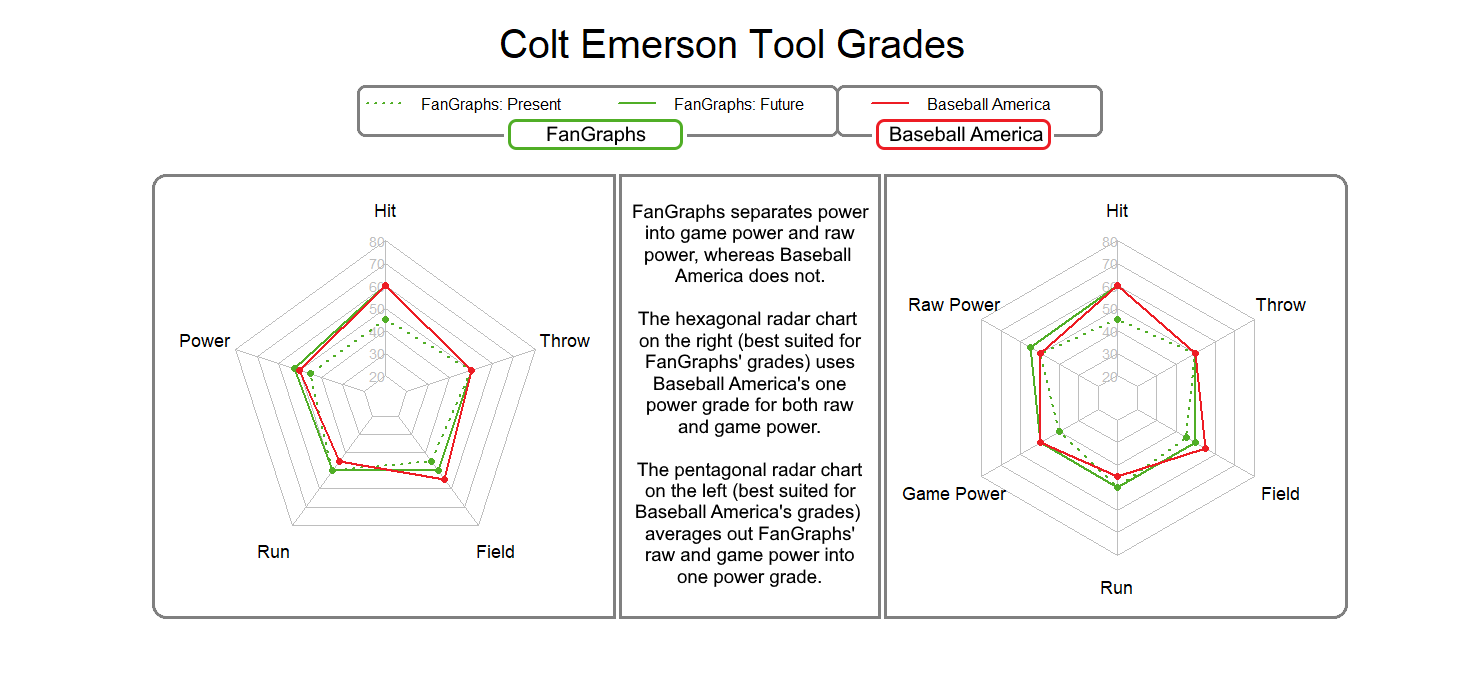
FanGraphs estimates Colt Emerson’s “future value” at 55 while Baseball America gives him an “adjusted grade” of 55 based on a 65 potential grade with average risk. [/caption]
Emerson is perhaps the most well-rounded hitting prospect in the Mariners organization, with no notable weaknesses in his profile and what is by all accounts a good bat. FanGraphs estimates that he has a bit more raw power in the tank while Baseball America gives him an above-average fielding grade, but the hit tool is what will separate a Colt Emerson that becomes an infield utility guy from a Colt Emerson that becomes an everyday player.
While Emerson played in six games for the Triple-A Tacoma Rainiers in 2025, little can be gleaned from such a small sample, so I’ll go over his Double-A stats from 2025 as a lodestone. Over 34 games with the Double-A Arkansas Travelers, Emerson slashed .282/.360/.430 with three homers, 10 doubles, 18 RBIs, and seven stolen bases in as many attempts. His non-park-adjusted OPS+ of 124 is already remarkable, but with his home ballpark being the most pitcher-friendly of any in the Texas League, it becomes rather more impressive.
The key thing to keep track of will be Emerson’s general adaptability. He was able to rocket from High-A to Double-A to Triple-A last year, showcasing a developed ability to adjust to new environments. His .281/.388/.453 slash line in High-A Everett was a little better than his time in Arkansas, but the transition wasn’t the steep drop-off that often happens the first time a prospect goes to a new level. Emerson’s walk rate declined from 13.1% to 8.7% and his strikeout rate rose from 16.5% to 19.3% - so there was some notable difficulty in handling the better arms of Double-A - but he was able to work around it well. His .291 batting average on balls in play (BABIP) was around the MLB average and below the Texas League .301 average BABIP, indicating that Emerson wasn’t just getting lucky in Double-A.
In detail, viewers should keep track of Emerson’s pitch selection to see whether it adapts to higher-end arms in Spring Training, as that will give some insight into how much he will be able to take walks at a major league level. Viewers should also track his bat-to-ball control, as like with fellow keen-eyed prospect Cole Young, there could be some issues in making good contact on the pitches he needs to as he goes up against major league arms.
If Colt Emerson absolutely tears up the diamond in Spring Training, we could see him start out the year in the Majors - but otherwise, he can be expected to start the season in Triple-A. When he does make it to the Show, the M’s will probably have him mostly play third base with some appearances at second and the occasional spot at shortstop, though the Mariners’ long-term plan is likely to have Emerson become J.P. Crawford’s replacement at short if his defense ends up being up to snuff.
2. OF Lazaro Montes, 21 years old, Double-A Arkansas Travelers.
[caption id="" align="alignnone" width="1465"]
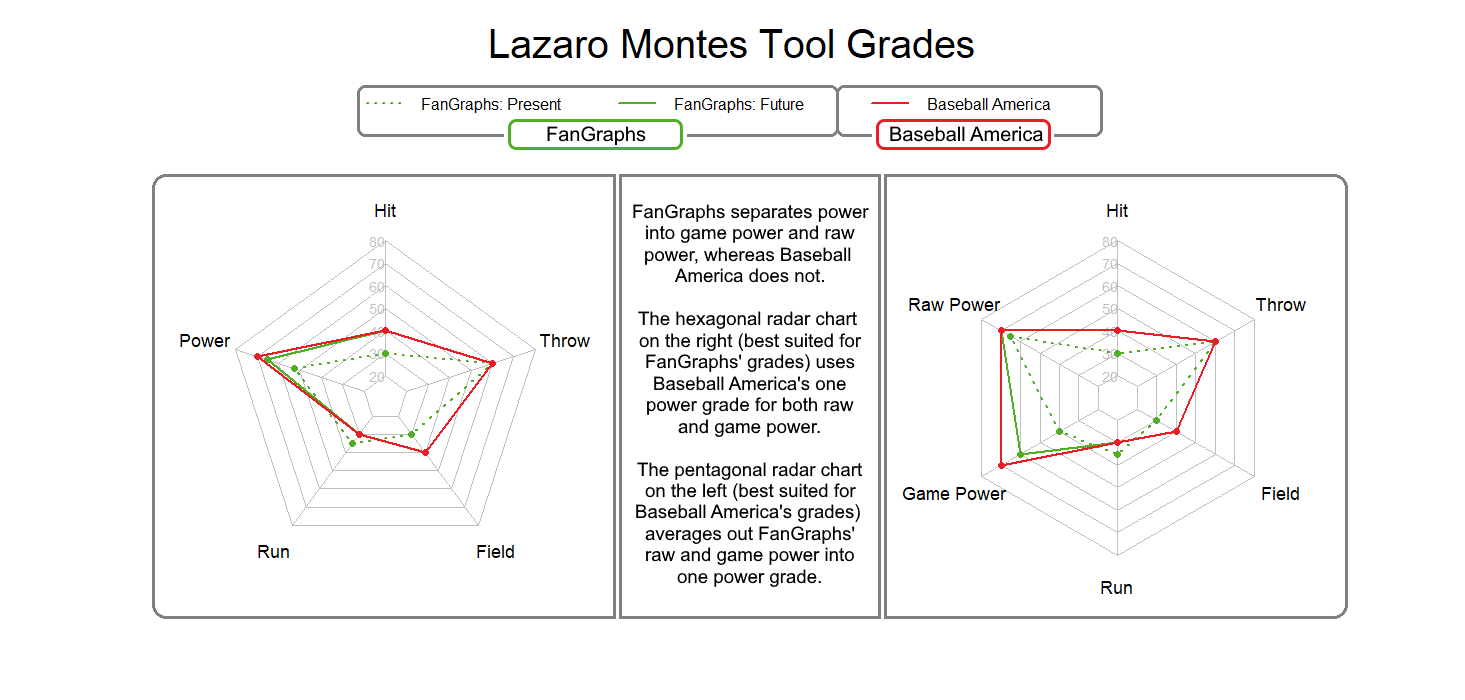
FanGraphs estimates Lazaro Montes’ “future value” at 50 while Baseball America gives him an “adjusted grade” of 45 based on a 60 potential grade with high risk. [/caption]
Where Emerson is an all-around athlete with notable hitting skills, Montes has a profile based on power and lots of it. FanGraphs and Baseball America have nearly identical projections for Montes, with hitting for contact, fielding, and running as notable weaknesses, though FanGraphs’ power split expects Montes to have considerably less game power than raw power.
Montes hit quite well in High-A Everett in 2025, with a .268/.387/.572 slash line (157 non-park adjusted OPS+), 18 home runs, 12 doubles, five triples, and 50 RBIs in 67 games. Comparatively, he had his share of struggles in Double-A, with a .213/.319/.433 slash line (112 non-park adjusted OPS+), 14 home runs, seven doubles, two triples, and 39 RBIs over 64 games, but a good portion of that was a decline in BABIP from .329 to .264. Still, though his overperformance in Everett and underperformance in Arkansas skewed the numbers, Montes is projected to start the season off in Double-A - and his isolated power did decline from .304 to .220.
The strikeout rates for Montes will always be fairly high, and they did jump from 27.6% in High-A to 30.5% in Double-A, another reason why he will probably get some more reps in Arkansas in the early weeks of 2026. His walk rate also declined with the level hop, from 15.9% to 12.4%, again an indicator that the M’s will want to see get back toward his Everett levels before bringing him further up the farm system. If he smooths those things out in Spring Training, however, we could see his road to the MLB shorten a fair amount.
While not the main reason why Montes is rated so highly within the Mariners’ system, his defense is also something to keep an eye on in February and March. He currently projects to be a fringe right fielder or DH, but if his glove and speed improve on the margins, he could become an everyday right fielder. With that in mind, his bat and power will be the deciding factor.
3. OF Jonny Farmelo, 21 years old, High-A Everett AquaSox.
[caption id="" align="alignnone" width="1465"]
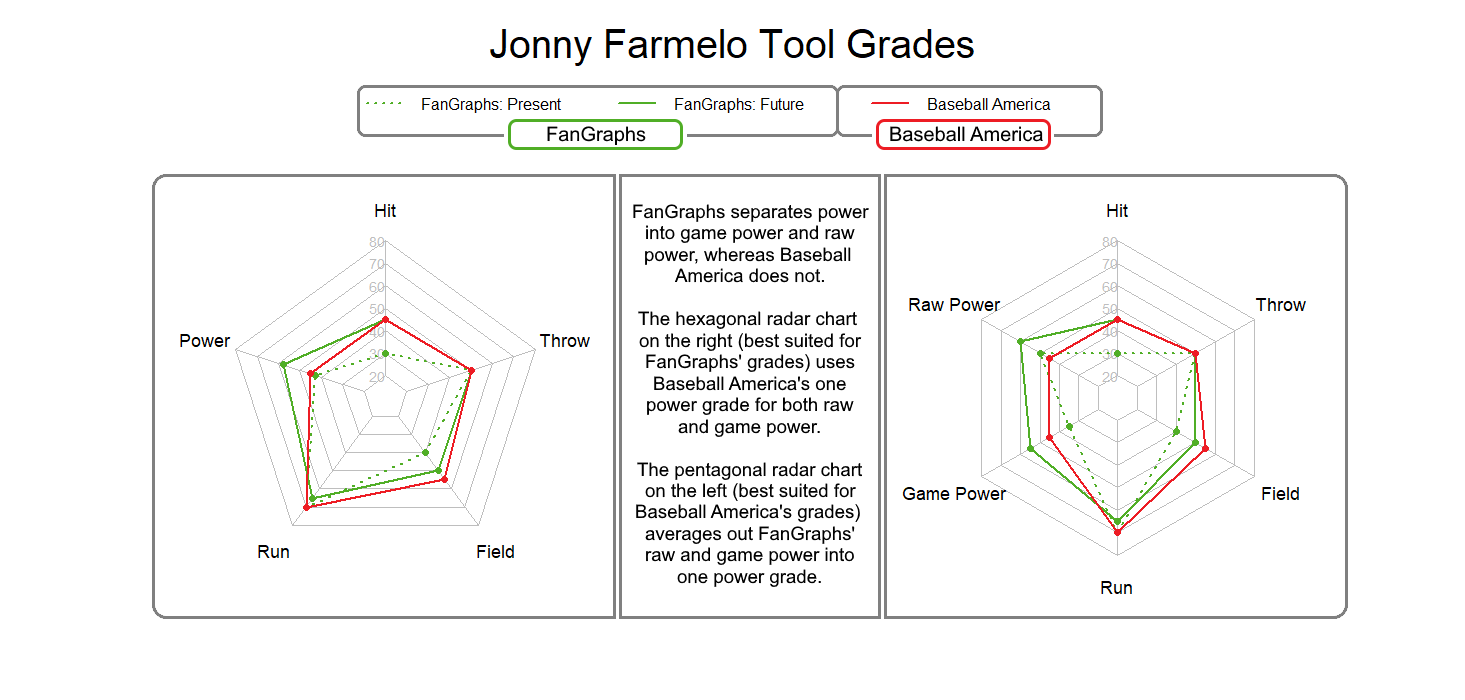
FanGraphs estimates Jonny Farmelo’s “future value” at 50 while Baseball America gives him an “adjusted grade” of 40 based on a 55 potential grade with high risk. [/caption]
Farmelo isn’t at all likely to make an appearance on the big league squad in 2026 unless he goes on a truly monster run, but he does have some interesting potential as a power/speed outfielder … at least according to FanGraphs. Here is a case where scouts appear to disagree. He often misses high-speed pitches, especially high in the zone, but an ability to get to balls low in the zone and drive them with power gives him some potential big league upside. In 29 games in High-A Everett in 2025, Farmelo slashed .230/.318/.460 with six home runs, but it’s worth noting that Everett’s cozy fences gave him a leg up that he won’t see in Double-A. Still, both FanGraphs and Baseball America made note of quick bat speed, so that 60-grade raw power might really be in the tank.
Injury troubles have kept back some of Farmelo’s development over the years, so Spring Training will also be an avenue to see where his fielding and running skills are. He has shown incredible speed in the past, with 18 stolen bases in 20 attempts at Low-A Modesto in 2024, but he was much more reserved on the basepaths in 2025. Should his fielding excel to the higher echelons of his profile and the speed return, Farmelo could profile as a center fielder, but if not, left field might be more his purview.
Bat control and pitch selection will be one of the keys to watch in Peoria. Neither Baseball America nor FanGraphs expect him to have a strong hit tool, but he needs to make more consistent contact on pitches inside the strike zone in order to reach the peak of his potential power profile. Spring Training will be a good test of his bat-to-ball skills against these higher velocities.
4. 2B Michael Arroyo, 21 years old, Double-A Arkansas Travelers.
[caption id="" align="alignnone" width="1465"]
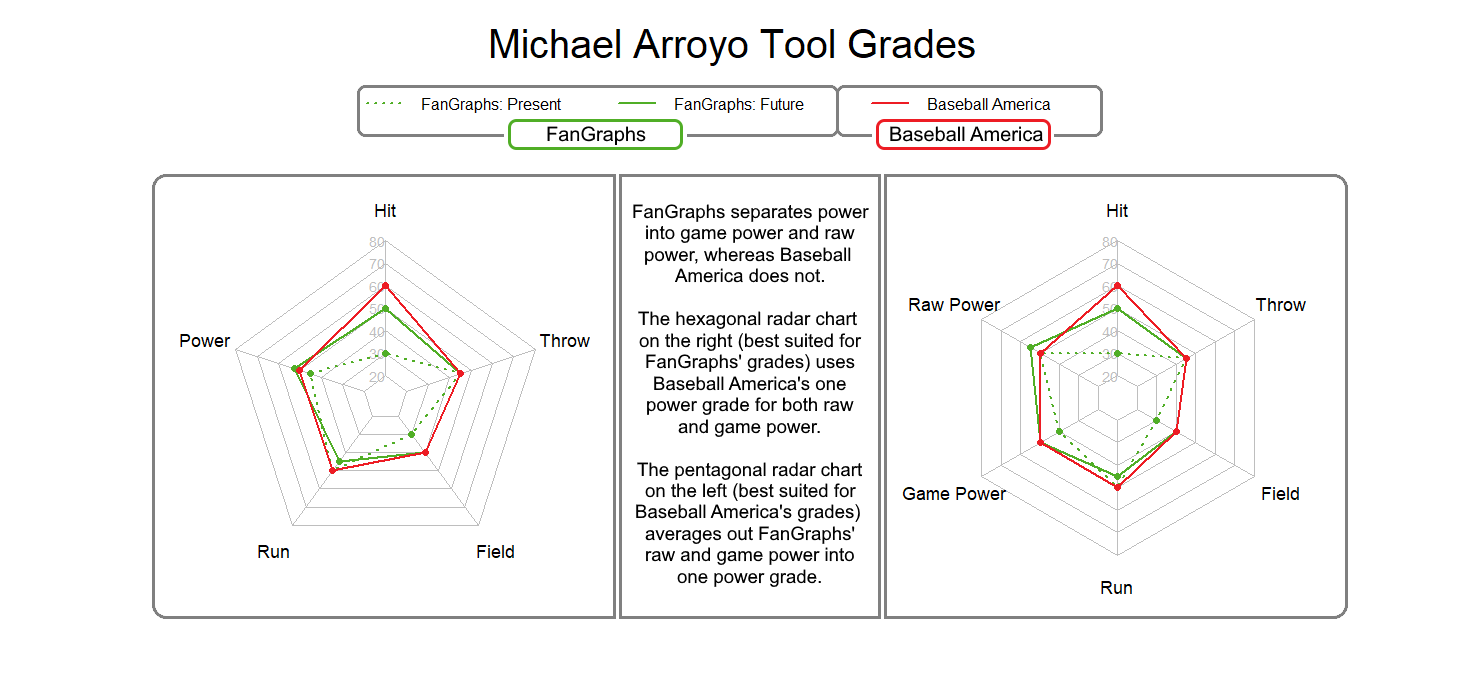
FanGraphs estimates Michael Arroyo’s “future value” at 50 while Baseball America gives him an “adjusted grade” of 45 based on a 50 potential grade with mild risk. [/caption]
The biggest part of Arroyo’s game is his eye at the plate. He doesn’t swing at a whole lot of stuff outside the zone, swings at most pitches inside the zone, and has good contact rates when he does swing. He’s a pull-heavy hitter with a quick, short swing who crowds the plate, which might carry some wrist injury risk given how much it results in him being hit by pitches.
Arroyo slashed .269/.422/.512 with 15 home runs, 14 doubles, and 39 RBIs in High-A Everett in 2025, though his production decreased to .255/.376/.341 in Double-A Arkansas. A lot of that probably has to do with the park change, as Everett’s cozy dimensions are not replicated in Arkansas, but that also says that much of Arroyo’s power production is marginal. Still, his 12.7% walk rate and 21.2% strikeout rate went to 12% and 15.6%, respectively - not only did his walks remain largely identical, but his strikeout rate actually went down as he faced stiffer competition.
A keen observer should keep track of how Arroyo approaches breaking balls, which he has performed well against, and heaters, where he has had more struggles. Seattle as a team followed that pattern in 2025, being comparatively good at hitting secondary pitches but comparatively weak against fastballs over the meat of the plate, so I would expect high-speed heaters to be a weak point. Still, his time in Peoria will offer an opportunity to keep track of his plate discipline and ability to drive the ball, though he will probably return to Double-A to begin 2026 in earnest.
Defense is less of Arroyo’s wheelhouse. He isn’t particularly great at second and might end up relegated to left field, putting more onus on his offense to carry him forward.
5. C Luke Stevenson, 21 years old, Low-A Modesto Nuts.
[caption id="" align="alignnone" width="1465"]
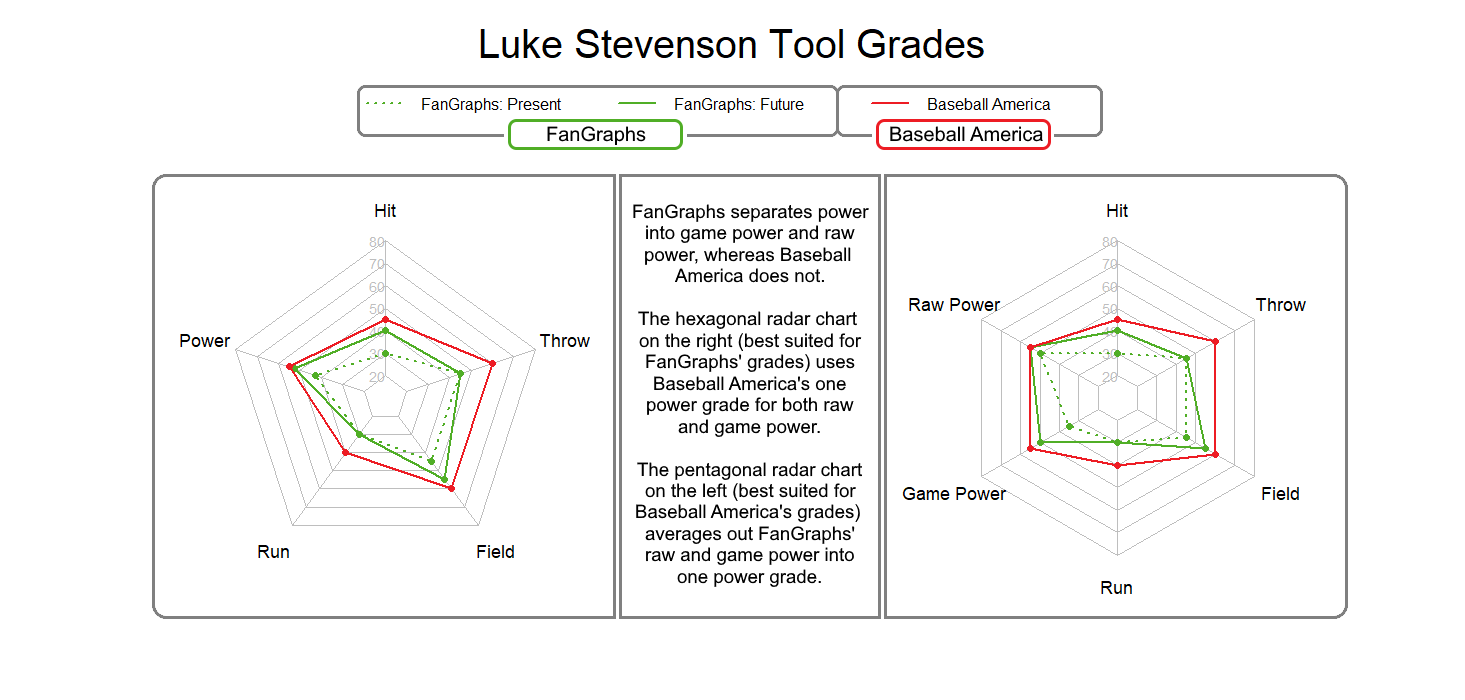
FanGraphs estimates Luke Stevenson’s “future value” at 45 while Baseball America gives him an “adjusted grade” of 40 based on a 50 potential grade with average risk. [/caption]
As for the immediate catching depth beyond Cal Raleigh and Andrew Knizner, there is Jhonny Pereda, but a longer-term catching prospect for Seattle is recent draftee Luke Stevenson. He has only played 22 games of pro ball, slashing .280/.460/.400 in 100 plate appearances for the Low-A Nuts, but the M’s evidently liked his development enough to extend him the Spring Training invite.
FanGraphs notes a swing profile that could portend improvements in bat-to-ball skills, but at present, he is more power-over-contact. His 23% walk rate in Low-A is a good sign about plate discipline, but Spring Training will be a strong test of his abilities against better arms. The Mariners have liked what they have seen so far from him, and if things don’t go further south than Amundsen-Scott Station, he should end up in High-A to start off 2026.
Baseball America is higher than FanGraphs on Stevenson’s abilities behind the dish, but both are clear that there is definite room for improvement. Baseball America makes mention of leadership and baseball IQ qualities in his game, while FanGraphs notes his difficulties in transfer and pop time, though the Mariners system has dealt with those issues before in developing Cal Raleigh. His reps in Peoria will be a time to see what sort of development needs to be done with his defense.