Does Leo Rivas’ Spring Power Surge Portend Hidden Mariners Threat?

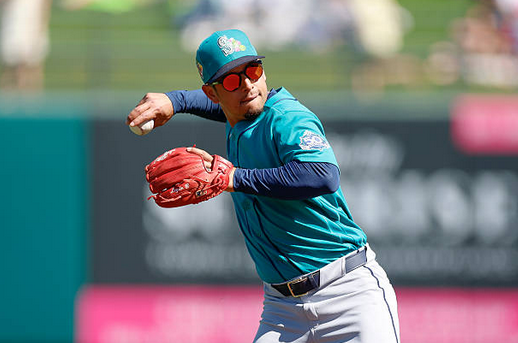
A 464-foot moonshot from Brennen Davis on Sunday afternoon may not have been all that surprising to those who have kept track of his spring superheater, but a 441-footer from the 5-7, 150-pound Leo Rivas - accounting for the other two of Seattle’s runs during the team’s 6-3 loss to the Brewers - probably turned a few heads in surprise.
If the Mariners’ 2026 season goes according to plan, they’re going to have situations like they did in the bottom of the seventh of Game 5 of the 2025 ALDS, when they need a pinch-hitter to come through in a winner-take-all playoff game.
That was when Leo Rivas shined, swatting a game-tying single in what ended up a 15-inning marathon memorably walked off by Jorge Polanco. Rivas, whose greatest strength that year was an ability to take a free pass (his 18% walk rate was the third best of anyone with 100 or more plate appearances last year, behind only Aaron Judge and Dylan Beavers), jumped on an 0-1 changeup out over the plate for the hard-sought hit.
Things then turned sour, however. Rivas slashed .071/.235/.071 in the ALCS, seeing 17 plate appearances as the M’s began using him as a starter. Rivas struck out swinging three times in Game 7, once on a slider well low and inside with men on second and third with one out, the next on a borderline slider with a man on second and one out, and the last one on a 3-2 high heater.
Seattle’s oft-ignored utility guy seems to be putting that behind him, however, as he has opened Spring Training on a run of solid play - but will this mean anything for the regular season?
Rivas has kept up the walks, taking four free passes in 21 Cactus League plate appearances, but the big difference between his 2025 slash line (.244/.387/.333) and that of his 2026 spring (.235/.381/.647) is the types of hits he is getting. Of 22 hits last year, 18 were singles, with a hard hit rate lower than 98% of his peers. His EV90 - the exit velocity of the exact batted ball that was hit harder than 90% of his other ones, sometimes considered more predictive than a pure average of exit velocities - was 97.9 miles an hour, lower than 97% of his peers.
When a player’s contact is that soft, supposedly perfect launch angles that serve other ballplayers with longballs can turn into easy flyouts.
This gives opposing pitchers a clear playbook for Rivas: attack the zone. He had the lowest chase rate in the business last year, but he also had a first percentile swing rate and a third percentile zone swing rate, only hacking at 55.4% of strikes in 2025 (the league average zone swing rate was 66.8%). Even when he swung at pitches in the zone, he only got the bat to the ball 81% of the time, meaning that any given pitch over the plate had a 55.1% chance of being a pure (non-foul) strike compared to 44.8% against a league average hitter [1].
But if Rivas can even occasionally make pitchers pay dearly for a meatball or two, that changes the game plan a whole lot and forces pitchers to walk him even more.
There are good signs. Rivas’ hard hit rate jumped from 19.7% in the 2025 season to 36.4% in this year’s spring training and his pull-air rate (a good marker for home run power as pulled balls in the air become homers at a high clip), jumped from 13.6% to 36.4%.
But I’ll have to pump some breaks here. Rivas’ average exit velocity has been functionally identical across 2025 and 2026. His “Max EV”, AKA the exit velocity of his hardest hit ball, is only about a mile an hour faster. The below chart goes over a suite of underlying statistics from last year and 2026 Spring Training, and while a lot of it is better, it’s not exactly better by much.
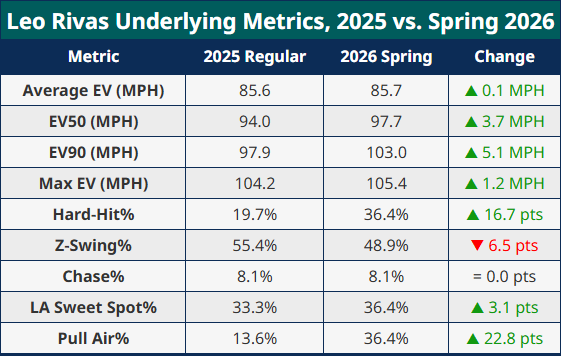
You might notice that three of the stats give 36.4% and this is not an unusual coincidence: Rivas has made fair contact 11 times so far in Spring, and he has four hard hit balls (95 miles an hour or more), four balls pulled in the air, and four in the “launch angle sweet spot” of eight to 32 degrees. These aren’t the same four pitches, but with such a small sample size, it just so happens that the proverbial dice landed on four a few times.
This small sample size obviously has implications, but it’s worth noting a couple things. One is that Rivas only made fair contact 66 times in the 2025 regular season, quite a bit less than an everyday player [2]. The other is that despite having a sixth of the balls in play as he had last year’s regular season, he already has the same number of batted balls 103 miles an hour or above (two). Perhaps it’s just noise, but perhaps it’s something of an indication that he might play towards the top edge of his slugging range: something like .390, give or take 30 points.
Any increase in power, of course, will have the handicap of playing in T-Mobile Park. Rivas’ homer on Sunday went 441 feet, but this was heavily amplified by flight-friendly Arizona air and some evident backspin on the hit: it had a 105.4 mile an hour exit velocity and a 34 degree launch angle, a combination that has resulted in balls traveling just 387 feet in Seattle over the past four years and 391 feet over the StatCast era. That’s a home run to straightaway left where Rivas hit it, but not the moonshot no-doubter given by the Arizona distance. Spin and game conditions make a whole lot of difference - these two batted balls were hit just as hard and at the same angle as Rivas’ homer - but 441 feet is something more often produced by near-perfect launch angles and 110-plus miles an hour off the bat.
But given how Rivas is set to fit on the team, a small increase in power might be more than enough to make him into a hidden threat. He won’t be an everyday starter, but with Brendan Donovan seemingly set to be the Mariners’ everyday third baseman, Rivas is probably the team’s top infield utility guy. A switch hitter, he can neutralize platoon advantages late in games, and manager Dan Wilson can always throw him on the field in place of a cold hand if need be. Just like last season, they’ll need to be careful not to overuse him (as happened in the ALCS), but the occasional Rivas appearance will be a proverbial curveball for opposing pitchers - especially if this power surge is legit.
[1]. Of course, hitters swing more with two strikes, but we can run these calculations here, too: batters swung at 88.2% of pitches in the zone last year and had a 15.3% in-zone whiff rate, meaning that any given two-strike pitch in the zone had a 25.3% chance of becoming strike three. Rivas, despite only whiffing 12.7% of the time on two-strike strikes, only swung 81.6% of the time - giving the pitcher a 28.8% chance of getting strike three with a pitch over the plate.
[2] Cal Raleigh, for example, made fair contact 411 times last year.