Analysis: Do Mariners Actually Have Something Real in Brennen Davis?

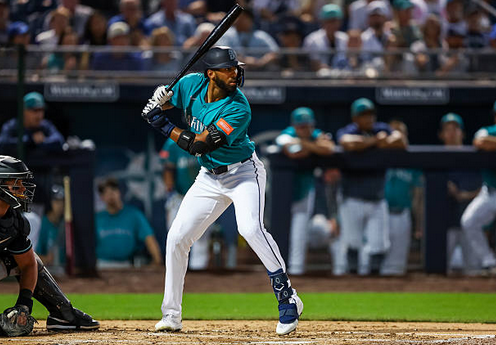
SURPRISE, Ariz. - The prospect trajectories of Brennen Davis and Jack Leiter are like a lenticular print. From one angle, they seem like they could not be any more different, but from the other, they have quite a few similarities. On the one hand, they both peaked in prospect rankings in 2022, when they each got the coveted number one spot in their respective organizations from Baseball America - and their stock fell in future years. But on the other, Davis has never seen a single pitch in the big leagues, while Leiter weathered a rough couple of outings in 2024 to come back for a full rookie year in 2025 when he pitched to a 3.86 ERA and 4.15 FIP in 151 ⅔ innings, finishing seventh in rookie of the year voting.
You wouldn’t know it from the way Davis took Leiter to town on Friday. The long-beleaguered outfielder saw a belt-high fastball over the inside part of the plate in the fourth inning of the Mariners’ game against the Rangers and sent a 437-foot missile to left center. The M’s went on to break a six-game Spring Training skid that had seen the team score 40 less runs than their opponents with a 5-1 victory. It was Davis’ third homer of the spring and brought his Cactus League batting average to .476. Is this for real?
There’s always somebody every spring that puts on a show out of absolutely nowhere. He’s not on any preseason lists, he’s not someone that people keep much of an eye on, and nine times out of ten, it’s a fluke that everyone forgets about once April rolls around.
For Brennen Davis, it has been a long time coming. Once a second-round draft pick out of Basha High School in Arizona, he first made it to Triple-A in 2021, where he slashed .268/.397/.536 with a 144 OPS+ … and has never made it to the majors. He suffered injury troubles year in and year out - fractured ankles, some back issues, even the Old Faithful of horrid injury luck in being hit in the face by a pitch - and hasn’t played more than 71 games in a season since 2021. He fell from first on Baseball America’s list of top Cubs prospects in 2022 to second in 2023 and has not been ranked since. He ended up in the Yankees’ system in 2025 before finding his way into the M’s organization.
As the Dallas Mavericks can tell you, injury-prone dudes named Davis have their share of drawbacks, even when they’re elite. That’s much more true of guys who haven’t seen a lick of the highest level. It’s a longshot, especially considering that the M’s have a full suite of outfielders in Julio Rodríguez, Randy Arozarena, Dominic Canzone, Luke Raley, Rob Refsnyder, Víctor Robles, and Brendan Donovan (he can play left!). Rhylan Thomas is another longshot, but at least he’s on the 40-man.
I wouldn’t be talking about Davis if there weren’t something there, however. He finally had a good Triple-A season again in 2025, with a .248/.324/.576 slash line and 132 OPS+ in 36 games for the Scranton/Wilkes-Barre RailRiders, but what has really stood out has been his white-hot Spring Training.
Out of 25 plate appearances and 21 at-bats, Davis has accrued 10 hits, four doubles, three homers, and two walks while striking out five times. He has averaged a 97.3 mile per hour average exit velocity and his 116.6 mile an hour homer on Friday came in as the fifth hardest hit ball of the spring so far.
Obviously, these kinds of superheaters don’t last. No one has a 75% hard hit rate through a season or even a month. But directionally, a lot of this stuff is similar to what he put up in Triple-A last year. He had a 91.8 mile an hour average exit velocity with the RailRiders (94th percentile among Triple-A batters with 100 or more plate appearances), a 13.3% barrel rate and 51.8% hard hit rate (both 95th percentile), and a 31.8% pull-air rate (the best in Triple-A).
That pull-air rate is worth taking another look at. It’s a massive predictor of general power, as over a third of pulled fly balls end up as homers compared to less than 10% of those that go to center or the other way. There were only two major league ballplayers who had a pull-air rate above 31% in 2025 [1], and their names were Cal Raleigh and Isaac Paredes with 80 home runs and 39 doubles between them.
But this isn’t to say that pull-air rate is a skeleton key. The Triple-A leader in pull-air rate in 2023 among those with 100 or more plate appearances was Wade Meckler, who slugged a measly .250 in 23 games for the Giants that year and is yet to return to the Show, not to mention that his 2025 pull-air rate was the 15th worst of those with 100 or more PAs in Triple-A. Jakson Reetz (also in the Mariners organization) has been near the top of the Triple-A pull-air rates for three straight years with little to show for it. Of the top 25 in 2024 Triple-A pull-air rate, only 10 played in the majors at all in 2025 and only three (Miguel Vargas, Jahmai Jones, and Pete Crow-Armstrong) had positive Baseball-Reference WAR.
I’ll circle back to hard hits. Flat hard hit rate might not be the most predictive metric, since weakly hit balls don’t say a whole lot about one player or another - it’s the especiallyhard hits that count. There is “best speed” (also called EV50), which is the average of the top 50% of a player’s batted balls that season, but the most common in modern analysis is 90th percentile exit velocity (EV90), which is the exit velocity of the exact 90th percentile batted ball a player had in a season. Davis’ 108.1 mile an hour EV90 in 2025 is the same as Kyle Stowers and Jake Burger had in the majors, while his 103.8 mile per hour EV50 was the same as Fernando Tatis Jr. and Matt Olson.
The good news for Davis is that EV90 in the minors seems to be quite a bit more predictive than minor league pull-air rate. The 2024 Triple-A top 10 in EV90 contained Junior Caminero, James Wood, Heliot Ramos, and Roman Anthony, a better success rate than the pull-air sample.
These things do mean that it’s possible for Davis to break out in the majors, and MLB leaderboards in this kind of batted ball data are filled with stars and consensus breakout picks.
But there are quite a few reasons why the Days of Davis are a longshot. Davis is quite the free-swinger, chasing pitches off the plate at a greater clip than 90% of Triple-A guys last year and his in-zone contact rate was worse than 95% of his peers, with just 28 players [1] with 100 plus plate appearances whiffing more often at strikes. This results in Davis striking out quite a lot (31% of Triple-A plate appearances in 2025) and somewhat rarely walking (7.8% of Triple-A plate appearances in 2025). The 50 qualified hitters who had a 30%-plus strikeout rate in Triple-A in 2024 produced a crop of hitters so generally unremarkable (aside from Spencer Torkelson) that Matt Wallner is probably the second best among them.
Going by pitch category, Davis is a little more discerning on fastball-type pitches - swinging at less than 30% of balls out of the zone compared to more than 43% against both off-speed and breaking balls - and misses them a little less, though he still misses heaters more often than most. Perhaps he could draw a comparison to Eugenio Suárez when it comes to breaking balls: he chases them a lot and misses almost half his swings, but when he does connect, he absolutely torches them with a “barrel” [3] rate of 21.1% on breaking balls in 2025. But this is a weakness that MLB pitchers will gleefully exploit, as all those swings and misses and outs come from the many times he takes a hack at spinny stuff anywhere quite a bit out of the zone to on the edge.
Weaknesses continue with the aforementioned laundry list of injuries and the fact fact that he is 26 years old, giving Davis truthers a tight schedule for him to splash his way into the Show. Some pitchers on the 40-man roster like Casey Legumina and Troy Taylor are perhaps on the hot seat, but the reality is that Davis is almost certainly injury cover at present for Seattle. That means there’s a decent chance he makes an MLB debut in 2026, but as to whether he can crash his way into an important role? That’s a half-court hurl on a hope and a dream. We’ll all remember if he makes his proverbial basket - and there are good reasons why he might! - but it’s far more likely that the 2026 Mariners will make do without him.
[1] According to TJStats, which doesn’t include pop ups in its version of pull-air rate. Baseball Savant does (Raleigh and Paredes are both above 38% there), but since TJStats is my source for Davis’ pull-air rate, I decided to go for consistency.
[2] Fun fact: the 29th worst zone whiff rate in among Triple-A hitters with 100+ PAs in 2024 belonged to none other than Canaan Smith-Njigba, Jaxon’s older brother.
[3] A “barrel” refers to a ball with an exit velocity/launch angle combination that has a minimum .500 batting average and 1.500 slugging percentage.