Would Drafting College Teammates Accelerate Seahawks’ O-Line Improvement?
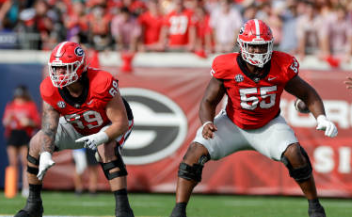
For the better part of a decade, the Seattle Seahawks have struggled to not only build a quality offensive line, but sustain the unit by maintaining and developing long-term starters through the draft, struggling to achieve any sense of continuity, particularly in the interior at the center and guard spots.
Since the start of the 2019 season, Seattle has had six different centers start in Week 1, beginning with Justin Britt in his final season with the franchise. After Britt went down with a torn ACL midway through the 2019 season, the pivot position has truly been a revolving door with the likes of Kyle Fuller, Ethan Pocic, Austin Blythe, Evan Brown, and Connor Williams each opening the past five seasons as the starter. Last season, Williams abruptly retired during a Week 10 bye, thrusting Olu Oluwatimi into the starting lineup for the last nine games.
The situation has not been much better at right guard, where the Seahawks have opened the season with a different starter four of the past five years, including Gabe Jackson, Phil Haynes, and Anthony Bradford each getting a turn in the previous three campaigns. That number could increase to five out of six this summer with Bradford set to be pushed by Christian Haynes or an incoming rookie for a starting role in a new offense better suited for more athletic blockers.
Considering the constant turnover Seattle has endured along the offensive line, it may be a time for a change in strategy for general manager John Schneider, and ESPN NFL Draft analyst Matt Miller proposed an intriguing idea in a recent interview on Seattle Sports 710. Why couldn’t the franchise kill two birds with one stone by investing both of their second round picks in Georgia center Jared Wilson and guard Tate Ratledge to both immediately improve the line and bring much-needed continuity in the trenches?
“I’m kind of fascinated by the idea of putting teammates together, because they’re comfortable playing next to one another,” Miller said on the Brock and Salk show. “There’s not going to be that learning curve of, ‘OK, I’ve gotta figure out this center I’m playing next to.’ So if you draft these guys and put Wilson and Ratledge together, you’ve already got some chemistry on your offense line.”
Miller raises an interesting point, as the Seahawks are far from the only team in the NFL that has struggled to assemble a quality line with supply and demand issues with only so many good tackles, guards, and centers available making the task a challenging one, begging the question of why teams haven’t tried to draft teammates who already have built in chemistry from playing extensive reps together in college.
From this year’s draft crop, even though they only started one season together in Athens, Ratledge and Wilson easily stand out as the best pair of college teammates who could be reunited in the NFL. Both players have received consensus Day 2 grades as second/third round prospects and earned outstanding grades from Pro Football Focus last season with each finishing in the top 15 of their respective positional group among Power 4 blockers.
With a new coordinator in Klint Kubiak coming on board with a zone-heavy scheme stemming from former Broncos Super Bowl winning coach Mike Shanahan’s popular system, the Seahawks will be shifting their priorities towards landing athletic linemen who can block on the move and consistently climb to the second level to reach linebackers and safeties. Wilson and Ratledge stand out as two of the best athletes in this class at any position, as the former ran a blazing 4.84 40-yard dash at the combine and the latter posted a remarkable 9.96 Relative Athletic Score, the eighth-best score out of 1,730 guards dating back to 1987.
Between the lines, Wilson dominated as a zone blocker in his lone season as a starter for the Bulldogs, receiving a 78.9 grade from PFF that ranked eighth out of 146 qualified FBS centers. Even with ankle surgery leading to him missing several games in the middle of the schedule, Ratledge received a respectable 71.4 grade in that department last season and scored even higher with a 74.3 mark in 2023.
While the idea of keeping Ratledge and Wilson together carries merit for Seattle or another line-needy team, however, they aren’t the only potential pairing of former college teammates that the Seahawks could consider from this draft class, and other such alternatives would be more spread out into day three rather than using both second round picks on the two players.
“Teams work so hard to keep their starting five together once they get one,” Miller said. “So you bring in two players who already have that relationship and that trust in each other, I think you’re cheating the game a little bit if you can bring in two teammates.”
In another example featuring a blue blood program in Ohio State that would fit with Miller’s logic, guard Donovan Jackson likely will hear his name called at some point in the second round. The three-time All-Big Ten and 2024 All American selection showed off his athletic chops successfully sliding to left tackle to replace injured starter Josh Simmons last season, helping the Buckeyes eventually capture a national championship while posting a 74.3 zone blocking grade.
Next to Jackson, center Seth McLaughlin also received consensus All-American honors after transferring from Alabama despite suffering a torn Achilles in practice in November, allowing just seven pressures and no sacks in pass protection. Since he’s recovering from the significant injury, he wasn’t able to participate in any pre-draft workouts and has been projected to be selected at some point on day three of the draft, creating a realistic opportunity for a team to draft both players if they wish to.
Interestingly, that isn’t the only scenario where McLaughlin could be reunited with a teammate in the NFL. Since he played his first four seasons for the Crimson Tide before transferring, he played extensive snaps next to guard Tyler Booker, who most draft pundits expect to be off the board in the first round. While the massive 6-5, 321-pound blocker doesn’t have the fluid athleticism of a Ratledge or Jackson, he still performed fairly well as a zone blocker to go with elite pass protection numbers and would provide a physical presence Seattle has sorely lacked up front for quite some time, making him worth consideration at pick No. 18 if available.
Even if the Seahawks opt to draft other positions in the first three rounds, there’s also an X-factor pairing that could be in consideration in the latter rounds that would offer intrigue, as Western Michigan guard Addison West and center Jacob Gideon ranked among college football’s premier zone blockers at their respective positions. Earning All-American honors, West gave up a grand total of two pressures during his senior season and ranked first among guards with a 93.3 zone blocking grade, while Gideon ranked sixth among centers with a 78.5 zone blocking grade.
Ultimately, while Miller’s concept of drafting college teammates together makes sense in a vacuum looking at this year’s class, teams often don’t go that route because they are seeking the best players available and typically, two players from the same team don’t fit that bill. And even if they do, the opportunity isn’t there for the same team to draft both players. In the past, teams like Alabama and Ohio State have had multiple offensive linemen go in the first or second round in the same draft, but there wasn’t a chance of any of them landing on the same NFL team.
The Seahawks, however, may be a rare exception to that rule that bucks past trends by holding two picks in a three-pick span in the second round and two additional picks in the third round, giving Schneider the ammunition to draft Wilson and Ratledge or Jackson and McLaughlin. They also have another unique situation where they could use their first-round pick on North Dakota State guard Grey Zabel and potentially pair him back up with second-year center Jalen Sundell, as the two previously played snaps next to each other with the Bison.
With so many different possibilities heading towards the draft in Green Bay, after failing to shore up the line in recent years, Schneider may very well decide to enter Miller’s “cheat code” from Seattle’s war room. And based on his past track record, what does he have to lose trying something different?