Washington LB Jacob Manu Faces Tough Decision For Outdated Redshirt Rule

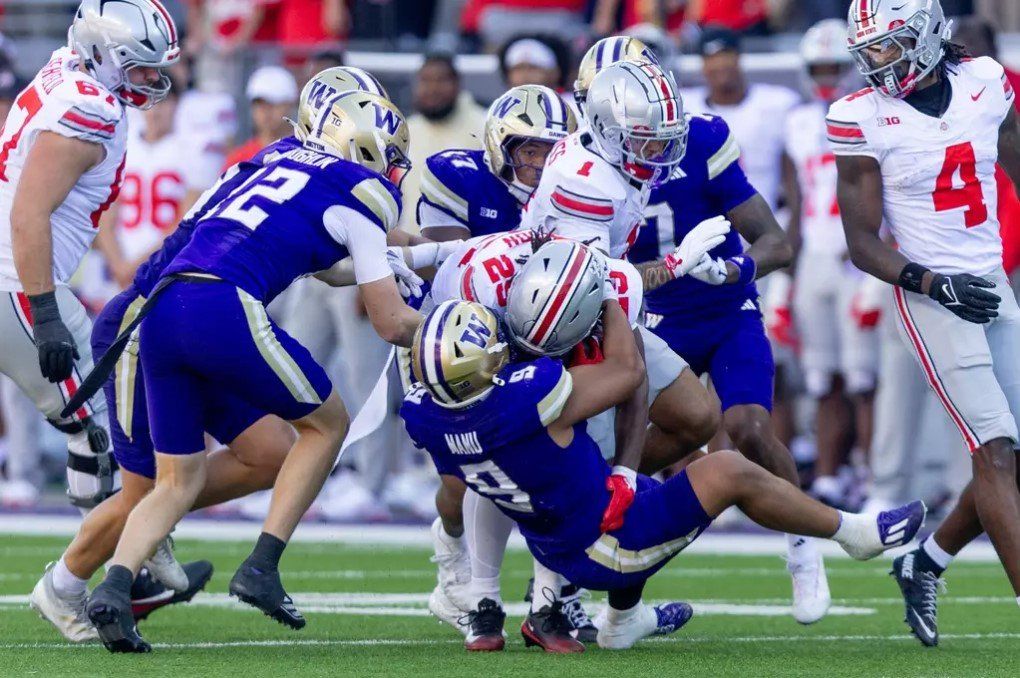
Washington Huskies linebacker Jacob Manu and his coaching staff face a tough decision.
Play in four-plus games and help the team this year. Or keep it to three or less for a shot at helping the Huskies and perhaps himself in 2026. As of now, he can’t have both.
The college football world keeps changing, and it’s time to make another one.
Today.
The redshirt rule for college sports needs to go away for good. And, if the NCAA doesn’t get in front of it, the organization that governs college sports will likely get beaten badly in court once again. The NCAA is considering a proposal to allow players five full seasons of eligibility. Currently, in football, players can use a “redshirt” season that does not count toward the four-year maximum if the player only appears in four or fewer regular-season games. Changing the rule takes away the “to play, or not to play?” decision players and coaches must make.
Manu is one of many examples of athletes who would benefit in multiple ways from being allowed to play five seasons in five years. Recently cleared to play after ACL surgery ended his junior season in the seventh game of 2024, he returned to play 29 snaps against Ohio State last Saturday. Manu can either play in three more of UW’s regular-season games and preserve a redshirt for the right to play college football in 2025. Or he can play in more games this season and take a shot at the NFL.
“It’s so important that we get an answer,” Fisch said Monday. “We’re five weeks in. You’ve got to make decisions on redshirts, not redshirts. You’ve got to make all those types of decisions that go into this. You’d love to know. Are we going to let these kids play for five years?”
Manu, who is undersized by NFL standards at 5-11, 225 pounds, would likely make more money playing another college season with a revenue share portion and potential name, image and likeness (NIL) income than he would taking a shot a pro football coming off an ACL recovery.
The pressure for him to play all the games that lie ahead on the 2025 schedule became even greater when Taariq “Budda” Al-Uqdah suffered a serious knee injury against Washington State. If Manu plays against Maryland Saturday based on need at the position, it means he can appear in just two more games. And as he builds himself back into playing shape, his snap counts will be limited — which means none of the four games are likely to be full ones.
“You got to slowly progress him back into the season,” Fisch said. “You know, to say this is the only year he can play isn’t right. It’s not right to do to the team, and then you have an injury at his position, so you’re kind of forcing him to make a decision that could directly impact him financially.”
Fisch believes Manu could make an impression this year that would allow him to reap the benefits of being a known quantity playing college football in 2026. For some players, that’s a much better situation than hoping to latch on to an NFL practice squad.
“He’ll probably be a team captain for us,” Fisch said. “He’ll probably be able to have an incredible amount of outside NIL opportunities because of his personality and because of what he means to the team.”
With college programs needing to manage the finances — including divvying up the revenue share for players that is capped at $20.5 million this season — coaches and players need to know as soon as possible who can and will play for them the following season.
Instead, they wait for the lagging NCAA to set a direction.
No coach has ever had a losing streak in games like the NCAA’s had in court and kept a job. Yet the NCAA seems to be steps behind what it realistically needs to do to keep itself out of court, where it loses like FCS squads looking for paydays against a Big Ten teams.
We won’t go deep into how the NCAA ended up sharing up to $20.5 million with athletes, but if it had given its football players a lease on a Camry and some pizza money 30 years ago, that might have kept them out of court in recent years. The long list of “Nos” uttered for decades became a massive “Yes.”
Something similar could happen with player eligibility limits if the NCAA isn’t careful. Could we have regular Van Wilder situations in college football? The NCAA is already losing challenges from players who attended junior colleges.
Vanderbilt quarterback Diego Pavia is currently in his sixth year of playing college football, and could potentially earn a seventh. A federal judge in Tennessee granted Pavia the right to play this season, ruling that his playing days at New Mexico Military Institute shouldn’t count because it’s not a 4-year school.
That likely won’t be the end of questions about player eligibility. Prior to the four-game rule being applied in 2018, a player who appeared in one game could only be granted a redshirt if there was a medical reason.
It’s time to change the rule again. For one thing, it’s not completely reasonable to expect all students to graduate in four years. At the University of Washington, for example, 65% of the student body graduates in four years, compared to 84% after six years.
It is more difficult for students in current times to line up all classes correctly as the scheduling has become more compressed. And of course, as students transfer, the credits don’t always follow. This also applies to athletes who choose to transfer for football reasons.
Coaches will become less and less concerned about players burning a redshirt because they know the player may opt for the NFL or enter the transfer portal before a fifth season of college football anyway. And what are the odds of a coach staying put for five years? If it’s a player who’s not going to be selected in the first couple of rounds of the draft, taking away a fifth year because they played special teams as a freshman shouldn’t affect their ability to make money in college as a fifth-year season.
It’s better for everyone involved if the decision is no longer a decision. If they’re in school for five, let them play five.