Huskies Await College Football Playoff Format to Determine Scheduling Strategy

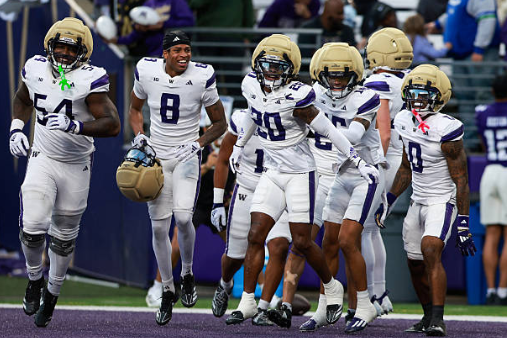
Is it better to face Alabama or Portland State?
If the goal of the Washington Huskies football team is a spot in the College Football Playoffs, that’s a difficult question to answer while the long-term format and selection process remain unknown.
That’s why Washington and many schools have put the brakes on scheduling nonconference games. Prior to the college sports chaos of the last few years, it was not uncommon to know some of Washington’s opponents 10 years ahead of time. Though it didn’t always shake out as planned, UW often employed the A-B-C format — a game against a national power (Michigan, Oklahoma, LSU types), a solid opponent (Boise State, BYU) and, except for a tough September day for Jimmy Lake’s Huskies in 2021, a gimme (Montana, Idaho, Weber State).
Washington announced in January of 2022 that it would play a home-and-home series with Tennessee in 2029 and 2030. That’s a fairly typical time frame for major programs. Since then, though, Washington and other programs are reluctant to ink deals until they know the implications of such matchups. Washington athletic director Pat Chun was asked at a press conference on June 18 about future scheduling and Tennessee. He did not include any information about the Volunteers in his answer. The series remains listed on the Huskies website in the future schedules section and may very well still happen. But, it might be best to wait a bit before booking a 2029 trip to Knoxville.
“We’re a little bit on a hold right now, because we’ve got to see how the CFP expansion does or doesn’t happen,” Chun said. '“Because we have to schedule ourselves strategically to put ourselves in the best position to get to the college football playoff. So, where expansion ends up, or what the format is specifically, will dictate what our formula is or principles are relative to scheduling.”
The CFP committee has often demonstrated that it’s better to beat an Idaho than lose a big matchup that people actually want to watch. That’s a major factor in the different theories of playoff selections and scheduling. Though the 2025 format is set with 12 teams, 2026 could bring about as many as 16. How many spots and who they’re reserved for will go a long way toward determining what kinds of nonconference games we see.
In recent years, it’s become more common for teams to bow out of big games if their schedules look too tough, and programs often look to generate more income from adding a home game. Most recently — before they ended up in the same conference — Ohio State paid Washington $500,000 to get out of games in 2024 and 2025. The Buckeyes did not know then that conference scheduling would put them in Husky Stadium in 2025 anyway.
Remember the infamous ESPN cupcake game in 2017? During Washington’s 38-7 conference win over California on October 7, 2017, ESPN reporter Quint Kessinich mocked UW‘s schedule — the Huskies faced nonconference opponents Rutgers, Montana, and Fresno State that season — by lining up actual cupcakes on the field to demonstrate the Huskies’ “cupcake” schedule. What Kessinich missed, though, was that Wisconsin had backed out of a 2017 game with the Huskies. It didn’t help that Rutgers was much weaker than expected when that series was scheduled.
Wisconsin opened the season with wins over Utah State, Florida Atlantic, and BYU, and only a narrow loss to Ohio State in the Big Ten title game kept the Badgers out of the four-team CFP.
The question for the 2025 CFP committee will mostly revolve around who earns the couple of berths in the 12-team field and where teams are seeded. For 2026 and beyond, more questions must be answered.
How Many CFP Teams?
Arguments are being made for 12, 14, and 16 teams. Part of the decision is what ESPN is willing to pay for during the height of the NFL playoffs if these games continue to be played into late January. The other issue is whether or not byes are good. All four teams with playoff byes following the 2024 regular season lost in the quarterfinals. It could be argued that some of it was matchups, but rust may have been a contributing factor for teams that hadn’t played in a game for a month.
How Many Automatic Bids?
That’s where things get complicated, and even those within the two power leagues — the SEC and the Big Ten — are at odds. For the sake of simplicity, let’s assume it’s 16 teams. I believe that’s where all this is headed within the next five years. The two most common formats being suggested are:
5+11: The Big Ten, SEC, Big 12, ACC, and the highest-ranked team from the remaining conferences each receive a bid. The other 11 spots come from at-large teams filled by the committee.
4-4-2-2-1: This format gives the SEC and Big Ten four automatic playoff spots. The ACC and Big 12 get two apiece. The remaining four spots are filled by the top-ranked team from the other conferences, plus three at-large teams. The SEC and Big Ten have hinted at using play-in games for a couple of their automatic qualifier spots. For example, this past season during conference championship weekend, the SEC’s third-place team, Tennessee, would have hosted sixth-place Alabama, while fifth-place Ole Miss would have traveled to fourth-place Georgia for playoff berths.
It’s an interesting debate for the two most powerful conferences. Is the security of four bids worth handing two auto bids to the ACC and the Big 12?
If you like nonconference game results to matter, it’s pretty easy to shout “Give me 5+11!” from the stadium rafters. However, if you want big-time nonconference matchups scheduled, the 4-4-2-2-1 is for you. What I don’t expect to see is the best of both worlds: Massive nonconference opponents facing off in games that feel like they mean everything. Those September days are over.
Those old enough to have been on pins and needles when No. 4 Washington visited No. 9 Nebraska on September 21, 1991 for its second game of the season might have trouble imagining a game like that not really meaning all that much in the grand scheme of a 16-team, auto-bid climate. Even without the season on the line, though, it’s probably still more intriguing than UW’s second game coming up this year — against UC Davis.
If only the conference winner is guaranteed a bid in the 5+11 format, teams are more likely to schedule more winnable games. Big Ten and SEC teams, in a 16-team bracket, might get in with three conference losses. But, they’re less likely to be admitted by a committee with an additional nonconference loss, even if it’s a last-second field goal loss to the No. 1 team on the road. If there are four automatic bids, teams may become more aggressive with scheduling, because only conference games will count in the standings. That, however, means a big nonconference matchup won’t be a determining factor when it comes to getting into the playoffs (though seeding would be affected).
It could also lead to more excitement during the final weeks of conference play as teams vie for bids. For example, imagine if the UW win in the 2018 Apple Cup had put Washington in the CFP? That sounds more exciting than a Rose Bowl that had been reduced to an exhibition game. Decreasing the human element of the committee is also a factor in the automatic qualifier argument.
“Tell me the sports in which humans pick the playoffs,” Chun said on 93.3 KJR’s Dave “Softy” Mahler and Dick Fain radio show on June 19. “It’s only college. And there is no computer that can tell you if the fifth-place team in the SEC is stronger than the fourth-place team in the Big Ten. I am a proponent of taking the human element out of team selection as much as possible.”
Chun said the 4-4-2-2-1 format, which has been proposed by the Big Ten, accomplishes that.
“The committee would essentially have to seed but also have to pick three teams,” Chun said. “I would rather have that than 11 teams. … When conferences themselves don’t play the same schedule — on top of that, conferences play a different number of conference games. On top of that, some play more (lower division) FCS schools than others, and there’s no way to do this through a computer or a subjective quote-unquote eye test. Why not take that subjectivity out of it?
Going back to UW’s 2016 playoff season, what if the Huskies had lost 24-21 at Alabama on September 10 instead of smashing the Idaho cupcake 59-14? The Huskies, with two losses, would have almost certainly been left out.
If you’re reading this, there’s a good chance you’re not an Oregon fan, and it was a good day in 2019 when the Ducks lost their second game of the season on November 23 at Arizona State. Oregon wound up being ranked sixth by the CFP committee on December 8. If not for a 27-21 loss in the season opener against Auburn, the Ducks likely finish in the top four that year and get in. Whether or not Burrow would have delivered a 2024 Ohio State-level thumping can only be left to the imagination.
Schools being rewarded or burned for scheduling impacts decisions of coaches and athletic directors for years. That’s how you end up with games like Austin Peay at Georgia in Week 2 this season. The payday for a strong matchup is not worth risking CFP money and the university's advertising value and recruiting clout that comes with playoff games.
One of the rare exceptions to this was the chaos in 2023, when the CFP committee had to choose between one-loss Alabama, one-loss Texas — which had beaten ‘bama earlier in the year — and an undefeated Florida State team that played a weak schedule. The committee caught a break — literally — when FSU quarterback Jordan Travis broke his leg late in the season and gave the committee an excuse to leave out the Seminoles.
Until teams are not punished for losing tough nonconference games, we won’t see many. And until a new playoff format is finalized, we won’t see a whole lot of future games scheduled.
Huskies’ Future Scheduled Nonconference Games
2025: Colorado State, UC Davis, at Washington State
2026: WSU, Eastern Washington
2027: Fresno State, at WSU
2028: Eastern Washington, UNLV, WSU
2029: at Tennessee, Boise State
2030: Tennessee, Hawai’i