Huskies’ Big Ten Staying Power Depends on Standing Toe to Toe With Big Dogs

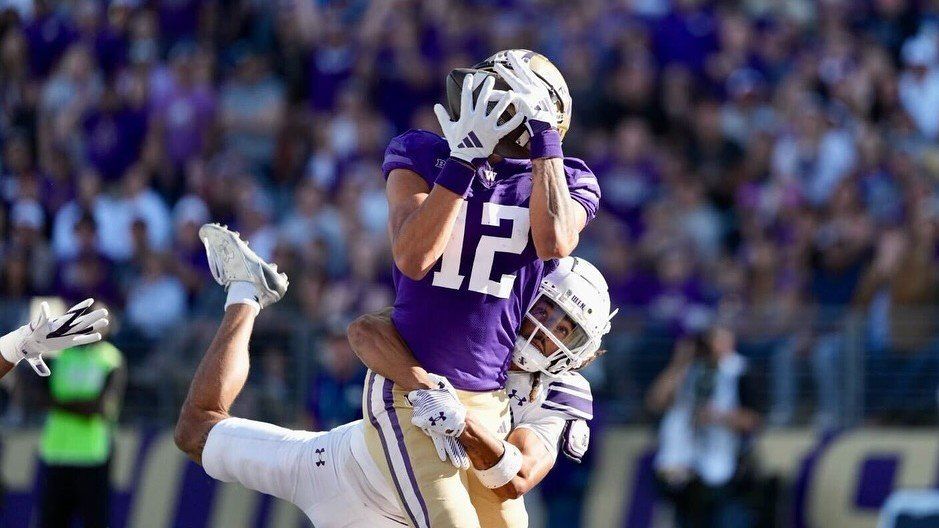
[caption id="" align="alignnone" width="939"]
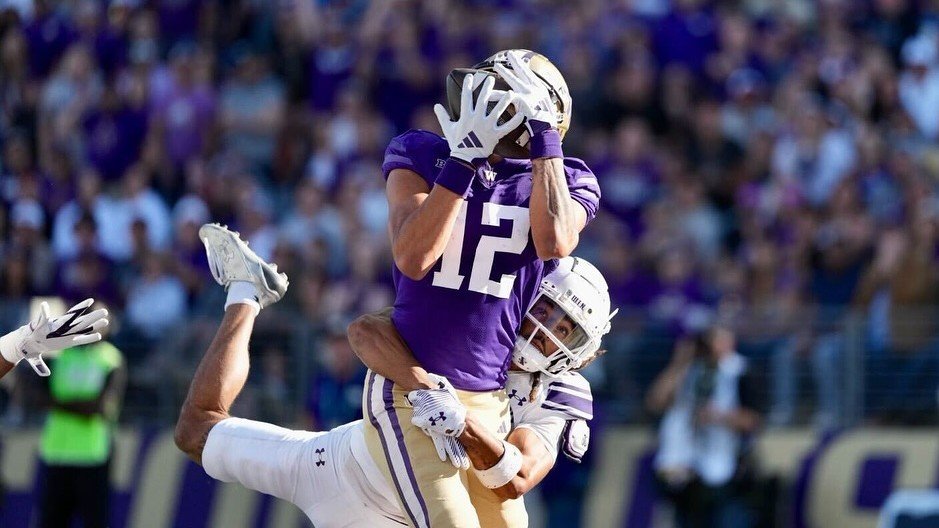
Washington Huskies receiver Denzel Boston hauls in a catch over his shoulder during a home game against the Northwestern Wildcats. Credit: Denzel Boston/Instagram [/caption]
SEATTLE, Wash. — Can the Dawgs keep up with the big dogs?
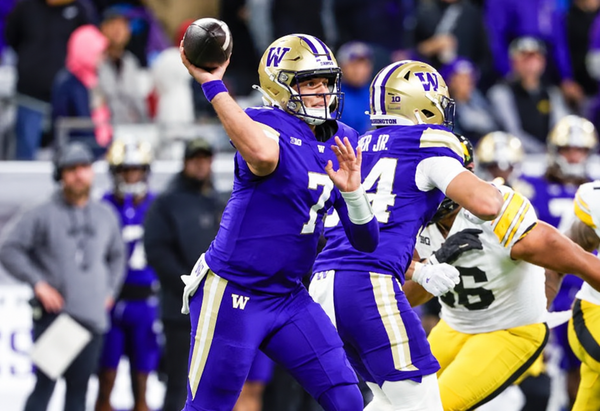
The next 5-7 years will tell us a lot about the program. Though there may be unforeseen challenges and changes in the years ahead, Washington Athletics is set to begin its second season in the 18-school Big Ten conference. Here are some key issues for Washington — football in particular — that will determine where UW will stand in the new world of college athletics.
Get a Large Share of the Next TV Deal
In 2022, the Big Ten announced a seven-year, $8 billion media deal that runs through the 2029-30 school year. USC and UCLA were added at full share (approximately $60 million per year), while Oregon and Washington were admitted with a half-share as the Pac-12 foundation began to crumble.
There is growing speculation that the days of every school in each conference receiving the same figure may be coming to an end. Expect a larger share for schools like Michigan, Ohio State, and Penn State, and a lower number for campuses such as Rutgers, Northwestern, and Purdue. This is also likely to be the case in the SEC.
Where does Washington fit into an unequal model? UW is not Ohio State, but it’s also not Rutgers.
“Whatever the defined full share is, I’m confident we’ll get it,” Washington athletic director Pat Chun said at a media gathering on Wednesday. “Now, will uneven revenue sharing be a part of the equation in the Big Ten by then? … But I feel very confident that our brand, the value we’ve added to the Big Ten, the DNA of our city here in Seattle and this whole Pacific Northwest, the totality of what the University of Washington brings to the Big Ten is significant.”
How significant is something we’ll learn more about over the next few years. Washington’s football TV ratings over the next three years will play a major role. That necessitates strong seasons that lead to big games in key viewing windows.
Dawgs Unleashed, Donor Connections
As of the House Settlement, a booster no longer has the theoretical ability to call Jedd Fisch and say, “Here’s $10 million. Go buy me two tackles and pass rusher.”
Name, Image, and Likeness (NIL) deals now must pass through a clearinghouse and be deemed as a deal for legitimate business purposes. It remains to be seen how clean of a process that will be, as there could be lawsuits for deals that are denied. But, at the very least, each above-board payment will receive some scrutiny.
“When NIL was pre-House settlement, it was pay for play,” Chun said. “It’s fraudulent NIL.”
Washington created “Dawgs Unleashed” to establish relationships with businesses to generate earning potential for athletes that won’t count against the revenue sharing cap. The great unknown is what that’ll actually amount to. Fisch and Chun have both been vocal about a dozen Fortune 500 companies within 30 miles of campus giving UW a major advantage. Others are skeptical, though, about those companies dishing out marketing dollars for advertising deals and appearance fees for college athletes. It may take a Heisman-level football player, or an athlete who has a major presence outside the sport, such as LSU women’s basketball player Flau’jae Johnson, who is known for rapping as much as hooping.
While a donor can’t pull out a wallet and buy a player, UW will continue to utilize donors as much as possible. Those relationships will often serve as catalysts for NIL deals with businesses. And donor dollars will continue to be a key for facility upgrades, coaching salaries and buyouts and other expenses that don’t count as part of the revenue sharing cap. While NIL figures are not made public, Chun lauded the athletic department’s record $70 million fundraising in the past year.
Continued Support From Upper Campus
During much of the previous century, the Huskies athletic department operated with a financial surplus. Those days are gone, for the next several years and quite possibly for the foreseeable future. The renovation of Husky Stadium, rising coach salaries, skyrocketing expenses — in part related to all sports traveling to the Midwest and East Coast for conference games — and a half-share of Big Ten TV money are among the reasons.
“We’re an entity that needs assistance,” Chun said. “Specifically, we focus on where our stadium debt is. … So, it’s a continual work, hand in hand, with campus to manage our budget together. Whenever we get to a full share, it’ll be a very different place for the University of Washington. It’s just the first 4-5 years in between is one of them we have to manage.”
Washington re-opened its stadium in 2013 after a $280 million remodel that was scheduled to be paid off over 30 years. That plan was restructured, in part due to the pandemic, and the athletic department was to make $3.1 million interest-only payments in the fiscal years of 2023-2025.
Some help from the administration is considered feasible, in part because of the advertising value and brand recognition of a strong athletic program. As the UW transitions from the retiring Ana Mari Cauce to Robert J. Jones — formerly the chancellor at Big Ten rival Illinois — the athletic department must continue a strong relationship with upper campus.
Minimal Coaching Changes
As Washington learned after the 2023 season, a coaching change puts a program in a tough position. Players can leave through the portal, and often there are very few options available to replace them. Recruiting typically takes at least a one-year step back when a coach leaves for a perceived better position.
It will be vital for UW to retain strong coaches whenever possible. There’s growing discussion to remove the winter portal, which was most recently open December 9-28 in 2024. The spring portal would remain, though aligning the academic calendars of semester and quarter schools can create some date difficulties. Getting rid of the winter portal, though, would resolve some of the issues of players jumping ship while they’re unsure of the next hire. Eliminating a portal window could also lead to more lawsuits.
Prioritize Local Players
Washington, in all sports, should prioritize local players. Of course, the Huskies will always have to draw from other states, as there’s not enough top in-state talent to form full teams at UW. Though players are more comfortable than ever going away to college, having local kids play for the school adds an element to the program. While this means it’s important keep the blue-chip talent, UW should take a hard look at the high three-star down the street as a potential long-term advantage over the low four-star who might not be 100 percent certain of pointing out the state of Washington on a map of the U.S. Fisch and his staff are recruiting hard nationwide, and have a staff big enough for a long reach.
But, they must make local players feel like a priority. Keeping players like O’Dea’s David Schwerzel, who recently committed to UCLA, should be top of mind, perhaps even more so than a five-star athlete that winds up elsewhere. It’s a delicate balance, and one that Fisch must walk carefully. Steve Sarkisian, for example, landed some big-name recruits, but was sometimes left scrambling to fill out a class because he swung for the fences in recruiting rather than taking the occasional base hit.
Navigating Other Major Changes
The one thing we can be certain of is more uncertainty. While the House settlement is a start, UW must be nimble enough to adjust as the college athletics landscape continues to change. Title IX, a federal law requiring schools that receive federal funds to provide equal opportunities for female athletes, could be an issue down the road with revenue sharing. If Congress at some point grants an antitrust exemption, that will create yet another type of playing field. It’s also possible that the House settlement gets challenged and is completely or in part overturned at some point.
The chaos is likely not over, and Washington must embrace it.