Instant Takeaways: Storm Nearly Spoil Clark’s Career Night in Shootout Loss vs. Fever


[caption id="" align="alignnone" width="2499"]
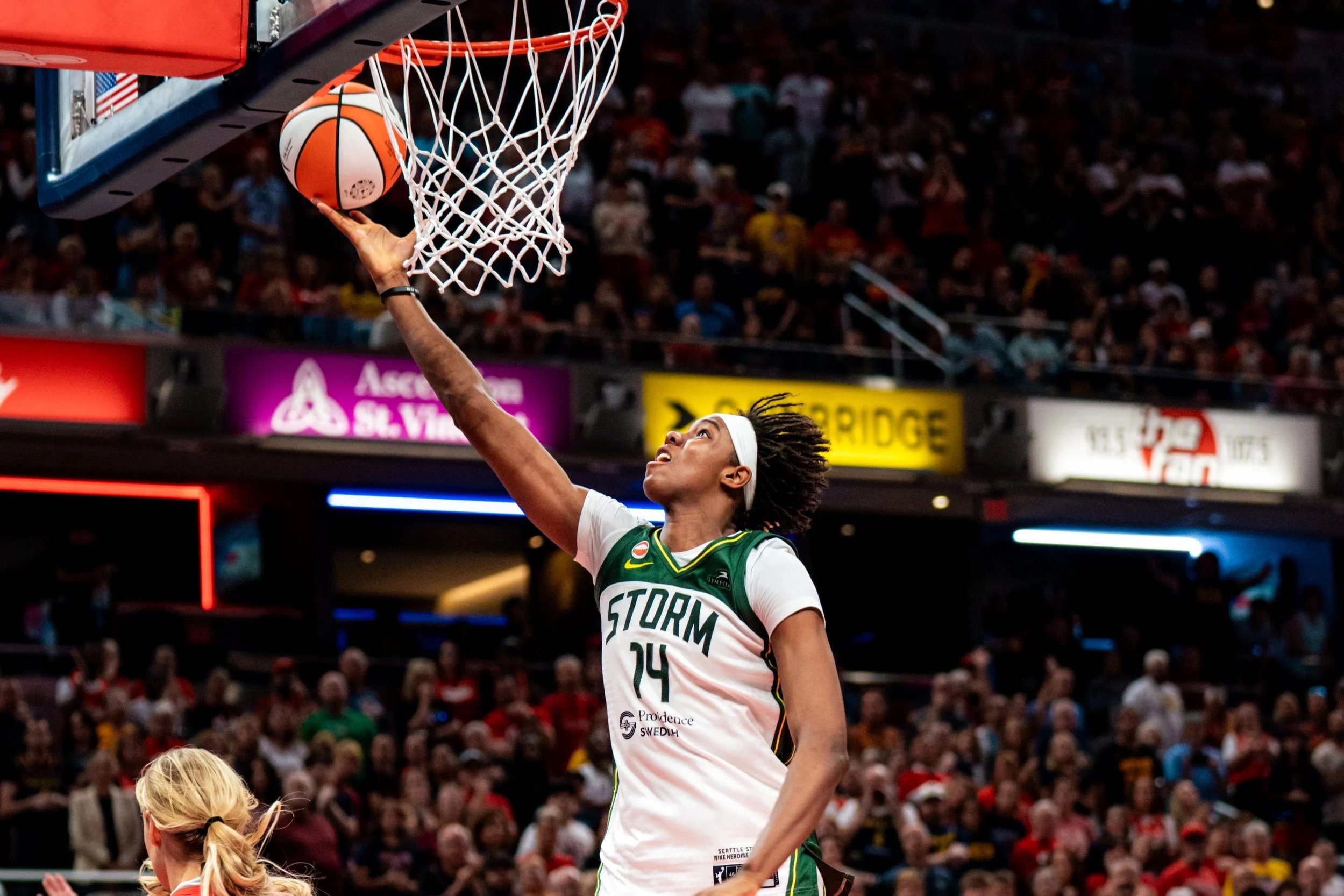
Seattle Storm forward Dominique Malonga (14) goes up for a layup in the team’s 110-107 loss to the Indiana Fever on Friday, July 17, at Climate Pledge Arena. Credit: Courtesy of Seattle Storm [/caption]
The Seattle Storm nearly spoiled Caitlin Clark’s career night in a high-octane shootout, but late-game mismanagement cost them in a 110-107 loss to the Indiana Fever on Friday, July 17, at Gainbridge Fieldhouse.
Seattle (6-21) erased a 17-point first-half deficit and led by eight midway through the fourth quarter. But the Storm were still forced to have Natisha Hiedeman force up a half-court heave to try and tie the game at the buzzer. It was off the mark.
Dominique Malonga led the Storm with 28 points and 14 rebounds, while the entire rest of the starting lineup also scored at least 15 points.
Clark posted a career-high 45 points and 10 assists for Indiana (15-10), while Kelsey Mitchell added 30 points. Monique Billings finished with 16, and no other player on the Fever had more than eight.
The Storm bested their season average of 80.6 points per game by a mile, but they fell to 0-9 in games this season decided by five or fewer points. In one of their best offensive performances, they still struggled to manage a high-pressure situation down the stretch.
Here’s what we learned from one of the most entertaining Storm games of the season.
Erasing the early deficit
It was close for much of the first quarter. The Storm kept it within four points until the Fever mounted a ferocious 13-6 run to close out the period, sending them into the second quarter with an 11-point lead.
Mitchell was on fire for Indiana early. She totaled 17 points on just nine shots and sank two of her three 3-point attempts. That tied for the second-most points scored by a player in one quarter in Indiana franchise history.
As much as that hurt the Storm, it made their mission in the second quarter simple: Force someone else to score for the Fever.
The Storm executed that mission effectively, as Mitchell scored just two points in the second quarter. However, that opened things up for Clark, who poured in 14 points in the period.
Seattle somehow weathered the storm. Despite trailing by as much as 17, the Storm shot 56% from the field in the first half and tightened up on defense. Indiana went ice cold from the field after the midway point of the second quarter, and Seattle took advantage on the other end.
The Storm turned stops into fast-break points, operating the full-court offense that head coach Sonia Raman likes to run. That pacing, when working effectively, is precisely how Seattle wants to operate.
A huge and-one from Malonga with 25 seconds left in the first half trimmed the Fever’s lead to 59-56 at halftime. Malonga led the Storm with 18 points and eight rebounds in the first half on an efficient 8 of 11 shooting.
Million dollar move with a 10 cent finish
The third quarter was arguably the most entertaining 10 minutes the Storm have played all season. Indiana and Seattle traded rapid-fire triples, and the Fever held a slim 76-75 lead with 4:29 remaining in the period.
Awa Fam woke up, hitting four 3-pointers in the third quarter alone. She was a major catalyst for the Storm, looking every bit the part of where she was drafted at No. 3 overall this offseason.
Flau’jae Johnson turned a takeaway into an and-one on the other end late in the third, giving the Storm their first lead since the very beginning of the game. Seattle was humming, a prime example of how good the Storm can be at their best.
The Storm were shooting 65% through three quarters, and they took a six-point lead into the fourth quarter. However, as expected, the Fever weren’t going to roll over.
In the last 10 minutes, it was simply two heavyweights trading blows. Seattle held an eight-point lead with just over five minutes left before Indiana began to narrow the gap.
The offenses fully took over, and the game was tied at 102-102 with just over a minute remaining. Clark earned her new career high in scoring in the period, while the Storm continued its balanced approach.
With 39.1 seconds left, Clark drilled a 25-foot 3-pointer to give Indiana a 105-102 advantage. Malonga cut it to just one point with 18.7 seconds left. She again had to do so with 5.1 seconds left, but that was after draining far too much clock.
The Storm were going for a quick two with 17 seconds remaining, but they had to get that bucket in fewer than 12 seconds to make it worth it. After fouling Clark to extend the game, the Storm had just 3.5 seconds to get up the court and get a 3-pointer. That resulted in Hiedeman’s missed Hail Mary.
On a good note
Sure, it’s another close loss. The Storm have lost six of their last seven. But we saw a side of this current roster that hasn’t been present since the overtime loss to the Wings in June that preceded two straight wins over top teams.
Seattle turned defense into offense and ran Raman’s system at its best. The Storm’s 11 total fast-break points are deceiving, since the full-court offense was in full force — even if those situations aren’t considered fast breaks.
They shot 57% from the field, which is a season high, and got contributions from the entire starting lineup. Raman leaned more heavily on her starters, also, which has generally led to more success. So there’s a positive from the coaching angle as well.
The Storm’s 27 assists marked the third time they’ve hit that mark as a team, and it’s the second-most they’ve compiled in a game. They outrebounded the Fever by nine.
There were more positives in this game than negatives. These are all lessons this young group will carry into the rest of the season and beyond.
What has to improve?
If 12 seconds don’t come off the clock down the stretch, for what was supposed to be a quick two, the Storm may have won this game.
It comes down to the inexperience of this Seattle team overall, but it also falls on Raman to emphasize the situation. With no timeouts left, the Storm should’ve taken a 3-pointer after the amount of time they drained.
That late-game management is key, and the blame falls equally on the shoulders of the players and Raman. The Storm are 0-9 in these close games as a result of that, and their season could look vastly different otherwise.
This might be something that isn’t fixed until 2027. With the Storm in last place in the WNBA standings, that’s to be expected. It still has to be a major point of emphasis moving forward.
Up next
The Storm finally concluded a long five-game road trip. They now return home for a three-game home stand that begins with back-to-back games against the Minnesota Lynx. The first game is at 7 p.m. on Monday, July 20, at Climate Pledge Arena.