Sevens to Seawolves: Inside Malacchi Esdale’s Unique Journey to Major League Rugby

[caption id="" align="alignnone" width="2722"]
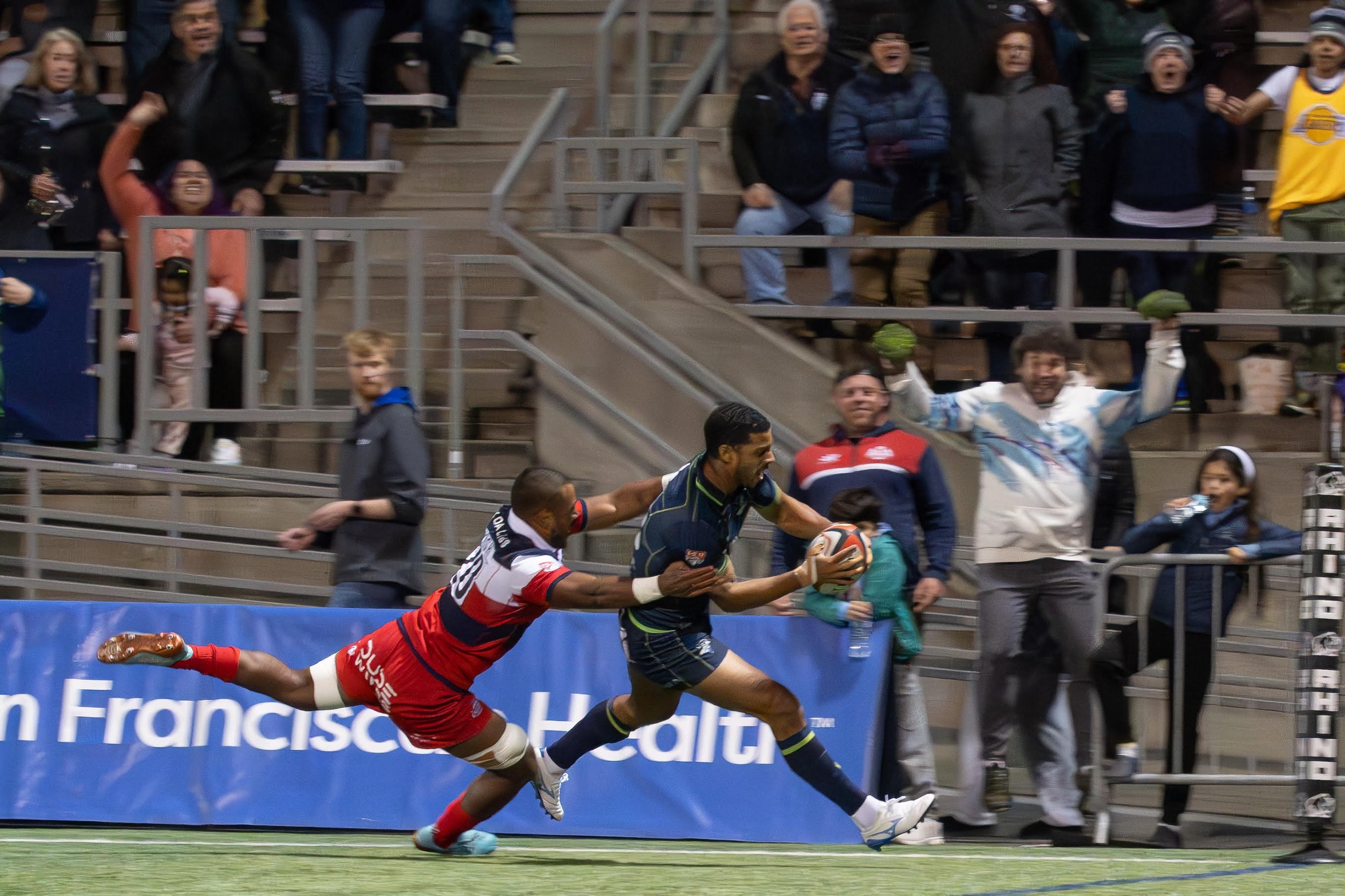
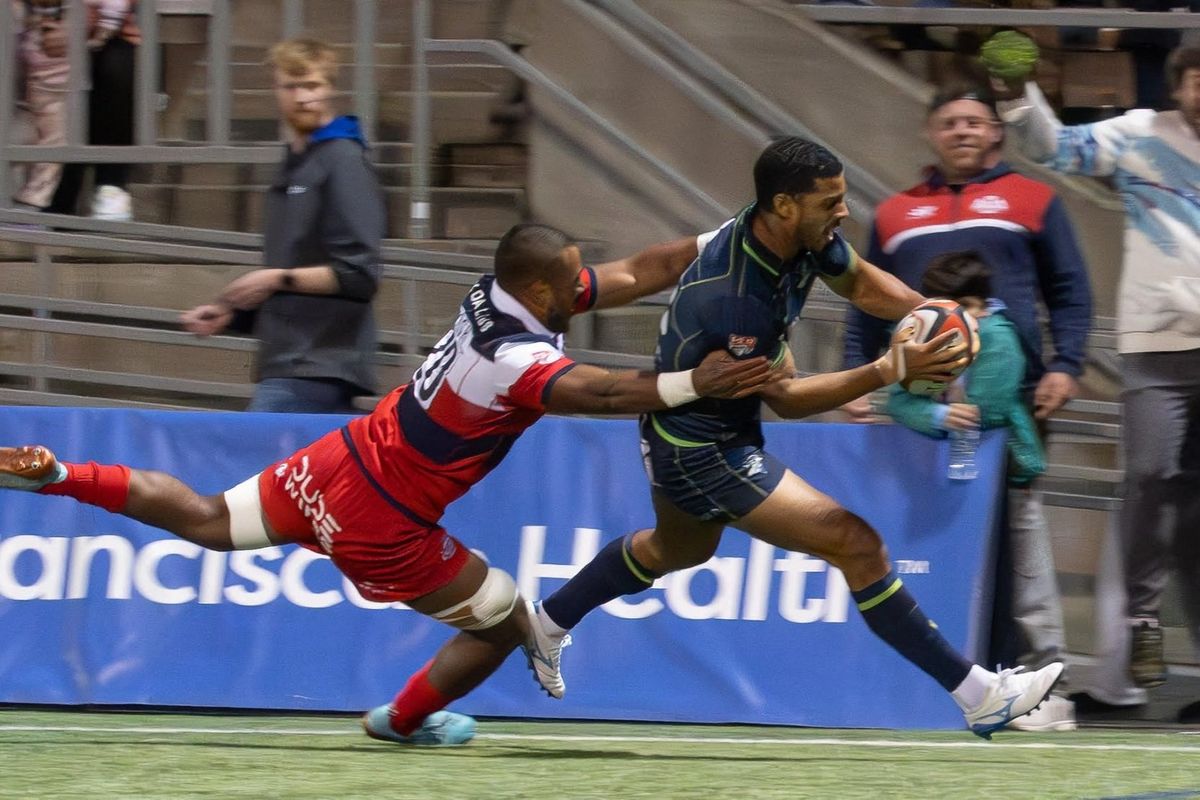
Seattle Seawolves wing Malacchi Esdale goes for the game-winning try on March 8, 2025, against the New England Free Jacks. Credit: Punkus Arnett/Seattle Seawolves [/caption]
On Saturday, March 8, Malacchi Esdale found his way into the shouts of every fan in Starfire. In the 79th minute – his fourth minute on the pitch – he rocketed up the side past five Free Jacks and dove into the corner of the try zone for the winning points of the match.
The Seawolves had signed Esdale in September 2024, one of the first offseason acquisitions after the 2024 year ended with a heartbreaking loss in the MLR Championship. Esdale, who stands at 6-2 and weighs 214 pounds, was one of Seattle’s new additions at wing going into 2025. For the previous few years, he had been playing on the USA Eagles Men’s Rugby Sevens team, and that sevens speed is what Seattle was looking for when they acquired him.
Rugby, however, was not Esdale’s first sport. Growing up in Delaware, he first played soccer – being taught by his uncle, who works as an athletic trainer – before getting into football, where he was a wide receiver in high school after he moved to Florida. His first experience with rugby, oddly, came soon after an injury he sustained in football.
“After a while of playing football [in high school], I got injured. We were in the playoffs my sophomore year and I dislocated my shoulder,” Esdale said. “I was waiting to get surgery, and my friend played on the local rugby team, and he was like, ‘Hey, before you get surgery, do you want to play rugby,’ which is a weird thing to say to someone who's waiting to get surgery.”
Nevertheless, Esdale acceded to his friend’s request. Evidently, the new sport did not cause any more shoulder problems despite offering arguably more contact. From the very beginning of his time in rugby, he played on the wing because of his speed. Initially, he said, it was not very hard – the skill level of the players he was up against was not anything special. But as he went further into the sport, he went up against tougher opponents. During that time in the later years of high school, Esdale would practice with his coach’s son, something he credits with helping him adjust to the new sport.
“They would invite us over, and we'd watch rugby all the time. He had a son who was really good at rugby, so we would kick to each other and pass to each other,” Esdale remarked. “So I learned a lot of fundamentals before I got to the professional level.”
Esdale was not quite done with football just yet, going to junior college in New York City before transferring to Miami on a football scholarship – but failing to make the team and then moving a third time to University of Central Florida. He played club rugby at UCF, meeting people in the sport just as Major League Rugby began to be assembled. A coach at UCF had a connection with Australian loose forward Matt Trouville – then the captain of the Seattle Saracens (now Seattle Rugby Club), but who would go on to be one of the inaugural members of the Houston SaberCats – who reached out to Esdale about joining the nascent league.
“We had just finished up the Sevens summer club season and [Trouville] was like, ‘Hey, there's this league. I caught wind of this league that's about to start up,’” Esdale recalled. “I had no intention of doing anything with rugby, other than playing the club level, but he was like, ‘Hey, you're good enough. I think you're good enough to give it a crack.’”
Just out of university, Esdale accepted, joining the Houston SaberCats for their 2018 season as one of the inaugural seven teams of MLR. His rookie season was not extremely notable – no tries in eight games (seven starts) for that year’s last-place side – but he improved in 2019, scoring his first try in Week 5 of that year in a 44-27 loss to the Toronto Arrows and finishing the season with four tries (20 points), 911 meters gained, and 76 tackles. He only played in five matches in 2020 – with COVID heading the season off at the pass – and scored one try, gained 165 meters, and made 10 tackles.
“It was cool, as a young athlete, being a part of an organized – I think at the time, it was more on the semi-professional side – but being a part of an organization like that was awesome,” Esdale said. “To be a part of the foundation is pretty huge.”
While Esdale’s career was just beginning, he played alongside Osea Kolinisau, a Fijian whose career was in its twilight. Kolinisau, who made 261 appearances for the Fiji Rugby Sevens and led his team to two Sevens Series championships and an Olympic gold medal, recommended that Esdale try out for the USA Eagles Sevens. It took a year and a half of tryouts and slow improvement, but in 2021, he became part of the Eagles Sevens.
Esdale played internationally until 2024 in the Sevens Series, a set of Rugby Sevens tournaments that takes place each year in multiple cities around the world. In 2022, he was on the Eagles team in the Rugby Sevens World Cup, scoring a try in the 11th place game against Kenya, a 26-19 victory for the Americans. Just before being signed by Seattle, his Sevens career culminated in representing the United States in the 2024 Paris Olympics, where he played in five matches.
According to coach Allen Clarke, Seattle began to seriously look at Esdale in July 2024 as that year’s campaign moved toward its fateful conclusion in the Championship Game. However, Clarke and Esdale had been in contact before that point due to the presence of ex-SaberCats on the team, such as flyhalf Sam Windsor. According to Esdale, it was not initially about direct contract talk.
“Just casual conversations, talking about what the future may hold. And [Clarke] sold me on the team culture here,” Esdale said.
Eventually, as the team began to take a serious look at Esdale, they got into the details trying to find a way to bring him on board with the Seawolves.
“We had discussions on what my role would be here and everything surrounding me being here, and I felt very comfortable and secure in our conversation, so that ultimately led me to being here.”
Esdale is not the only Rugby Sevens player the Seawolves have had. Mat Turner, who played fullback and occasionally wing for Seattle between 2018 and 2023, made 34 appearances for the England Sevens between 2008 and 2013, with England being the runner-up in the 2013 Rugby World Cup Sevens.
In his six years with the Seawolves, Turner played in 45 games and gained 3360 yards, made 207 tackles, scored 15 tries with 1 automatic conversion, and kicked two conversions and a penalty for 84 career points. He was a key player in Seattle’s two championships as well. In the 2018 season, he notched a league-leading 926 meters in 2018 as well as four tries and 52 tackles while starting all 10 games (the regular season was eight games in 2018 – it has been sixteen games every season since, with the exception of 2020). He returned in force in 2019, playing in 15 games (14 starts), gained 1355 meters, made 40 tackles, and scored a career-high 8 tries.
Turner’s last few years with Seattle were not as impressive as his heavy-hitting championship-winning pair of 2010s campaigns, but just as his career was ending, the Seawolves picked up another international Sevens player, this time Martin Iosefo, a hard-hitting backfielder who played in 53 Eagles Sevens matches between 2014 and 2021.
Iosefo made it to the Olympics twice, in Rio 2016 and Tokyo in 2021. The Eagles got bounced out in the group stage in 2016, but made a run to get sixth place in the 2020 Olympics. Iosefo scored two tries in that second campaign, one in a group stage match against Kenya and the other during the 5th-8th place playoff in a match against Canada.
The eight-year Eagle made it to the Seawolves in 2022, immediately having a big impact. Iosefo racked up 1161 meters gained, 43 tackles, and seven tries for 25 points in 17 games in 2022, most of the time as a wing but with some play at center. His final try that year was in the MLR Championship game, a 30-15 loss to Rugby New York. In 2023 – his last season with Seattle – Iosefo played in 12 matches with 14 starts, gained 860 meters, made 68 tackles, and scored five tries.
Esdale notes that the Seawolves’ storied history – from their championships to their international-caliber players – is a reminder to be the best player he can be.
“I think there's definitely a little bit of pressure […] being a part of this club. I know that I have to uphold these standards and maintain this level of success they’ve had,” Esdale stated. “If anything, it just pushes me to be the best player I can be. And I just want to add my little bit, my piece of the puzzle that'll complete the picture.
For the Seawolves, international Sevens players offer the requisite speed that the team needs to run their fast, back-centric style of rugby, according to coach Clarke. This is especially true of the back three – where Turner, Iosefo, and Esdale all play, though the heavy-hitting Iosefo put in some spots at center for Dan Kriel or Tavite Lopeti during his two years with Seattle.
One of MLR’s big goals is to promote and improve American rugby. The league hopes to have at least one million American children playing the sport by the 2031 Men’s Rugby World Cup and the 2033 Women’s Rugby World Cup, both of which will be hosted in the United States. There is no doubt that having USA Eagles players on the domestic league’s best teams would boost both the domestic leagues and the international play, though one wonders which direction this would primarily flow.
Regardless, for Coach Clarke, his primary goal is ensuring that his team is the best in MLR.
“We're intent on recruiting and developing the best players and people to represent the Seawolves from all over the world, while getting the balance right between overseas and domestic team members,” Clarke stated. “Our process is to identify local talent first and foremost, before talent from North America and abroad.”
Though Esdale likes both the international stage and the domestic league, he prefers the fan environment and travel schedule, including no 38-hour travel days in a domestic league such as the MLR.
“I think the Seattle fan base is rooted here, so you feel all the love. Even when I first landed, going to the grocery store, going to the WAC [Washington Athletic Club], I had people notice me who had been following my career,” Esdale said. “You feel the love on both stages, but I think it's just a little bit more homegrown and rooted [in Seattle].”
For now, Esdale is focusing solely on the Seattle Seawolves’ 2025 season as he prepares for his first start on Saturday on the road against RFC Los Angeles.
“I would love to just win. Honestly, I don't care what I do on the pitch, as long as I'm contributing. So my goal for the team is to get a dub, and then my goal for myself is to just play as good as I can and contribute to the team.”