Seawolves Bye Week: Lessons From First Seven Weeks of 2025 Season

[caption id="" align="alignnone" width="1877"]
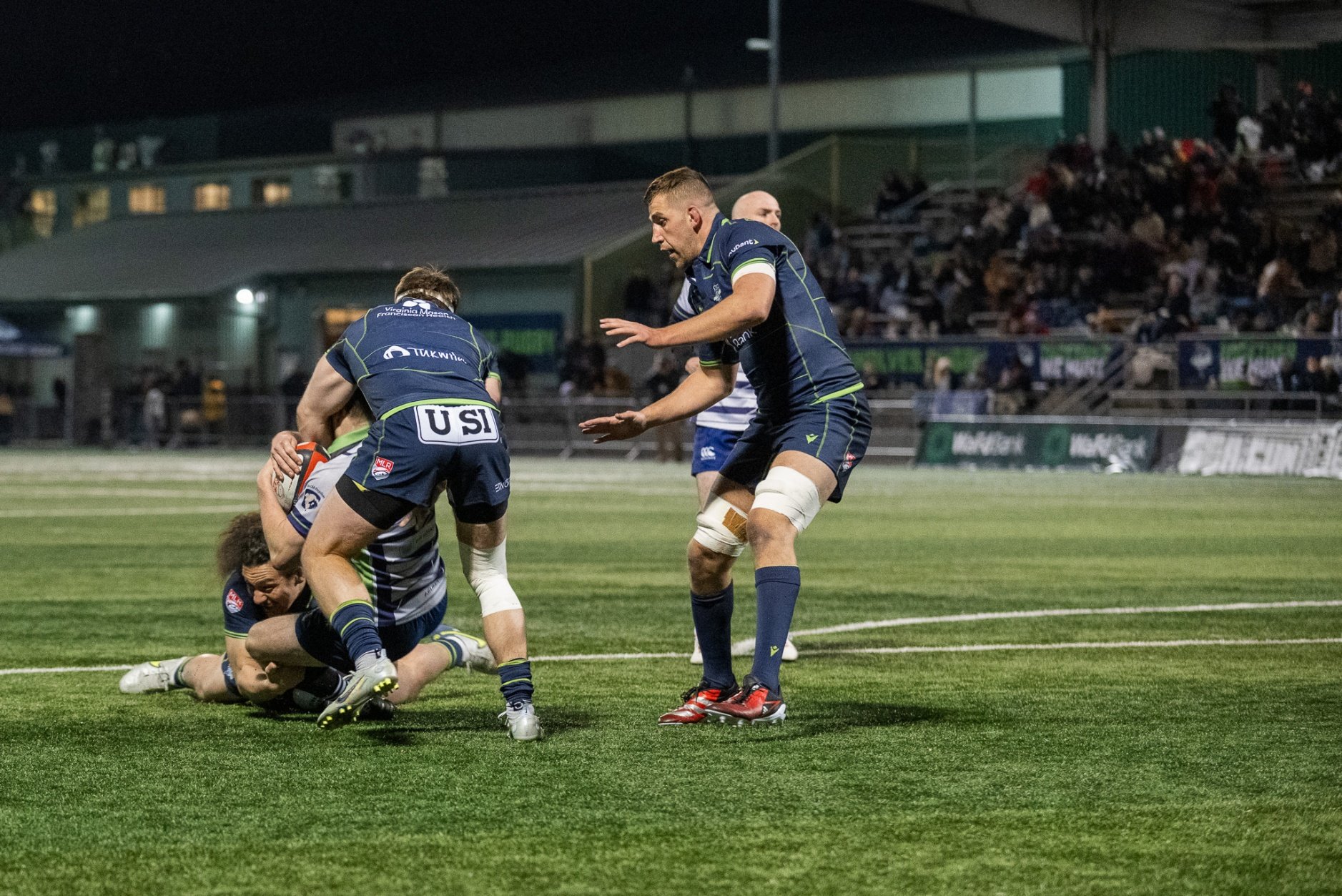
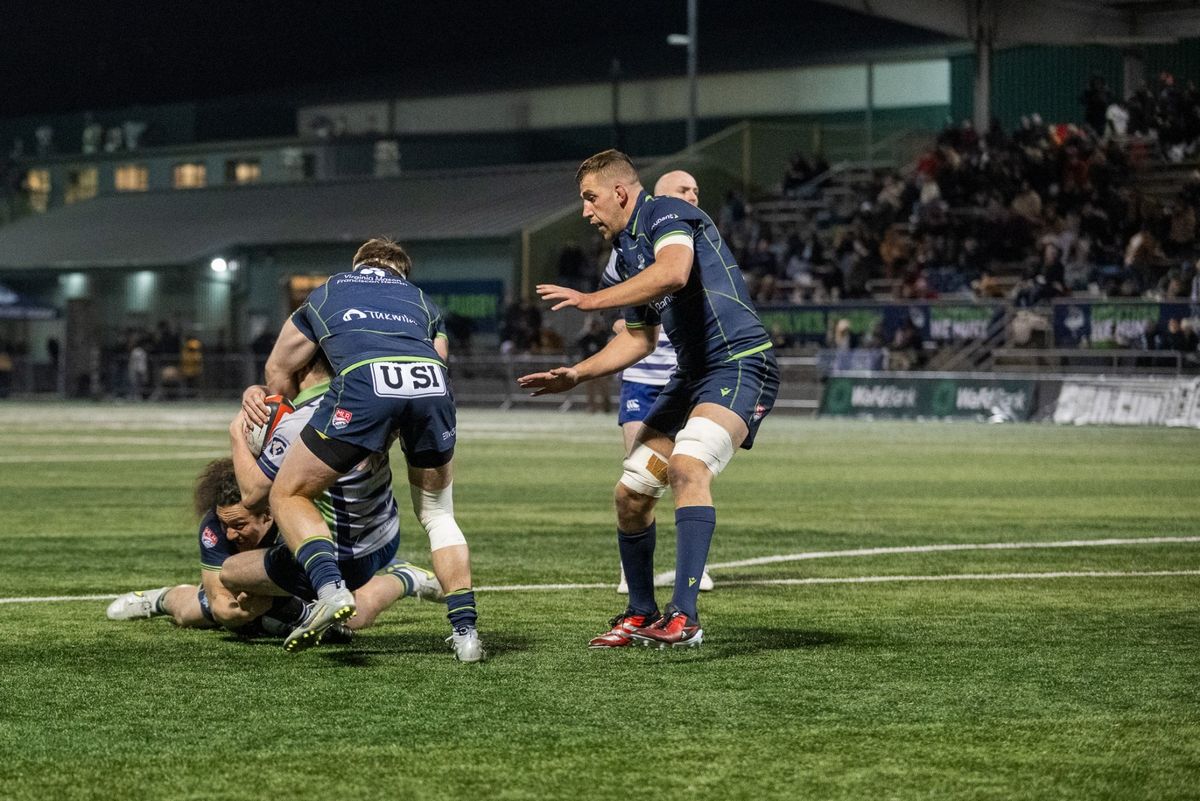
The Seattle Seawolves battle Seattle Rugby Club in a preseason match on February 7, 2025. The preseason battle was a 71-0 Seawolves win, but the regular season has seen the Seattle pro side start off 2-5-0. Credit: Punkus Arnett/Seattle Seawolves. [/caption]
Less than a year after being crowned 2024 Western Conference Champions, the Seattle Seawolves are on track for an early exit in 2025. At two wins, five losses, and zero draws, the team is off to their worst start since the 2021 season, when they also went 2-5-0 on their way to a 4-12-0 season and a fifth-place finish in the Western Conference – the only full season as of yet in which the Seawolves have missed the postseason.
Seattle, the only Western Conference team with a losing record, is currently last in the West with 15 table points. In fourth is RFC Los Angeles, at 4-4-0 and 24 table points. While both the San Diego Legion (5-3-0) and the Utah Warriors (5-2-0) have 26 points, the Warriors edge into second with a plus-58 differential as opposed to the Legion’s plus-50. The Houston SaberCats, with a 5-3-0 record and 28 table points, sit in first place.
On offense, the Seawolves are scoring 23.9 points per game, worst in the Western Conference and ninth out of 11 teams in MLR, only better than the Miami Sharks and Anthem Rugby Carolina. On defense, Seattle is a bit better, comparatively – allowing 28.4 points against per game, fourth in the West (ahead of RFCLA) and seventh in the league. This is a far cry from 2024, when Seattle scored an average of 31.1 points per game and allowed an average of 23.3 points against per game.
Impacts of Player Turnover
Of the 36 players on the Seawolves’ roster, 13 – a little over 36 percent – are new additions to the club, while 20 players who were signed with the team in 2024 left during the offseason. The departed players include props Sam Matenga and Olive Kilifi, hookers Joe Taufete’e and DaQuan Perry, locks Jean Droste and Mahonri Ngakuri, utility forward Reid Davis, back row man Monate Akuei, scrumhalf Ryan Rees, flyhalf Mack Mason, centers Tavite Lopeti and Tevita Kuridrani, wing Conner Mooneyham, and utility back Sam Windsor. In addition, Peter Malcolm, a powerhouse hooker in the 2023 season who suffered a season-ending injury in 2024, retired from professional rugby at the end of the 2024 season.
Many of the new additions are seeing significant minutes in 2025, including props Juan Pablo Zeiss and Njabulo Gumede, hookers Kerron van Vuuren and Dewald Kotze, locks CC Mahoni and Malembe Mpofu, utility forward OJ Noa, flyhalves Rodney Iona and Eddie Fouché (who have both also played inside center), center and wing Mika Kruse, and wing Malacchi Esdale.
Esdale, a fast former Eagles Sevens player, has been a strong addition despite seeing a somewhat limited 167 minutes in his five games. He has four tries (almost two per 80 minutes) and 131 meters in 18 carries for 7.3 meters per carry – the only player on the 2025 Seawolves who currently has more than seven (although fullback Divan Rossouw is at 6.9 in that statistic).
However, some of the other swaps have been rougher for the team, particularly in flyhalf and hooker. Mack Mason, the departed flyhalf, was one of the best flyhalves in MLR in 2024. Not only was he a stalwart ball handler and team leader, he also had a consistent boot, with his 172 points being second-best in the league. He had a 69 percent success rate (36 for 52) on conversions and a 91 percent success rate (30 for 33) on penalties. Joe Taufete’e, the 2024 starting hooker for Seattle, not only made accurate lineouts but – due to his 6-0, 265-pound stature – provided key weight for the front row that synergized with the Seawolves’ physical strategy, scoring eight tries in 2024.
While Iona and van Vuuren are both solid players, neither are the dominating presences of their predecessors. Iona – who seems to be the team’s preference over Fouché at flyhalf – certainly has a good ball handling ability and an ability to land kicks in the field. However, he lacks the ironclad consistency of Mack Mason in those areas and is much worse off the tee, going 4 for 9 on conversions and 1 for 3 on penalties. Fouché, who is often given the kicking duties, is more consistent from the tee, going 10 for 15 on conversions and 3 for 5 on penalties. But he has less ball-handling or game management skill than Iona, and so often finds himself at inside center or coming off the bench.
Kerron van Vuuren is in a similar situation. While the 6-2, 225-pound South African is a good hooker – making the majority of his lineouts and hooking in the scrums as he needs to – he does not provide the extra mile that Taufete’e gave Seattle in the same position. Dewald Kotze, despite coming off an 11-try 2024 campaign with the Dallas Jackals and having more resemblance to Taufete’e physically at 6-0 and 245 pounds, has been in the backup role for the 2025 Seawolves. Kotze has played in seven games with one start and his 148 minutes is about half of van Vuuren’s 387. Van Vuuren has been better in the lineout this year compared to Kotze, but the two are very similar in other statistics – van Vuuren edges Kotze in tackles per 80 (14.9 to 13) while Kotze has the slight advantage in crossed gainlines per 80 (4.3 versus 3.3) and meters/carry (1.3 versus 0.9).
League Adjustment and Sloppiness Derail Game Plan
The Seawolves’ plan on offense throughout the last few years has largely focused on a two-pronged physical strategy to gain meters on central pushes through the rucks and take advantage of opposing penalties to push further on scrums and lineout mauls, two facets of the game that Seattle has historically dominated.
While Seattle is still consistent on scrums, the other elements of this plan have fared less well in 2024. The team’s lineouts themselves are still good, but not great, and it is the mauls where the team has deteriorated in comparison to previous years. The decline in maul effectiveness – and in the effectiveness of ruck crashes – comes in large part from the rest of the league’s adjustment to the physical Seawolf style.
This is compounded by the team’s nagging quality issues on offense, both in passing and suffering penalties. The team’s issues in passing have largely been risky offloads leading to balls going the other way and sloppy passes costing the team both meters and possessions. The penalties, meanwhile, have been chiefly knock-ons, but also not releasing penalties – an echo of ruck issues early in the season.
The April 5 match against Old Glory DC offers a clear example of opponent adjustment and lack of ball quality. Old Glory, the best tackling team in MLR, completely stuffed Seattle’s ruck pushes, out-tackled the Seawolves by a factor of nearly 2 to 1, and significantly out-gained Seattle despite the Seawolves having most of the possession time. Seattle’s only try during the first 70 minutes of the game occurred on openside transition while Old Glory was shorthanded. The second try of the game, a heads-up scrum pick by Riekert Hattingh, occurred after goal line pick-and-runs failed to punch through. The first ten minutes and the final ten minutes of the match were some of the only times when Seattle could put together extended time in the opposing half, as the team’s penalties drove the play towards Seattle’s posts.
Another example is found in the March 22 game against the Utah Warriors. Despite Seattle having two thirds of the possession and spending most of their time well forward in Utah’s half of the pitch, the Seawolves were only able to land three tries – one from Riekert Hattingh’s goal line lunge, one from Malacchi Esdale’s touchline dash, and one penalty try. During the rest of Seattle’s drives, Utah held firm at the goal line until Seattle kicked for post or committed a penalty that ended the threat. Bad ball handling, however, was the largest issue, as Utah scored a try off a risky attempted offload by Seattle going the other way.
So far, the Seawolves have not counter-adjusted to these new challenges. Quality is one thing, as it is the team not playing the system as well as they can, but the attacks running into opposing walls even when executed correctly are perhaps more worrying signs long-term.
How Does Seattle Get Back on Track?
It goes without saying that if the Seawolves are going to make a run for the playoffs in 2025, they will have to re-rail the season as soon as possible. Luckily for Seattle, the bar for entry is to be in the top four teams in the Western Conference – essentially, to not be last. Assuming that each other team in the West keeps their current point pace, Seattle would need 49 table points to safely edge out RFCLA (currently on pace for 48) for a playoff spot. 34 points over nine games, or 3.8 points per game, is equivalent to seven wins with six having the four-try bonus point.
Though it is unlikely that all four of Seattle’s Western competitors will keep at or above their current exact pace, it will still be a tall task, with the first game back being against Eastern Conference-leading Chicago Hounds.
Aside from improvements in quality – something that can be achieved by the current starters in the current system – the potential paths of improvement would both likely take time to hone in. These are in tactics and in personnel, though there are signs of life in each path.
One element of Seattle’s attacking strategy that has still bore fruit in spite of other struggles has been the use of the team’s speedy outside backs. Malacchi Esdale and Divan Rossouw both have four tries, all on line breaks. Ina Futi, although try-less, is fourth on the team in meters made at 157, third on the team in clean breaks with five, and second on the team in defenders beaten at 17.
The other path for Seattle, that of personnel, shows significant promise, though much of it is unknown due to the fact that many potential pieces have seen limited playing time. Hooker Jesse Mackail, a 6-1, 240-pound Kiwi, saw 25 minutes in the back half of the team’s February 16 loss against the San Diego Legion and performed well, scoring two tries and notching 3.25 meters/carry. Props Njabulo Gumede and Chance Wenglewski have each only seen 57 minutes in 2025, all off the bench, while 6-8, 269-pound lock CC Mahoni has seen less minutes than his engine room counterparts but has played well enough – with 17.2 tackles per 80 minutes – to receive a USA Eagles callup on April 9. Flanker Devin Short also received the USA callup, with 13.2 tackles per 80 and a team-leading five turnovers won. In the backfield, Brock Gallagher has looked good in his 54 minutes at scrumhalf, while center Calvin Liulamaga, the team’s first-round pick in the 2024 draft, has not yet seen a minute of play.
That being said, much of the minute decisions are sensible. Wenglewski is playing behind second-year Seawolf Cam Orr, who has played well at loosehead, with three tries in seven games. Orr is also 20 pounds heavier than Wenglewski. Short saw multiple starts before Elton’s return on March 29 against Anthem, but Elton – who has consistently racked up about 16 tackles per 80 his entire career – is higher in the depth chart. Although Gallagher is good, the starting scrumhalf JP Smith is one of the best players on the team and one of the best scrumhalves in MLR. Still, shaking up the starting roster for a game or two could re-energize the team and give a better sense of what the Seawolves have in the tank.