Seawolves Players, Coaches Discuss American Rugby at Preseason Town Hall

[caption id="" align="alignnone" width="1024"]
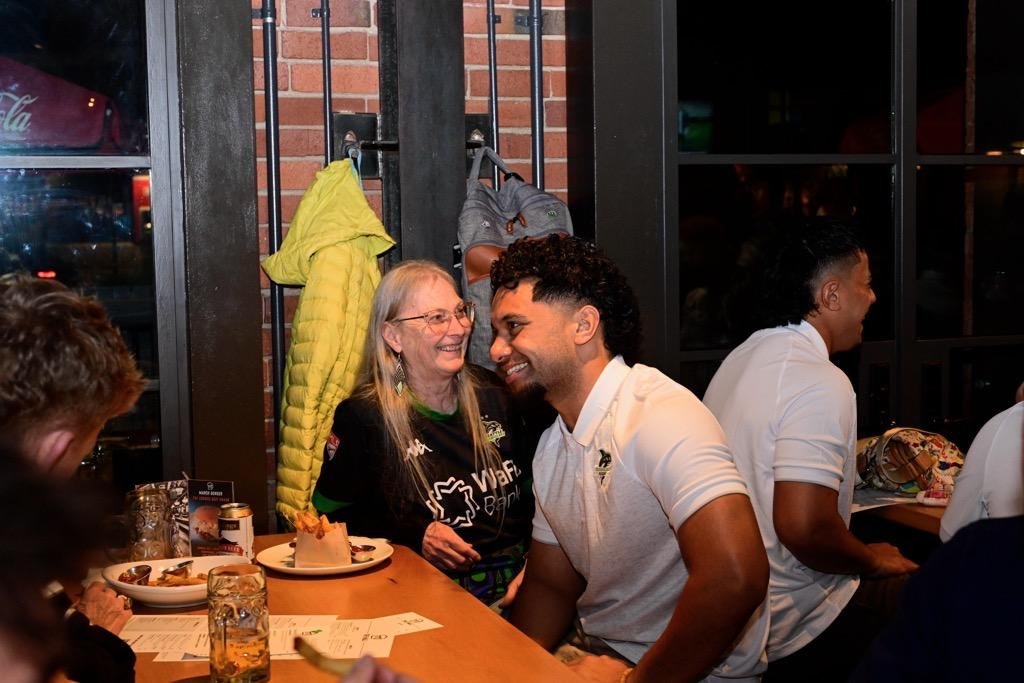
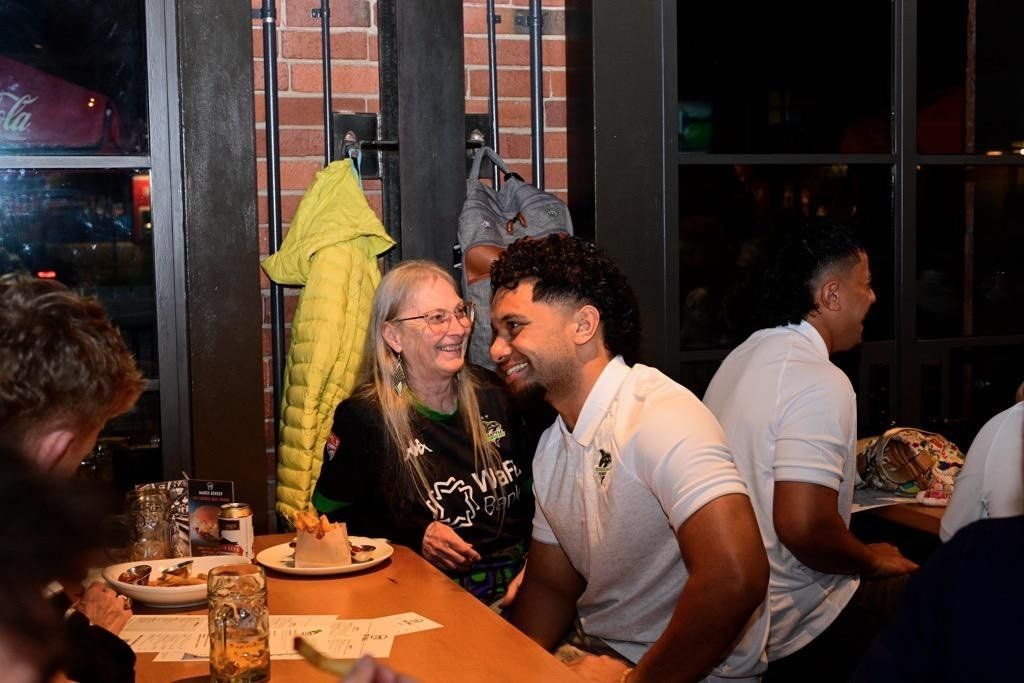
Seawolves center Calvin Liulamaga talks with fans during the team’s preseason town hall on March 4, 2026. Credit: Punkus Arnett/Seattle Seawolves. [/caption]
SEATTLE, Wash. - One of rugby's most enduring traditions is that, when all is said and done and the 80 minutes are played, the sides mingle with each other over beer and pizza. The Seawolves' usual post-match stomping ground is Watershed FC, a pizza bar within the Starfire Sports complex where players can be found after a match, win or loss, chatting with each other and with the fans.
That same kind of environment existed in the Hall on Occidental on Wednesday evening as the Seawolves hosted their season ticket member town hall. Doors opened at 6:00 pm and it was not long before the fans began to stream through into bench seats beside wooden tables. The chats were cordial as always between the Seawolves and their fans to begin the evening as they waited for the main festivities to begin - those being, of course, a series of Q&A sessions emceed by Seawolves chief operating officer Drew Dambreville and some surrounding announcements.
Among all the festivities ran a through-line: that of developing the game of rugby in the United States.
Appreciation for the die-hard fans was quite apparent, both with Dambreville’s announcement of capital investments - a new scoreboard and sound system at Starfire - and with the words of Seawolves head coach Allen Clarke, who was the first to take questions.
“Without you, there is no club and there is no professional game,” Clarke addressed the fans gathered south of downtown that evening.
Only a few minutes before introducing Clarke alongside new assistant coaches Robbie Abel and Stephen Brett, Dambreville discussed the Seawolves’ initiatives to grow rugby at the youth level in the Pacific Northwest.
“We have a long-term goal of putting rugby balls in the hands of 20,000 kids between now and Rugby World Cup,” Dambreville said. “Our main goal is to introduce the youth to rugby, and by doing so, we know a large percentage will choose to play the game.”
Longtime back rower Pago Haini, who hung up the spurs after seven seasons, 50 caps, and eight tries in the MLR per the North American Rugby Database (NARDb), has been a big part of these game-growth initiatives. Although he has retired for good from playing the professional game, he is still with the Seawolves as the director of youth and community programming.
“The big part of it is trying to get rugby in school,” Haini told Emerald City Spectrum. “We’re going around elementary, middle schools, even high schools, hosting assemblies, spreading the gospel of rugby.”
That process involves hosting assemblies at schools - often with team mascot Rucky in attendance - and circling back with physical education teachers to get them on board with the fundamentals of the game. The initiatives have already seen some success, according to Haini, with some schools including rugby in their upcoming spring PE curricula.
Growing the foundations of the game at all ages is a task that is all the more important for MLR and for American rugby on the heels of one stormy offseason. Two teams merged and four folded, reducing the number of sides down to six and the number of matches down to 10, the wrong direction for things to be going as the US prepares to host the Rugby World Cup in 2031.
“Truthfully, no, it was a shock, because (it was) such a good product and so many competitive teams last year and teams that went deep into the knockouts … aren’t with us for 2026, that was a major surprise,” Clarke told Emerald City Spectrum. “But we all know life’s not a straight line, and you adapt accordingly.”
Optimism about the future of the game, even in challenging (to say the least) circumstances, was abundant in the Hall on Wednesday. Once and future Seawolf LaRome White, a prop who left the 2025 season as an MLR Shield runner-up for the Houston SaberCats and entered 2026 with a new contract in Seattle, saw a whole world crumble around him by September even when it seemed that the reigning Western Conference champions were safe - and yet professed hope for the worst to be in the rear view mirror.
“We had promises that Houston was going to be one of the last teams in the league, and when that [Houston folding] happened, it was just heartbreaking, because they’ve been there since year one. And now to see them not in the league anymore, it’s almost like a reset button on the whole league,” White told Emerald City Spectrum. “But I think it’s heading in the right direction.”
White wasn’t the only one to come over from a busted side. Abel, who directed one of the most powerful forward packs in the MLR last season with the Utah Warriors, was unexpectedly out of a job as the Warriors’ potential team-saving investment fell through.
“To be honest, it was quite a shock,” Abel said about Utah’s cessation of operations, echoing sentiment from around the room over the turmoil that rocked the league in the offseason.
But being raised by, as he put it, “a rugby-mad farmer,” Abel was perhaps destined to continue working in the game. He quickly found a new job with the Seattle Seawolves as assistant head coach, where he will be working with the forward pack.
After the coaches came some returners, four of whom populated the L-shaped couch beside Dambreville at the north corner of the Hall. The most decorated of them all was scrumhalf JP Smith, who has accumulated 22 tries in 106 appearances (per NARDb) and who has played quite a bit with the USA Eagles, though he was flanked by fellow South African-turned American (and likely soon-to-be capped USA Eagle) Dan Kriel.
Eagles-capped wing Ina Futi followed them up with a memorable laconism upon being asked how he approaches taking on bigger guys at the wing.
“Bring ‘em down,” Futi said, eliciting a big holler from the audience.
But the three veterans - with 212 MLR caps between them per NARDb - were also flanked by a young center who is yet to receive his first nod to a matchday 23. Calvin Liulamaga, the team’s first-round pick in 2024, is an Auburn-raised local. He came up through the nascent and at times informal American rugby pyramid, starting with the Rainier Highlanders rugby club and continuing on for Central Washington University during his collegiate years.
According to Clarke, Liulamaga is set to receive his first cap sometime in the 2026 season, viewing his time in 2025 as something of an apprenticeship.
“Calvin was close last year, but I think it reflects the jump from collegiate rugby to the professional game,” Clarke said. “And it doesn’t matter whether you’re in the US or you’re in Ireland or New Zealand or France, you learn your trades and you become proficient in your trades.”
New additions to the Seawolves pod followed up the veterans and (in Liulamaga’s case) pre-debut sophomore as White, flanker Paddy Ryan, and center Mark Bennett sat on the couch with the mic darting between them and Dambreville.
Again, the development of US rugby was the recurring theme. Ryan, who is USA capped due to his mother’s Bostonian birth despite Ryan’s own upbringing being in Ireland and Britain, expressed admiration for the quality of MLR play - something he discovered upon traveling to hither shores to suit up for the San Diego Legion.
“When I came here, I was blown away by the quality of players and the quality of athletes that play in Major League Rugby,” Ryan said. “You got a lot of homegrown American players as well that were playing football and then have tried rugby, and they’re some of the best athletes to come and play against: they’re raw, but they’re talented, and we need to keep developing them to be the next Eagles.”
The potential is obviously there in a country of 340 million people, but in order to realize that potential, the institutions need to be built up. Perhaps there should be a guiding star in the development of American soccer, once an afterthought on the American sports scene but now a robust system with an expansive youth development pyramid, legions of homegrown fans, a league with legitimate superstars, and academies (looking at you, Seattle Sounders) that produce truly world-class players.
If there is that guiding star, however, it wasn’t mentioned. But the basic idea is the same: familiarize Americans with rugby from the ground up. Success at the international level may be a long time coming; after all: the USMNT is still stuck in an absolute Groundhog Day-esque slog trying and failing to become a solid international side. But American soccer itself now has strong cultural foundations.
This focus on the nuts and bolts isn’t keeping the Seawolves from shooting for bigger things, however. The team recently announced their plans for a two-week tour with the Stormers of United Rugby Championship, a team based in Cape Town, South Africa. This was something that had been in the works since September, according to Clarke, and there’s quite a host of reasons for doing it.
For Dan Kriel, it will be a return to his hometown. He noted his plans to bring the team to Table Mountain - perhaps an expected move from the very outdoorsy Kriel (there’s a reason he lives in the Pacific Northwest) - but I venture to say that is merely an added benefit from the rugby perspective.
When it comes to the big reasons, chief among them in the immediate sense is the preparation. Seattle just had one preseason contest in 2025 against the Seattle Rugby Club, a less challenging preseason than some of the other MLR sides had gone through - and perhaps a reason for their slow start.
“That was definitely an element to it, and an important element,” Clarke said of the preparation aspect. “You know, there’s no better way to bond a team, particularly in a reduced pre-season, than being away together for two weeks. You’re living, breathing, eating together, on the field together, socializing together and then competing together against a really good Stormers 15.”
But there is much more to their tour than just sharpening up for 2026. The two teams signed a three-year contract that clearly entails some sort of partnership, but the goal of the Stormers coming to Seattle is not something that has yet been put to paper. There are also commercial considerations - the Seawolves are looking to potentially grow their brand internationally - and the opportunity to improve team operations.
“If you’re them (the Stormers), you’re probably waiting to see what we’re like in terms of our quality, a team coming from America,” Clarke said. “So it’s important that we represent ourselves well in Cape Town so that we not only represent Seattle Seawolves, we represent USA rugby.”
Fans and players alike slowly streamed out of the Hall once the Q&As concluded, with the season ticket-holders stopping to purchase team merchandise from Haini on their way out. Among all the uncertainty over what the future has in store for the MLR, American rugby, or the Seawolves and their youth initiatives, there was a general happiness in the air: because whatever happens, there are 10 MLR fixtures ahead for the Seattle Seawolves.