Seahawks Maintain Present/Future Cap Flexibility Amid Receiver Spending Spree

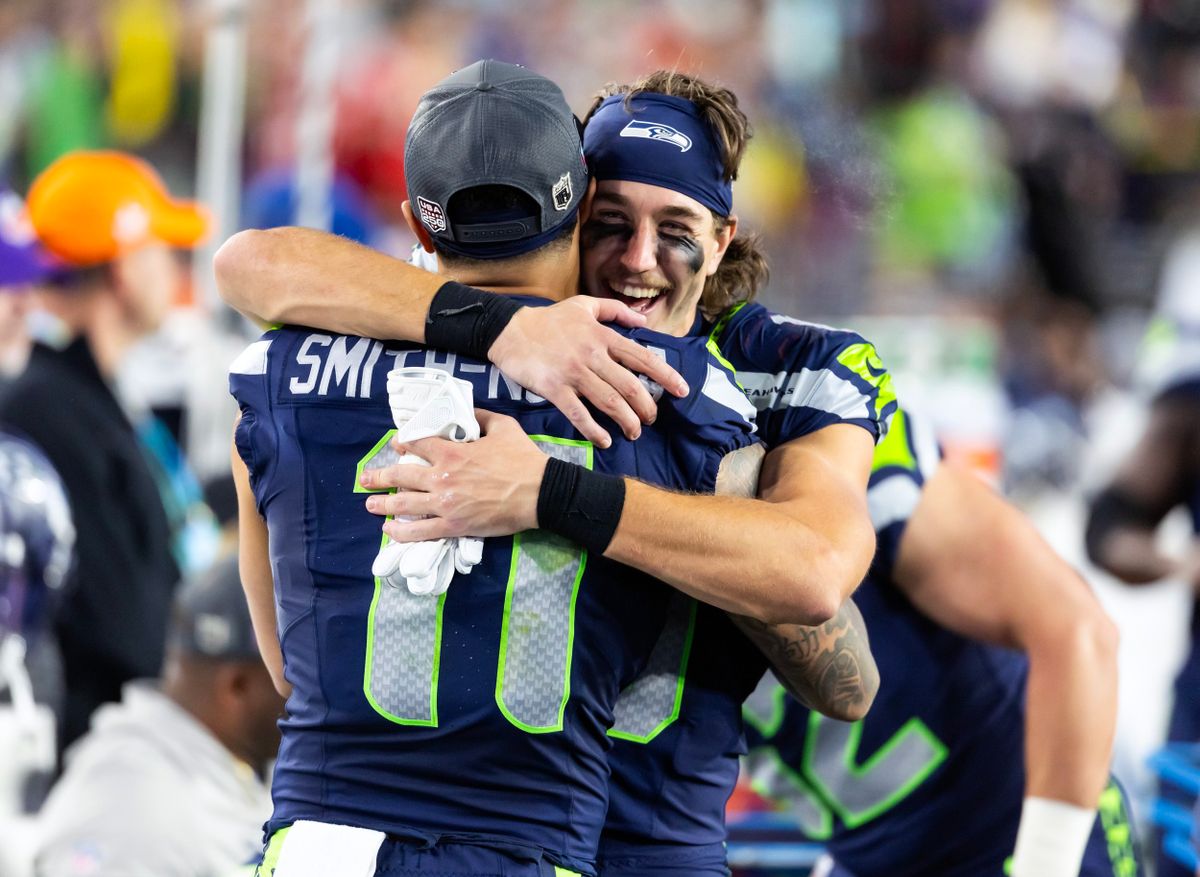
[caption id="" align="alignnone" width="4778"]
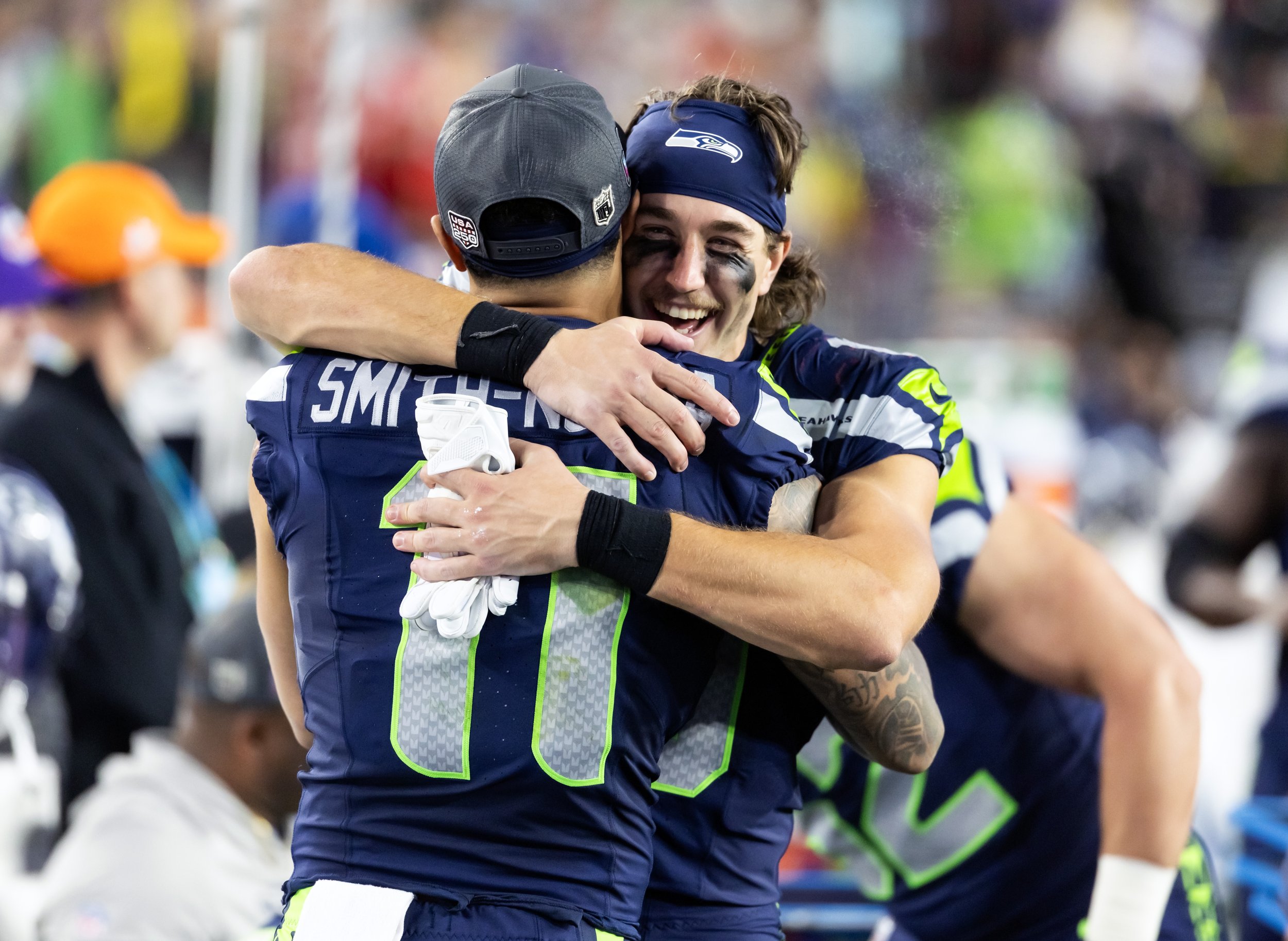
Seattle Seahawks wide receiver Jake Bobo (19) celebrates with Jaxon Smith-Njigba (11) against the New England Patriots during Super Bowl LX at Levi's Stadium. Mandatory Credit: Mark J. Rebilas-Imagn Images [/caption]
Kicking off a busy Monday in late March with a bang, the Seattle Seahawks worked swiftly to reward Offensive Player of the Year Jaxon Smith-Njigba with a record-setting extension, making the superstar receiver the highest-paid player at his position in NFL history with a four-year, $168.6 million contract.
Only a few hours later, weeks after locking up speedy wideout/return specialist Rashid Shaheed a three-year, $51 million contract on the first day of free agency, general manager John Schneider dipped even more financial assets into the receiver group, as the Seahawks opted to match the Jaguars’ two-year offer sheet for special teams ace Jake Bobo. Between those three contracts, the franchise has shelled out north of $220 million at the position this month, including over $120 million in guarantees for Smith-Njigba’s market-setting extension.
Adding those three deals with veteran Cooper Kupp’s remaining two years with base salaries of $12.9 and $12.4 million, per Spotrac, Seattle has a league-high $83 million in combined average annual value (AAV) at the receiver spot in 2026 and nearly equaling that total at $78 million in 2027. In both seasons, they sit at least $6 million ahead of the next team behind them, illustrating tremendous investment in the position compared to the rest of the NFL.
Based on those raw numbers alone, it’d be easy to question Schneider’s decision making process throwing so much money at a single non-quarterback positional group, especially in the case of Shaheed getting paid instead of running back Ken Walker III.
But under Schneider’s leadership, paying out big contracts for Doug Baldwin, Tyler Lockett, and DK Metcalf over the years has been a successful business plan, and the Seahawks have consistently been among the biggest spenders prioritizing financial assets at receiver, including ranking in the top six in AAV each season from 2021 to 2024. While such prioritization of one position undoubtedly will impact the ability to spend elsewhere, the front office has done a fine job structurally scaffolding deals for Smith-Nijgba, Kupp, and Shaheed to keep plenty of cap flexibility both in the present and long-term.
Starting with Smith-Njigba’s historic extension, Schneider wisely picked up the receiver’s fifth-year option on March 20. Using this contractual mechanization, which the franchise also did with left tackle Charles Cross before extending him in January, Seattle allowed itself to spread out the signing bonus over an additional year on what amounts to a six-year deal rather than a four-year one with the new years not officially starting until 2028. As a result, while his cap hit increased by $5 million in 2026 due to signing bonus proration, it decreased by $8 million in 2027, giving the team more room to operate a year down the road.
Smith-Njigba’s salary cap hits will skyrocket to $32 million and $36.5 million in 2028 and 2029, but those jumps should coincide with the salary cap continuing to increase each year. And by that point, if not after the 2026 season, Kupp’s contract will be off the books and Shaheed will be in the final year of his new deal with a potential extension looming at that point.
As for Shaheed’s contract, while ponying up $34.7 million in guarantees to sweeten the pot, Schneider and cap guru Joey Laine wisely backloaded the deal with most of the base salary being paid out in 2027 and 2028 and two void years tacked on the end. As a result, he only carries a $7 million cap hit in 2026, which will allow the Seahawks to keep Kupp with a $17 million cap hit next season before having to make a decision on the veteran’s future next spring.
In the case of Bobo, after deliberating on whether or not to match Jacksonville’s offer sheet for the restricted free agent, Seattle opted to pay the former undrafted signee, whose value vastly exceeds his career receiving numbers. Under the terms of the two-year deal Jacksonville offer him, his cap hit will actually be $1.22 million less in 2026 than it would have been on a right of first refusal tender, and without accounting for incentives, the cap hit will be a similar price point under $3 million in 2027.
Considering Bobo’s importance as a core special teams player and an elite run blocker on the outside to deploy in new offensive coordinator Brian Fleury’s offense, coupled with the fact he provides a far cheaper hedge for Kupp under the premise that the latter could be gone after next season, the Seahawks made a wise business decision that doesn’t break the bank to keep a key locker room glue guy and fan favorite.
Even with Smith-Njigba, Kupp, Shaheed, and Bobo all under contract through the 2027 season, according to OverTheCap.com, Seattle has $33 million in cap space to work with currently, opening the door for Schneider to still pursue a trade and/or sign additional free agents before and after the upcoming 2026 NFL Draft. Thanks in part to Smith-Njigba’s cap hit going down nearly $10 million on his fifth-year option season, the team also has $57 million in projected cap space in 2027, and that number could increase by $14 million instantly if Kupp is cut or retires.
What the Seahawks decide to do with Kupp, of course, will defend on multiple factors. If the 32-year-old wideout improves upon his 2025 stat line of 47 catches, 593 yards, and two touchdowns next season and shows no signs of slowing down, it’s possible Schneider could explore a short extension to mitigate his $17 million cap charge in 2027. However, with Shaheed and Bobo under contract and 2025 fifth-round pick Tory Horton remaining a fixture in the team’s future plans at the position, he would be a prime cap casualty candidate, a decision that would be easier to make if he doesn’t match his production from his first year with the organization.
Regardless, even after Smith-Njigba signed the dotted line for a record $42.5 million per year, Seattle hasn’t backed itself into a corner when it comes to making any decisions regarding Kupp or the rest of the receiving corps over the next couple of years. Schneider can keep the band together for one more season, if not two, with the mechanisms in place to massage the cap as necessary as a means to pursue roster improvements at other positions as the Super Bowl window remains open.