Young Slugs RBI Double, Slaps Two-Run Single in Mariners’ Comeback Win over Twins

[caption id="" align="alignnone" width="4545"]
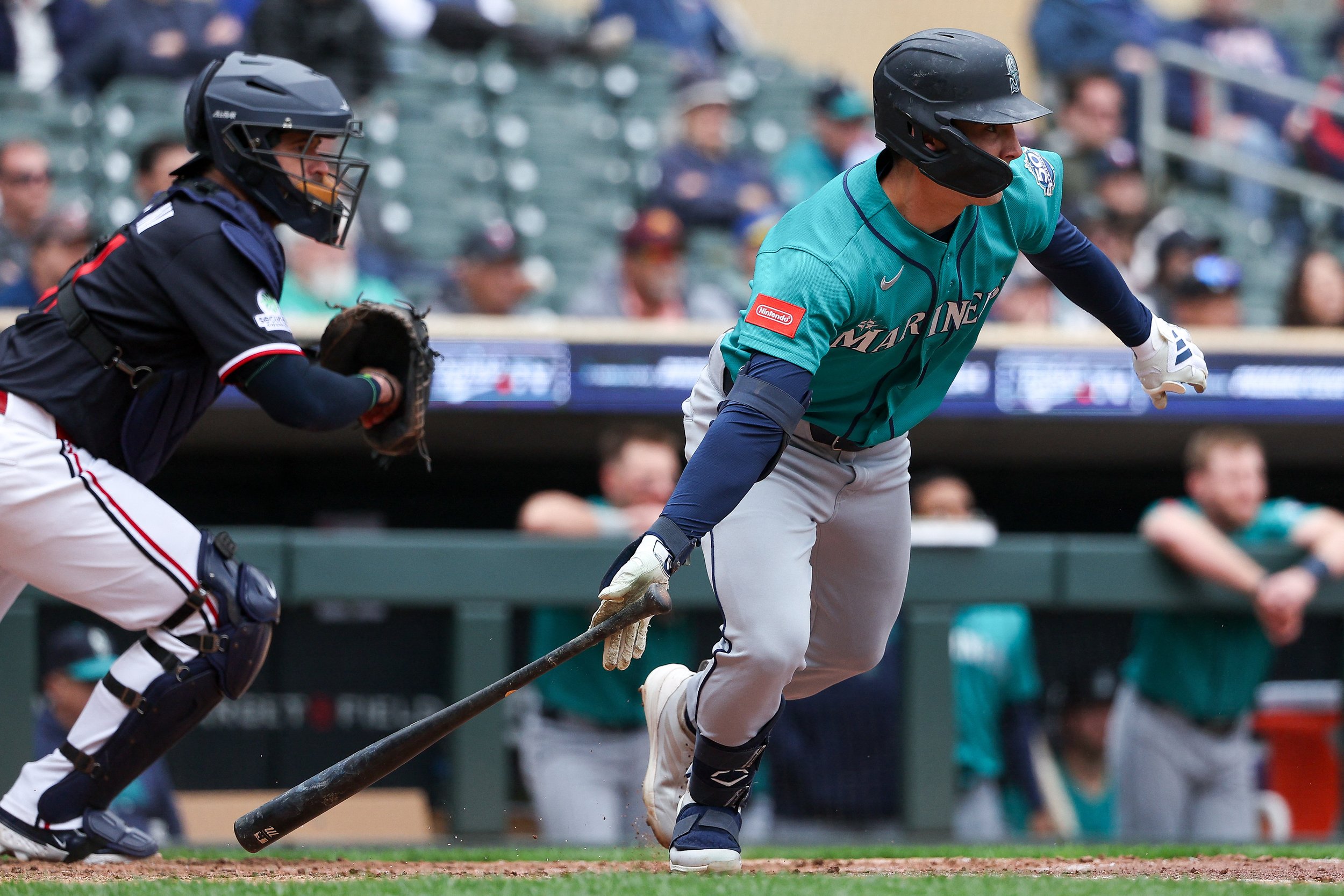
Seattle Mariners second baseman Cole Young (2) hits a two RBI single against the Minnesota Twins during the ninth inning at Target Field. Mandatory Credit: Matt Krohn-Imagn Images [/caption]
A .500 batting average and a .500 on-base percentage. 16 total bases in 22 at-bats. A 1.227 OPS. One home run, two doubles, and eight RBIs.
Those were Cole Young’s hitting stats over the Mariners’ 5-1 road trip to get back to .500 baseball by the end of April. Three of those RBIs came in the Mariners’ 5-3 win in their rubber match against the Minnesota Twins on Wednesday and two were as timely as could be with the M’s down one in the top of the ninth.
What goes up must go down, but the second baseman’s offensive breakout has been the Mariners’ best friend more than once in the young season on plenty of different-color diamonds.
George Kirby kept the Twins to two runs despite a big fourth inning opportunity.
Just like Logan Gilbert on Tuesday, George Kirby didn’t get the defense behind him that he wanted, with uneasy outfield play extending a fourth inning that saw the Twins put a pair of runs on the board and ballooned his pitch count enough to end up nixing the quality start and adding some workload for the Mariners bullpen.
The game started off pretty well for Kirby, though, working around lone singles in each of the first three innings with a double play in the third and some good old punchouts in the second.
Minnesota began to put together a threat with one out in the fourth. Kirby stayed on the outer edge of the zone one pitch too long against Ryan Jeffers, who knocked a single into the outfield. The Mariners hurler nibbled around the zone to Kody Clemens and issued a walk and a miscommunication between Julio Rodríguez and Luke Raley allowed Luke Keaschall to load the bases on a bloop single.
Although Kirby rarely got rattled on Wednesday, there was one moment when a near-disaster seemed to take him out of a big part of the zone. He peppered Matt Wallner’s zone with a perfect four-pitch sequence: a couple of called strikes on the upper and outer edges of the plate, a high fastball to make Wallner think up, and a buried splitter for the strikeout. But when Brooks Lee took a high and inside cutter about 15 feet foul of a grand slam, Kirby decided to try for changeups low. One went too far low and didn’t get a bite, but the second went a hair too far up in the lower part of the zone.
Lee - perhaps reading fastball - barely managed to make contact off the end of the bat and blooped it into no-man’s land in right center for a two-run single.
Those runs were the only ones that the Twins managed against Kirby. Another double play ended the fifth quickly, and although Kirby started nibbling far too much after a Clemens double and a two-out walk to Wallner ended his outing at 5 ⅔ innings. Eduard Bazardo quickly got the last out to end the jam, though.
Seattle took out two relievers quite quickly and wound up having to lift Matt Brash due to injury concerns.
An always uneasy part of the Mariners’ strategy of sticking with one reliever per inning is the danger of what to do in extras. When you use all the high-leverage arms in the sixth through ninth, you leave yourself in an awkward position for the ghost runners in extras.
With a tied 2-2 game in the bottom of the seventh, Mariners manager Dan Wilson took Bazardo out for Jose A. Ferrer with the lefty Trevor Larnach up and Byron Buxton on first. The thinking was clearly to knock Larnach out of the game, but Bazardo still looked solid on the mound and had only thrown 10 pitches. Ferrer easily worked through the rest of the frame on 11 pitches of his own, but as the eighth inning began, Wilson went to his designated setup man.
Matt Brash was notably uncomfortable after his first pitch, and when he stiffed up after the second, Cal Raleigh motioned for the trainer. A conversation on the mound ensued and Brash left the game. It seemed like a lot of it was precautionary, but with Brash’s injury history, this was the opposite of what Seattle wanted.
Injuries never help anything, reliever churn included. Gabe Speier was available as a break-glass case after his outing on Tuesday, and he had to come into the game cold and found himself in a jam as Jeffers singled and James Outman pinch-ran and swiped second. Speier struck out the following two batters, but as his pitch count climbed and he lost his edge, Victor Caratini grounded a ball towards the hole between short and third.
The J.P. Crawford of yesteryear would have at least gotten his glove on the ball and knocked it down. The Gold Glove winner of Crawford’s prime would have made the play and ended the inning. But the Crawford of 2026 isn’t the defenseman he once was, and the ball went into left field for a go-ahead single.
Cooper Criswell finished the inning after Speier allowed two more to reach base and reached 30 total pitches. But Seattle was now down a run with three outs to play with.
Cole Young’s hot streak continued to provide most of the runs the Mariners had on Wednesday.
Crawford did better with the bat than with the glove in the rubber match, walloping a home run in the top of the third against Twins starter Taj Bradley. For the first six innings of the game, that was all the Mariners could manage.
Bradley, who had a 6.61 ERA and 3.80 FIP in 2025, has become something of an early breakout for Minnesota. Over his first half dozen starts of the year, he had balled out to a 2.91 ERA and 3.80 FIP, and though the amount of fly balls and homers does mark him out as a regression candidate, he got a whole lot of whiffs from Seattle as he breezed through the first two-thirds of the game.
Dominic Canzone took a two-out hanging splitter on a frozen rope into right and managed to leg out a nail-biting double thanks to an offline throw from Wallner in right. For the first time all game, the Mariners got a guy in scoring position, and who else would be up in that situation but Young?
The Mariners second baseman has found himself in these situations quite a bit to begin 2026, with 34 high-leverage plate appearances coming into Wednesday’s game. And despite being the youngest player on the team, he had thrived in these spots, slashing .286/.412/.607 with a double, a triple, and two homers.
Another extra-base hit came in the seventh as Young lifted a 2-2 fastball to left center. Off the bat, it looked like Buxton, a strong defender in center, would be able to get to it for the third out. But it kept drifting and drifting and Buxton turned his head to watch it take a hop off the warning track and the wall before snaring it. Young had himself a game-tying double.
Young had another opportunity in the ninth inning. Eric Orze, trying to get his second save of the year, had difficulty hitting the broad side of a barn against Randy Arozarena and only managed to recover from a 2-0 start against Luke Raley because Raley didn’t take the chance to rattle him with a swing on a middle-middle spinner. The decision to take everything until he threw one over made sense, but that pitch was the exception where even a loud foul ball could have caused the wheels to fall off for Orze. Canzone got his second knock of the game with a drive into right center field to bring up the hot-hitting infielder.
Wilson brought in Leo Rivas to pinch-run and take off for second, and Caratini didn’t throw with Arozarena on third and the double steal on his mind. Orze fell behind Young 2-0 in the meantime, but some well-located stuff brought the count back even. Young sought to simply get the ball into play with two strikes and two men in scoring position, and even though Orze’s splitter was well outside the zone, he put a good piece of bad ball hitting on it and dribbled the ball through the middle of Minnesota’s drawn-in infield.
The score flipped on its head. Raleigh gave his team their fifth and final run with a sacrifice fly, but the winning tally had already been scored as Andrés Muñoz dealt a clean ninth inning.
Some of Young’s clutchness has come from a greater contact rate in big situations. While he generally whiffed on 24.7% of his swings going into Wednesday’s game, that rate had been 11.4% with runners in scoring position (with the concurrent non-RISP whiff rate being 30.6%). Even only after March and April, this was statistically significant [1] - and his trend continued.
“[Young]’s been a really tough two-strike hitter, and again, it goes back to being patient,” Wilson said. “Number one, he doesn’t let the game speed up on him, he’s got really good control of his emotion and the moment doesn’t seem too big for him, which is huge. And being able to see the pitch and let it get deep enough and not chase, and he’s not afraid to go the other way with it.”
Now, part of it has been luck, as the dribbler on Wednesday epitomized, but a good proportion of his hitting has been legitimate. Young’s batting average on balls in play (BABIP) with runners in scoring position, while a notably high .360 for the year (due for regression) isn’t something stratospheric like is often seen in these kinds of brief situational overperformances.
Young’s six-game heater is definitely an outlier, with a ridiculous .556 BABIP over the road trip that isn’t going to sustain itself. Contact hitters like Young live and die on whether the balls they put in play can find holes or not, and in the close confines of T-Mobile Park, outfielders have a notably easier time getting to balls wherever they are hit.
But between some already Gold Glove caliber defense (though not quite as high as DRS thinks it is) and timely offensive production, Young has shone brightly in the first month of his sophomore campaign. And even though he won’t go crazy all the time, the Mariners have to be more than happy with his output and development.
On Deck
The Mariners return to Seattle to face the Royals and Braves on a homestand starting Friday. The Royals haven’t yet fulfilled their longstanding ambitions to break out in the AL Central and sit with a 12-17 record going into their contest against the Athletics on Wednesday night, but the Braves have rapidly become the class of the NL East and are one of only two teams with 20 wins.
Seattle, despite their skid to begin the campaign, are now at an even 16-16 record. In a seemingly weak AL West, that still leaves a wide-open runway.
[1] Young had 49 whiffs in 160 non-RISP swings before Wednesday and eight whiffs in 71 RISP swings. The p-value of the RISP subsample being identical to the total sample (with the alternate hypothesis that the RISP subsample had less whiffs) was 0.01258, below the standard 0.05 threshold of statistical significance.