Mariners Trajectory Rapidly Approaches Inflection Point with Fifth Straight Loss

[caption id="" align="alignnone" width="4049"]
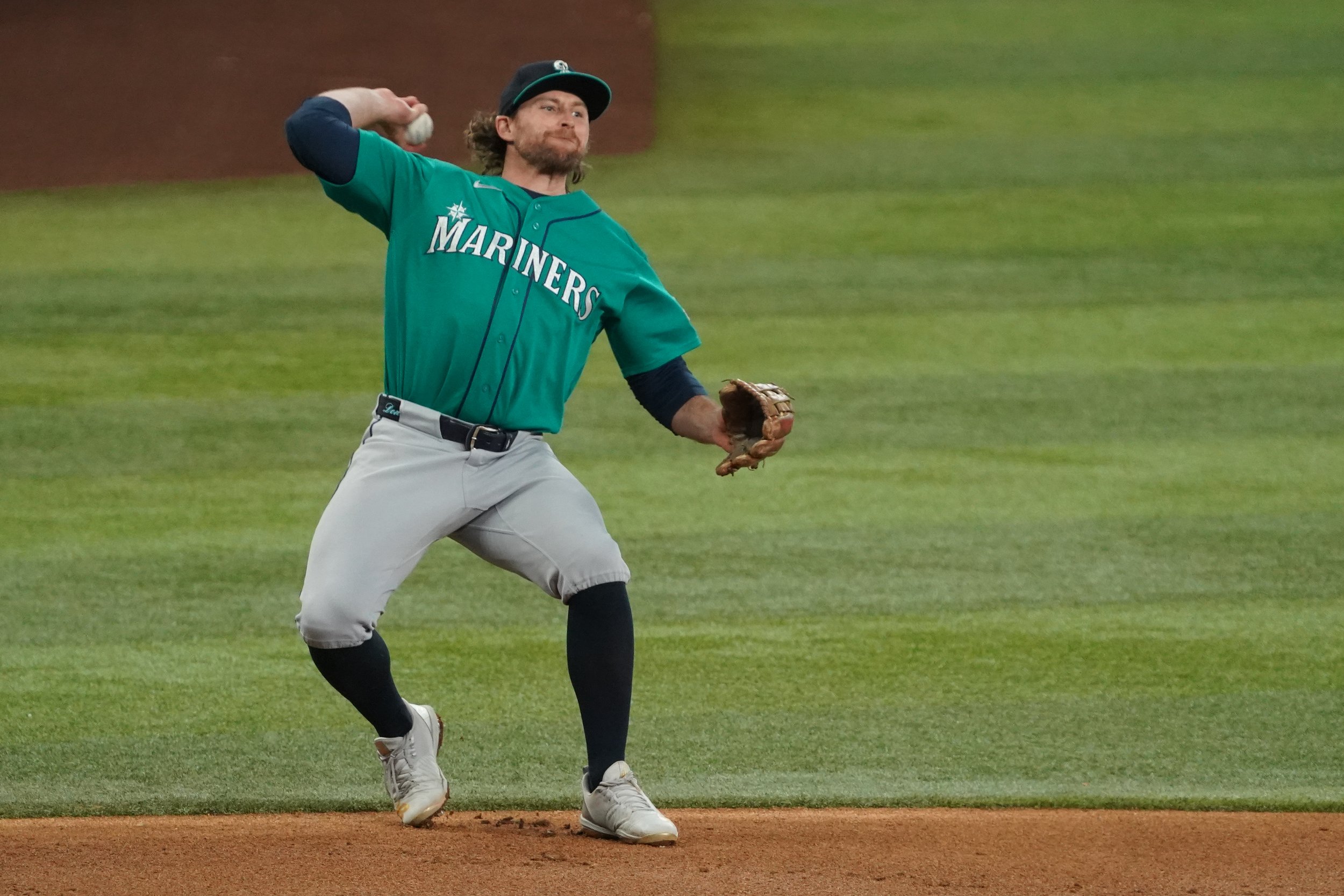
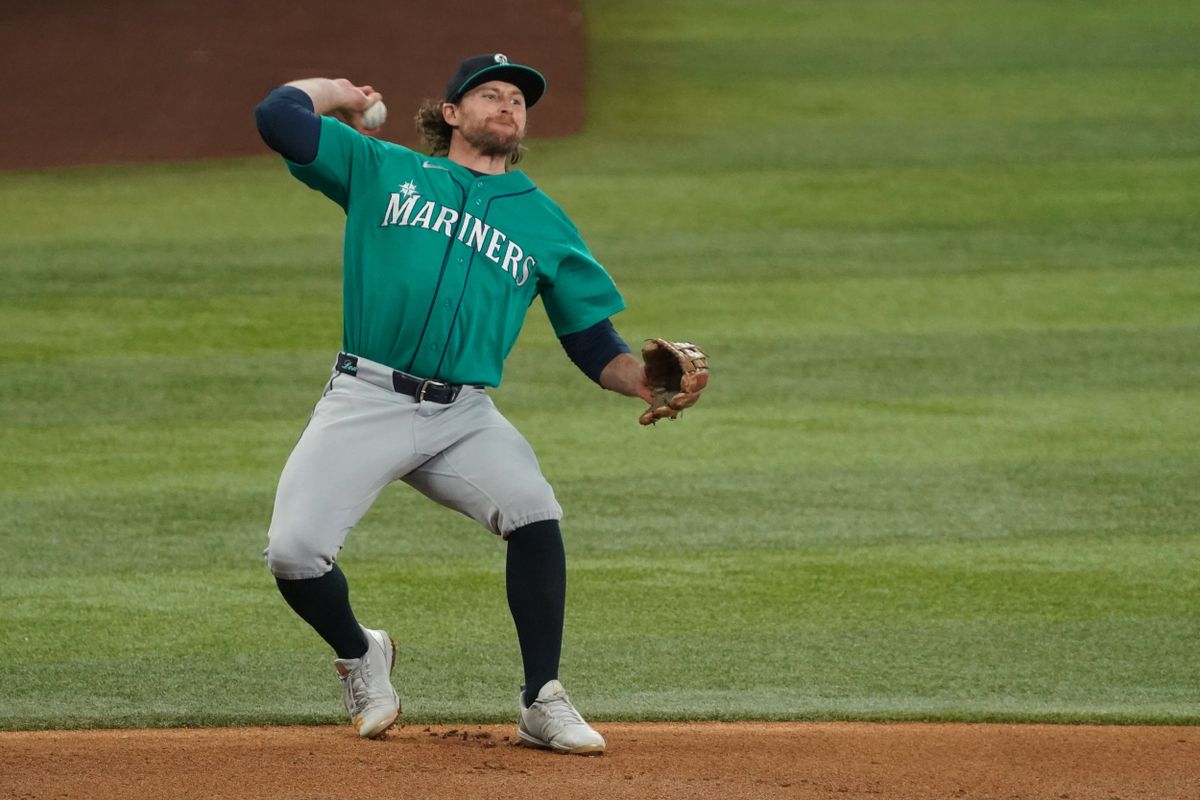
Seattle Mariners second baseman Brendan Donovan (33) throws to first base during the fifth inning against the Texas Rangers at Globe Life Field. Mandatory Credit: Raymond Carlin III-Imagn Images. [/caption]
Despite an impressively bad two-decade playoff drought to begin the millennium, the Mariners haven’t been in the habit of fully burying themselves three weeks into the year, usually waiting until May to let everything fall apart in their down years, missing the mark in September during their good years, and crashing into the last wall like George Russell in Singapore in their great years.
But inexplicably yet unsurprisingly, the proverbial team bus looks like it’s being steered by a tumbleweed through a baker’s dozen games in 2026. The team’s stellar pitching has carried them to four wins, but a combination of atrocious defense and somehow worse hitting dropped their ninth game of the year (and fifth in a row) in a 3-0 defeat to the Rangers in Arlington.
Seattle suffered their third (kind of fourth) shutout of the season, barely avoiding getting no-hit by MacKenzie Gore and co.
The Mariners offense, team-wide, has been having the kind of performance where 105 mile an hour groundouts to short are hopeful signs because the team is usually hitting 75 mile an hour groundouts to first.
Rob Refsnyder, who is still without a hit in 15 at-bats with the Mariners, flashed the leather in right despite his initial billing as a lefty specialist DH. Granted, he made catching Josh Smith’s hard liner seem more difficult than it actually was after taking a fairly inefficient route, but he still made an excellently timed running leap at the wall to take the hit away. Compared to a Mariners defense that has been overthrowing and underrunning all season, it was music to Bryan Woo’s ears.
For what it’s worth, Refsnyder torched up some balls with the bat, one a slightly foul home run in the first and the other a lineout to center. His process looks fairly sound at the plate, though there is worry given the Mariners’ Dipoto-era history of acquiring right-handed platoon bats at the exact moment they fall apart like the Blues Brothers’ alleged car.
But the rest of the team fared significantly worse at the plate. Singles from Mitch Garver and Cole Young were the only hits the M’s mustered, with the team’s on-base getting bolstered due to a couple first inning walks on bad ball calls that went unchallenged from Rangers catcher Danny Jansen. Julio Rodríguez looked ever more imbalanced as he swung, seemingly tinkering with his approach, while many others were simply absent.
By the end of the game, the M’s had been shut out once more, their third time going scoreless in their first 13 games (fourth if you count the first game against the Angels, where they were scoreless through nine).
More shaky defense in the fifth ended the Mariners’ chances of lucking into an extra-innings ghost run.
For whatever reason, it didn’t quite seem like the M’s ace brought his best stuff to Arlington. While Woo always throws mostly four-seamers - coming into the game with 57.6% four-seam usage over his first three starts - he almost exclusively tossed that pitch on Wednesday, with 53 of his 83 offerings being the heater. The swing-and-miss wasn’t quite there, especially early on, as he left a lot of stuff over the plate, but Texas didn’t make much of it early on.
Coming into the third, Woo looked quite frustrated for a guy who hadn’t given up a run in his first two innings. Granted, the Rangers had produced some loud flyouts and appeared to have a bit of a light beat on the fastball, but it probably had more to do with the way the M’s have been hitting on the other side. Refsnyder’s glovework in that frame either nixed a homer or a double, either way, it took a run off the board for Texas as Brandon Nimmo sent a double to center later in the frame. Julio Rodríguez very much should have caught it, but he took a bad route to the ball and it flew over his head.
That piece of shoddy defense didn’t bite the M’s, but two more of what has become a common sight for those in Mariners uniforms came to haunt Seattle in the fifth. Jansen sent a one-out routine grounder to third that inexplicably caused Donovan to fall backwards as he threw, taking a lot off the toss and allowing Jansen to reach. Smith whacked a ball into center and Ezequiel Duran split the left side with a single of his own to load the bases for Texas, but Brandon Nimmo’s dribbler to first looked like an easy second out at the plate.
Except that Connor Joe, recently called up from Triple-A Tacoma for an injured Víctor Robles, overthrew Garver at the plate to allow two runs in. Despite Garver being otherwise the best position player for Seattle (getting a hit earlier on and throwing Jansen out at second later on), he didn’t commit to a jump to save the second run. A Wyatt Langford walk and Corey Seager sacrifice fly put the third run across for the hosts, but it was clear to all that the game had ended the moment the first run crossed the plate.
The Mariners, who appear to be growing ever more lifeless by the inning, looked to have all but given the game up then and there. With the way they were hitting, the only semi-realistic path to a win was a scoreless tie going into extras followed by some good luck to scratch across a ghost run on a couple of productive outs. Leaving Joe in the game to face the right-handed Luis Curvelo in the top of the eighth was perhaps the most obvious example of the clubhouse’s lack of fight. With such an intense malaise over the team, it was a plain miracle that Garver managed to scratch across a hit in the top of the fifth and Young did the same in the ninth to prevent a combined no-hitter from the Rangers pitching, though such an alternate outcome could have actually been a blessing in disguise in the form of a good hard kick in the pants.
Seattle did do one thing right: using their good relievers even when down three runs in the game. Jose A. Ferrer, Eduard Bazardo, and Gabe Speier each tossed clean innings, with the M’s bullpen complimenting the starters to form a crack pitching core with little batting backup to speak of. Even with the Mariners bats looking more lost than a sailor in the high desert, it was still the correct process to try and keep the game on the off chance they found a spark in the final frames.
The Mariners’ five-game skid has put them on the verge of an early end to the season’s lofty hopes.
Going into the Mariners’ seven matchups against the two other divisional hopefuls - the Rangers and the Astros - the team needed to avoid a 1-6 or winless run to keep themselves roughly in striking distance for the rest of the year. The best they can now hope for is a 4-3 stretch, and that’s if they sweep the Astros at home over four games. They can still tread water by splitting the series against Houston, but if Seattle fails to take more than a game against the Astros in the upcoming four-game set, there won’t be many nails left to drive in the team’s coffin despite 145 games remaining on the year. There simply haven’t been very many good teams who began the year 4-13 or 5-12: of 116 teams since 1962 who have opened their first 17 games with four or five wins, just 15 (12.9%) have played .500 ball and just four (3.4%) have won 90 games or more.
As to the current records of those in the AL West, there’s less predictive value in a 4-9 (Mariners), 6-7 (Astros), or 7-5 (Rangers) opening to the season. But the median rest-of-season winning percentage of .0466 for 4-9 teams (a combined 73-89 record) is quite a ways away from the median .513 winning percentage of teams that start 7-5 (a combined 84-78 record). A full 75% of teams that started 4-9 finished 80-82 or worse, with just nine out of 118 such teams (7.6%) finishing with 90 wins or more.
[caption id="" align="alignnone" width="1500"]
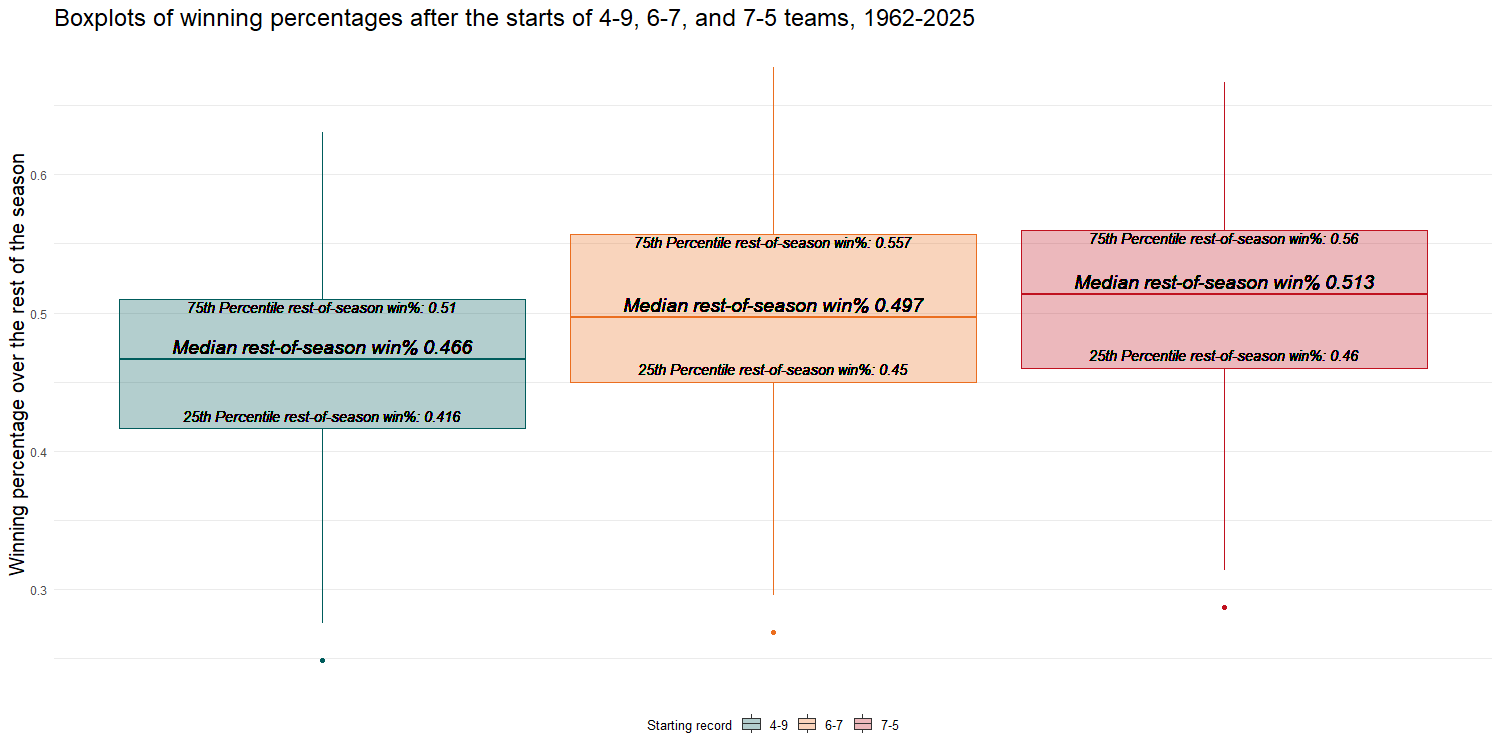
A set of boxplots showing rest-of-season win percentage distribution after select starts to the season, from all years since 1962 except 1994, 1995, or 2020. Data compiled in RStudio. [/caption]
The best team to begin the year 4-9 actually began the year 4-10: it was the 1979 Pirates, who proceeded to win 94 out of their next 148 regular season games en route to a World Series championship. And projecting based off of starts is an inherently flawed enterprise to begin with, as it doesn’t account for the actual talent level that is producing such a result. Were the 2026 Dodgers to start 13-2 (no longer possible after their Wednesday loss to the Blue Jays), people would be a whole lot more confident in them than the 2019 Mariners who did the same, and rightly so.
According to FanGraphs’ projections, the Mariners still have a 42.9% chance to win the AL West, better than both the Rangers (33.1%) and Astros (17.9%) but far down from the 60% that FanGraphs gave Seattle before the season began. According to that model, where the Mariners had a 50% chance to win between 84 and 93 games before the first pitch was thrown, they now have a 50% chance to win between 82 and 90 games.
The Mariners have a day off before facing Houston at home. The series has the chance to tell all there is to be known about the 2026 Mariners, but at the same time, the team hasn’t mercifully cast aside all pretension of competition halfway through April since 2004. Even in the horrific years of 2008 and 2011, they still tread water throughout April.
If for no other reason, that might be the surest guide that the four games against Houston will see more life than expected.