Hancock Stuns in First 2026 Outing, Mariners Thump Guardians 8-0

It all seemed to come together on Sunday afternoon. Unlike the first or third game of the series, where the Mariners kept it close but fell in the end thanks to some bullpen mismanagement, defensive miscues, and lethargic hitting - and unlike the second game, where two timely homers brought them to victory - there wasn’t a single moment of the fourth game between Seattle and the Cleveland Guardians where it seemed the pressure was on for the home crew.
Hitters up and down the lineup did their duty, the defense looked good, and that whole tone was set when a once-touted prospect whose bad luck had eaten his star finally seemed to turn a corner.
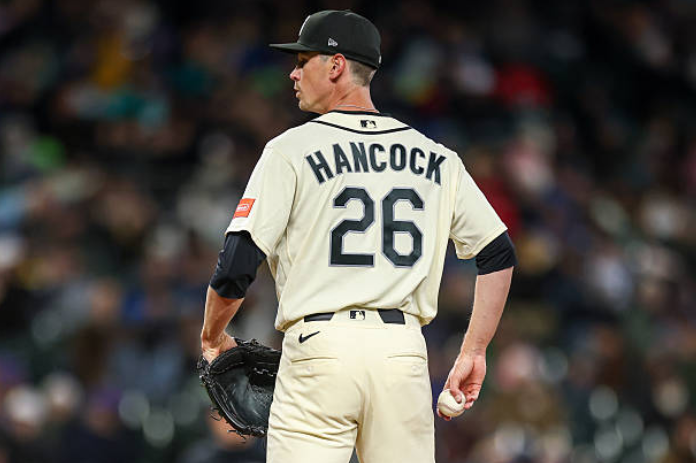
Hancock impresses in first 2026 start, tossing six no-hit innings and setting a career high in strikeouts.
Mariners starter Emerson Hancock came into 2026 with one more chance to become a major league starter. The former first-round draft pick has pitched to a 4.81 ERA, 5.23 fielding independent pitching (FIP), 1.359 walks and hits per innings pitched (WHIP), and a 2.06 strikeout-to-walk ratio. He had particularly struggled with control even more than walks as such, with errant pitches forcing him to groove a strike or two and get punished in bad situations.
Hancock looked a lot better in Spring, with much better sequencing and location leading to an elite 37.1% whiff rate, far higher than his 20.1% in the 2025 regular season, and strikeouts for a full third of his opponents. It didn’t show up in his 5.40 ERA, but one homer and one walk in 15 innings was one loud bullhorn that the long-awaited Hancock face turn might actually be for real.
But the regular season is a whole new ballgame, pun intended. With the Mariners looking to salvage a split in the opening series before their three-game set against the Yankees, the long-beleaguered hurler had a big task ahead of him.
Hancock’s six innings of nine-strikeout, no-hit ball spoke volumes. His fastballs were the dictionary definition of filth, as he used his low arm slot to create a truckload of both horizontal and upward movement. This extra zip made up for the relatively slow velocity, which dipped continuously throughout the afternoon. Even better for the Mariner hurler, he had excellent command of the pitch, with most of his balls on it being razor-thin misses.
This increased usage of the four-seamer - which he used 27.1% of the time in 2025, 33.1% of the time in Spring 2026, and 52.6% of the time on Sunday - has been one of the biggest driving factors in Hancock’s improvement, as it complements his arm slot as a top-of-zone killer much better than his sinker. He also made good use of his somewhat recently-acquired sweeper, a pitch he threw just 3% of the time in 2025 but 25.8% of the time on Sunday.
The pitch count wasn’t as strong as the top line, and that’s because there’s still plenty to work on for Hancock. His sweeper was filthy when he commanded it well - Cleveland missed three of seven swings against it - but the pitch slipped out of his hand early plenty of times for easy Guardians takes. He didn’t have any control over his changeup, limiting his options against an opposing lineup where eight of nine batters could swing from the left side.
Still, Hancock made the most he could with what was effectively a two-pitch arsenal. He mixed things up in the beginnings of at-bats and was able to recover from bad counts with fastballs; the heater was tricksy enough to prevent the Guardians taking advantage of this predictability.
And when Hancock had a couple of strikes on the board, he got the chance to climb the ladder and get the chase anyway (that’s how he took down José Ramírez in the top of the fourth), but that’s not the only way he punched in his third strikes. He put in front-door sweepers to the lefties, dotted the lefties’ inside edge with the odd sinker, and got lone righty Gabriel Arias with the classic low and away sweeper.
The impact of exhaustion became clear in the sixth, even with no base knocks on the board for the visitors. Hancock started losing control over the fastball and nicked Guardians left fielder CJ Kayfus with it to put the leadoff man on. With nine-hole Brayan Rocchio in the box and Jose A. Ferrer warming up, it was clear he would need a double play to keep his chances of six innings alive.
Of course, with Lady Luck seemingly smiling upon the Mariner starter, he got that pitcher’s best friend. Manager Dan Wilson, with the cushion of a six-run lead, left him in to face Steven Kwan, who grounded out to put a nice gift-wrapped bow on an excellent first outing of 2026.
The only point of worry for Hancock’s future as a starter is that his four-seam velocity, which started out at 94.6 miles an hour on average in the first, dropped considerably with each passing frame and reached 92.1 miles an hour on average in the sixth. The Guardians weren’t able to pounce, but perhaps another team might.
Despite some early sluggishness with RISP, the floodgates opened in the fourth.
The M’s hadn’t done well in their first two games with runners in scoring position. Well, that’s quite the understatement: they had just three hits in 20 at-bats, with the Guardians getting the opportunity to come back and win Saturday’s festivities thanks to the M’s not putting things away when they had the chance.
Early on during Sunday’s game, it seemed like this trend might continue. Brendan Donovan led off the bottom of the first by being hit by a pitch and Cal Raleigh followed up with a walk, putting Cleveland hurler Slade Cecconi that much closer to the doghouse. But Julio Rodríguez made a couple bad swing decisions and grounded into a force out at third before both Josh Naylor went down swinging and Randy Arozarena ended the frame with a loud flyout to left center.
As so often happens in this game, the game-changing rally began on a fluke. With two outs in the bottom of the fourth, Dominic Canzone floated one to left field. Had Kayfus gotten a better jump on the ball or timed his slide better - or had Kwan still been playing left - it would have been an unremarkable flyout.
Fate fell that the ball fell out of Kayfus’ glove on the slide. Cecconi wild-pitched Canzone to third and walked Cole Young to first before Leo Rivas shot an RBI single into right field.
The nails began to be shut in the Guardians’ coffin with newfound Mariner infielder Brendan Donovan, who continued his hot start to the season (and made up for his disastrous Saturday error) with a three-run frozen rope off the top of the wall in right. A Rodríguez walk, Arozarena double, and Luke Raley single in the fifth brought the lead to six runs, and another bad play from Kayfus in left allowed run number seven on a Cal Raleigh floater.
Seattle even took advantage of a two-out error in the eighth inning to string together a run with a following walk and single, giving the happy totals of 8-0. The M’s went 5-16 (.313) with RISP during the matchup, more than enough to scratch a W on the day.
Cooper Criswell works a three-inning save with a massive cushion, but two hits end the chance of a combined no-no.
After Bryce Miller was clearly going to be on the fritz to begin the season, it became a debate as to whether Hancock or Cooper Criswell would fill in as the team’s fifth starter. Hancock’s good spring and the Mariners’ indications of giving him another chance during the offseason put the thumb on that end of the scale, but if his 2026 introduction had been like that of 2025 (when he gave up six runs in ⅔ of an inning), Criswell would have been the next man up this early in the campaign.
With Hancock on 97 pitches after six - and considering his injury history - there was no way the M’s were going to stretch him 40 pitches more to try get a no-hitter. Criswell, serving as the team’s long reliever, went out to the mound to mop things up and close out the blowout. He did give up two hits, but didn’t allow any runs on his way to a nine-out save [1].
Criswell has one of the lowest fastball velocities of anyone in the league, but his sidearm delivery and general craftiness means he can play well in certain spots. It also means his movement profiles slot into the “break with rise” or “run with drop” spaces of the movement chart, a really unusual way for pitches to move as break tends to come with drop and run tends to come with rise.
[caption id="" align="alignnone" width="2200"]
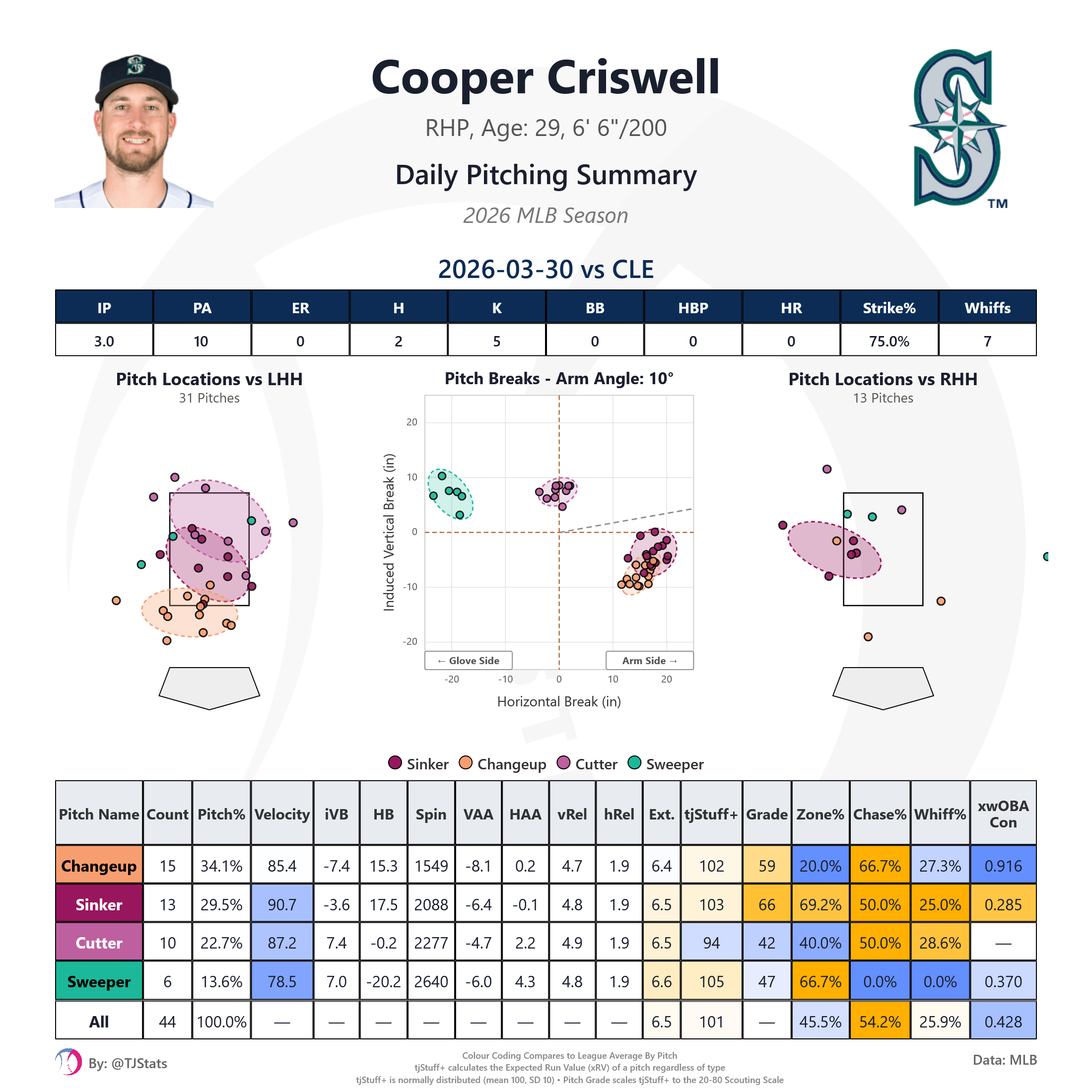
A dashboard of pitch movements, pitch locations, and stuff models for Cooper Criswell’s outing on Sunday. Image sourced from TJStats. [/caption]
The main downside for Criswell is that he doesn’t have very good command, leading to a fair few bad counts and hanging pitches. When a guy relies a lot on craft, it takes a lot of control to be able to break into the upper echelons of pitching.
But Criswell did his job fine on Sunday, and the Guardians went quietly over the last third of the ballgame. His outing may be baseball’s silliest kind of “save” as that term is understood nowadays, but he and the offense allowed a sweet rest for the remainder of the bullpen.
On Deck
The Mariners are now 2-2 on the season after their win and are four-sevenths of the way through their opening homestand, but their next opponent is the 3-0 New York Yankees, who they will play thrice before they take a rest day and travel to Orange County for a series with the Angels.
[1] Yes, it’s counted as a save if a player comes on for the last three innings and closes out any lead. Cooper Criswell got a save in 2026 before Andrés Muñoz did, a tidbit that is sure to become a trivia question.