Mariners Suffer Second Straight Bryan Woo Beating, Drop Randy Johnson Series Opener to Royals

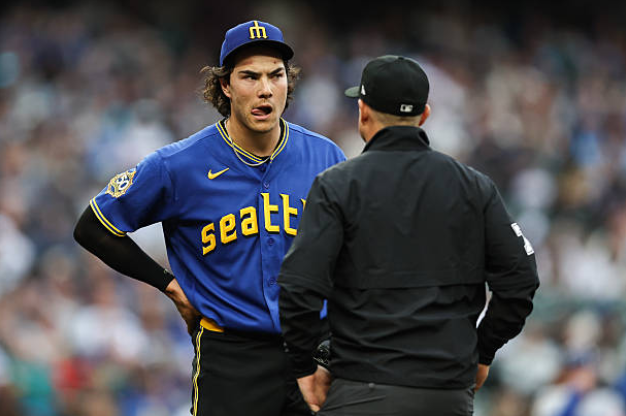
The Mariners and Royals spent most of Friday evening locked in a back-and-forth batter’s duel, with the Royals eventually coming out in front. In all the action of the game - from the Royals knocking four first inning runs off Bryan Woo to Julio Rodríguez’ two homers to a late Kansas City rally off Jose A. Ferrer to Alex Hoppe blowing down the Royals’ best hitters in the ninth only for the Mariners to go down with a whimper in the bottom half by a 7-6 score - there were a lot of moments that made the difference.
But among those, there is one that is perhaps most instructive in two concepts: one, that baseball is a game of inches where defense matters (you already knew that), and two, that a run in the first is worth as much as a run in the ninth. This isn’t about ABS, but based on how ABS strategy is often discussed, a reminder is perhaps in order.
Bryan Woo’s two bad bookends fell in two separate but similar buckets.
Woo came into his start against the Cardinals as a potential clear Mariners ace. He left the sixth inning of his start against the Royals having given up 13 runs in his last nine innings and carrying a 4.61 ERA.
The story of how he got rocked for seven runs in three innings against the Redbirds has already been told, though that game was not defined by the bad start thanks to a big-time offensive showing. The M’s got four homers to power six runs at home, but it wasn’t enough this time.
Woo’s opponents had torched an inordinate number of longballs off his usually effective heaters. But as Woo allowed his four-seamer and sinker to drift lower in the zone against the Royals in Friday’s first inning, the visitors tacked on one hit after another and wound up with four early runs.
Kansas City’s game plan was obvious against the strike-throwing Woo: attack the fastball. For whatever reason, Woo didn’t keep his four-seamer or sinker at the top edge of the plate, and when that happens, an early aggressive team can put up a big number.
But it should be noted that a big part of Woo’s early earned runs were more on the Seattle defense than the Royals swinging well. The pitfalls of Kansas City’s aggressive swinging were evident in the middle innings, but with a couple of defensive miscues with men on base in the first (and the aforementioned very plated fastballs), things went haywire.
Maikel Garcia started it off as Woo sent him a juicy 1-2 sinker after having lost control of a slider the pitch before, sending a single to right to lead off the game. Bobby Witt Jr. reached on an infield knock and Vinnie Pasquantino sent one to the right side.
Now, the second baseman is typically drawn a little in with a double play available as compared to usual, trying to free up an ounce of time to get a throw off to his partner at short. But Cole Young was drawn far too close even for that situation, and the ball bounced past his outstretched glove.
[caption id="" align="alignnone" width="477"]
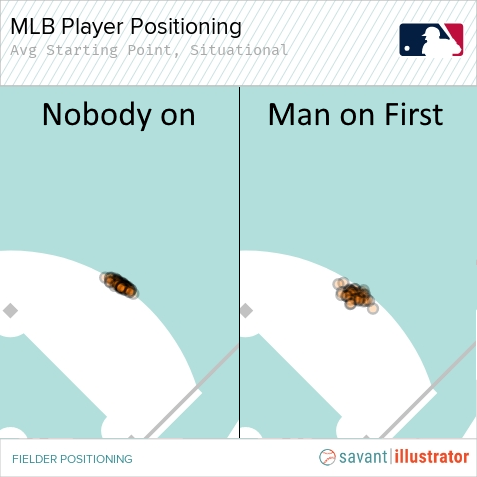
Average positioning of MLB second basemen in 2026 depending on situation, per StatCast. Cole Young was noticeably closer than even the closest point in the rightmost graph, which just so happens to be Young’s own season average in that spot. [/caption]
It probably wouldn’t have become a double play even if he got his hands on the ball, though the M’s would have gotten one out either at second or third. Either case would have probably resulted in a two-run inning, with Arozarena in left saddled with getting the throw home on Salvador Perez’ following double, but as it stood, that double knocked in the second and third runs of the game with still nobody out. And, when speaking of counterfactuals, it’s entirely possible an out could have settled Woo’s nerves just enough for his heaters to go back to the top of the zone, or a million other things. That’s the issue with counterfactuals.
But even two runs would have been enough. It doesn’t really matter when a run is scored; at least not as much as people think. It adds to the total all the same. All the other game-changing moments were obvious. But something as simple as the second baseman setting up a few feet too far forward of the base is the exact kind of thing that goes under the radar.
Perez’ double was followed up by a loud Carter Jensen flyout and a quiet Jac Caglianone groundout. Woo threw another plated heater to Isaac Collins, but he popped it up into shallow left.
Unfortunately for Seattle, Leo Rivas took a bad route to the ball and it got lost in the Bermuda Triangle. Kansas City scored their fourth run of the inning.
Woo improved his pitch location going into the second inning, and it was night and day as Royals hitters began shanking one easy out after another. When a team like the Royals strings together a bunch of hits with early aggression, they seem really strong at the dish; but when they lose discernment on which pitches to swing away at - or when they run into a spell of bad luck - things can go very well for the pitcher.
The second, third, and fourth passed as nine balls went in play and nine outs were made.
As the inning card turned over to the fifth, Kansas City started taking more pitches, looking to counteract Woo’s zone-expanding adjustment to the Royals’ earlier, but this worked in his favor as Kyle Isbel looked at strike three. It was, however, the first strikeout Woo had managed to toss in the game, with the Royals making contact on most everything Woo gave them.
But as Woo fell behind Vinnie Pasquantino 2-0, he fell into one of the classic bad habits in the annals of pitching: trying to cheat a quick strike. Woo threw a heater right down the heart of the plate, not high in the zone where he can get away with stuff due to his shape, but right down Broadway. Pasquantino knocked the cover off a moonshot to right, bouncing off the glass between the lower and upper decks.
Woo recovered for a bit, though the signs (mostly secondaries left right out over the heart of the plate) were there as he cut down Perez on strikes and got Jensen to fly out. Woo went right over the heart of the dish with a sweeper to Caglianone, and although the Royals’ slugger got under it, he still knocked it hard enough and rightwards enough to travel a few rows past the shortest wall in T-Mobile Park.
By this point, he was clearly on some sort of tilt, throwing stuff up in the vain hope of getting quick outs. That he did to end the frame, but despite his relatively low pitch count of 84, Mariners manager Dan Wilson pulled him after six innings. It was almost certainly the right call.
Julio Rodríguez put the team on his back with the bat, though a defensive miscue dampened his outing a bit.
It’s a terrible irony for the Mariners center fielder that his own heroics with the bat were why his slippage with the glove mattered on Friday.
One of the more under-followed occurrences in 2026 has been Mariners center fielder Julio Rodríguez’ noticeable defensive decline. While he has effectively recovered from a two week batting slump at the beginning of the year - more on that later - an opening defensive rut has not gotten better.
Some defensive numbers to start. Unlike with Young, where defensive runs saved (DRS) and fielding run value (FRV) highly diverge, they pretty much agree that Rodríguez hasn’t been up to snuff as a defender; he had -2 FRV and -3 DRS going into the night’s action.
Now, he has also had a negative DRS year in 2023, but at least in that campaign, he had an 88th percentile FRV. The eye test, which has always been on Rodríguez’ side in center field, has made a hard turn the other way. For whatever reason (perhaps it’s related to a slight drop in sprint speed), he has issues covering the ground he needs to, he makes mistakes on the transfer, and seems to just be a little slow out there.
It was one of those transfer mistakes that cost the Mariners - maybe - a run in the eighth. With Jose A. Ferrer on the mound in a tied game (the Royals had scored six runs and the Mariners had tied it. Why? Also Julio Rodríguez), Perez knocked a leadoff hit into left center field. The 36-year-old Royals catcher is going to be a first-ballot Hall of Famer, but not for his speed, and especially not for his speed now. Had Rodríguez cleanly cut the ball off, it would have easily been a single. But he bobbled the ball, his arm seemingly moving less than he thought it would, and Perez hustled to second.
The actual sequence of events was this: Jensen grounded Perez to third, Lane Thomas knocked him home with a hit, Isaac Collins struck out, and although Michael Massey executed a perfect hit-and-run, Isbel grounded out to end the inning.
Again, counterfactuals are tricky, but Jensen’s groundout went directly to Crawford covering second. It was about the most tailor-made double play ball one could have asked for - but the runner was on second. It’s a game of inches, and sometimes, it’s a game of 90 feet.
It’s basically impossible to assign any “blame” (if it can be called that) for the Mariners’ loss to Rodríguez, however, because he was one of the only reasons they were in a tied game to begin with.
The bottom of the first began with a walk by Crawford and a strikeout by Cal Raleigh, but when Royals starter Cole Ragans left a 1-1 changeup over the middle of the plate, Rodríguez obliterated the baseball and completed the true outcomes triad. Seattle got two runs back from their then-four run deficit.
Seattle showed their longball chops throughout the game, though not always from the likeliest source. Ragans, who had plenty of issues plating big juicy meatballs to the Mariners, hung a curve on his first pitch to Connor Joe in the fifth. It may have been to a hitter who had homered once in every 47.49 [1] plate appearances, but the starting right fielder turned on it and hammered a homer of his own into Edgar’s Cantina.
Ragans’ last pitch of the game was another hanger, this one in the bottom of the sixth to Arozarena. As much as Rodríguez’ strangely dormant defense has been an overlooked story, so has Arozarena’s newfound consistency, with an altered approach at the plate leading to a .289 average and .381 on-base percentage going into the game. His Friday performance looked a bit more like years past, as he got a sombrero but still gave his team a run with an opposite field big fly to right center.
And so the story returns to the Mariners center fielder. With his team down two, Crawford once again reached base, though this time with one out against southpaw Royals reliever Daniel Lynch IV. Rodríguez strolled to the dish with two away and again got a 1-1 count. Again, a lefty gave him a good pitch to hit, though this one was a fastball down the middle.
Rodríguez drilled it to straightaway center field. Isbel ranged back to the deepest corner of the ballpark and timed his jump perfectly, but the inches (about 18 of them) favored Seattle as the ball eked past his glove. After the giant hole the M’s had dug for themselves, Rodríguez had dug a path right back out, and it was a brand new ball game just a few minutes after the seventh inning stretch.
The chants were deafening in SoDo as Josh Naylor rolled to the plate, though they roared out the name of the man right before him in the order. It made what came next all the worse for those 36,384 expectant spectators.
Rookie Alex Hoppe tore down the top of the Royals’ lineup to set a one-run table for the bottom of the ninth, but Seattle couldn’t cash it in.
Alex Hoppe’s first major league mop-up outing was better than the box score said it was. After all, he had eased through his first three batters, only falling to bits as he lost command upon being made to throw more pitches than he had all season in Triple-A Tacoma. But with just an inning to complete, his electric stuff missed a whole lot of bats as he mixed locations beautifully with a slider and four-seamer.
Garcia, who strikes out less than almost anyone in the game, fell to a sequence of some low sliders, an away four-seamer, a jammed sinker, and a fastball about three feet above the strike zone that got him to chase. Witt somehow couldn’t get the bat off his shoulders as Hoppe threw a meatball down the zone with a 2-2 count and in the process showed why standing on five doesn’t work in blackjack. And he topped it all off with a tremendous job mixing eye levels against Pasquantino, who took a big rip at a ball at about, well, eye level. It was six feet above the plate.
If Hoppe turns out to be a solid reliever (and he has the stuff, with the command and composure in question), it could very well be a revelation for a bullpen that has just lost one of its keystones to injury. In any case, a better low-leverage guy than Cole Wilcox who can also manage some medium leverage and extra inning work would help out the M’s a ton.
But those questions are for the future. Friday night ended as Cal Raleigh got under a first-pitch fastball from Kansas City closer Lucas Erceg, and the Mariners went back under .500 with a 16-17 record.
Emerson Hancock will have his work cut out for him on the mound on Saturday, as the offense behind him will be facing Royals ace Seth Lugo.
[1] Just to let you know not to round it to 48.