Mariners Strike Back vs. Astros, Remain Barely Breathing in AL Playoff Chase

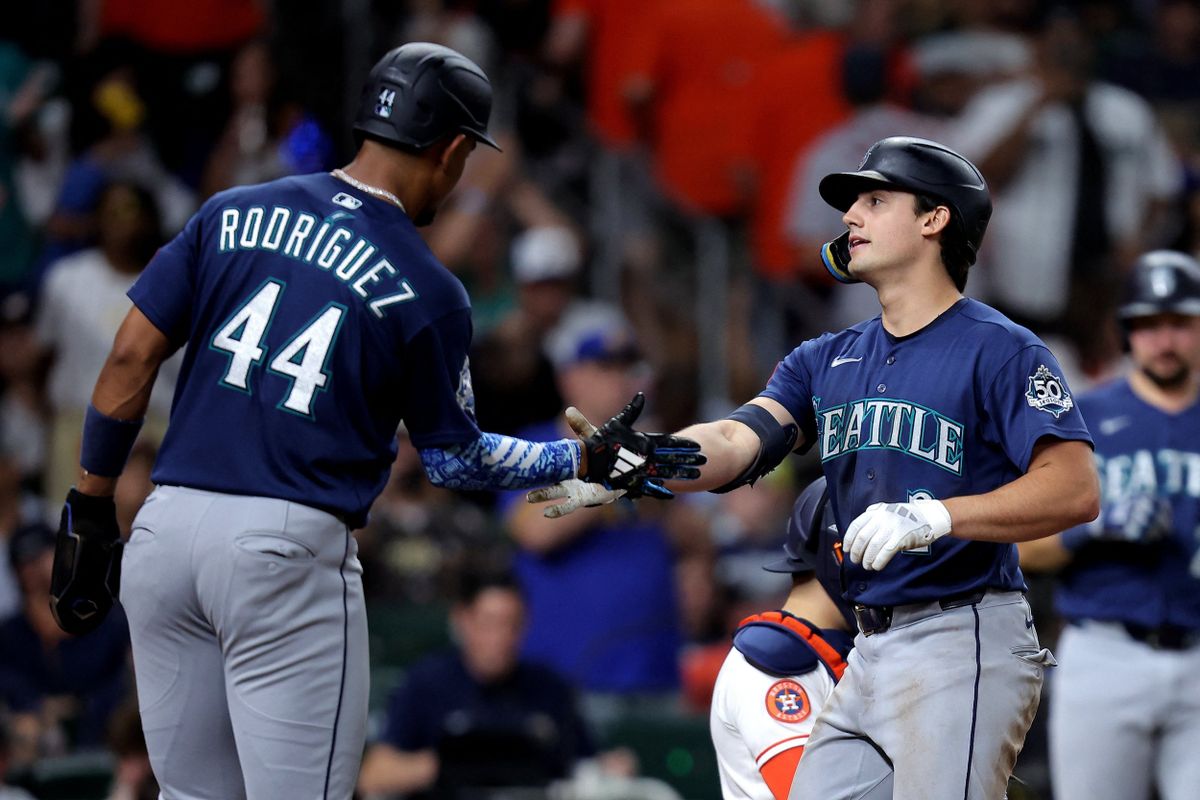
[caption id="" align="alignnone" width="3931"]
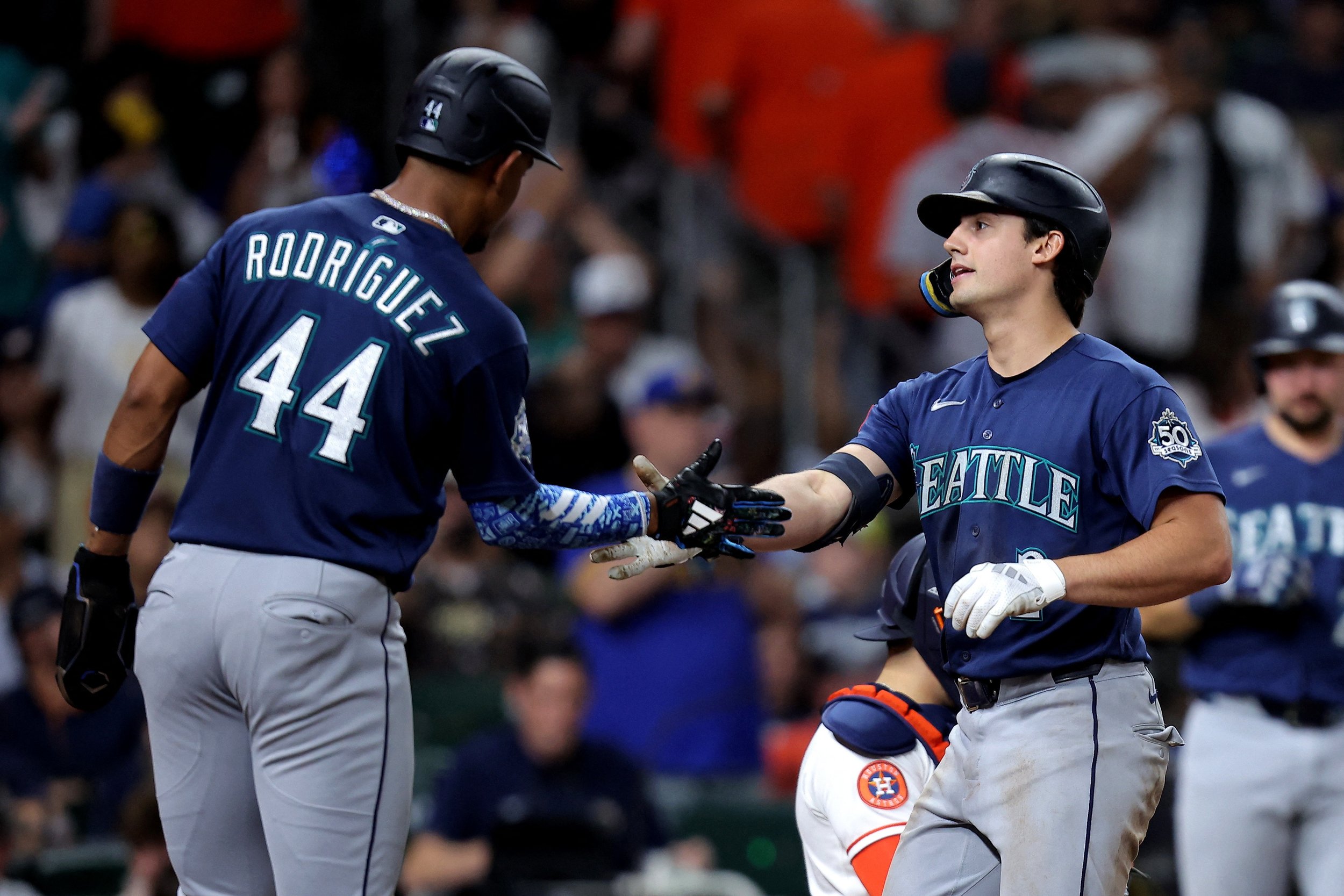
Seattle Mariners second baseman Cole Young (2) is congratulated by center fielder Julio Rodríguez (44) after hitting a three-run home run to right field against the Houston Astros during the ninth inning at Daikin Park. Mandatory Credit: Erik Williams-Imagn Images [/caption]
A cloud of horror hung above the Houston air as the Mariners began their game on Saturday. The team was fresh off a gut-wrenching 10-inning loss where the difference depended on two squibbers that fell away from the Mariners defense before Christian Walker torched an Andrés Muñoz cookie into Galveston.
And yet they came back from the brink on Saturday, with a lockdown start from Emerson Hancock and a lively offense in the unfriendly confines of Daikin Park, winning 10-5 on the heels of what, more than all the others, could be described as “the worst loss of the year”.
“I think we all kind of felt like that was a great ball game last night, and it was more indicative of who we are as a team,” said M’s manager Dan Wilson on Saturday, even in spite of Friday’s loss. “And so, I think in some ways, it felt like, yes, we didn’t get the result that we wanted, but we played the way we wanted.”
The Mariners played the way they wanted to on Saturday, and this time, they got just the result they needed.
The Mariners offense went to task with runners on, scoring 10 runs despite just one homer.
Seattle’s offense has depended on the home run for years, and since the start of 2025, around half of all their runs have been scored that way. When Saturday’s game began, the team had a .718 OPS with runners in scoring position since the start of 2025, the seventh-worst in baseball.
Despite their aforementioned bullpen disaster, the team’s performance with runners in scoring position on Friday was commendable, as they went 4-for-12 and scored all seven runs without hitting a home run. That trend continued against the admittedly subpar Astros pitchers on Saturday; the Mariners scored 10 runs while going 7-for-17 with runners on second or third.
Things started early in the second against ‘Stros starter Hayden Wesneski. Three straight singles from Julio Rodríguez, Josh Naylor, and Cole Young produced the team’s first run, and while Cal Raleigh struck out, Victor Robles clocked a triple into right center to give Seattle a 3-1 lead. Brendan Donovan capped off the rally with a two-out run-scoring single.
That last hit was a preview of much of the rest of the M’s production, as with two outs in the fourth, Donovan got his second RBI single of the game and made the score 5-2. By the top of the eighth, Wesneski was long gone, but another two-out rally picked up apace. Robles singled and stole second before Brock Rodden knocked a double into left center and Donovan finished off that rally with his third two-out RBI single of the game. The skipper praised the 3-5 performance from his third baseman.
“Not only getting on base, but coming up with big hits too, and tonight was no exception there,” Wilson said of Donovan. “You can kind of see his progression as he's gotten back here, and at-bat to at-bat, has really fell into being much more comfortable.”
It wasn’t until the ninth that Seattle had their first homer, a three-run wall-scraper from Cole Young to make the score 10-4.
The team got 15 hits all told, with Donovan, Dominic Canzone, Rodríguez, Naylor, Young, and Robles all having multiple hits, while Rodden reached base twice.
Emerson Hancock had a sweeper renaissance in Houston, controlling it better than he had in months.
While Hancock had never become a bad pitcher at any point in the season for the Mariners, his first seven starts of the year - when he had a 2.59 ERA and a 28.9% strikeout rate - were not to be quite repeated over his following 15 games, when he had a 3.74 ERA and 19.6% strikeout rate. Part of this was the starter settling into his groundballing identity, but it was a bit of regression for a pitcher that had begun the year on a steamer.
Much of that regression was downstream of a loss of sweeper control, and when Hancock displayed a sharp command of the pitch on Saturday, he became nigh-unhittable for the Houston Astros. Six of the 14 swings Astros batters had against his sweeper were misses (43%) while eight out of all 24 sweepers were called strikes or whiffs (33%).
But it did take Hancock 20 pitches to throw his first sweeper of the game. In his first 19 pitches, he only got one out, with a walk and three singles bringing in a run for the Astros before he struck out Christian Walker on that first sweeper. Taylor Trammell struck out to end the inning, but he had thrown 23 pitches in one frame.
Over the next five innings, Hancock averaged 10 pitches an inning. The only run they scored was a Christian Vázquez solo shot in the second, which also came on the only three-ball count from the second through the sixth. The only other hit in that time was a third-inning single that was erased by a double play.
Of course, this wasn’t just thanks to the sweeper. Hancock’s four-seamer was roughly another third of his arsenal, and it had a 39% whiff rate and 42% called strike plus whiff rate (CSW).
Entering the seventh with 73 pitches, Hancock had a potential complete game in his sights - but the Astros finally began to awake as Hancock’s control waned. He got into a three-ball count with Trammell, who challenged a borderline 3-2 pitch for a one-out walk, and it took him nine pitches to deal with Cam Smith. Trammell got to second on Smith’s groundout - Houston’s first runner in scoring position since the first - and Hancock had already passed 90 pitches by this point.
It wasn’t a pitch that got Hancock out of the inning, though. As Trammell danced off second, Hancock turned around and picked him off the base, ending the frame and his seven-inning, two-run outing.
Daikin Park struck back late against Victor Robles despite his early production.
Going into Saturday’s game, the Mariners’ hadn’t seen much production from right-handed right fielder Victor Robles. Although he had a .256 batting average, his lack of walks and lack of power meant a .300 on-base percentage and .298 slugging percentage.
Maybe it’s something about these Astros, but his performance early in the game was encouraging. His 2-for-4 outing increased his OPS from .598 to .631, and he got a triple for the second straight game. But things started getting dicey in the eighth, as he was slow to get up after sliding for his stolen base, and he was even slower to rise in the bottom of the ninth after diving for a Jose Altuve triple.
It was apparently an issue with Robles’ right shoulder, and though he stayed in the game, it sets up a degree of uncertainty for right field going into the coming days. Taylor Ward, the Mariners’ deadline acquisition in the outfield, is reportedly down with a thigh issue, and a day-to-day injury for Robles could make Seattle’s bench quite thin as they continue on a stretch replete with must-win games.
As for the ninth, Altuve scored on a groundout, but it was the only run the Astros scored that frame as the M’s won 10-5. Houston’s two other runs had come on an Isaac Paredes two-run shot off Jose A. Ferrer in the eighth.
Cal Raleigh continued struggling at the plate, though his staff management had a notable highlight.
In a game full of 2-for-5, 3-for-5, and 2-for-4 showings, Raleigh’s 0-for-5 stuck out like a sore thumb. His OPS declined further to .557 while his average dropped to .156, not that his disastrous season at the dish is a new item.
Raleigh’s biggest sin on Saturday wasn’t the strikeout, of which he only accrued one, but the popout: he had four launch angles above 40 degrees, three above 50, and two above 60. This, of course, didn’t stem from anything different to his recent punchouts, as he swung at plenty of nonsense well above the strike zone.
But despite the continued dearth of offense, Raleigh managed a positive moment on Saturday. In the bottom of the seventh, with Hancock beginning to slip from his lockdown grasp of the Astros lineup and Trammell on second, it was Raleigh who apparently called for the pickoff move.
“I’ll give credit to Cal,” Hancock said. “Cal kind of said, like, ‘hey, this might be a play here,’ and I got to a 1-1 count right there to (LaMonte) Wade, and then just do what we’re kind of taught. Kind of just saw Trammell jump off and just made a great throw to Brock, and he was able to chase him down. And I mean, that’s a huge out.”
And perhaps locking in on the pitchers is what Raleigh needs in order to simplify his offensive approach. In any case, it capped off Hancock’s winning outing.
On deck
Despite the Mariners’ dismal 58-66 record - they would have to go 32-6 to match their record from last year - the team still has a chance to make the big dance at the end of the year. That this is true after all that has transpired over the year for the Mariners is an indictment of the league and the expanded playoff structure more than it is a commendation of the M’s themselves, but they would be remiss if they didn’t take advantage of the American League’s continued weakness.
After the action was concluded on Saturday, the Mariners were five games back of the divisional lead and three games back of the third wild card spot. Such a deficit so late in the season means the team doesn’t fully control its own destiny, but it leaves open the possibility of an unlikely return to the playoffs.