Still-Sleepy Mariners Suffer Sixth Loss in Eight Games, Lose Series to Athletics


[caption id="" align="alignnone" width="4859"]
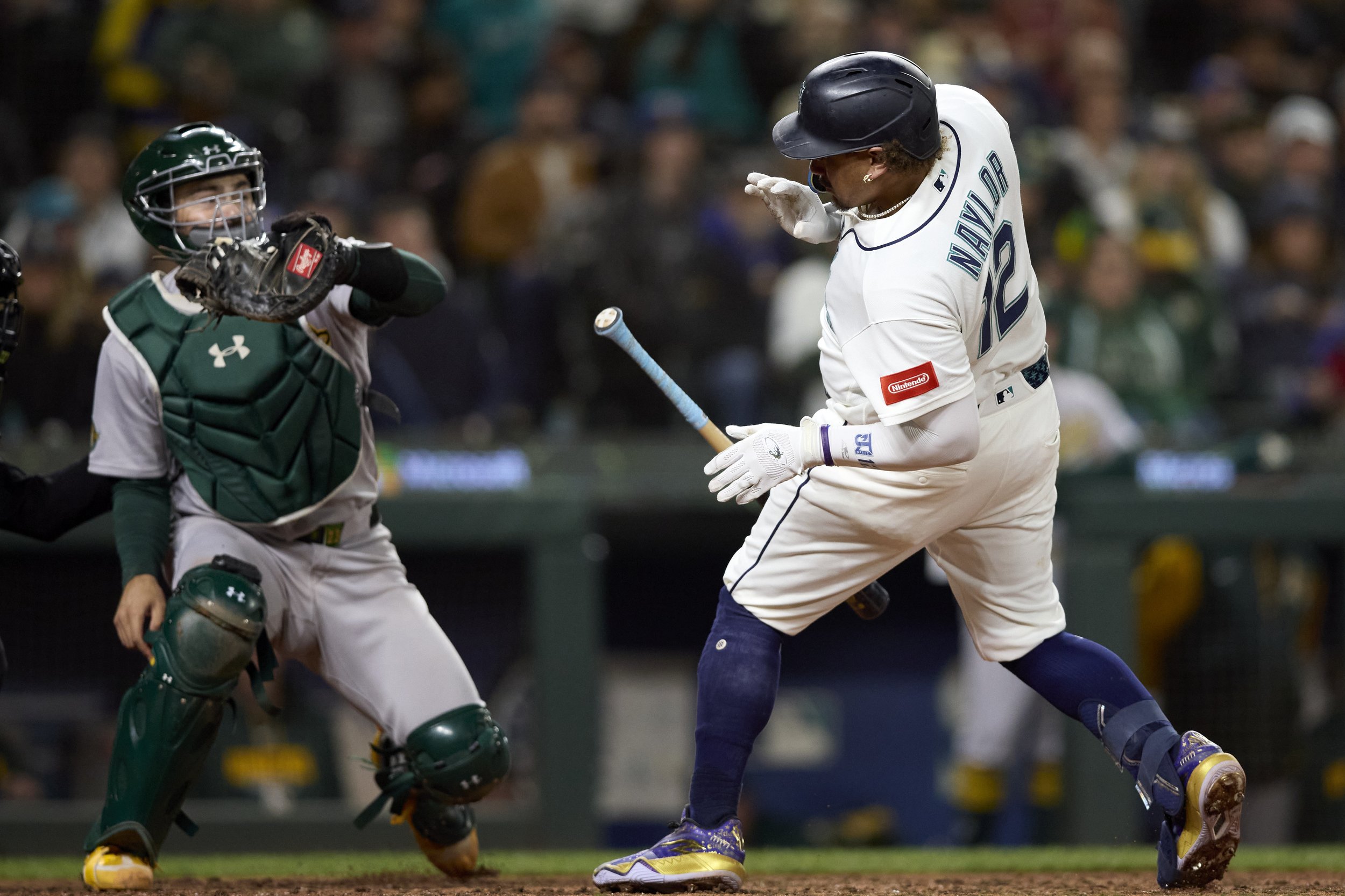
Seattle Mariners first baseman Josh Naylor (12) avoids a pitch in front of Athletics catcher Shea Langeliers (23) at T-Mobile Park. Mandatory Credit: John Froschauer-Imagn Images [/caption]
SEATTLE, Wash. - The M’s didn’t look much worse on Tuesday night than they had all year. The problem was that they didn’t look any better, either.
All they have shown in the first 25 games of the season has been mediocrity, inconsistency, and a gradually weakening confidence in their own abilities. The team hasn’t fallen fully off the table, but as the drudgery continues seemingly indefinitely, the phrase “right now” will become an ever more faded addendum to the phrase “this team is bad.”
Because let’s be realistic: the M’s can’t bank on a 10-plus game win streak to propel them out of the herd every year at the last moment; at some point, they need to learn how to start the regular season strong and not let up. Lifeless 5-2 losses to a sneakily threatening divisional rival can only happen so often for a team with World Series aspirations.
Luis Castillo threw a decent outing, but a high pitch count and loss of secondary control late forced him out early.
For an organization used to unearned no-decisions, Luis Castillo’s five innings of two run ball was about the platonic ideal of a no-decision.
A mental lapse from Castillo led to a run for the A’s in the top of the first. Castillo had some issues settling in location-wise, walking Nick Kurtz to begin the game, and although he started working his next couple of hitters more effectively, he seemed to forget about Kurtz’ presence on first and the runner got a monster jump for an uncontested stolen base.
Castillo wasn’t on his A-game in the first couple of innings, but it wasn’t his F-game either. He had an excellent battle with Carlos Cortes for the second out, changing eye levels and pitch types before knocking him down with a backdoor slider. But he had an issue with leaving stuff too far out over the plate in those frames, and Tyler Soderstrom jumped on a hanging slider for a run-scoring double. It was hit too hard to have scored Kurtz from first, but with the stolen base, it was an easy run for the A’s.
Jeff McNeil jumped on the first pitch of the second, but after that, the M’s hurler settled down and got in a groove. Eight straight hitters fell in order, three of them strikeouts as he located some heaters at the top edge of the zone and did well to mix high and low pitches. But it was McNeil who put the second A’s run on the board in the top of the fourth, taking a plated changeup over the right field wall.
As the fifth inning rolled around, Castillo still had the opportunity for a quality start, having thrown just 68 pitches. It took just one throw for Lawrence Butler to ground out, but the wheels began sliding off the bus as Castillo stayed low in the zone for one too many pitches against Zack Gelof. It took seven pitches to get Nick Kurtz out and another seven to give Shea Langeliers a free pass. Although Carlos Cortes flew out to end the inning, his pitch count had jumped to 95 and the last four innings would have to be tossed from the ‘pen.
The Mariners couldn’t hit with RISP, but that was because they couldn’t hit in general.
Left-handed starter Jacob Lopez didn’t have the best command early on during his outing, walking both Julio Rodríguez and Josh Naylor with two outs in the first. But a shanked swing from Randy Arozarena ended Seattle’s first opportunity with a man on second, though Seattle wouldn’t end up having that many of those and squandering those they did get.
The third inning was when the first run came home for Seattle. Lopez actually jammed the leadoff Refsnyder with the cutter inside - it seemed Refsnyder thought it was a four-seam over the middle - but the leadoff man found a hole with a bloop to center. By this point in the game, the M’s were holding back on the aggression and making Lopez throw strikes, and Raleigh saw five pitches before knocking a borderline changeup into left.
The M’s have had their issues getting knocks with runners in scoring position, but especially with striking out with less than two outs and thus being without things like sacrifice flies. Rodríguez and Naylor both shot fly balls to medium depth left center field in the bottom of the third, however, and Refsnyder moved up a station on each one to tie the game up. But despite Arozarena continuing the action with an opposite field single of his own, J.P. Crawford sent a can of corn to left and the M’s just got the one run.
Cal Raleigh took a down-the-middle spinner just a hair over the wall in left to get Seattle’s run, but other than that, it was the same story as it had been for the whole of 2026 and going back into 2025: they couldn’t hit with runners in scoring position. How much a team thrives or struggles with RISP relative to their baseline performance early on in the year doesn’t necessarily impact whether they will do so during the rest of the season. But that doesn’t discern between what exactly is causing a team or its component players to overperform or underperform with RISP.
It’s important not to confuse underperformance with a team’s hitters being bad with RISP because they’re bad in general. The Mariners in 2026 have been a good example of this, as they exited the game with the eighth worst OPS (.673) in baseball and the sixth worst OPS with runners in scoring position (.667). The M’s issues aren’t that they hit like pumpkins as soon as a guy gets on base, it’s more that they’ve been hitting like pumpkins in general. There are games like Monday where they go 1-12 with RISP and others where they hit well with RISP, but plenty where it’s something like 0-4 as happened on Tuesday.
Seattle hasn’t been getting the home runs they have sought, either, entering the game with the fifth lowest home run rate (a hair under 2%) in baseball since March 30, well under the league average 2.6%. And when a team doesn’t hit homers and doesn’t create traffic, there aren’t many runs to be had.
Part of this has to do with approach. For all their tribulations in 2025, they just haven’t seemed to deal with adversity all too well in 2026. Aside from a five-run comeback against the Astros where they got down to brass tacks and took a small yet confident approach, they have appeared to lack confidence in themselves and their teammates to get the job done. Their approach hasn’t seemed to involve hunting particular pitches or trusting their own talents - things a hitter can do to add some proactivity to an inherently reactive enterprise - instead with a lot of half-swings, semi-hard hits, and trying to prepare for everything a pitcher can do.
That’s even though the element of predictability was less present on Tuesday. The hitters showed some solid ability to adjust to Lopez’ wildness in the middle of the Athletics hurler’s outing, but they still didn’t trust themselves enough to put that kind of solid contact on the ball.
The last big chance for Seattle was with two men on and two men out for Josh Naylor, but the first baseman rolled a grounder over to second and not a run was scored.
The usually stalwart bullpen gave up plenty of runs for the A’s to take the second game.
Eduard Bazardo and Gabe Speier entered the game with ERAs of 0.96 and 2.08, respectively. Bazardo’s 3.02 FIP and 1.179 WHIP looked a lot like Speier’s 2.44 FIP and 1.154 WHIP, both of which were some very good statistics early on.
Expected FIP (xFIP), however, had been less kind to the pair of relievers. Where FIP takes into account strikeouts, walks, and homers, xFIP replaces the homer component with fly balls, as the ratio of home runs to fly balls isn’t generally something a pitcher can control. Bazardo and Speier’s xFIPs of 4.93 and 4.02 were plenty more pedestrian going into Tuesday, and although Bazardo didn’t regress in the way that xFIP would intuit (home runs), he did still yield a pair of no-out doubles that put the A’s up a run. He buckled down after that, but since the offense didn’t manage to tie it up at any point - in fact failing to produce another run - he was saddled with the loss.
Speier dug Seattle into a slightly deeper hole as he grooved a sinker to the right-handed Shea Langeliers, who torched a 417-footer to center field to make it 4-2 and Cortes rocked another meatball for a double. He didn’t make any other big mistakes, but that’s the exact way that an ERA or FIP approaches an xFIP: fly balls begin to become homers at a rate closer to league average. For a guy like Speier who is overperforming his xFIP, the meaning of regression is more homers allowed.
With a two-run deficit and a dead offense, manager Dan Wilson went to low-leverage Cole Wilcox in the eighth. He got the first two men out but fell into a jam after Leo Rivas muffed a play at third and nibbling didn’t work against Butler. At least in that frame, however, he caught Gelof looking to get out of it with no issue.
Wilcox wasn’t so lucky in the ninth. No matter where he put the ball, the A’s had a beat on what he was going to throw, with two early singles moved over by a groundout to the right side. Wilcox intentionally walked Soderstrom and tried to get Jacob Wilson to roll one over, but his sinker went down the middle and into right field to drive everyone up a station.
It wasn’t a good outing for Wilcox, whose WHIP is now a flat 2.000. Granted, a lot of these hits have had plenty of luck, but he is giving up good contact to one hitter after another. Seattle’s quest for a suitable low-leverage guy may be continuing, even after Casey Legumina got designated for assignment and replaced by Alex Hoppe.
On Deck
The M’s have one more game against the A’s before taking a travel day and heading off to a six-game road trip. Up against them will be the Cardinals and Twins, two teams with above .500 records. Meanwhile, the M’s have fallen to five games under .500 for the second time in 2026, an ugly mark they hadn’t reached since April 29, 2023.