Mariners Slug Enough Sunday Homers, Take Home Series against Rangers

[caption id="" align="alignnone" width="2048"]
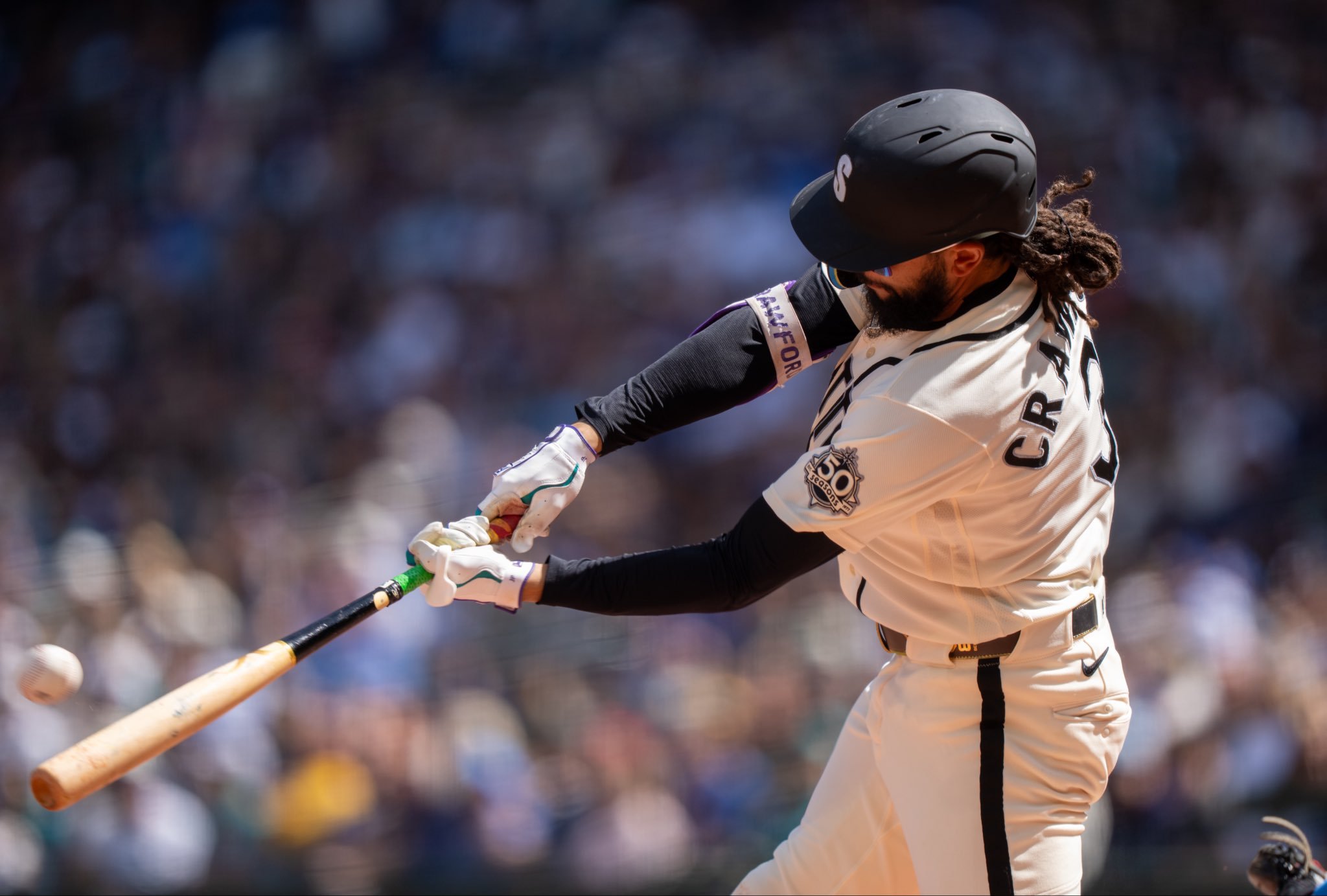
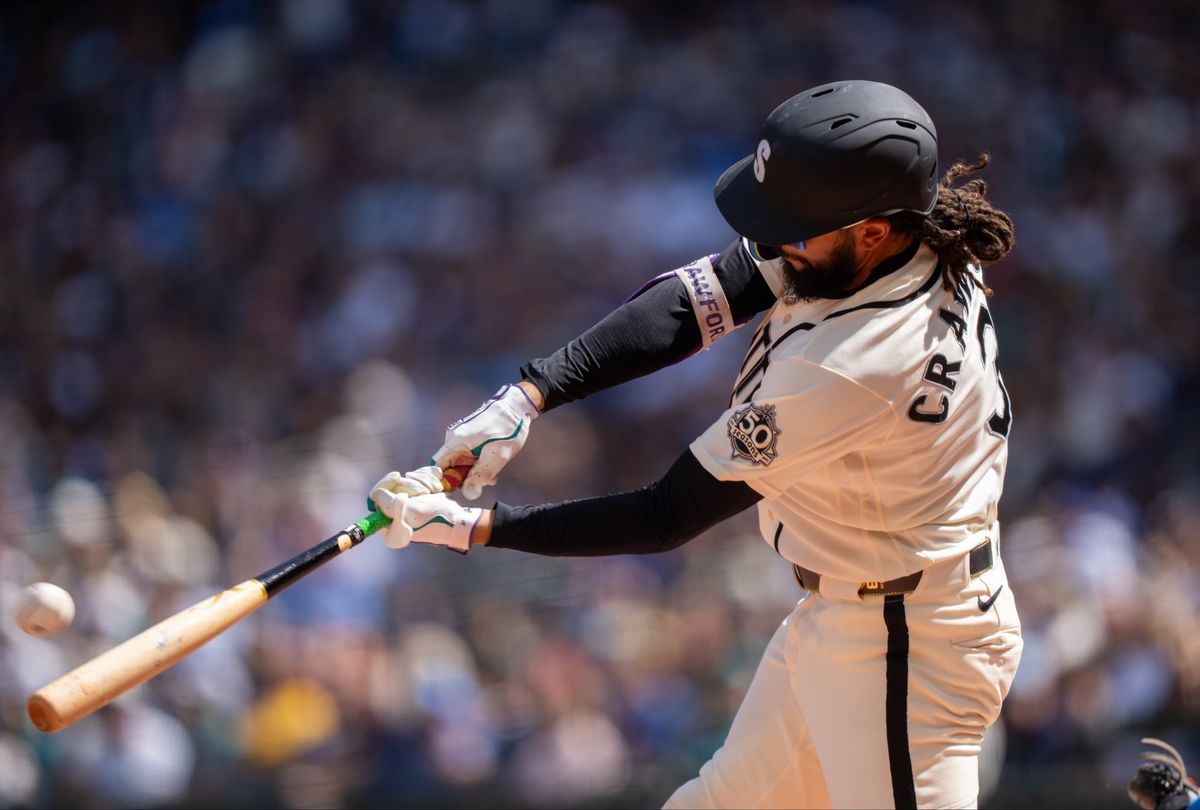
Seattle Mariners shortstop J.P. Crawford (3) hits a two-run home run during the second inning against the Texas Rangers at T-Mobile Park. Mandatory Credit: Stephen Brashear-Imagn Images [/caption]
When the M’s dropped Friday night’s game 5-0, their ninth straight loss against non-Astros teams, they found themselves on the edge of disaster. But two games later, they aren’t in that bad of a spot for the rest of the year, with the season series against the Rangers a manageable 2-4 despite the sweep in Arlington.
Sunday’s rubber match was decided by two things: home runs and Bryan Woo. Seattle scored all its runs via the longball in their 5-2 victory while Woo did Woo things on the rubber to keep the Rangers off the board for all but one inning of the game. It’s still a ways until a true turnaround can be declared, but the M’s did what they had to do in their weekend day games.
They also mash in the stellar Steelheads threads, for what it’s worth.
Bryan Woo dealt a cold dish to Rangers hitters, going seven innings and squeezing out most of the life from Seattle’s AL West foes.
One way to describe the skill of the Mariners pitching staff is as follows: on any given day, any of the Mariners starters can look like the ace. First among equals, however, is Bryan Woo. He had not looked any worse than his two stalwart previous years to start 2026, with a 2.16 ERA, 2.24 FIP, and 0.920 WHIP over his first four starts.
For the first five innings on Sunday afternoon, it looked like he might be on his way to the three most beautiful words in baseball: complete game shutout. The Mariners starter managed to combine ruthless efficiency with swing-and-miss stuff, striking out five in those first five innings. Woo threw nine pitches in the first, 10 in the second, 11 in the third, and 12 in the fourth and fifth.
The Rangers began to claw some good contact on Woo in the sixth, but it didn’t amount to much but loud flyouts in that frame. In the seventh, however, Woo got into a jam. Corey Seager led off with a five-pitch walk (though two of those balls were unchallenged would-be-strikes on the edge of the zone), and despite running ahead of Wyatt Langford 1-2, Woo tossed a plated sinker that ended up in left field for a hit.
Woo’s sinker is better than most, but as he began to lose control of it in these late frames, plunking Joc Pederson to load the bases with one out and giving up a sacrifice fly on a sinker over the plate. Woo tried a slider to Evan Carter, but it hung over the middle of the plate for the Rangers center fielder to pelt down the left field line for a run-scoring double.
The second run was all Texas would manage against Woo or anyone else. Josh Smith sent Cole Young a routine ground ball to end the inning. When Gabe Speier trotted out to begin the eighth, Woo’s final line was set: seven innings, four hits, two earned runs, one walk, and six strikeouts.
As usual, Woo relied plenty on his four-seam fastball, with the sinker going into action as the game wore on. Like many teams upon facing Woo for the third time through the order, the Rangers began to get used to his four-seamer, and this did leave him a fair bit back-footed as he didn’t go to his sweeper much.
This does leave Woo with a clear blueprint to improvement: find enough of a feel for the sweeper to incorporate it consistently in the end of games when teams adjust to his elite fastball. But nobody is going to complain that an ace pitcher went seven innings and gave up two runs.
Unlike in Saturday’s contest, the bullpen worked the final innings without any hiccups, as Speier knocked down the eighth and Andrés Muñoz struck out three batters in the ninth … granted, one of them (Jake Burger) reached first on a wild pitch, but Muñoz simply got Carter to become the fourth out of the inning to complete the Mariners victory.
Seattle’s platoons had a mixed day, but Refsnyder launched his first homer of the year.
Coming into Sunday’s action, platoon right fielder Rob Refsnyder hadn’t logged a hit in 18 at-bats to begin the 2026 season. While his skills against lefties are very clear from his past four seasons and he hadn’t really looked diminished from 2025, there have been worries about a right-hander adjusting to T-Mobile Park, Refsnyder’s age, and the M’s tendency to pick up this kind of player at the exact wrong time.
At least for an at-bat, Refsnyder put some of these worries away, hopping on a first-pitch fastball from left-hander MacKenzie Gore and scorching a line drive over the fence in straightaway left. Seattle led 1-0 after the first pitch as Refsnyder showed some of his Boston-era chops. Ironically, his 106.2 mile an hour, 25 degree bullet might have only barely scraped the Green Monster in Beantown.
It was Refsnyder’s only production, however, and his .045 average and .342 OPS coming out of the game show that he still has a ways to go to make up for his early slump. Perhaps Refsnyder, who had his second kid recently, can tap some more of his dad strength.
Mitch Garver did the catching duties as Cal Raleigh DHed, while Connor Joe played first to give the struggling Josh Naylor some rest. Garver reached base once on a walk, while Joe reached twice with a single and a walk (though his single would have been a double had it not bounced off third base umpire Rob Drake). It wasn’t an especially banner day for the righty platoon guys in the aggregate (they went 2-12 with a walk and a homer), but it was better than what the M’s had seen beforehand during the 2026 season.
Home runs mattered for the Mariners, who left eight men on and went 0-4 with runners in scoring position.
The clear adage about the 2025 Seattle Mariners was that they lived and died by the home run. The team tried to address this in the offseason - bringing in Brendan Donovan and adjusting Randy Arozarena’s approach to be more contact-oriented - but with Donovan on a day-to-day hip injury and the rest of the team’s difficulty getting the engine started with either home runs or contact hitting, it seems the M’s are back to something of square one.
But when they do get the home run production, things go smoothly. After Garver took his seven-pitch walk in the bottom of the second, J.P. Crawford came up with one out and one on. Crawford is much more of a contact-focused batsman than many on the M’s, but when he sees a mistake pitch, he will sometimes let loose.
That’s what Crawford did on Gore’s 0-2 curveball that stayed about middle-middle, sending a frozen rope to right. It appeared for a fleeting moment that Brandon Nimmo might have had a beat on the ball, but as it continued flying, there was nothing he could do: the ball zoomed into the seats to put the M’s up 3-0.
Seattle’s third and final longball came from Arozarena. Although the first two M’s quickly made outs in the bottom of the fifth, a Julio Rodríguez single set a small table for Arozarena. Just like Crawford, he took advantage of a curveball from Gore; even though this one managed to get a bit below the knees, it never lost Arozarena’s eye, and he drilled it off the foul pole to give the Mariners their fourth and fifth runs.
There were more chances, but when the homers didn’t come through, Seattle wound up without any extra insurance. Raleigh and Rodríguez both reached base with two outs in the seventh and Seattle loaded the bags with two gone in the eighth, but neither Arozarena or a pinch-hitting Luke Raley knocked them home.
It didn’t matter on Sunday. Missed chances certainly will dog the M’s at points - as always, the difference will be degree - but the three bombs and lockdown pitching meant that they didn’t need to capitalize with runners in scoring position this time around.
The Mariners won a key series against the team most likely to usurp the AL West title.
Although the AL West was shaping up to be something off an uneven three-man battle going into the season, the Astros’ myriad issues and the Mariners’ slow start have made it a two-team fight between the M’s and Rangers.
Who has the edge depends on who you ask. Baseball Prospectus’ PECOTA has always been high on the Mariners, keeping them with a notable edge even at their lowest points such as early Saturday morning when the M’s found themselves five games under .500 for the second time with nine straight losses to non-Astros teams.
Neil Paine’s Elo model is perhaps the tail of the other end of the curve, still giving Seattle just a 25.3% chance to win the division compared to the Rangers’ 41.7% chance early on Sunday morning. His model of the actual abilities of both teams was roughly even - the Rangers at 1521 and the Mariners at 1519 - but this only meant that Seattle’s early struggles made the difference in his simulations.
FanGraphs and the prediction markets can be seen, then, as the median projection, roughly equivalent to the general consensus. This is literally true in the case of prediction markets, though FanGraphs happens to be pretty congruent with the markets (if a little more on the bullish side for the Mariners), with the postgame percentage chances of winning the division at 50.8% for Seattle and 31.1% for Texas.
With the series win, the M’s are one and a half games out of the division lead. But early in April, worrying about standings is futile; the team just has to get in a groove and think about the game in front of them.
A three-game set against the Athletics begins on Monday.