Hancock, Mariners Get Sunk by Flock of Blue Jays Big Flies, Own Rudderless Offense

[caption id="" align="alignnone" width="3354"]
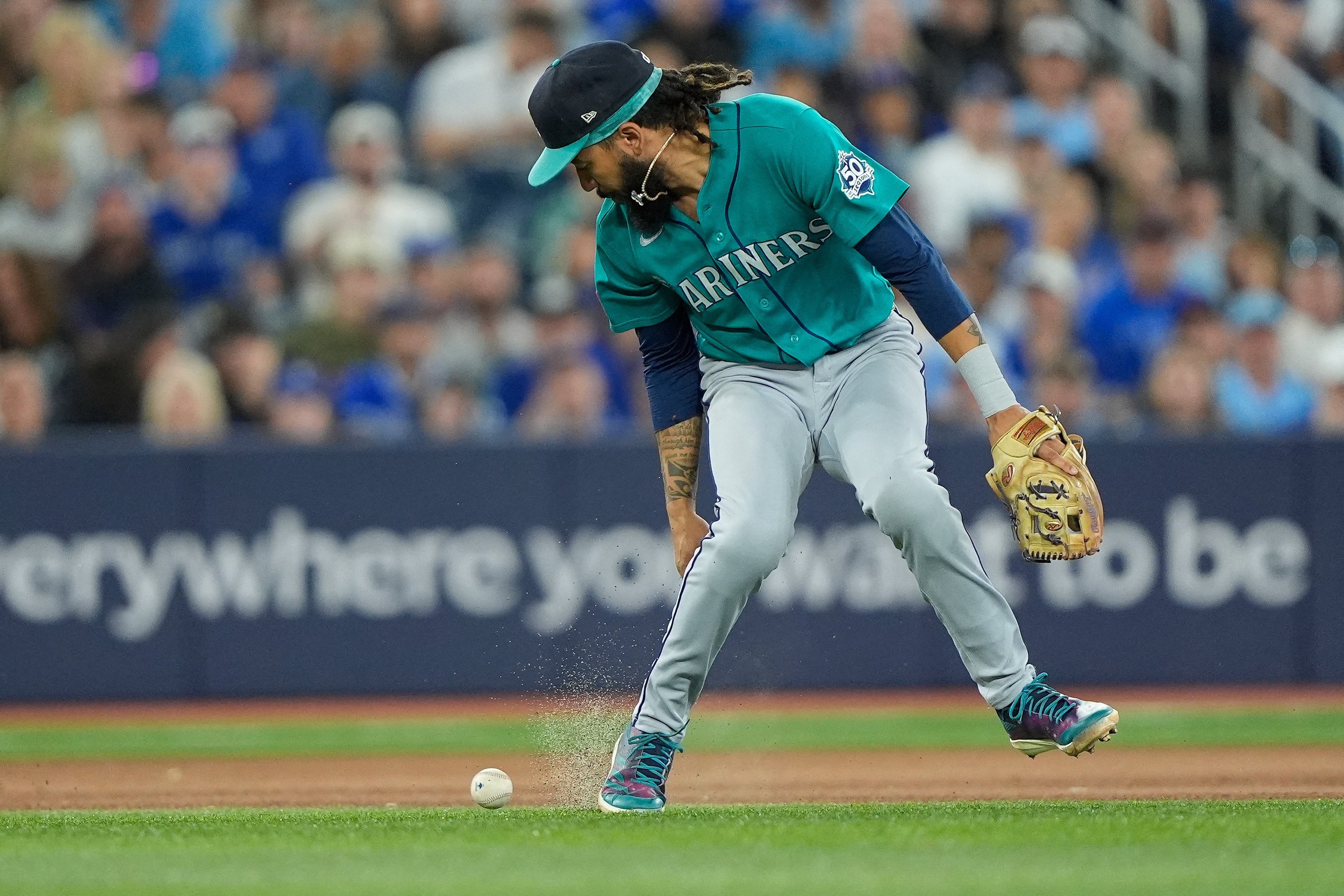
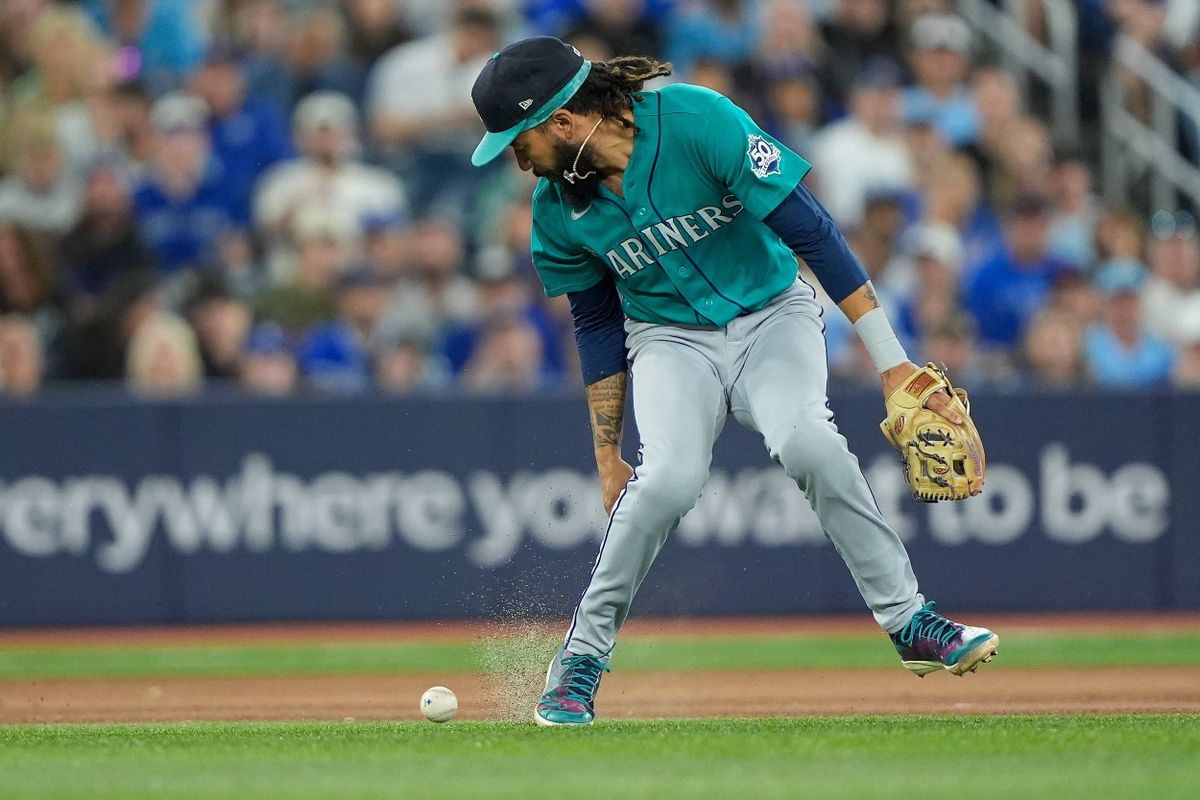
Seattle Mariners shortstop J.P. Crawford (3) mishandles a ball hit by Toronto Blue Jays third baseman Kazuma Okamoto (not pictured) during the seventh inning at Rogers Centre. Mandatory Credit: John E. Sokolowski-Imagn Images [/caption]
If the Mariners drive this busted up tractor all the way to the postseason, Fernando Alonso himself should bestow their accolade.
Before the All-Star Break, the Mariners could have perhaps been considered a slightly above mediocre team that was underperforming to the level of a slightly below mediocre team. They had scored 392 runs and allowed 376 runs, not to the level of their supposed World Series contention but better than what has since followed.
With the conclusion of Seattle’s 8-1 loss to the Toronto Blue Jays on Friday, the M’s have now been outscored 215-135; with the second fewest runs in the majors ahead of only the Angels and the third most runs allowed behind only the A’s and Rockies. Their -80 run differential since the All-Star break is up there with said Athletics among the worst in the game, and if their .299 Pythagorean winning percentage would be a 48-114 record if it were applied evenly to a full season.
Their actual 16-22 second half record (instead of their Pythagorean 11-27) would be a 68-94 season extrapolated out. Not that such a performance is anywhere close to what they needed, but ever so barely, their overperformance - it could be euphemized to optimal run distribution - has kept them in the hunt for an AL West title. Even at a queasy 64-71, they are four games back of the Astros in the AL West.
If their play against their onetime ALCS rival is any indication, that last lick of resurgent energy could be all but spent. They are long since out of games to punt away, with a butcher’s bill dozens of contests long that shows no signs of letting up before the M’s can have a snowball’s chance of paying it off.
Incredibly, those metaphors were far less tortured than the team’s efforts on Friday night.
Emerson Hancock gave up two homers and five runs as his sweeper took a dip, with an injury scare to boot.
If there are any silver linings for the M’s to take away from their series opener in Toronto, the fact that they didn’t give Vladimir Guerrero Jr. his first Rogers Centre home run of 2026 - that this is the truth so deep into August is a fact so absurd as to reinvigorate the baseball hopes of the Pacific Northwest - but that didn’t make the rest of Emerson Hancock’s start any more encouraging.
Five innings of five-run ball can happen sometimes, even to a good pitcher. Hancock’s outing wasn’t the kind of complete dud that wrecks a game from the get-go, but it still put the Mariners in a bad spot early on.
Brett Bateman found wood on Hancock’s second pitch of the game for a leadoff single in the first, then stole second and made it to third on a groundout. Guerrero didn’t need to leave the yard to log Toronto’s first run of the game, as he simply grounded a screaming double past the drawn-in J.P. Crawford at third. George Springer made it to first on a weak grounder and Hancock hit Jesús Sánchez to load the bases with one out.
Kazuma Okamoto took a ball to the warning track at 102.9 miles an hour to sacrifice home the Jays’ second run and the third run came from the bat of Andrés Giménez before Hancock finally stemmed the bleeding and got out of the inning.
But on that groundout that got Bateman to third base, a perhaps more important event took place. Hancock had to hurtle towards the slow dribbler to get to it in time, and in the process, he appeared to awkwardly stretch forward and got back up in clear pain.
“It felt weird, just something that felt like I needed to be able to kinda get through to be able to get as many outs in the innings that you could,” Hancock said. “I think that’ll be another thing, just see tomorrow how everything’s feeling.”
Hancock said that he felt “something” in his left leg when he reached to tag the runner. Manager Dan Wilson and head athletic trainer Kyle Torgerson both went out to check on the hurler, but after a conversation, they trotted back into the dugout and let their starter continue the game.
“I just said I wanted to go. Like, if it gets worse, if something gets a little too bat, where you can’t go out and compete, then I’ll say something. But at the same time, I wanted the ball and I wanted to just kind of keep going.”
Though Wilson acknowledged what followed later in the first and towards the back end of Hancock’s five innings, he gave the starter credit for his toughness.
“Just wanted to hear from him what had happened and where he was at,” Wilson said. “He wanted to throw a couple and felt pretty good, came in between innings and we talked again and he felt pretty good, the velo was there, it felt like he continued to throw the ball pretty well. And I think we felt comfortable with where he was at.”
Hancock, for his part, didn’t feel that the knock affected his performance; his pitches, after all, did just suffer a bit of natural regression after his previous two outings, when he gave up five runs in 12 ⅔ combined frames and struck out 14 batters. On Friday, for comparison, he struck out just one in his five frames. The sweeper, which he had shown a renewed precision with during his recent outings, took a big step back in the control department and Hancock only threw eight of them. The Jays were all over Hancock’s sinker, with three out of four batted balls against it being hard hits. But in the second, third, and fourth, Hancock found a weapon to keep his opponents quiet: the cutter. It may not have been much by his standards, but he managed to keep the Jays off the board for three frames with two pitches.
The fifth wasn’t so kind. Nathan Lukes went down and dug a one-out 1-1 changeup out from underneath the zone and put it over the wall in right, making it 4-1 for the Jays, and George Springer rocked a plated 1-2 sweeper into one of the many upper terraces in Rogers Centre’s left field. Hancock got out of the inning, but the rough game was more than enough to hand him the loss.
Wilson said that the M’s will be taking looks at Hancock later in the night and going over his bill of health on Saturday, but expressed optimism despite acknowledging a “strain of some kind.”
The first two relievers for the Mariners let the game get even further out of hand.
Seranthony Domínguez took over the throwing in the bottom of the sixth against his former team. Domínguez, who has been more or less the hit-or miss hurler the M’s expected when they got him in exchange for Luis Castillo at the trade deadline. Like most of the rest of the team on Friday, Domínguez was in “miss” mode during his inning of work, as he yielded an Okamoto big fly on his fifth pitch, a 2-2 sweeper that found way too much of the plate.
It was Michael Rucker time with a five-run deficit in the bottom of the seventh, but that didn’t make the Blue Jays let up. Rucker walked the leadoff Lukes and, with one intermediary out, gave up three straight singles as Toronto turned their 6-1 advantage into the game’s final 8-1 score.
Were the offense more competent, that bad inning might have mattered. But with the way they were playing, the game was over when Hancock gave up that sacrifice fly all the way back in the first.
An early homer from Dominic Canzone was all the offense.
Seattle had one bright spot in the whole game, and it came in the first inning. Against a Dylan Cease whose fastball was almost two miles an hour lower than season average, Dominic Canzone found every fiber of the barrel and nearly hit the ball far enough for two home runs. His 433-foot blast was the result of a ball hit at 112.8 miles an hour off the bat, soaring into the seats in the top of the first for his 20th big fly of the year and putting the M’s ahead 1-0.
Of the 21 batted balls Seattle accrued over the following eight-plus innings, just six (29%) were hit at 95 miles an hour or above. Cease didn’t suddenly find the zip on his fastball, and though his slider and changeup each got solid whiff rates and called strike-plus-whiff rates (CSW%), he hung plenty of stuff over the middle of the plate.
The Mariners just couldn’t capitalize. Whether it was Taylor Ward fouling off a cement mixer in the second, J.P. Crawford staring at a couple grooved changeups in the third, Canzone whiffing on a hanging slider in the fourth, or Ward shanking a fifth inning Broadway hook, Cease gave them the chances to get traffic. But aside from a fifth inning Cole Young double and a pair of singles in the sixth, the M’s didn’t get another man home during Cease’s outing.
“Just weren’t able to get too much traffic going, able to get a couple guys on in the sixth,” Wilson said. “But nothing to cash in on.”
Former Mariner Paul Sewald took the hill in the eighth and Seattle had another brief opportunity as Randy Arozarena walked and Canzone got his second hit of the evening (the DH accounted for 40% of Seattle’s base knocks on Friday), but a Julio Rodríguez hard lineout and a Josh Naylor soft groundout put the nail in the Mariners’ coffin. Crawford’s official game-ender in the ninth only made official what had been clear for hours.
Must-win situations keep gathering as the odds get longer.
Had the Yankees and Mets fared better against Houston during the week, the M’s would be in a stunningly good place for their record. Alas for the Rogers Centre visitors, Houston has remained marginally competent, and the deficit the Mariners have in the AL West has grown to four games.
If there is any slimmer of hope for Seattle’s (more than) half-dead playoff hopes, they must surge back in the final two games of the weekend set.
“We have to,” Wilson said. “And it starts with putting up our good at-bats again … we were able to jump on the board early today, which I thought was great, but tomorrow, we’ll come out flying again and hopefully get on the board early and keep adding on as we go.”