Randy Arozarena’s Mammoth Fifth Inning Homer Reverses Hitting Woes, M’s Beat Stros 9-6

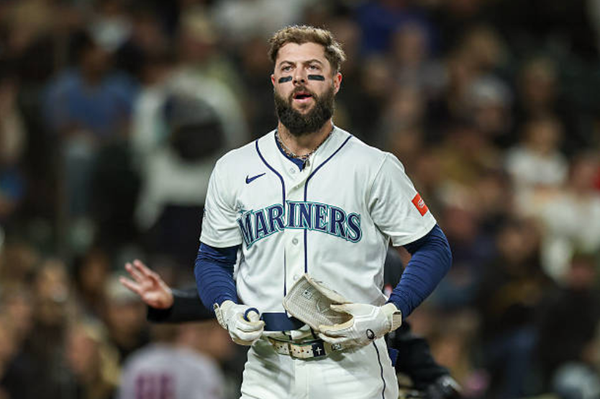
[caption id="" align="alignnone" width="2048"]
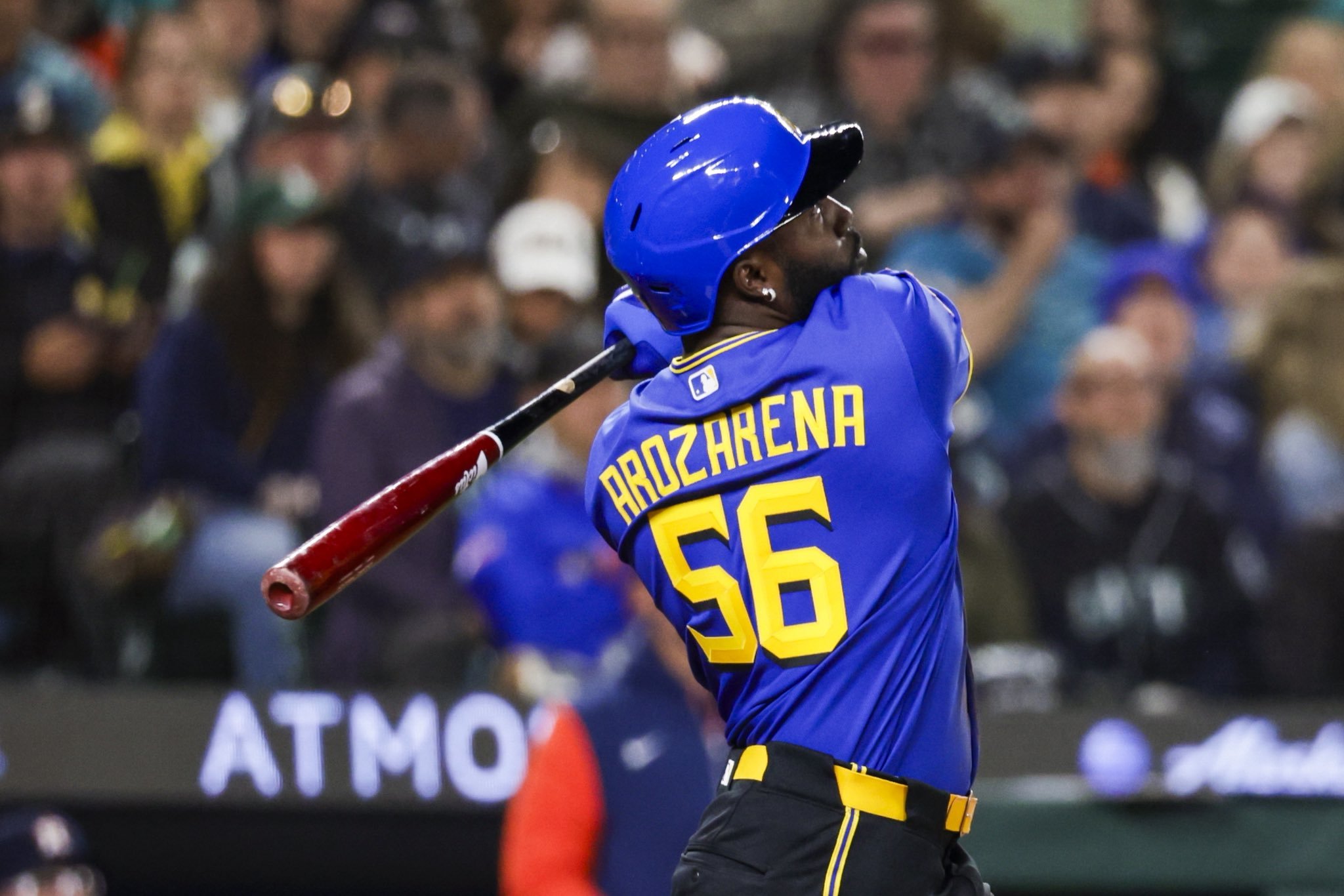
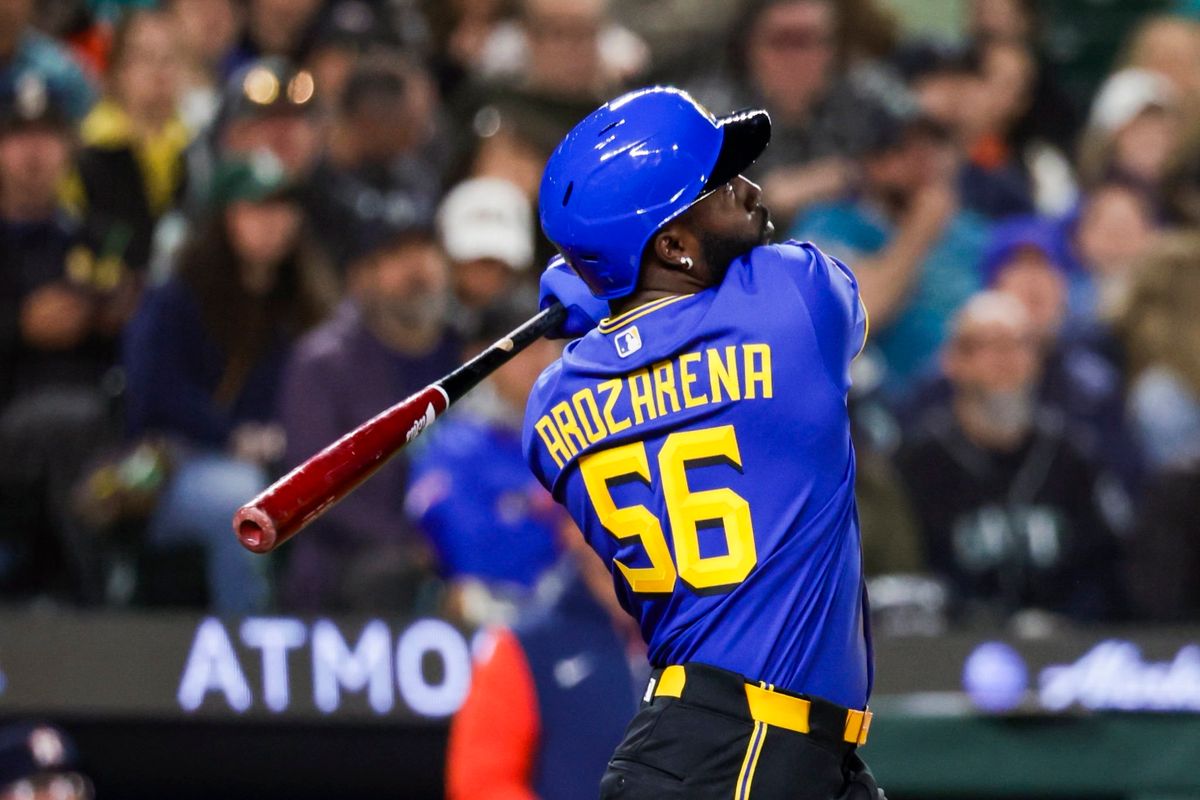
Seattle Mariners left fielder Randy Arozarena (56) hits a two-run home run against the Houston Astros during the fifth inning at T-Mobile Park. Mandatory Credit: Joe Nicholson-Imagn Images [/caption]
The look on Andrés Muñoz’ face told it all as Leo Rivas stepped on third to complete the final out: exhaustion and catharsis.
It was a feeling that reverberated around Mariners country as the team won its first game and nearly a week, put more than two runs on the board for the first time in a few days, and had a solid defensive showing after scores of innings full of botched glovework.
The Astros’ struggling pitching and the Mariners’ struggling offense both showed early on Friday.
Ichiro’s statue unveiling outside T-Mobile Park on Friday night encountered an unusual mishap: the bat cracked and bent at the handle as the tarp was taken off to unveil it.
It was the proverbial picture that said a thousand words about the Mariners offense. Over the first 13 games, the Mariners had failed to score before extras in four of them. The whole batting crew had looked about as lost as three Roman legions in the Teutoberg Forest.
But imagine, for a moment, that Arminius’ crack Germanic warriors just started falling over themselves in said forest. It would have made things easier for Publius Quinctilius Varus, there’s no doubt about that.
That perhaps overcooked metaphor is apt to describe the way Tatsuya Imai pitched during his third of an inning on Friday. Of the 37 pitches he threw, 20 of them were balls and about 75% of those weren’t particularly close. Imai served the M’s a set of runs on a silver platter without the slumping bats having to lift a finger.
J.P. Crawford walked. Cal Raleigh walked. Julio Rodríguez hit a dinky infield single and Josh Naylor had a free pass of his own, but not before Imai pelted the backstop to score Crawford. The Astros starter’s famous backwards slider ran in to knock Randy Arozarena on the hand and score Seattle’s second run. Another dink job from Luke Raley plated a man, and though it was initially called a double play, only the out at first stood when replay review showed that Astros second baseman Isaac Paredes never tagged Arozarena. Imai’s day ended after tossing his fourth walk Cole Young’s way.
Upon facing a pitcher who wasn’t gifting uncompetitive walks to every second hitter, the Mariners’ offensive struggles quickly reappeared. The left-handed Steven Okert fanned Dominic Canzone on three straight sliders and Leo Rivas popped out to end the inning.
Seattle hitters against Tatsuya Imai was perhaps the best example of a stoppable force coming into contact with a movable object. That movable object - or stoppable force, take your pick - fell over like a leaf in a light breeze upon facing something more challenging.
“Something more challenging” was simply a pitcher who could throw strikes, as the M’s bats remained unable to intuit any sort of sequencing and unable to square up meatballs, continuing their all-consuming passivity through the end of the fourth. A chance in the third thanks to two Ryan Weiss walks fell through Raleigh and Rodríguez’ fingers with two flyouts to right, the first after Raleigh looked at a couple of breaking balls in his wheelhouse before admirably fouling off a bunch of stuff with two strikes and the second as Rodríguez got jammed inside on a heater.
A true Mariners breakout on offense would have to wait.
Emerson Hancock had four excellent innings and gave up one crooked number besides, but he limited the damage to provide an overall solid outing despite a dicey second.
It’s plain from the flow of Hancock’s games that he has incredible stuff but sometimes lets his sequencing and control slip a little bit. This can be especially true of his knockout sweeper, which is just about unhittable when located well but doesn’t always get the right location.
Hancock overcooked his sweeper quite a few times early on, once harmlessly in the first, but the second with a man on in the top of the second. That pitch - and the ensuing walk - noticeably affected Hancock’s confidence, and he plated a fastball to Correa that luckily ended up only landing in center field for a single to load the bases.
The other way Hancock slipped in the second was a lack of use of his high fastball. Like a lot of low arm slot guys, Hancock’s four-seamer plays like lightning at the top edge of the strike zone, but with the bases loaded and nobody out, he shied away from it at points. Although he started Cam Smith off with such a diet, the Astros right fielder got a backed-up sweeper over the heart of the dish.
Lady Luck smiled once more upon Seattle as Smith’s bullet flew close enough for Rivas to snare, putting the first out on the board. Hancock locked in with some pinpoint sweepers to Joey Loperfido for the second out, but a miracle opposing NOBLETIGER [1] was not ultimately in the cards.
Hancock’s 2-2 fastball to Christian Vázquez ran about half a foot inside, but the hot-hitting Houston catcher kept a beat on it all the way and seared a liner down the third base line. Unlike Smith’s similar shot, this one was well outside his reach and plated all three baserunners to tie the game.
The rest of the game went very well for Hancock. He worked his way out of the second without further issue and resumed his dealing in the third, finishing the game with five innings pitched, five strikeouts, and two walks along with his three earned runs. Once he got the fastball dialed in at the top of the zone and had settled in with the sweeper, he looked like the kind of casually stalwart Mariners starting arm the team has become accustomed to - an arm in the Latin sense of the word.
Such a return to form was a beautiful sight from a pitcher who has had his issues letting ball games get away from him. Perhaps the Hancock of 2025 lets the second inning fall off the rails with nobody out or one out en route to a seven- or nine-run blowup start. Like a starter unconcerned with having to perform or lose his starting role (yet perfect for Hancock, who indeed has such pressure), he settled in and did his due work.
But the second inning was a big blaring bullhorn from the baseball gods that the M’s weren’t going to be able to fall backwards into a victory against the AL West’s longtime gatekeeper; Seattle would have to earn its laurels.
Randy Arozarena walloped his first homer of the season in style, sending a rocket further than Artemis II in the bottom of the fifth.
By the time Arozarena came up in the fifth inning with a man on first, five Mariners had already drawn walks from Astros pitching. Arozarena took three pitches about a foot high and a fourth on the edge. He thought it was a walk, turned back, and tapped his head looking for a challenge. He said after the game he thought it was a 50/50 shot, and with the break-even confidence level of 35% in that situation, challenging was the right play. It was too late to challenge, though, so Arozarena. went back to the box.
Arozarena got something better than a walk as Ryan Weiss pumped a middle-middle 3-1 fastball. The classic hitter’s pitch doesn’t come as often as it once did as pitching staffs have learned to mix things up, especially with big power guys like Arozarena at the dish, but the Mariners left fielder obliterated Weiss’ offering like Joey Chestnut downing a dozen hotdogs.
That’s an understatement. Yordan Alvarez hardly moved in left, merely looking up as the 426-foot moonshot sailed into the upper deck. Arozarena gave it a premier pimp job as he began trotting to first. Seattle led 5-3.
Against the Astros - as Alvarez proved in the top of the eighth - insurance runs were necessary. But the tone had finally been set by the Arozarena bomb.
Seattle had perhaps its best batting inning of the season in the bottom of the seventh. Houston, having to use its bullpen for 26 outs, opted to try preserve some of their guys by offering up Weiss and J.P. France’s right arms as sacrifices, and by the seventh, Weiss had tossed 64 pitches and France 27. The latter’s exhaustion began to clearly show as he hit Luke Raley and gave up a single to Cole Young, but the works really got going as Canzone belted a hanging curveball into the gap in right center for a run-scoring double.
A wild pitch plated Young and brought Canzone to third, and Crawford’s single two batters later made it 8-3 in favor of Seattle with still nobody out and men on first and third. Raleigh knocked in the final Mariner run with a groundout to complete the four-run rally.
Just about everyone who strolled to the dish in that frame kept things simple during their at-bats: taking pitches off the plate, not trying to force too much on pitches they could hit, and thinking small.
Cal Raleigh won three ABS challenges, but there are still things to learn for the Mariners catcher.
Much has been noted about Cal Raleigh’s relative inexperience with ABS challenges, with the 2024 Platinum Glove winner gaining just 0.2 challenge runs over expected on defense coming into Friday’s game. But like many in the game, it seems he is learning more as things go on.
Raleigh made four challenges (three behind the dish, one at the bat) and won three of them. The first was probably the most important, process-wise: with an 0-1 count, two outs, and the bases loaded, Hancock’s sweeper at the bottom edge of the zone was called a ball. In order for the challenge to be the correct play, Raleigh needed to be 42% sure or more, but he seemed clearly confident and the call was overturned. It ended up mattering little with Vázquez’ ensuing bases-clearing double, but the overturn was beautiful process and 0.27 run expectancy.
The Mariner catcher made a challenge in the box in the bottom half, turning a 1-2 strikeout into a ball call. The break-even confidence level for challenging that pitch was 59%, but given that it was over an inch off the plate, perhaps Raleigh indeed thought he had something of a 60-40 or more. It was 0.14 run expectancy, but all it served was a few more pitches for Okert as Raleigh popped up.
With a leadoff Carlos Correa on a 1-1 count in the top of the seventh, the break-even confidence level to challenge was 64%. Nevertheless, Raleigh tapped his helmet as strike two was called a ball, and he indeed won his third challenge of the night. It’s difficult to judge process on successful challenges in low-leverage situations and a pitch less than an inch into the strike zone - on the one hand, it could demonstrate pinpoint zone knowledge, on the other, it could represent an over-eagerness despite lack of true confidence. In any case, it was 0.12 run expectancy to the Mariners.
Raleigh’s challenging had a little bit to be worked on in the ninth. With the Astros down three - how that happened is a story that largely begins and ends with Alvarez, but it will be told after a few boring paragraphs about run expectancy and strategy charts - Andrés Muñoz quickly dealt with the first two batters but lost his command in the wind as Loperfido stood in the box, tossing a pair of balls that weren’t particularly close. His third pitch was a slider that came much nearer to the zone (just 0.3 inches from being a strike, in fact), and Raleigh challenged home plate umpire Austin Jones’ ball call.
Despite it being the ninth inning, that situation actually called for a 76% minimum confidence level, given that the M’s only stood to gain 0.06 run expectancy. Perhaps momentum considerations (meaning getting Muñoz back in the zone with a better count) came into play with the M’s only needing one out to win the game, but it was still about -0.2 run expectancy, the average value of an overturn.
Now, with a 3-2 count and a ball that was as borderline as could be (in fact it was barely a strike), Raleigh’s strategy-chart correct move was to challenge the call if he was at least 47% confident of an overturn. Given that the M’s only had one challenge left, perhaps he was being reserved, but the overturn run value in that situation is misleading: while it would be taking the Astros’ run expectancy from 0.12 to zero (with the added overturn value coming from the fact it would end the inning), the actual situation was that the M’s would have won the game there and then if the M’s had challenged and won. A win is worth a whole lot more than a run; about nine runs go into a win on average, meaning that Raleigh only needed to have something in the range of a 2% confidence of overturn in order to make the challenge worthwhile.
Cole Wilcox took a big slip from his previous outings, but the rest of the bullpen did its job as the Mariners wrapped up the win.
One of the more underobserved elements of the Mariners’ disastrous road trip (perhaps underobserved because it, unlike the rest of the team’s work, wasn’t disastrous) was Cole Wilcox’ solid performance as Mariners mop-up man. Wilcox hadn’t given up a run over 4 ⅓ innings of work before Friday, striking out six while walking one thanks to a solid combo of some heaters, a sweeper, and a gyro slider.
Against the Astros’ high-powered lineup, it seems that there will be little rest for the headmen of the Mariners bullpen. Wilcox hung a sweeper to Vázquez that ended up in center field to lead things off in the eighth before leaving a slider up in the zone for a Jeremy Peña single.
In came Alvarez, a slugger who hits like Barry Bonds on his good days and like Albert Pujols on his bad days. Like with the previous two guys he faced, Wilcox left a breaking ball in the middle of the plate, an item Alvarez can devour in his sleep. It was 9-6 Mariners by the time the ball landed, and Matt Brash quickly got started in the bullpen.
An out and a hit by pitch later, Brash came into the game to put out the fire, something he did in four pitches and one double play. Muñoz’ first save opportunity of the season an inning later had shades of Fernando Rodney with a pair of two-out walks (okay, that’s not fair to Rodney, he would have walked three with one out before getting the save), but a lazy grounder to the left side sealed the deal.
On Deck
The beautiful and haunting thing about these moments in sports is that their ultimate significance is not yet known. Did the Mariners offense finally start the engine after two weeks with no jumper cables, or will they go back to their inept ways on Saturday? Is it the end of the Mariners’ near-catastrophic (as much as an-early season one can be) losing skid and the beginning of a run to the catbird seat, or is it a dead cat bounce that will be undone by the end of a grueling Monday afternoon?
The Astros’ pitching situation is in far direr straits than a Seattle offense that finally showed some life, as visiting manager Joe Espada will have to take a stab at a a piecemeal three-game effort from a bunch of not-quite-starters and a set of relievers. The Mariners have the action and the motion for now - will they play it to a series win against Houston?
When it comes to Ichiro’s statue, the bat was fixed not long after the unveiling. Whether or not that’s also symbolic is of course unclear, but Arozarena’s stroke of life sure made it seem that way on Friday.
[1] No outs, bases loaded, entire team incapable of getting easy run. Incredibly, given that it’s about as forced as a Teutoberg Forest slapstick metaphor, this term has existed for almost a decade.