“We Know Where We Are At”: Lone M’s Win in Bronx Shows Blueprint Despite Not Being Enough by Itself

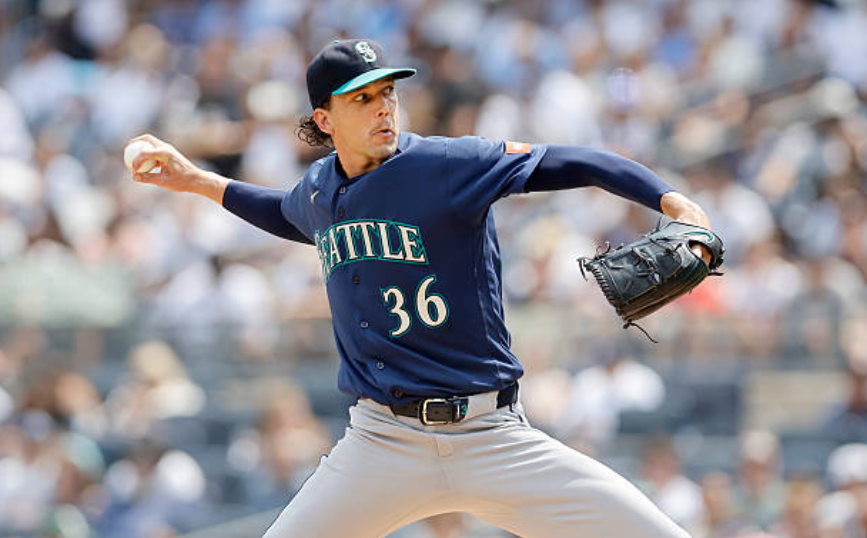
Over the past seven games, the Mariners have found themselves outscored 34-11. It was 34-10 going into Thursday’s afternoon contest in the Bronx; the team rode a stellar six-inning, seven-punchout, no-run start from Logan Gilbert to break an ugly six-game losing streak. The spell, starting in Seattle against the Tigers, had seen them finally stop treading water - because they had sunk like a stone. Were it not for some unexpected production on Wednesday (ultimately in vain as the pitching gave up 10 runs that day), the team’s scoring would have been better described not in runs per game but games per run, Anthony Bennett style.
When things go this pear-shaped for a baseball team, a lot of fingers get pointed and plenty of blame gets cast. The Mariners are 57-65, having barely avoided two straight sweeps to the two top teams in the AL; there’s certainly have plenty of blame to go around. No one is hitting, the team’s hurlers aren’t putting up quality starts, and even when they have a lead, their bullpen blows up and another ugly L goes up on the calendar. Perhaps the finger can go at skipper Dan Wilson, or president of baseball operations Jerry Dipoto, or the hitting crew of Edgar Martinez and Kevin Seitzer, or to strength and conditioning, or a player development side that can’t seem to turn good players into great ones, or an analytics department that seems to follow more than it leads, or owner John Stanton. Or maybe everybody, or maybe nobody.
The players blame people far more familiar: themselves. For a team that constantly talks about the importance of belief, the bluntness of their self-doubt is a bullhorn.
“It starts with me. I’m awful,” Cal Raleigh noted after their Tuesday 4-1 loss to open the series in New York. Over the course of the 2026 season, Raleigh has a .159/.267/.297 slash line, good for a worse batting average and OPS+ than all but one of Dave Valle’s Mariners seasons. Raleigh hadn’t been scheduled to speak to media that day, he simply held an impromptu presser where he called himself horrid in every possible way. Can you blame him for feeling like that?
Winning 1-0 on a Thursday Weston Wilson homer won’t meaningfully change things by itself; the M’s have seen too many would-be turnarounds go belly-up to believe that one win means the job is finished. That was true when they were a pair of games over .500, that was true when they were a pair of games under. 500, and it’s still true now that they’re seven games underwater.
They’ve known this, intellectually, for a long time. But what to fix and how to fix it are different questions by an order of magnitude. If we all could only acknowledge that something needs fixing in order to fix it, we would all have a lot fewer problems. It doesn’t work like that.
How can Cal Raleigh fix his utter brokenness?
Above everything else, the complete disintegration of the Mariners’ biggest 2025 star is the difference between a World Series contender and a first overall draft pick contender.
Raleigh knows more than anyone that he isn’t playing up to standard. After all, no qualified hitter has logged a batting average as bad as Raleigh since before integration. The most recent qualified batting average that bad was Buster Haywood’s .146 for the 1946 Cincinnati-Indianapolis Clowns of the Negro American League; the most recent AL or NL qualified average .159 or below was that of Bill Bergen’s .139 for the 1909 Brooklyn Superbas (they weren’t even called the Dodgers back then).
The M’s captain explicitly put the lion’s share of the onus on himself after Friday’s loss.
“As the leader of the team, I feel responsible,” Raleigh said. “And I just have to do a better job getting ready to go, being prepared, and bringing that edge and that readiness each night at seven o’clock.”
The contours of Raleigh’s profile provided his historic power in 2025 just as they bequeathed his monumental collapse in 2026. He has the fifth-highest qualified attack angle in baseball at 17 degrees this year and had the fourth-highest at 18 degrees last year, and this means that when he makes contact, balls go in the air at a much higher rate. But when such a player’s timing is screwed up, the kinds of batted balls that become homers become fewer and farther between.
We can look at the top 10 qualified hitters this year in terms of attack angle to see how this timing issue comes into play.
Hitters like Raleigh tend to be a certain way: slugging-over-average with a fair amount of popups but also plenty of barrels and fly balls. The degree of their production is in a lot of ways governed by their hard-hit (see Munetaka Murakami) but also in how many of their hits in the air are pop-ups as compared to more productive liners or fly balls. Raleigh’s 12.9% pop-up rate is quite a bit higher than the 7.3% league average, but this was his exact pop-up rate in 2025, too.
The key performance indicator for Raleigh is the hard-hit. Whereas he had a 49.1% hard-hit rate last year, his 34.8% hard-hit rate going into Thursday’s game was just 22nd percentile among MLB hitters. When most of the batted balls go in the air, they need to be hit with some gusto, otherwise they fall in for harmless outs. His splits against ground ball pitchers, where he has a more respectable .673 OPS, are some evidence of this - even if low liners and grounders are soft, they have a chance (still lower than if they’re hard) chance of falling in.
And yet although the goal is home runs, Raleigh can’t be selling out too hard for them. His swing is already geared to produce big flies as long as he hits it hard, so his goal at the plate needs to be recognizing the pitch and squaring it up. It’s the old saying of thinking small to do big things, like the M’s did when they faced the Astros early in the year, did once again against the Cardinals, and did a third time against the Athletics before seemingly forgetting that skill altogether in June. Raleigh knows it, too.
“The approach is just not there. To me it’s just off-balance swings, late to the heater, early on the off-speed. And I’m not pointing fingers. I’m ultimately the worst of the group right now and I understand that,” Raleigh said. “And I think putting your pride aside. Sometimes baseball players can be stubborn, and we’ve just got to put our pride aside. We have to maybe focus a little more on the team aspect or hitting the ball the other way or trying to just take singles and not trying to go for the long ball every time because, ultimately, when you rely on the long ball, you’re gonna get a lot of off-balance swings and you’re gonna be a little out front of stuff.”
Part of simplifying hitting means not thinking as much about it. This is one of baseball’s better-known paradoxes, but the good thing for Raleigh is that he has plenty of things to worry about besides his bat. He has to manage the pitching staff each day and formulate plans to go after the opposing lineup - and his miserable spiral on the hitting side is having a clear impact on this side of his game. He is beginning to abhor risk behind the plate, foregoing all but the best two or three pitches in his battery-mate’s arsenal and often having his hurler throw four or five of the same pitch in a row. This gives opposing hitters tons of looks at otherwise great pitches and takes away the unpredictability pitchers rely on.
Bryce Miller, who gave up five runs in six innings on Wednesday, relied almost exclusively on his splitter, four-seamer, and sinker (those last two are variations of the same pitch). Three of his 89 pitches were either of the sweeper or slider, and he didn’t throw a single cutter or curveball. While he made sure to specify that the issue with his outing was executing with two outs and getting his fastball above the zone against lefties, he did look back on his arsenal as a bit of a mixed opportunity.
“I mean, I kind of wish we would have got to the other stuff a little more, but I felt like the splitter was working. You know, we had seven lefties in the lineup. Didn't really have any issue with the two righties,” Miller said after his start. “I would have had six pretty good innings if I could change two pitches that I execute, but yeah I mean I wish I would have threw a few more curveballs. I really don't love the cutter to this team to the lefties, so really the only thing is mixing in a couple curveballs, I probably would have done differently.”
Plenty of New York’s hits came on the first or second pitch of the at-bat - related to the issues in execution that Miller mentioned - but there were other times when the limited arsenal bit him with venom. Leading off the bottom of the third, Austin Wells worked a six-pitch full count, and by the time the seventh pitch (a down-and-in four-seamer) came in, Wells had already narrowed down the possibilities enough for the mistake to matter. There were two more long plate appearances in the inning: a six-pitch walk to Ben Rice where all the pitches were splitters and an eight-pitch Spencer Jones at-bat where the lefty only saw four-seamers and splitters. On a visual line, these three at-bats are striking in how repetitive the sequences were:
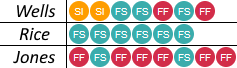
It’s true that these pitches weren’t executed as well as they could have been, especially the fastballs that both became extra-base hits. Miller got Jazz Chisholm to ground out in the following inning at the end of a six-pitch at-bat with a well-executed sinker on the outside edge and later got Chisholm again on a six-pitch strikeout despite five of them being splitters - though it’s notable that the only non-splitter was the fifth pitch, and the splitter immediately after was the only one Chisholm’s bat missed in that appearance.
Perhaps Raleigh can kill two birds with one stone in the final month and a half of the season: focusing more on sharpening his pitchers’ arsenal usage, and in so doing, allow his hitting to become more straightforward.
This isn’t to say that the pitchers aren’t getting any love. Bryan Woo, whose scoreless Tuesday outing was a welcome respite from the cavalcade of road beatdowns he had suffered, expressed plenty of appreciation for his catcher after the game, all the more so when told he had publicly shouldered the blame.
“It’s the sign of a true leader when things aren’t going your way individually but you’re still giving everything you have to make sure that the guys around you, you’re getting the best out of them,” Woo said on Tuesday. “Especially during games like that, you don’t have to go out and see these things and go the extra mile to make some of these adjustments, but he’s still doing them. It’s been frustrating for him on the offensive side … I think the most important thing just remember, we all got his back. However he’s doing - good, bad, indifferent - we’re gonna be fighting by his side, no matter what.”
Woo’s own ideas for how to help Raleigh out were just that: remind him that it’s a team sport and that Raleigh can’t do it all by himself. From his vantage point, he had been seeing Raleigh try to tough it out as an individual, not as a group.
“He takes it as hard as anybody, we all do. But you just have to continue to remind him that he doesn’t have to carry the whole ship by himself; you’ve got 25 other guys trying to pull the rope and trying to figure this thing out,” Woo said. “I think, sometimes, high-performing people just want to take all of that and try to put it on themselves, figure it out for themselves. But you gotta remind them that it’s a team game.”
Perhaps the way Gilbert and backup backstop Jhonny Pereda played the game on Thursday is a blueprint for how Raleigh can approach the rest of the year.
Jhonny Pereda and Logan Gilbert did everything right for one game, but the M’s will need a lot more where that came from.
Raleigh didn’t have the catching duties and went an unremarkable 0-4 with two strikeouts as the DH. The batting ineptitude wasn’t just on Raleigh, as the M’s only run on Thursday came from a Weston Wilson homer in the second inning. That wound up being the only run of the game, in no small part due to Gilbert’s gem. Unlike Miller, who used two and a half pitches on Wednesday, Gilbert’s Thursday outing saw him throw four different pitch types with regularity: four-seam, slider, splitter, and changeup. He didn’t really favor any of the four, but his greater usage of the changeup was notable.
“Being able to zone a pitch that goes away from lefties is big. The slider’s been good for me, but I like having a different look. The 2-1 to Jazz [in the second inning, one pitch before striking him out] was probably my favorite one today, to throw that different look in a behind count, in-zone in a pretty good spot,” Gilbert said. “Then if you throw that, the splitter, they have to respect it a little more and go. Any time teams shut down on the splitter, you don’t want to eliminate a pitch, and I think the changeup opens it up for me.”
Gilbert knew how much momentum had been swinging against the Mariners. His last start, after all, had been the second game of the losing streak, when he went 6 ⅔ with two runs but got saddled with the loss thanks to the M’s putting up a lone run all game, just as they wound up doing on Thursday.
The difference was the runs Gilbert didn’t give up against the Yankees. He stranded a leadoff double in the second and didn’t allow another runner to second all game, with the only near-scoring position chance overturned on appeal after a bullet of a throw from Dominic Canzone in right. All the while, he racked up seven strikeouts while allowing just one walk and four hits. Yankee hitters missed 15 of their 44 swings against him (34%) and 29 of his 95 pitches (31%) were called strikes or whiffs. Any time both of those two rates - whiff and called strike-plus-whiff (CSW) - are both above 30%, it’s usually a good outing.
“When you’re in a situation like this and you have the ball, you always wanna make a statement if you can and try to stop a streak,” Gilbert said. “Hopefully we aren’t on that many losing streaks, but we know where we’re at right now in the standings and every game is very important.”
Pereda helped him out with a couple of two-strike ABS challenges in the sixth, both on pitches on the outside corner. Gilbert appreciated the momentum swing in that inning.
“That was a turning moment for me on the mound, I felt like. The first one I thought was there, the second one I thought, no chance. I was telling Jhonny, when he challenged, I’m like, ‘no-no-no-no-no’, and then we won it,” Gilbert said. “So, I learned my lesson: don’t doubt Jhonny out there.”
From a factual standpoint, that may be a bit of an overinterpretation: Pereda has a total of -1.3 challenge runs this year despite only playing in fits and starts throughout the season. And the second, on a 1-2 count with a man on first and one out, had a 49% break-even success rate - meaning that Pereda would have had to have been at least 49% confident in an overturn in order for it to be the correct play. All’s well that ends well, however, and they were both strikes.
Where Pereda outshined Raleigh on Thursday - other than with the bat, as he went 1-3 - was the sequencing. He and Gilbert kept a good balance of cycling through each of his pitches while not over-cycling (that is to say, completely avoiding two-in-a-row sequences, as a battery doesn’t want to telegraph that the previous pitch is out of the deck of cards). Yankees hitters were on their toes throughout the six innings Gilbert threw and, despite two walks from Eduard Bazardo, the hosts didn’t score anything against him, Jose A. Ferrer, or Andrés Muñoz.
The belief and joy that Gilbert and Pereda had on Thursday was perhaps the biggest change from their previous contests. At least among the battery, there was a sense that they were going to have fun out there, and that’s something the rest of this team needs to take to heart.
That’s even true if part of it is also acknowledging one’s own shortcomings. Though the overall thrust of Raleigh’s impromptu presser was self-criticism, there was a subtext that other players in the clubhouse may not have been too keen on taking accountability.
“Ultimately, the players decide the outcomes of these games,” Raleigh said on Tuesday. “Obviously, Dan has a say in who comes in, and writes the lineup, and we understand that. But at the end of the day, those 26 guys have to be ready to play, and we have to rely on each other, and that’s where the performance comes in. Dan’s not out there playing. Edgar isn’t out there playing. Woody’s not out there pitching. That’s what it comes down to, it comes down to those 26 guys in that locker room, and we’re gonna have to lean on some different guys each night, and that starts in the clubhouse. And we just have to do a better job of relaying that and understanding that we can’t point fingers; we can’t say it’s Jerry’s fault, Justin’s fault, or Dan’s fault - it’s not their fault, it’s our fault. We’re the ones that are performing and we have to accept that. And that’s the tough reality of it.”
Raleigh was ostensibly responding to outside criticism of Mariners management, but the degree to which his comments focused on internal change suggests that he was criticizing - though not naming - players who thrust the blame of their failings on the manager or the front office.
As for Raleigh himself, the blueprint may remain as previously outlined: a greater focus on his pitchers, a greater willingness to seek help, and an attitude that it’s okay to have fun, even when things are going to hell in a handbasket.