Are Spring Demotions Setbacks for Montes, Morales? Analyzing Mariners Roster Moves

PEORIA, Ariz. - Through the course of Spring Training, there will always be players who impress and players who don’t. It’s quite a small sample in these early games - there’s a reason that farm teams play over the course of a whole year - but it can give a sense of readiness when it comes to facing big league or near-big league opposition. The Mariners made a series of moves on Wednesday, March 11 that indicated how they feel about a number of prospects in their organization, sending five non-40 man players to minor league camp and optioning two more guys to Triple-A.
But what do each of these moves mean for the players involved? Are they significant setbacks in their journey to the Show, or was it something that was bound to happen? As we’ll see, it depends on the player.
Lazaro Montes still has a ways to go before making his MLB entry.
There has been some serious billing for Laz Montes over the years, with occasional comps to premier sluggers like Yordan Alvarez and some very clearly high marks on his raw power. But from his play thus far in Spring Training - and Seattle’s move to send him to minor league camp - it’s clear there’s still a gap between his skillset and an MLB one.
Over 26 plate appearances in big league camp, Montes slashed .160/.192/.240 with just four hits, one walk, and 10 strikeouts. A 38.5% strikeout rate and 3.8% walk rate would be a hindrance to any ballplayer, but with power being Montes’ make-or-break skill, a no-homer showing to go along with it didn’t produce clear confidence that he is going to be MLB ready in 2026.
[caption id="" align="alignnone" width="1465"]
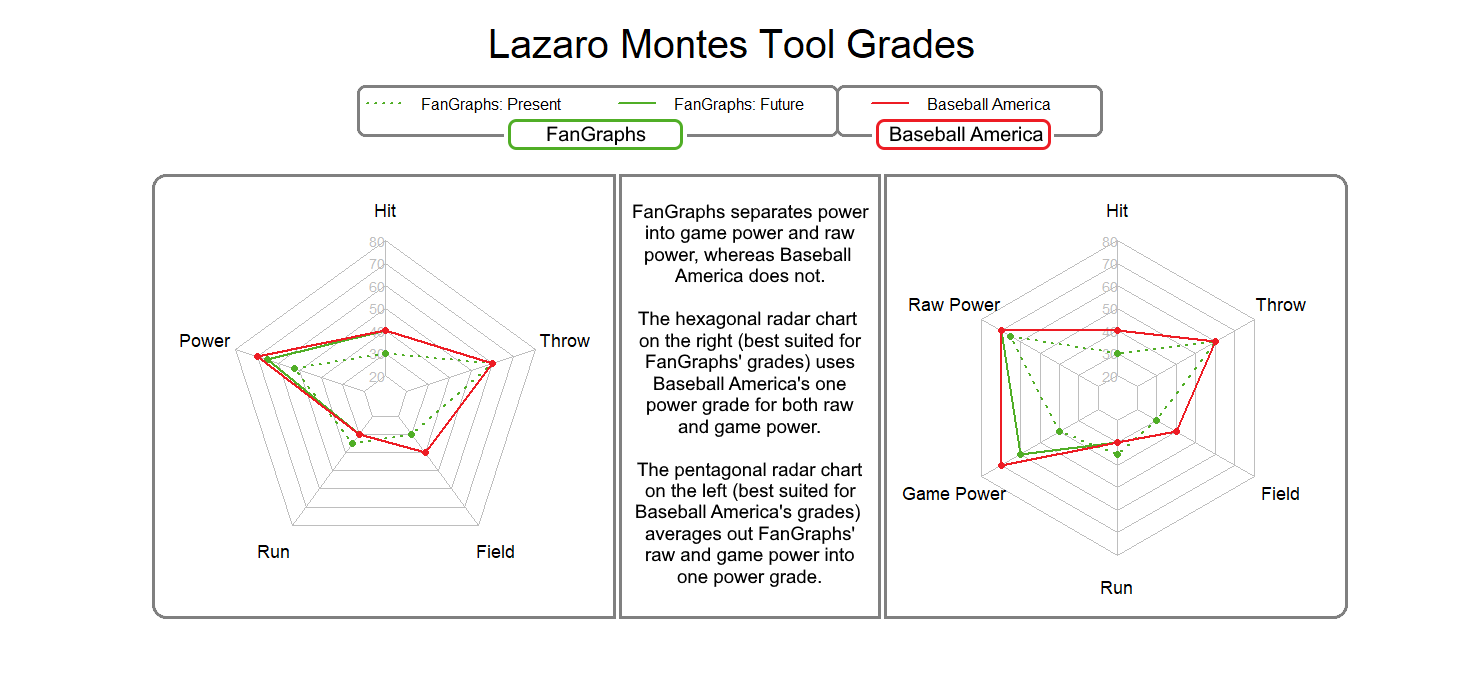
These radar charts show Baseball America and FanGraphs’ tool grades for Laz Montes. Based on his play in Spring Training, he could be said to have had something in the range of a 30 hit (6th percentile wOBA) and 65 raw power (89th percentile EV90) - exactly the same as FanGraphs’ “present” ratings! [/caption]
That’s not to say there weren’t good signs, however. Despite a below average 33.3% hard hit rate, Montes had a solid 90.8 mile an hour average exit velocity while the average exit velocity on the top half of his batted balls (EV50) was 100.3 miles an hour, a figure that would have marked him a little below average among qualified MLB players last year. The real positive, however, was that Montes’ EV90 - the exit velocity of his 90th percentile hardest hit ball - was 108.6 miles an hour, 89th percentile among everyone in MLB camp league-wide. Both EV50 and EV90 are more predictive than a pure average exit velocity, and those give somewhat different directional indications for Montes. But the ability to smoke a couple of balls even when clearly caught on the back foot by better competition is Montes’ silver lining here.
What does this all mean for Montes? Well, it’s not a great sign, but he’s only 21 years old and has time to improve. He will probably start the year off back with the Double-A Arkansas Travelers, with brass looking to see if he can best his .213/.319/.433 slash line there, and there might be a promotion to Triple-A in the cards to see how he fares against better pitching. Still, we’re probably looking at a 2027 debut for Montes at best, and that might be later in the year.
Tyler Cleveland isn’t exactly Tyler Rogers - and still needs to iron out walks - but there’s some good signs under the hood.
All things considered, I’m still fairly bullish on Cleveland. That’s not because he has the same name as the home of the Rock n’ Roll Hall of Fame but because he’s a submarine guy and “weird is good” is a helpful thing to keep in mind when it comes to pitchers (and especially relievers!).
Cleveland’s top line was pretty bad this Spring, with an enormous 22.50 ERA in just two innings pitched as he gave up six hits and six runs (five earned), walking three and striking out four. Looking at the underlying metrics gives us some interesting, if polarized, information. He had a stellar 51.8% whiff rate and 35.7% called strike plus whiff rate (CSW%) bolstered by low average exit velocity and hard hit rate, clear indications that his submarine pitches are confusing.
[caption id="" align="alignnone" width="2732"]
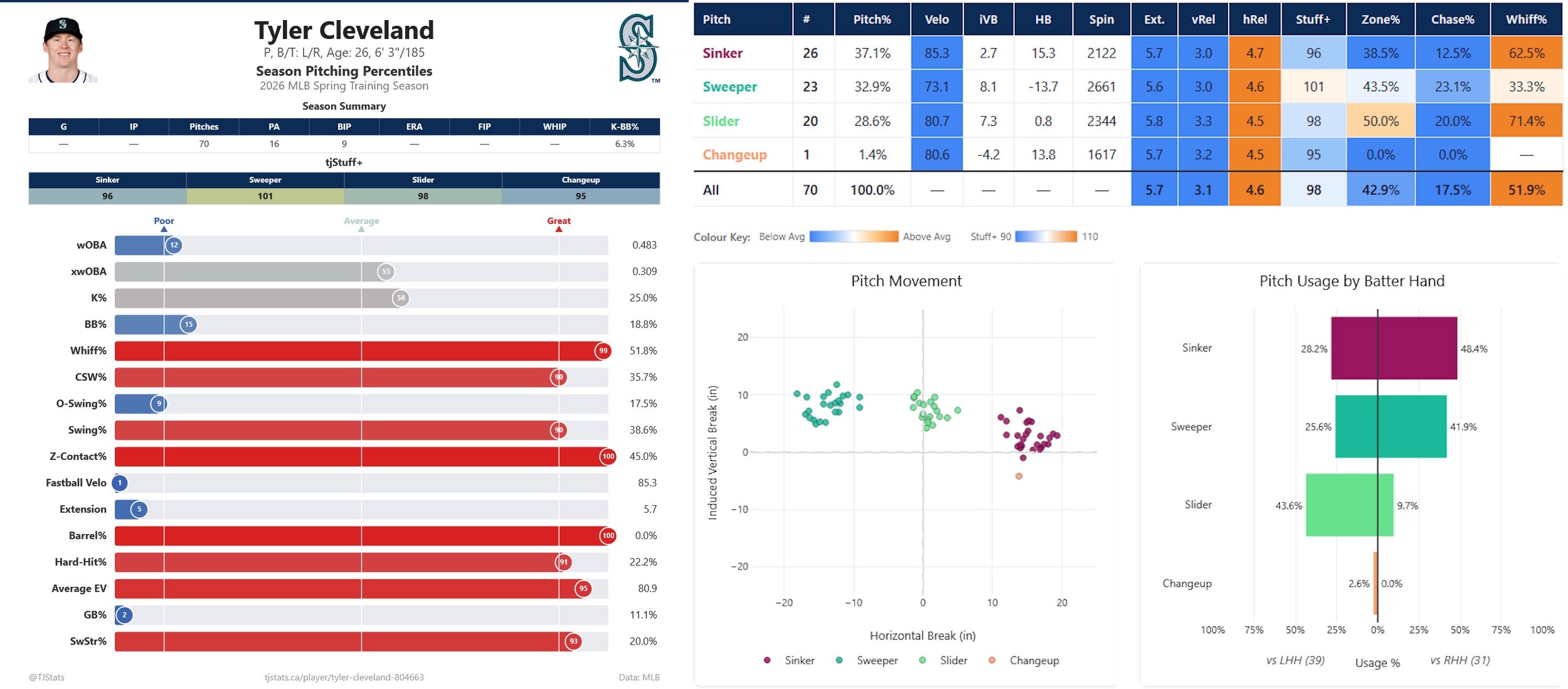
The percentiles chart on the left looks a lot like a list of high school football standings: lots really high, lots of really low, and a couple marks in between. Data courtesy of TJStats. [/caption]
It must be said, though, that both the bad and the good on the above graph would surely have evened out given more time. Directionally, however, most of this stuff is what I would expect to happen given his profile - except for one thing. Cleveland sported well above average ground ball rates in 2025, but an 11.1% grounder rate over his time in big league camp this year marked an intense departure. I’m not too worried given the miniscule sample size, but it’s something to consider.
Cleveland is often compared to fellow submariner Tyler Rogers, but I want to note that there are a fair amount of differences in pitch profile between the two. Rogers has two pitches, a sinker and slider that operate very differently to how those pitches do out of other guys’ hands thanks to Rogers’ arm angle, but Cleveland has three, effectively (ignoring the changeup): a sweeper with lots of gloveside movement, a sinker with lots of armside movement, and a gyro slider in between. All three pitches fight against gravity somewhat, which is different to Rogers’ mix of a sinker that has heavy drop and a slider that has comparable rise to some of the best four-seamers in the game. This makes Cleveland’s profile a little less unique than Rogers’, though he clearly still fools batters due to his arm angle.
The walks are probably the most worrying thing in his performance. Of the 70 pitches Cleveland tossed, just 33 (47.1%) [1] were in the strike zone. This was especially true of his sinker, which only went over the zone 38.5% of the time. He clearly has to work out how to keep himself over the plate against stronger opponents, and going back to Double-A Arkansas to start the year is likely his plan for 2026. I wouldn’t be surprised to see him with the Triple-A Tacoma Rainiers this year, too, though an MLB debut this season is a little more doubtful.
With Emerson Hancock putting things together in Peoria, Michael Morales is seemingly limited to being a depth option for 2026.
Although he’s profiled as a starter, Michael Morales’ only appearances this Spring were in relief, where he pitched 2 ⅓ innings to a 11.57 ERA with four walks and one strikeout. Despite fairly decent (though in need of improvement) control for both the High-A Everett AquaSox and Double-A Arkansas Travelers last year, Morales really struggled with control this Spring, throwing just 20 of his 51 pitches (39.2%) over the plate. It was a bad showing for a guy who profiled as a potential depth starter option, albeit behind Emerson Hancock, Cooper Criswell, and Dane Dunning.
[caption id="" align="alignnone" width="1465"]
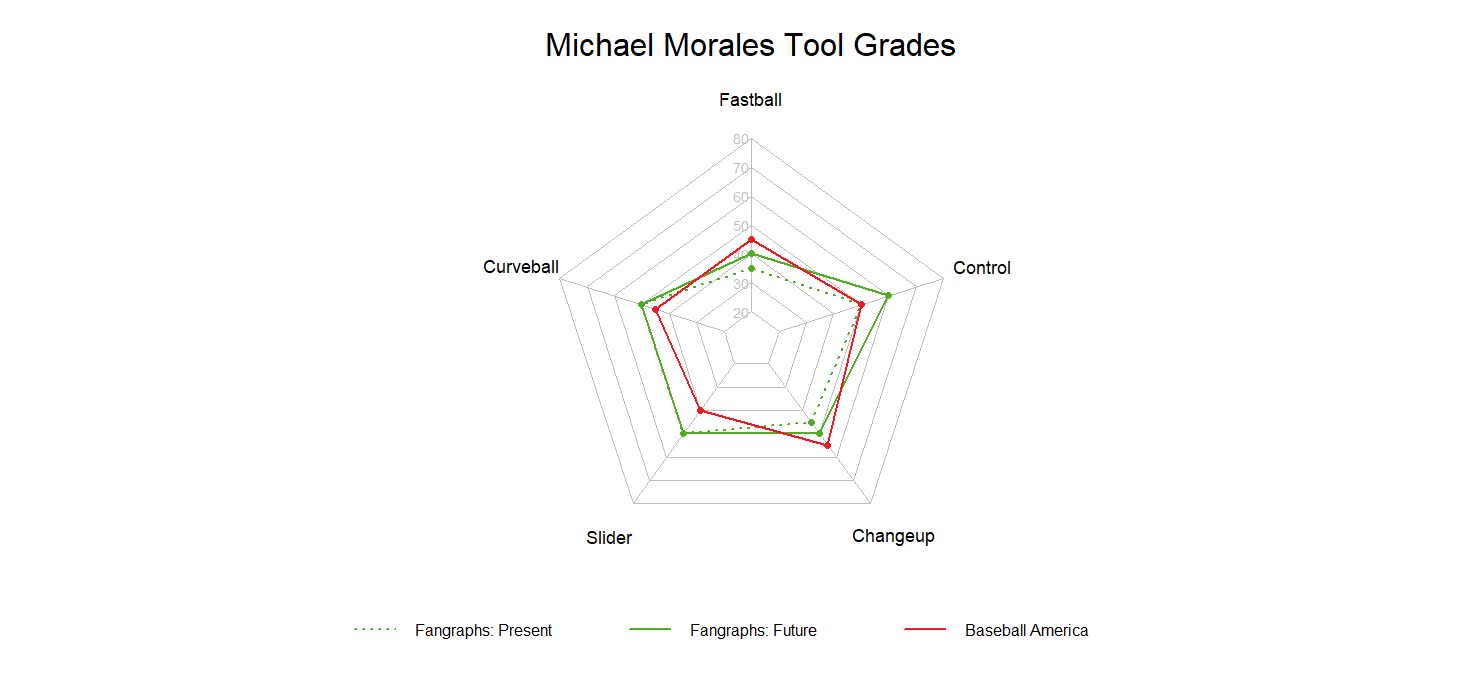
It goes without saying that Michael Morales did not live up to his solid control and command ratings during this year’s Spring Training. The M’s better hope it’s an outlier. [/caption]
While Morales has fought against his own lack of strikes in Peoria, Emerson Hancock has been throwing better than ever, seemingly getting a strong feel for the zone and cementing himself as the team’s sixth rotation option. Given a Wednesday setback for Miller, it’s looking increasingly likely that the Mariners will need Hancock or someone else to step into that role for the time being. Luckily for Seattle, not only is Hancock performing well, but so is Criswell, who has a 1.74 ERA in 10 ⅓ innings this Spring with 10 strikeouts and two walks.
This leaves Morales out in the cold, especially since he clearly needs some more development time in Triple-A (and potentially Double-A) before he’s major league ready.
Organizational depth remains organizational depth, while a pair of relievers will get reps in Triple-A to start out the year.
While Brennen Davis has given the Mariners unexpected hope for him, most of the team’s organizational depth pieces remain as such. Outfielder Spencer Packard and catcher Nick Raposo, who both have never made it out of the minors despite being in their mid-to-late 20s, are back in minor league camp and probably set to return to Triple-A for 2026. Pitcher Blas Castaño did see three innings of action with the big league team in 2025, but he has officially been placed on the Rainiers roster to start out 2026. So has reliever Domingo González, who has pitched pretty solidly so far. Both pitchers have a decent chance to make some relief appearances with the team in case of injuries higher in the depth chart - and the team is probably more confident about their big league futures than they are with Packard and Raposo - but Tacoma is their starting place for April.