Mariners Show Mediocre Makeup, Roll Over Dead in 5-0 Defeat to Royals

[caption id="" align="alignnone" width="4500"]
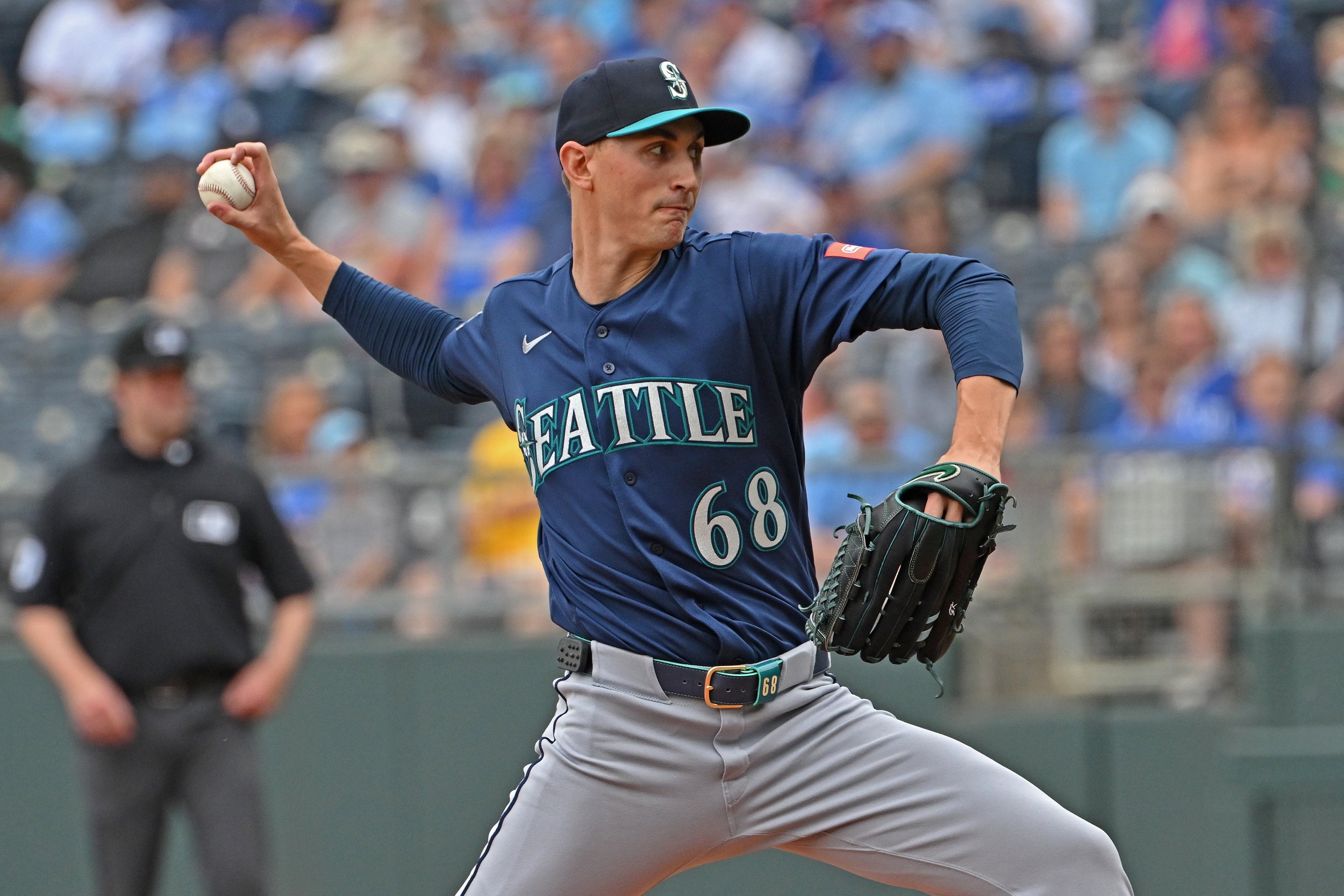
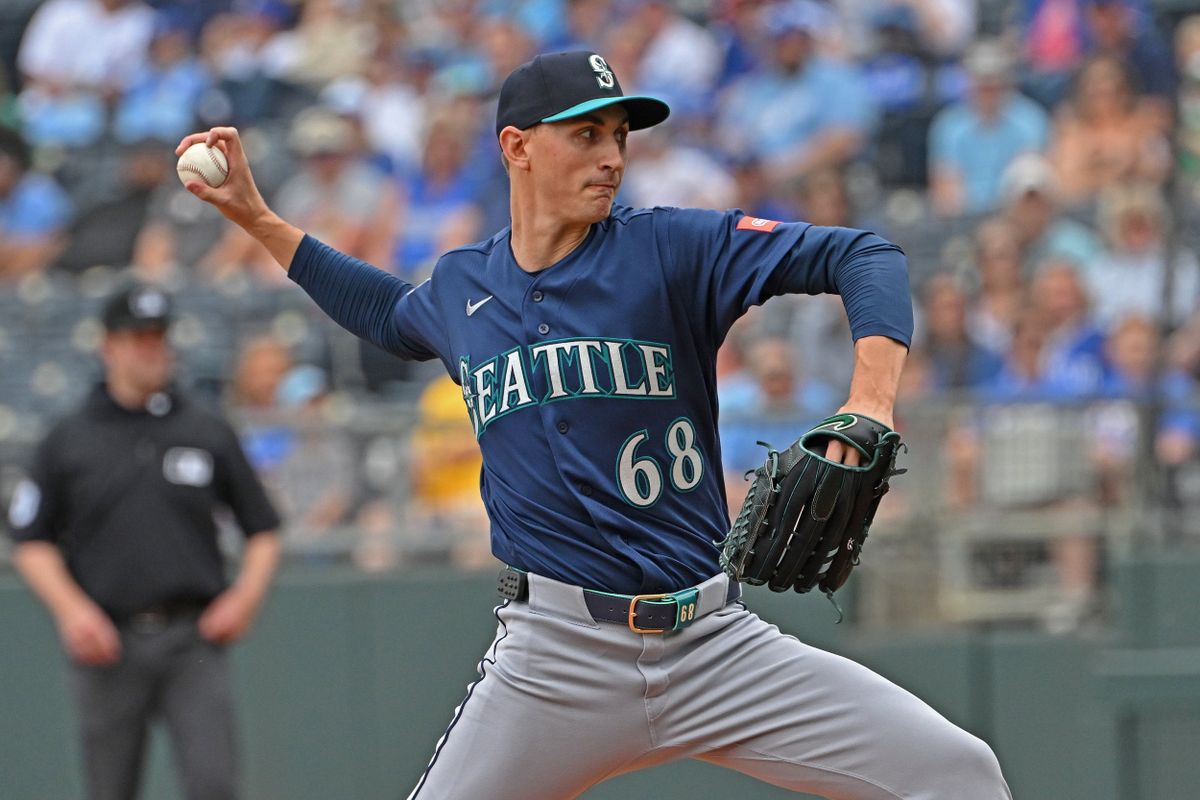
Seattle Mariners starting pitcher George Kirby (68) throws a pitch in the first inning against the Seattle Mariners at Kauffman Stadium. Mandatory Credit: Peter Aiken-Imagn Images [/caption]
Friday’s game, a 5-0 loss for the Mariners, was over in the first inning. It didn’t matter how many ostensibly good hitters were in the lineup, and it wouldn’t have mattered if Cal Raleigh had been healthy and swinging. George Kirby got the benefit of the baseball world’s decision in eons past to go with ERA instead of RA/9, therefore getting the quality start. In fairness to him, an error (this time J.P. Crawford quite literally dropping the ball while standing on second base when Cole Young sent him a toss for a force out, rather hilariously charged as a throwing error on Young) directly led to that first inning becoming a three-run frame instead of a one-run frame, but Kirby didn’t do well to avoid contact in those situations, with far too much tilted chucking down the pipe.
Royals starter Stephen Kolek cruised from the first inning to the last, becoming the fourth pitcher league-wide to log a complete game shutout. Simply by throwing strikes and forcing the Mariners to make contact, the hurler broke them down as a light touch breaks a rust-ridden nail. Despite striking out only two batters, the Mariners got just four hits in 32 at-bats. Outside of Luke Raley and Cole Young, they got none. The team barely even looked sharp enough to be in the defending-everything-means-defending-nothing zone of bad hitting; they simply appeared to give up right off the rip.
Perhaps that is a little inaccurate. After all, when Raley and Young knocked a pair of one-out singles in the top of the second, the M’s had the beginnings of some sort of rally. It was quickly snuffed out as Dominic Canzone swung at a changeup in the dirt and grounded into a double play.
The Mariners’ swing decisions were of a team that is given micromanaged take signs so often that they’re not able to independently which pitches to hit and which ones to leave be, especially when - as so often happens - early patience does not create high pitch counts for starters but instead forces the hitters on a backfooted path that they are seldom able to recover from. Once that second inning chance dissipated, each player on the Mariners sought to win the game all by themselves, losing the ability to get base knocks as they tried to rock the ball and somehow awaken their teammates.
Such an awakening never occurred. Inning after inning passed, and despite Kolek throwing some very hittable first-pitch strikes, his low pitch count meant he could get away with them as the M’s wouldn’t swing. He could then expand the zone, paint the corners on 0-1 counts, and depend on the Mariners being far less disciplined once behind by a strike.
The Royals, for all their issues on offense this year (and there have been many, as the Mariners’ combined shutout on Friday clearly demonstrated), attacked early strikes in the zone right from the beginning. Maikel Garcia, the leadoff hitter, saw a sinker go outside to go ahead 1-0 and then attacked another sinker up in the zone to crack the leadoff double that sent the Royals going.
That’s not to say that Kirby didn’t throw any good pitches, though, as he kept Bobby Witt Jr. swinging out of the zone on some sweepers, but Witt dribbled a ball over to third, and although Colt Emerson put in a strong barehanded effort, the Mariners third baseman didn’t have enough juice on the throw and it went slightly offline in any case.
“Yeah, it really does,” George Kirby said about whether the base hits tested his ability to stick with the process. “In those moments, you just gotta keep trying to stay in control. Try not to let those things bother you, just keep making pitches … I still think I’m doing a pretty good job at it. I just wish some of those weaker balls put in play would go my way.”
The aforementioned error came on the heels of mistakes from both Kirby and batter Vinnie Pasquantino. The former left a curveball right down the middle of the plate, the latter shanked it right to Cole Young, and it appeared like a potential double play.
Crawford, despite public willingness to move to third base since Emerson’s call-up, has not made a start at that position yet. This is, according to the team, due to lingering tricep soreness from being hit on that muscle by a pitch, but it’s unclear if there’s anything more at play. In any case, it’s very possible that the run of play could have gone wrong in other ways had the two left-side infielders been switched.
A run would have scored in any case and did so in the real event, with Garcia breaking the scoring fast on the fielder’s choice and error. Still nobody was out. Both runners promptly executed a double steal against Kirby, with catcher Jhonny Pereda’s quick throw over to third not in time to take out the lead Royal. Kirby kept both Salvador Perez and Carter Jensen out in front with sweepers, but since they were out over the plate, both made contact. Jensen’s grounder to first scored the run as Naylor took it to the bag himself rather than keeping his eye on Witt and throwing over to the covering Young for a bang-bang play.
Kirby returned to a legitimate mistake pitch against Jac Caglianone, with an 0-1 changeup left high in the zone and whacked into the outfield to score the third run of the inning. That was the last scoring play of the first, but it was not the end of Kirby’s woes.
It wasn’t until the fourth that the first batter of a Royals inning made an out. The second saw the leadoff man erased by a double play, but in the third, two leadoff singles again gave Kirby a jam. Despite Kirby and manager Dan Wilson implying that the Royals got lucky with weak contact, there were clear mistakes made by the starter to these batters. Kirby fell behind Witt 2-1 and tried to front-door a sweeper high despite sticking around that area of the zone for two of the first three pitches, and he fell behind Pasquantino 3-1 before sending a fastball up that the three-hole hitter simply drove into the outfield.
Perez and Jensen both put fly balls out and in so doing brought the fourth run home on a pair of sacrifices. Kirby finally got into a groove in the fourth and fifth, but a streak of 10 straight batters retired ended with an out in the sixth as Jensen floated a low curveball into right field and got to second on a groundout to Young (Jensen had been running on the play and thus denied Seattle a double play opportunity).
Isaac Collins shot a single up the middle to bring Jensen home. Julio Rodríguez got a decent throw off and Pereda applied the tag well and quickly, but Jensen was simply too fast for the Mariners to prevent Kansas City’s fifth run.
The failures of the Mariners offense on Saturday in particular are not worth spending too much time on, save what has already been said. Looking to the near future, however, it doesn’t appear that the Mariners are approaching anything like a winning season. In late April and early May, the hard cap stood at the .500 mark; now, that seems to have lowered to two games under, the point at which they cannot go further. Of their healthy batters, just four - Rodríguez, Randy Arozarena, Raley, and Canzone - sit above a .700 OPS, a coarse benchmark of averageness. Only Arozarena sits above .800. Just three Mariners hitters (Arozarena, Rodríguez, and Young) are among the top 100 hitters by Baseball-Reference WAR (bWAR) and FanGraphs WAR (fWAR), though the ordering is different among the two.
Josh Naylor, despite treading water since an early slump, is still underperforming expectations and has been a slightly below replacement player according to Baseball-Reference. His performance has been roughly equivalent to the third of a season that he put together in 2021, but his isolated power numbers (slugging minus average) are the lowest of his career since 2020. Just about the only thing keeping his value steady is his base-stealing ability, one attribute that has not declined year-to-year.
J.P. Crawford and Cole Young have seen steep fall-offs from earlier runs of form and are both well below a .700 OPS, with Young slowly but steadily approaching the .607 he logged last year and any arrival of a sneaky power surge absent beyond fits and starts (and in fact the attempt at developing such sneaky power appears to be leading to a bunch of rolled over grounders as he tries to pull the wrong pitches). Crawford’s performance has been carried by walks, but that is in turn driven by a level of two-strike contact that is likely unsustainable; despite his wishes to stay a “Mariner for life”, he would either have to be a very good defensive third baseman or somehow sustain his “hot” level of production over a full year (he has done this in 2023, at least) in order to be valuable as more than a bench and depth bat on any Championship-contending Mariners team in years to come.
That does seem to be the issue with this roster: there are no consistent stars. Rodríguez is pacing what would be the lowest value season of his career, and though he is known for recovering from slow starts, this one isn’t due to any deficiency with the bat; rather it is a decline in defense that at times looks fleeting and at other times looks permanent. Arozarena, the team’s sole consistent full-time producer outside of Rodríguez, will be a free agent after this season, and the team doesn’t appear ready to bring him back and his 2026 performance so far appears to be fluky (a near-.400 batting average on balls in play does not sustain itself even over a whole year).
Cal Raleigh is a wild card, as a post-injury return to something approaching form would spark some life in the M’s offense, but it’s also very possible that this season renders him a broken player in the combined mold of two Orioles - Chris Davis and Adley Rutschman - before him.
When it comes to the other two current producers, Luke Raley can only hit one side of the mound while Dominic Canzone remains far too inconsistent to be a true designated hitter, and the latter’s preseason trade value is likely dwindling fast.
That leaves Colt Emerson. Six games is little to go off, but he is currently slashing .118/.250/.294. Granted, that is better than either Raleigh or Rodríguez did six games in, but it is also worse than Jarred Kelenic did at this point of his career; again, there is basically nothing to go off of here. But the fastball weakness is clear, and that brings us to the main throughline, even more than the lack of high-end talent.
They can’t hit the fastball. Good-hitting teams do their mashing by crushing mistake pitches and being okay on everything else; the very fact that they mash when a mistake is made covers up a lot of sins. But the M’s are slightly better than the league at hitting secondaries and stuff on the edges … only to be far worse that league average on fastballs over the heart of the plate. A big part of it is pitch selection and the aforementioned overmanagement of red and green lights for the hitters, but when they do get these pitches, they all too often let them go to waste.
Perhaps it is a lot of things, but the team-wide issue indicates it’s something in training or teaching that is causing these problems.