Mariners’ Meandering Losses to Reds Leave Team Shrinking Breathing Room

[caption id="" align="alignnone" width="4450"]
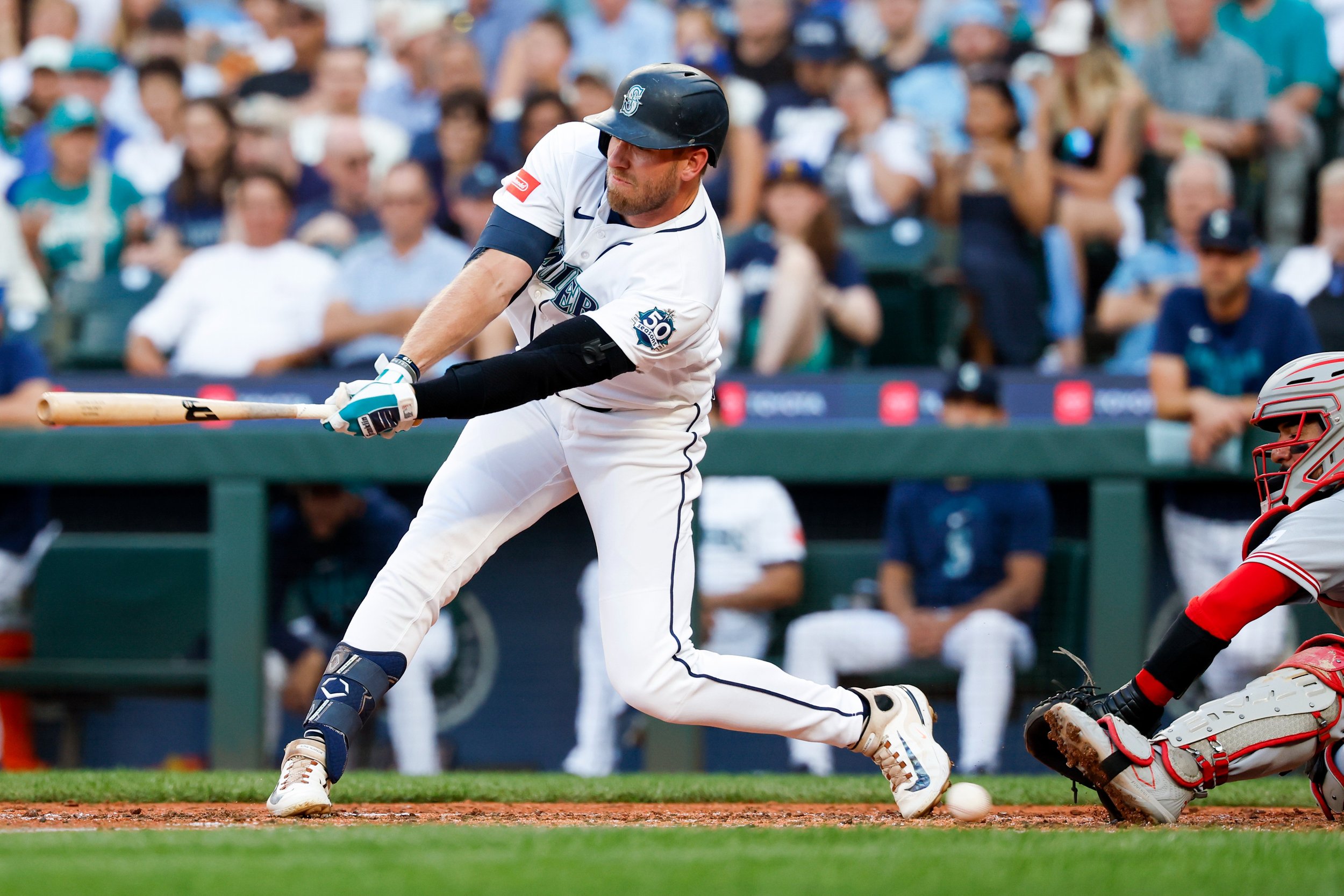
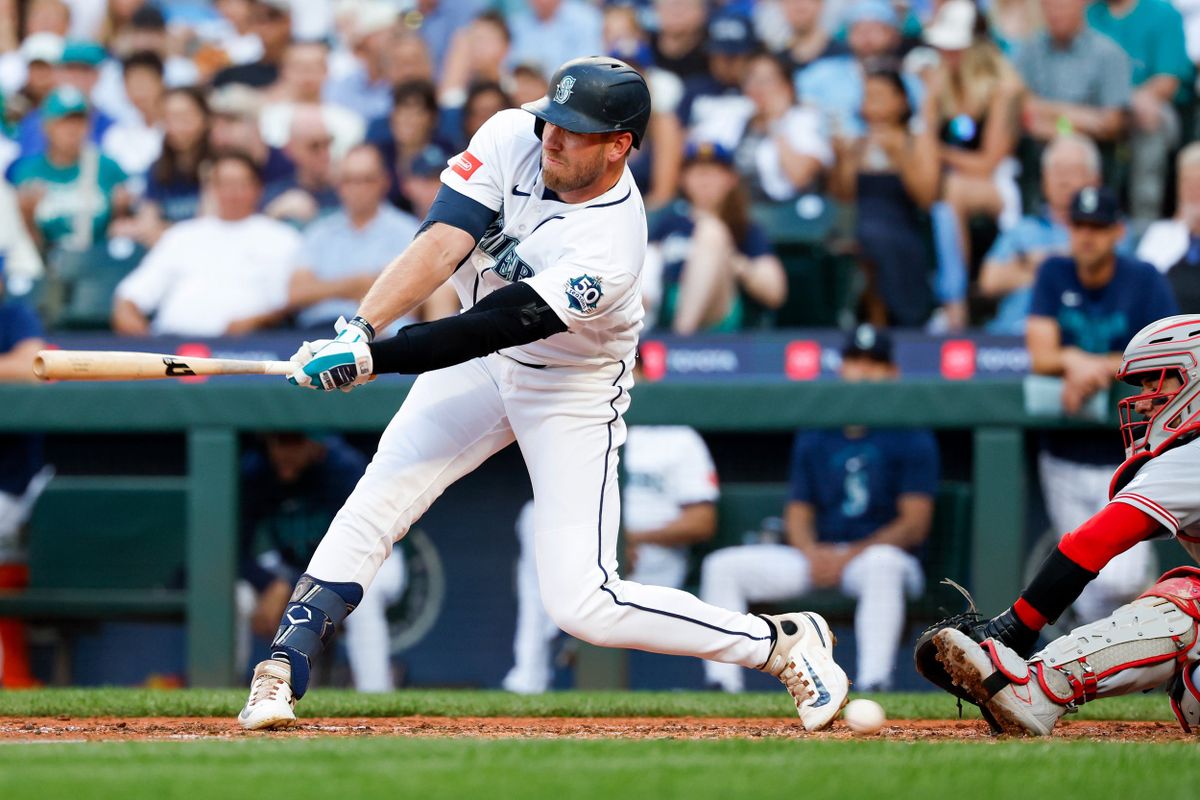
Seattle Mariners right fielder Luke Raley (20) strikes out swinging against the Cincinnati Reds during the fourth inning at T-Mobile Park. Mandatory Credit: Joe Nicholson-Imagn Images [/caption]
On March 31, 2026, the Mariners lost their sixth game of the season and fell to a .500 record. The team did so again on July 21, and in the 111 days between, they performed that same act thrice (June 20 and 25, July 9). Five times in between those days (April 3 and 29, May 29, June 29, and July 19), the M’s did the opposite, winning a game to get back to an even record.
Before the season, the team was held as one of the best squads in the American League. According to FanGraphs, they went into Wednesday’s matinee with the second-highest chance to win the World Series of any American League team, only behind the Yankees.
But the experience for the Mariners in 2026 has been a dreary cycle of drought and drenching. They get a set of wins and then the foot goes off the gas. They lose a bunch, struggle a bunch, and then get a cathartic burst of energy that sets them off for some wins. Rinse and repeat: 63% of the way through the season, they won half and lost half.
Wednesday wasn’t encouraging. Once again - this time by a score of 5-3 - the Mariners fell below .500, having lost the following two games of their series against the Reds to turn what could have been a momentum-bringing homestand into yet more water-treading.
Tuesday’s loss had been a little more of an encouraging one, with good at-bats during most of the game - other than clutch situations, as has been depressingly common with the team - and some good defensive plays by the Reds keeping Mariners runs off the board. But a mystifying decision by skipper Dan Wilson to put Michael Rucker in ended in a ninth-inning homer for Cincinnati and the complete dissipation of the team’s energy.
Both games were winnable, but the team plainly lacked the killer instinct to put the Reds away. Seattle is now 52-53; they would have to go 38-19 over the rest of the year just to match their win total from 2025. In more immediate terms, the losses continue their gradual, brick-by-brick immurement in the divisional race.
Any deficit was evidently enough for Dan Wilson to turn down the dials and put in the low-leverage relievers.
Rucker pitched in legitimate low-leverage during the M’s 8-0 win in the series opener, as none of the high-leverage arms were needed with Seattle’s giant lead. But although Jose A. Ferrer pitched a scoreless eighth (by the skin of his teeth and with help from a Colt Emerson laser from short), Wilson brought in Rucker with a one-run deficit instead of Gabe Speier, Eduard Bazardo, or Andrés Muñoz.
The reliever gave up a home run to Nathaniel Lowe to make it a two-run lead for Cincy. This didn’t directly affect the result, as the M’s didn’t score anything in the ninth, but it clearly deflated the team’s will to fight, with the quality of the at-bats falling off a cliff in that frame. When asked about it after the game, Wilson didn’t give a very heartening response.
“We've got a quick turnaround again tomorrow, so you've gotta weigh all your options there, and ‘Ruck’ did throw the ball extremely well last night,” Wilson said after Tuesday’s game.
Seattle had a lead going into the seventh inning of the rubber match, with Emerson Hancock having tossed six innings of two-run ball. Eduard Bazardo, however - who entered the game with a 2.28 ERA - walked Edwin Arroyo and left a sinker out over the plate for Ke’Bryan Hayes, and with two outs and two on, his first-pitch sinker to Sal Stewart ended up in the right field seats. It didn’t even appear to be that much of a mistake pitch from the Mariners’ perspective, but it was just one that Stewart was able to get a handle on.
Still, even with a slim two-run deficit against a team with a weak bullpen (and with an upcoming day off due to travel), Wilson went to Cole Wilcox. Cincinnati didn’t score any more runs, but it was a continuation of the team’s strangely expansive definition of low leverage.
Just about everything fell in for Josh Naylor, but not without some down notes.
If one positive could be definitively taken from the two losses, it was that the long-struggling Josh Naylor went 5-8 with a double, getting some rare luck on some of those hits and increasing his OPS from .667 to .682. Naylor also stole a base in each game, with his second-inning swipe leading to a run on Cal Raleigh’s following base knock.
But in the biggest moments of each game, Naylor fell short. With two outs in the seventh inning on Tuesday, the Mariners walked the bases loaded, but reliever Brock Burke got Naylor to meekly ground out to first. It was one of many missed opportunities for the Mariners in that game, as they went 1-10 with runners in scoring position that day, but it threw some cold water on Naylor’s inchoate resurgence.
In the bottom of the ninth on Wednesday afternoon, Naylor fought for eight pitches against Emilio Pagán, but he shanked a heater right down the middle, and nothing began in that frame. It was much less of a missed opportunity than in the game prior, but it still shut the door on any potential late comeback.
The team’s woes have stemmed in many ways from Naylor’s continued struggles, as his below-average hitting and bad defense have led to Naylor being a below replacement player during the 2026 season. This does mean that, despite the losses, Naylor’s performance was a bright spot, but it will have to continue into the future in order to mean much.
Colt Emerson’s slump at the plate continued apace, continuing questions of how long his opening runway extends.
When Emerson was brought up to the majors in May, Mariners general manager Justin Hollander mentioned an extensive runway for the young shortstop. When he began his career with a .910 OPS in his first 17 games, it appeared that he might be on the road to a Kevin McGonigle-esque immediate running start in the major leagues.
But since that point, Emerson has a .156/.217/.248 slash line with just four extra-base hits in 34 games. He has struck out in 35.5% of plate appearances during that time and walked 6.6% of the time compared to a 29.5% strikeout rate and an 8.2% walk rate during his first 17 games.
A lot of his early success was pure luck, but he did have a better process at the dish during these first games: he swung at 69.6% of pitches in the zone and 26.8% of pitches outside the zone, a difference of 42.8 percentage points. But in the following 34 games, he has had a 65.6% zone swing rate and 43.5% chase rate, a much smaller difference of 22.1%.
That difference - which doesn’t have a great statistical name aside from “Z minus O” but serves as a good representation of swing decision-making - went from almost 90th percentile league-wide to around second percentile league-wide.
And while Emerson managed a hit in the first game of the series, he didn’t get on base once during each of the losses. His defense still has a lot of value, but it is clearer than ever that he needs to reign in his free-swinging in order to finish the year in the majors.
The Mariners let their foot off the gas on Wednesday, and their continued off-on cycle raises mindset questions.
When Luke Raley hit a two-run single in the fourth to put the Mariners up 3-2 on Wednesday, it was the culmination of a big adjustment the M’s had made against Reds starter Brady Singer. Having initially tried to lift the ball against Singer as is the Mariners’ typical mode of attack, Singer’s high two-seamers quickly forced them to take more of a line drive approach to hitting.
But it was a culmination in the Clausewitzian sense: the point at which an attack loses its ability to continue. Once the Mariners had the lead in the fifth and sixth, the team sputtered offensively, seemingly content in their one-run lead.
The fruits of that contentment were evident when Stewart hit his game-winner in the seventh. Singer was on 70 pitches after four innings, just a frame away from being knocked from the game had the M’s pressed their advantage. Singer pitched well into the seventh in spite of that, with the only hit in the fifth or sixth being a Randy Arozarena single that evaporated with an ill-advised stolen base attempt.
Whether it is the lack of a so-called “killer instinct” or something else entirely, that inability to finish off the Reds when they could have may stick in their minds for some time. But they can’t dwell on spilled milk for long, as the next four games could determine the season.
The four-game series in Texas may be the moment the Mariners’ chances run out.
So far this year, the weak American League has given Seattle one opportunity after another to put their mediocrity behind them, opportunities the team has not yet seized.
But if the Mariners - now a game below .500, a half game beneath the Rangers, and set to face a gauntlet of tough teams in August - tread water in the series, the bricks in the immuring wall will grow higher. A series loss or sweep at the hands of Texas in their upcoming four-game set would likely spell the end of their divisional dreams.
Only a series win or a victory in all four contests are outcomes Seattle can view as acceptable, lest they be wholly upended by the guns of August.