Another “Rock” Detonation Raises Rotation Questions for Mariners

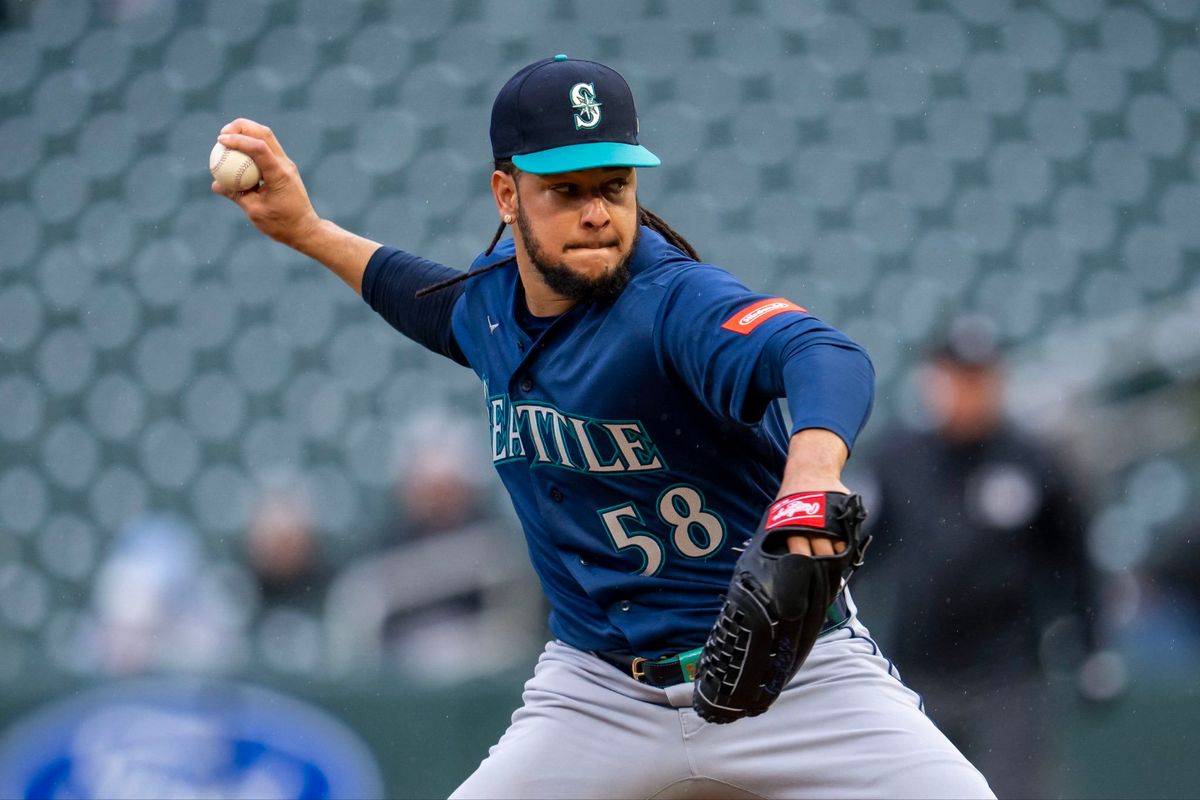
[caption id="" align="alignnone" width="2048"]
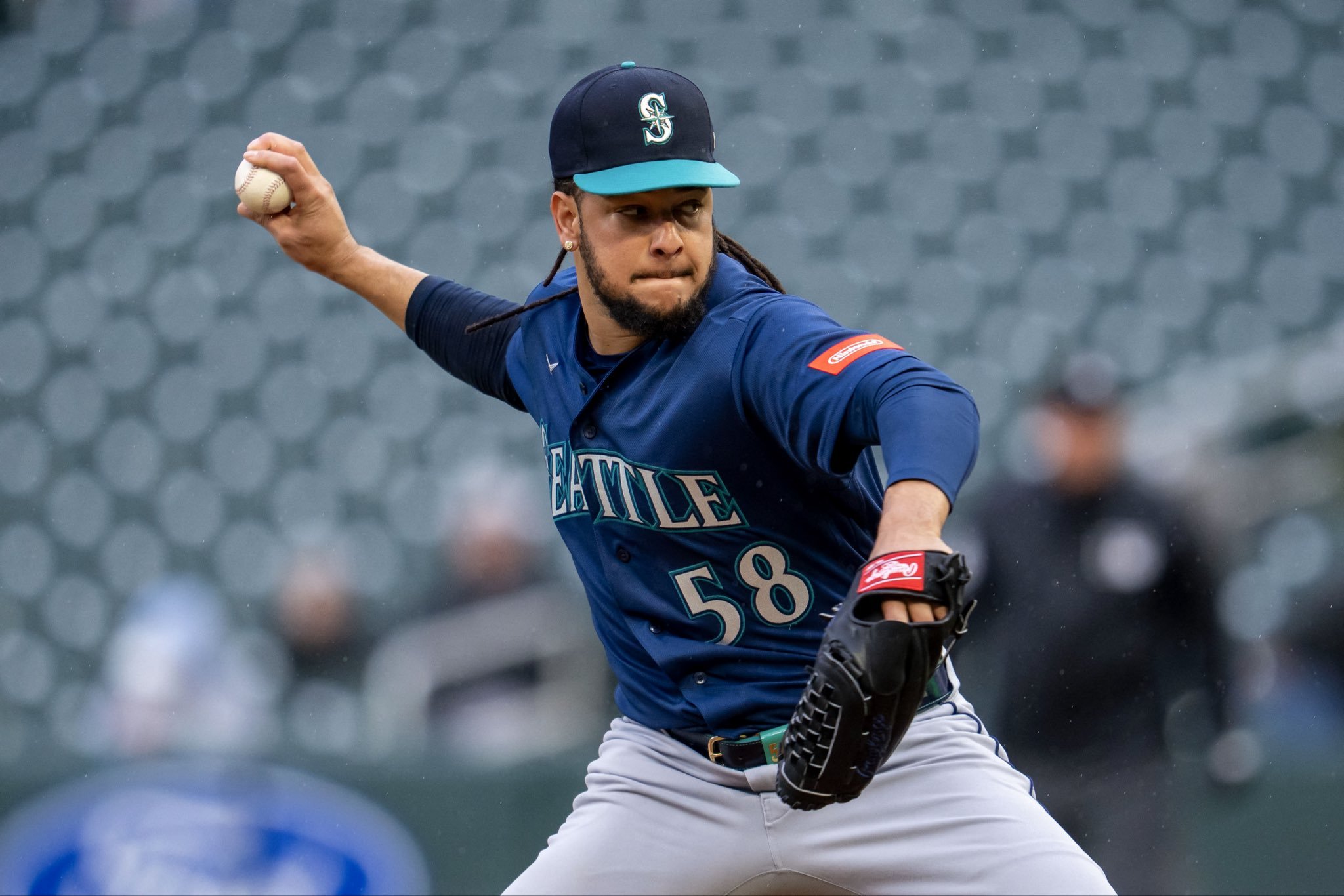
Seattle Mariners starting pitcher Luis Castillo (58) delivers a pitch against the Minnesota Twins in the first inning at Target Field. Mandatory Credit: Jesse Johnson-Imagn Images [/caption]
In Luis Castillo’s first start of the season, he blew down the New York Yankees with basically two pitches: his four-seamer and slider.
Over the following five outings, Castillo has given up less than four runs just once and has not finished a single sixth inning. Over that time, he has given up 35 hits, 24 runs, and 20 earned runs in 22 ⅓ innings, an 8.06 ERA over that time. “The Rock”, as of late, has been migmatite: a mix of metamorphic rock being molded and folded by time and volcanic igneous [1] rock associated with eruptions and explosions. Not very gneiss.
Five of those innings came on Monday night in rainy Minnesota. Although in his previous four starts (also struggles of outings, though not without bad defense behind him), he had struck out 16 and issued seven walks while giving up two homers - it was all hits in the field that had sunk him - Monday’s game was bad in the so-called three true outcomes and bad in the actual result. Castillo gave up two home runs, walked two batters, and struck out three. He gave up seven hits in total and just as many runs.
The Mariners’ loss on Monday started and ended, mostly, with Castillo’s bad start. Sure, debutant Alex Hoppe’s second inning of work fell off the rails as his control waned and hitters adjusted to his slider, but the M’s had essentially decided on pushing Hoppe as far as they could to mop up the game. Sure, the Mariners offense took quite a while to wake up, but they managed to put four runs on the board.
The question has to be raised: does Castillo’s slump warrant a change in outlook for the Mariners about how to utilize him for the rest of the season?
The first and fifth innings were the only frames where Castillo looked like the solid rock that the M’s have relied on for years, getting through those frames in 14 and 13 pitches, respectively. During those innings, he was able to get weak contact and effectively mix his four-seamer, slider, and even a few changeups.
That was about as good as Castillo’s pitching got on Monday. He kept too much of his stuff over the lower part of the plate against plenty of batters in the second, third, and fourth, starting with a leadoff Josh Bell who touched up a changeup into right to begin the second with a single. Although he got one out quickly, he plated one too many heaters to Luke Keaschall and the Twins second baseman ripped it into right field, made worse by a bit of a bobble by right fielder Rob Refsnyder as he picked it up and Bell roared around third.
Luckily for Seattle, Refsnyder’s arm is pretty solid. Even more fortunately, Cole Young delivered a strike to Mitch Garver at the plate, though it still wasn’t as quick as the average infielder might bring home. But although home plate umpire Gabe Morales’ call on the field was that Bell was out, replay review showed that Garver hadn’t applied the tag, and the Twins had their first run on the board.
Castillo managed to work through some of his own wildness, with a hit by pitch and a walk loading the bases before getting the final out. But his difficulty in mixing heights and keeping stuff off the middle of the plate caught up with him in the third and fourth innings, both of which featured home runs.
A misplay by Julio Rodríguez allowed Trevor Larnach to third and Bell didn’t bite on a couple of close sinkers before taking a walk before Ryan Jeffers slapped a single and Kody Clemens caught up to a fairly slow fastball up and in to drive a three-run homer and make the score 5-0 in favor of Minnesota. Castillo’s sins in the fourth were two hanging sliders, one that became a single to right and another that became a Byron Buxton homer in rather Glenallen Hill-esque fashion, as the Minnesota center fielder seemed to half-swing before launching it into the upper deck in left. For Castillo, it marked a seven run blowup start and a bad continuation of early-season struggles in 2026.
What should one make of Castillo’s struggles to begin 2026? To begin with, his ERA of 6.35 is the worst six-game start of a season for him since 2018, when he began the year with a 7.85 ERA en route to a 4.30 ERA for the season. As for a five or more game stretch with an 8.06 ERA, the last time Castillo did that was during the six games between April 25 and May 23, 2021, when he had an 8.68 ERA.
ERA isn’t necessarily the most predictive metric, however. Going one level deeper to fielding independent pitching, which takes out singles, doubles, triples, and field outs - things reliant on defense - to leave an ERA-scaled stat based on homers, walks, and strikeouts, he has racked up a 5.22 FIP in his last five starts; while that isn’t nearly as bad as his ERA, it is still far elevated from his usual numbers, even in a year like 2025 when he overperformed what might be expected based on his FIP.
Castillo has had three stretches of worse FIPs in the 2020s, perhaps of some comfort to a Mariners team that needs him to perform to at worst a fifth starter caliber and hopes for a repeat (or at least not a steep decline) from his strong 2025. There is precedent to this, and he has worked out of it before.
But for an aging contact pitcher, there is always the possibility that hitters may no longer consistently top or shank the pitches he throws, and when that happens, bad starts become more frequent. And as he has to re-incorporate the changeup given opposing hitters’ greater grasp on his sinker, there will be those moments where he lacks proper feel. The task of any pitcher in the league (especially a 33-year-old) is to adjust and counter others’ adjustments; for “the Rock” getting his season back on track will require changing to fit is diminishing skillset. Metamorphosis, if you prefer.
Aside from the fact his walks and homers belayed a worse underlying performance on Monday, a noted decline in fastball velocity as compared to the rest of 2026 was the most obvious way in which Castillo struggled. He averaged 93.5 miles an hour on his four-seamer, over one and a half miles per hour slower than usual for this season. His sinker was about two miles an hour slower than usual. These velocity dips were completely unlike his previous four starts, where most of the crooked numbers could be chalked up to defensive issues or batted ball luck.
This decline in velocity directly affected Clemens’ home run, as he likely wouldn’t have been able to effectively turn on such an up and inside pitch had it been a couple of miles an hour faster. In general, of course, a quicker (and better located!) fastball might have kept the Twins more on their toes and prevented the flow they got into during Monday’s game.
Do Castillo’s struggles warrant a move to the bullpen upon the return of Bryce Miller? Probably not. The Mariners will have to see whether Miller himself can return to form, as his performance in the 2025 season (outside of the playoffs, where he more than rose to the challenge) didn’t exactly arouse confidence. And in any case, the way Castillo pitches would only fit in the bullpen as a long reliever (for which he is overqualified) and the $24.15 million contract he has likely means that the team will want to get the most out of him. The M’s are banking on Castillo’s recent slippage being an outlier.
If starts like Monday’s where his control suffered and his fastball lost its zip build up, perhaps that might change - but for now, Seattle’s outlook is probably little altered.
The Mariners are most likely to go to a six-man rotation upon Miller’s return, with an Emerson Hancock move to the bullpen probably unlikely given his strong start to the season and an extra resilience in the face of pressure that seems to be genuine. The danger of this is that it will remove one reliever from the bullpen, probably the slot currently filled by Hoppe. The team is built on the idea that each of their starters will most often provide solid outings, but as recent form for even Bryan Woo has shown, that won’t be true all the time.
[1] The igneous component of migmatite is intrusive igneous rock, which doesn’t form due to blowing up, but puns supersede geologic accuracy.