Mariners Lose Batting Fight in Spite of Strong Glovework, Drop Series to Marlins

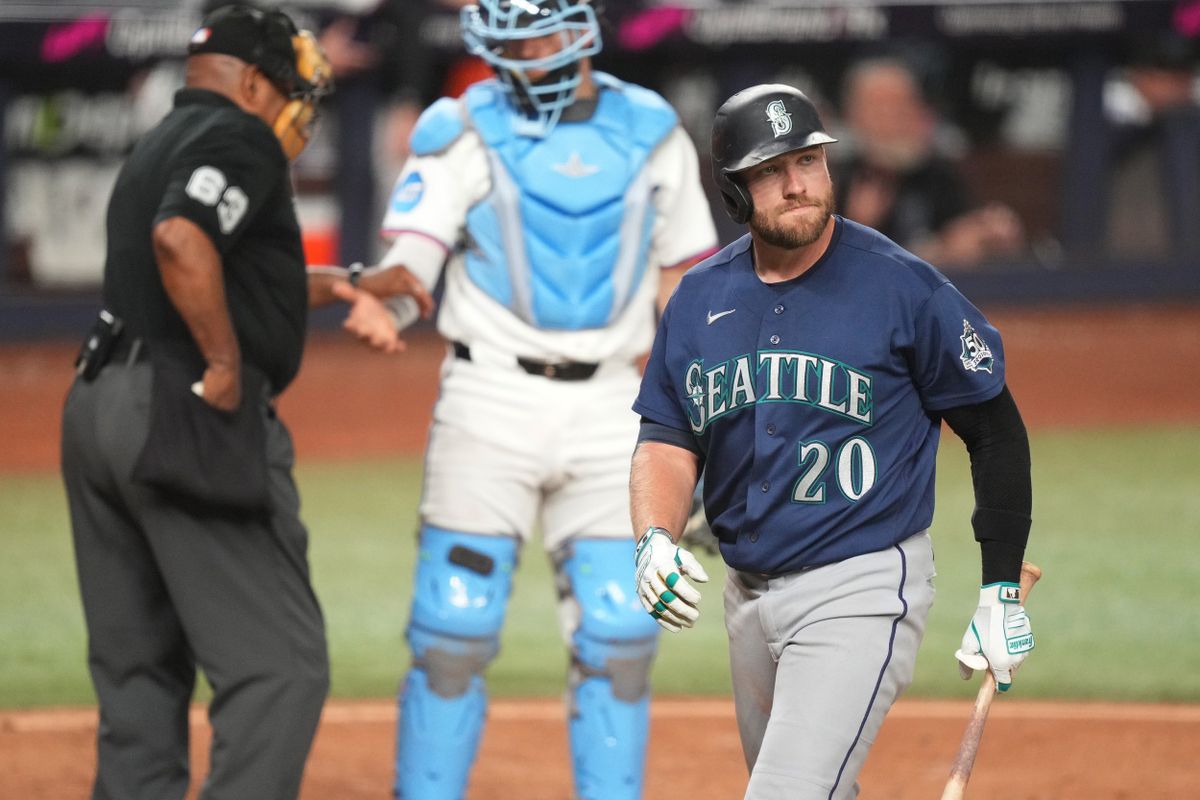
[caption id="" align="alignnone" width="4113"]
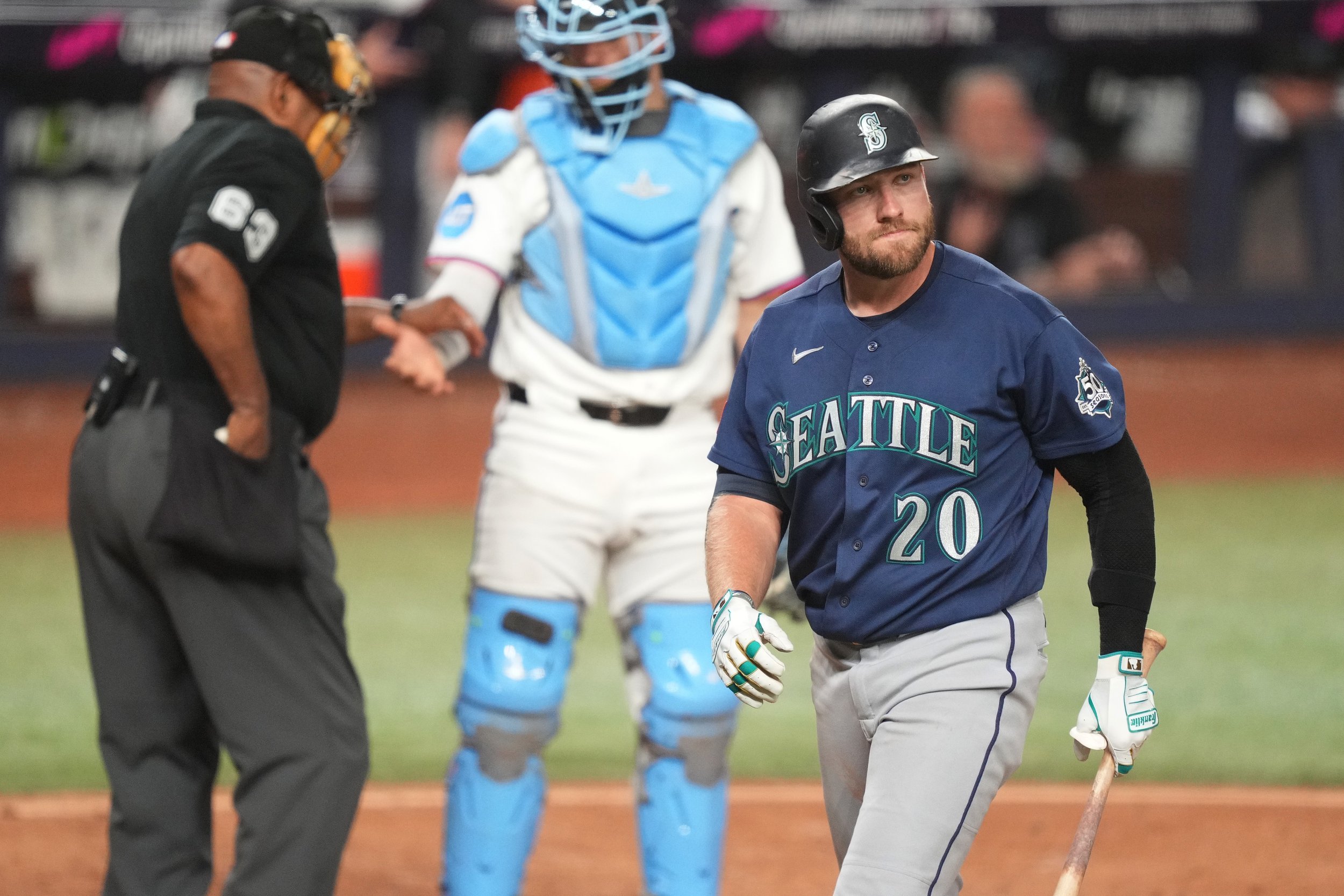
Seattle Mariners right fielder Luke Raley (20) walks back the dugout after striking out in the 9th inning against the Miami Marlins at loanDepot Park. Mandatory Credit: Jim Rassol-Imagn Images [/caption]
“It’s not the size of the dog in the fight, but the size of the fight in the dog.” It’s one of those quotes that is older than its normal attribution (in this case, Dwight Eisenhower). Today’s common formulation of the phrase may indeed trace back to a coach at the University of Washington back in the late 1920s, but as with so many things that are said before they are written, its true origin lies somewhere in the primordial mud of history.
Many on the Mariners - especially skipper Dan Wilson - often discuss the team’s fight and willingness to claw back from adversity. But the defining moment of the team’s 2-0 loss to the Miami Marlins on Wednesday was its very end: with both ABS challenges available and two outs in the top of the ninth, Cole Young watched a 2-2 pitch outside get called strike three to end the game. He did not issue a challenge, simply hanging his head in shame as he walked back to the dugout. The brief window of time to get his team a lifeline passed quickly.
“I think sometimes that's not the first thing that pops into your head in that kind of a situation,” Wilson said, “but you still have to remind yourself sometimes about the ABS.”
But as they say - once is a happenstance, twice is a coincidence, and thrice is a pattern. The Mariners have had games like Wednesday’s, where players across the lineup leave things on the table, plenty more times than that in 2026. If the players aren’t clawing and biting and fighting for every inch, if that aspect of the game is not a habit, then how deep of a well of resolve do the M’s really have? If the guy up at the plate with two outs in the ninth inning isn’t aware that the team has both challenges, how much water is this ship leaking?
The fight didn’t show up on offense, at least, though the M’s defense bailed themselves out of worse trouble. In a way, it was an inverse of Tuesday’s series opener when late action from the Mariners bats wasn’t enough to counteract the team’s defensive sluggishness. It was a loss all the same.
Cole Young and Colt Emerson had a mixed day defensively, but big efforts from three other Mariners kept more Fish off the board.
It’s hardly a rare day when the Mariners lose, but it is quite unusual to see both Young and Colt Emerson make big mistakes on defense. Both are still learning the ropes on all sides of the ball, but the young middle infield duo have already shown solid chops with the glove.
Miami already had a run on the board by the bottom of the third, but a slow jump by Emerson on what should have been a fairly routine grounder to short allowed it to sneak through for a Javier Sanoja base hit. Victor Robles’ own slow jump on the ball in center allowed Sanoja to hustle into second.
To this point in the series, the Mariners defense had clearly been caught off-guard by the degree of the Marlins’ aggression and willingness of their opponents to scratch out every extra foot on the field. But to the credit of those in the field, they began to turn on the jets.
Luke Raley, not necessarily known for great defensive play but certainly known for his hustle, got a pristine jump on a floater towards the bermuda triangle. Sanoja clearly thought the ball was bound for the outfield grass and took off towards home, but Raley dove and snared the ball for one out before tossing to second for a double play.
The notably uncommon Young miscue came next, though perhaps it can be excused by circumstance. Otto Lopez lined a screamer off the glove of pitcher George Kirby and the ball ricocheted slowly towards the second base bag. Young approached it and got turned around as the ball kicked off the base - usually an item no fielder can be blamed for - but in this case, the ball was clearly headed for a bounce off the bag. It didn’t seem that Young sped up to intercept before that happened, nor did he slow down to anticipate the ricochet.
Again, it was a bizarre enough play to be perhaps excusable. But it became a run for the hosts as Xavier Edwards whacked a triple down the right field line; with the state the Mariners offense was in, every run mattered dearly.
This was a lesson the defense had fully picked up by the time the fourth rolled around. With a man on second for the Marlins, Jakob Marsee chopped a ball over to Emerson at short. Thinking quickly, the rookie swung his body as if to throw to first - causing the runner Heriberto Hernández to begin moving to third - but then charged for Hernández to get the lead runner out. It was a risky play, and a less confident player would have been better advised to simply go to first, but Emerson sensed he had the ability to turn a runner at third into a runner at first and did so.
That inning ended soon after, but Miami’s constant threats did not. Lopez took advantage of a hanging 2-1 sweeper and sent a two-out double into center, turning what could have been a clean inning for Kirby into yet another dicey moment. Edwards fired a hit up the middle and Lopez quickly rounded third. With the Mariners’ usual (lack of) ability in making throws from the outfield or making tags at the plate, it seemed like a surefire run for Lopez.
Robles wasn’t taking any slow jumps this time, launching the ball towards home. Raleigh grabbed the ball to his right and rapidly swung left to plant his glove on the sliding Lopez. The Mariners execute such a play about as often as Bam Adebayo scores 83 points in a game, yet they did on Wednesday.
And thanks to the meager efforts of those same players on the other side of the ball, none of it mattered.
The Mariners got shut out for the eighth time in 2026, in a three-way tie for third in MLB.
It’s not nearly the best measure for a team’s batting performance, but the amount of games a team gets blanked can say something about their hitters if that number is drastic enough.
The M’s are now on pace for 14 shutout losses. That isn’t a death sentence in and of itself - 10 teams have been shut out 14 times in the regular season and gone on to make the World Series since the implementation of the 162-game season - but it usually doesn’t indicate greatness. Of 328 such teams since 1961, 86 had a winning record: that’s just 26.2%. That number recontextualizes the 10 aforementioned teams as 3% of all teams to suffer 14 or more shutout losses compared to an average of 7.5% of all teams since 1961.
Not that the shutouts themselves are the cause of this decreased production; they’re both downstream of the kinds of bad offenses that produce losing teams.
There are many other ways to describe the futility of the 2026 Mariners offense, but the way they played on Wednesday should suffice. They got five hits in 31 at-bats (.161 average) and reached base eight times in 34 plate appearances (.235 on-base percentage). None of the hits they had were anything other than singles. At one point, 16 of 17 consecutive hitters made outs.
Seattle at least managed to get some guys on base in the first couple of frames, with a pair of singles in the first and a pair of baserunners in the second, but that first inning half-rally came with two outs and a double play interspersed the two runners in the other. A pair of free passes with a wild pitch mixed in made the fourth inning interesting, but as Emerson’s two-out grounder finished the frame, the M’s became entirely dormant until the ninth.
Josh Naylor, the only Mariner hitter to reach base twice, flicked a one-out single to left and got to second on defensive indifference, which of course brings us back to Young’s missed challenge.
George Kirby’s quality start lowered his ERA to 3.76, but he made enough mistakes to suffer the loss.
Kirby had two clean innings on Wednesday, the first and the sixth. All the others had some sort of issue he had to deal with, and though some stalwart defense scooped plenty of it up in the later innings of his start, he didn’t have the kind of cushion for the team to withstand the errors he gave up.
As he has over much of his recent work, Kirby threw the kitchen sink at the Marlins, with the sweeper - making up 31 of his 86 pitches - his most common pitch on Wednesday, but plenty of four-seamers and sinkers alongside some changeups and curveballs.
Perhaps Kirby shied away from the curveball after Kyle Stowers launched a hanging hook 416 feet to dead center field in the bottom of the second. It was the first pitch of the inning, and it proved to be the game-winning run (though of course nobody knew that fact at the time). Kirby’s few other hanging breaking balls made up the majority of the Marlins’ extra-base hits, but beyond that, he pitched solidly, striking out seven and walking one.
Kirby’s sinker didn’t get any whiffs, but he had plenty of swing and miss on his other pitches against a Marlins lineup that doesn’t whiff very often.
By the time Kirby left the game, the M’s trailed by two, the same deficit the Mariners overcame in the top of the eighth (and then lost in the bottom half) the day prior.
Nick Davila spun two quick innings in his hometown, giving a preserved bullpen as the team’s only silver lining.
Perhaps Wilson should have, in principle, gone to his better leverage arms with such a small deficit. Perhaps such a pitching choice might have woken the Mariners dugout sooner to the reality that the game was still winnable. But his choice to go to Nick Davila for the final two innings ended up working to keep the score where it was regardless.
Davila hails from Hialeah, Florida, a suburb of Miami - making this a return home from the other side of the Lower 48. Davila thought this would have an effect on how he mentally viewed the outing, but when he got out to the mound, he found that notion false.
“Was not like I thought it was gonna be,” Davila said. “Simple, same nerves I usually have before a game.”
Davila isn’t a swing-and-miss pitcher, but he did a good job playing to his skillset of getting weak contact on the ground with his slider. The aggressive Marlins wound up playing into his hands as they didn’t manage to find any outfield grass against him, going down on 15 pitches in Davila’s two innings.
Had the Mariners managed to come back in the ninth, Davila’s efforts would have been a key reason for such a success. Even without a win, he still managed to give a day of rest to the top guys in the bullpen.
On Deck
If that bullpen restedness is going to matter, the Mariners have to put together enough hits on Thursday to get a lead and keep it.
Bryce Miller, who has rocketed his stock towards something of an ace status over his month and a half or so with the team this year, will be pitching for Seattle. The Mariners bats, meanwhile, will face right-hander Janson Junk, who sports a 4.80 ERA in 11 starts this year.
Seattle’s two losses have allowed the Rangers right back within a half game of the division lead as the team dropped to 47-46 with their Wednesday loss. the M’s previous mistakes have shrunk the margin of error that the team can afford in the future. It will take plenty of fight to keep their place atop the AL West.