Miller Start Goes South, Mariners Lose 19-2 to Cubs

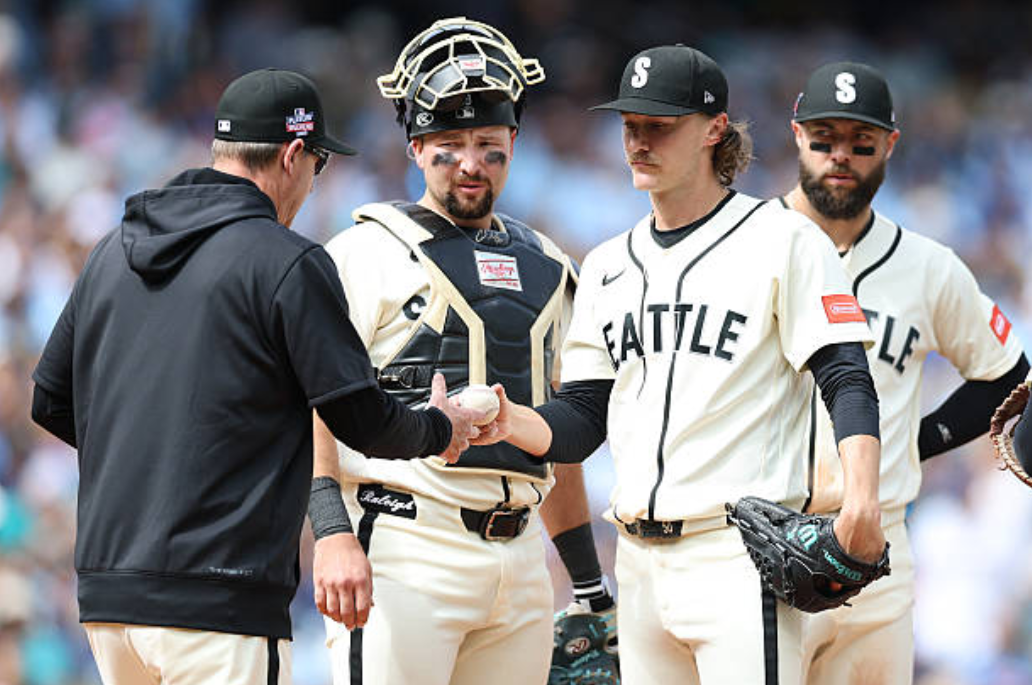
Bryce Miller’s previous start had become, for a given and quite load-bearing definition of “worst”, the worst loss in Mariners history, a 22-0 thrashing that began to be as humorous as it was maddening.
Going by that same run differential metric, Sunday was the fourth worst loss in team history, only behind their Milwaukee calamity, a 21-1 loss in Houston in 2019, and a 20-3 loss in Detroit back in 1993. It became the worst run differential ever in a Mariners home game, beating out three 16-1 losses.
The score was 19-2. Both teams left this series disappointed. Seattle, despite winning two out of three, had long since run out of games to punt, whereas the Cubs outscored their opponents 28-13 and lost the series.
“Today ended up similar to the other day, just kinda got out of hand, and those are tough ones,” said M’s skipper Dan Wilson. “Our team has shown the ability to flush them.”
While it is true that these awful losses haven’t set off any massive avalanches of failure, they haven’t been able to build any momentum from their successes, either. That’s why Sunday’s loss dropped them to 62-69, a record that would knock them out of commission in a normal year but one that barely keeps them afloat in the chase for the worst AL West since 1994, when the best team at the time of the strike was the 52-62 Texas Rangers.
Miller came into Sunday with a 6.57 ERA, 5.68 FIP, and 1.568 WHIP in his previous seven starts. Just once had he made it through six full innings, and the M’s had gone 0-7 in those games.
The first two innings went well enough for Miller, as he struck out three batters and didn’t give up any hits. Aside from one walk in the first, he was using all of his pitches to good effect in the zone at this point, and he even had some early run support as Randy Arozarena launched a leadoff homer in the bottom of the first and Victor Robles walked, stole second, and then stole third and made it home on an airmailed throw. Going into the third, it was 2-0 Seattle.
Despite a Michael Conforto homer to lead off the frame, the third looked like it would be another fast as Miller got two quick outs, one of them a strikeout of Pete Crow-Armstrong. But a walk to Seiya Suzuki set off a slow-moving cascade of failure. Michael Busch and Alex Bregman both walked as Miller fell behind each of them, and although he got to a 1-2 count against Ian Happ, the ensuing splitter dropped into Happ’s low-and-in wheelhouse.
Happ seared it off the foul pole for a grand slam. The game went from 2-1 in Seattle’s favor to 5-2 for the Cubs. As usually holds true, a starter can withstand any one of homers, hits, and walks - but any two in combination are killer.
“We talked earlier this week, like it felt like all of my walks in the last month or month and a half have scored,” Miller said. “But when you have seven walks, I mean, what do you expect?”
Miller struck out Nico Hoerner to end the third, but the damage was done. The M’s managed to squeeze another inning out of him, but although he began the fifth on 80 pitches and five runs allowed, there wasn’t anyone up and running in the bullpen.
That help was sorely needed rather quickly for Seattle. Miller walked Crow-Armstrong, then Suzuki, then Busch. Of the three free passes that inning, only the first was at all competitive; the final two took a combined nine pitches. By this time, the bullpen was finally going, but Bregman grounded into a run-scoring force at second before Jose A. Ferrer could come in and relieve him.
“The whole last month has been frustrating,” Miller said after the game. “But I just gotta get back to who I am … early, we threw all seven pitches in the first inning and I have confidence in all those seven, I just have to be more competitive.”
Miller’s continued run of duds - and the fact that Kade Anderson is now up with the MLB team - bring to mind the idea of having Miller finish the year out as a reliever. Now, this would be a twofold bet: that Bryan Woo is healthy enough to resume his spot in the rotation without issue, and that Kade Anderson will adjust quickly enough to big league hitters to be a consistently better hurler.
The upsides of such a move are hard to ignore, however. The M’s have a thin bullpen due to their six-man rotation and an even thinner one due to injuries to Matt Brash and Cooper Criswell; such a situation would be seriously helped by a pitcher who could go a couple innings at a moments’ notice when help is needed somewhere else.
The Cubs themselves proved this on Sunday. In the bottom of the third, right after Happ’s table flip, the M’s began putting the pressure on Shota Imanaga, as Cal Raleigh and Josh Naylor both singled to lead things off. Chicago swapped in Aaron Civale for a different look, and despite Civale’s 4.86 season ERA to that point, the different look - and Seattle’s own shorthanded lineup (the next three hitters were Weston Wilson, a slumping Cole Young, and Robles) - turned a potential countercoup into dust.
The manager Wilson was asked after the game if the team was considering such a move, and he gave a seemingly startled non-answer.
“We're looking at all kind of different options as we approach the end of the season here, and looking at everything,” Wilson said. “Obviously want to keep our rotation intact, but we'll see how things shake down here in the next few days.”
Those kinds of roster decisions are more in the purview of the front office than the manager (and such a move would depend wholly on Woo’s health), but from what the hurler himself said, this doesn’t seem to be even a major contingency plan.
“No, that hasn’t been a thing,” Miller said.
Before Wilson was asked explicitly about moving Miller to the ‘pen, he had expressed confidence in Miller’s ability to bounce back, though his verbiage was a good bit circular, fitting for a team that has been running in those circles for five months on end.
“The last couple starts, [he] has just had a tough time with command, finding a good feel for the zone, finding a good feel for his heater and his off-speed stuff, and he’s been making his adjustments in between,” Wilson said. “It just didn’t… today seemed like a very similar story [to] the other day, just trouble with the zone and then giving up a big hit with guys on base, and that was really the story today. But, you know, he continued to look at making the adjustments he needs to get ready for his next start.”
After Miller left Sunday’s ball game, perhaps the only singular observable irregularity on the great gray mass that was the Cubs’ blowout was the role that the backup infielders played in allowing it to get so much worse. Shortstop Leo Rivas, a hero from the first two games of the series, plummeted down to earth in the sixth as he kicked the ball around on a Tyrone Taylor grounder and wasn’t able to get to a two-out Bregman grounder in time to get any out, two events which resulted in a run for Chicago that made it 7-2.
With a man on first and two outs, Carson Kelly looped one to deep third. Had Weston Wilson taken a decent route to the ball, that would have been it for that inning, and Michael Rucker would have been spared the merciless thrashing the Cubs promptly gave him. But Wilson took a circular direction towards the floater and it fell between him and Robles. Pedro Ramírez, the runner at first, dashed home and scored Chicago’s eighth run.
Crow-Armstrong homered, Suzuki singled, Busch was hit by pitch, and Bregman and Happ both walked. Seattle pulled low-leverage reliever Michael Rucker and put backup catcher Jhonny Pereda into the game and finally waved the white flag. The Cubs repaid the favor with a single and their second grand slam of the game to make it 16-2 before clubbing W. Wilson - who had now moved to the mound - for three more runs.
The skipper’s responses to questions after the game were similar to his responses about Miller’s future. Wilson used the word “adjustment” seven times in less than six minutes in Sunday’s postgame, only once elaborating beyond the fact of making adjustments to provide further insight into what adjustment - he noted that Cole Young’s swing is in an in-between state at present, a factor contributing to his slump.
Miller, however, gave the adjustment he needs a good old naming and shaming. It’s the age-old bane of far too many slumping baseballers since the time of Old Hoss Radbourn and Cy Young: overthinking.
“For me, I’m at my best when it’s, ‘I’m gonna attack this pitch, I’m gonna give this pitch all I have and not think ahead,’” Miller said. “And I think, the last month, I’ve been thinking ahead too much and thinking of like, ‘what do I need to do to this batter, the next batter, the next inning, to get out of this with a good line and keep us in it.’ That’s not what I do when I’m at my best.”
The hurler noted that this issue had been something he and the team had discussed in the days leading up to Sunday’s outing, but the plan of action hadn’t materialized once the fans streamed into T-Mobile Park. Of course, thinking about not thinking is somewhat of an oxymoronic concept, but so is winning a series while scoring 32% of the runs your opponent does.
At the very least, the series win brought the M’s three games back of the Astros and Rangers, who are both at 65-66. Both of their competitors are pacing 80 wins exactly, but to get to that number, the M’s would need to go 18-13 over their final 31 contests. To get to an even .500 - needed for the division in that scenario thanks to the Rangers’ season series win - they would have to win 19 of 31, a .613 winning percentage.