Mariners Officially Call Lazaro Montes to Show; Timely or Too Early?

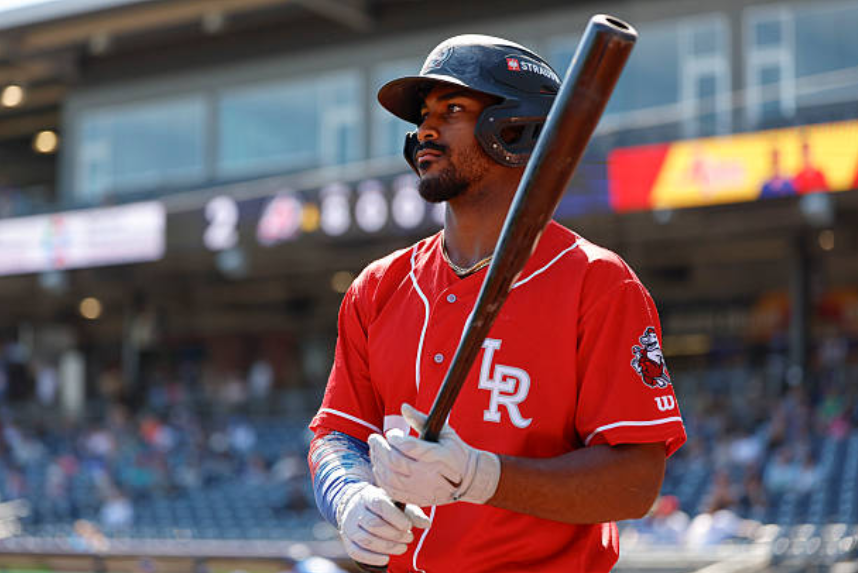
With MLB roster expansion in September, the Mariners brought on two players to turn the 26-man roster into the 28-man roster for the final month. One was lefty Hoby Milner, who the Mariners picked on a minor league deal Monday after the Cubs released him, and the other was the team’s third-best prospect according to Baseball America.
There is no denying Lazaro Montes’ ceiling as one of the most powerful bats anywhere in baseball. On Aug. 22 in a game against the Sacramento River Cats, Montes cracked a single that left the bat at 116.3 miles an hour. Just 11 players have done that in the majors this year, and that list is something of a who’s who of the hardest sluggers in the game: the worst hitter of that bunch this year is Vladimir Guerrero Jr., whose bizarre inability to hit the ball over the fence despite his eminent skill has led to a .679 OPS; he’s also the only one of those 11 hitters to sport a slugging percentage less than .400 this year.
That set of players has a fair bit more variation in their on-base percentages, however. Coby Mayo’s .284 means that his extra-base hits only improve him to something of a league average hitter on the whole, whereas Yordan Alvarez’ ridiculous .433 OBP highlights a hitting line that would fit in with Barry Bonds’ prime. At the top level, the difference is made by walks; Mayo walks just 7.1% of the time whereas Alvarez walks 15.8% of the time. Underlying this, however, are the items of plate discipline and contact rate; plate discipline to turn pitches outside of the zone into balls and walks and contact rate to force pitchers to avoid Broadway.
Here is where the question lies for Montes.
“Every season, you’re learning more,” the 21-year-old said a couple weeks after his call-up to Triple-A. “Every year, you’re learning more things that help you be more consistent. Not being perfect, because only God is perfect, but yeah, finding yourself, figuring yourself out more, and achieving that consistency you want.”
On the positive side, Montes has a good sense of the strike zone. Over his time in Triple-A this year, he has swung at 72.8% of pitches in the zone and 27.7% of pitches outside the zone, a difference of 45.1 percentage points. This will necessarily drop in the majors as he faces hurlers with better stuff that hugs the edges of the zone, but it’s still a solid gulf between the pitches he should swing at and those he shouldn’t.
But Montes swings and misses a lot. His overall 38.3% whiff rate is one of the worst in Triple-A, and so is his 34.3% in-zone whiff rate. It’s a lot easier for a pitcher to trust his stuff when he knows that there’s a good chance even a mistake gets missed. While there are a few players with overall whiff rates approaching 40% that are at least productive - Oneil Cruz, Munetaka Murakami, etc. - no hitter in the Majors with 100 or more plate appearances has an in-zone whiff rate above 33%. Jonah Cox and Sam Huff, who have 69 and 34 plate appearances, respectively, both have in-zone whiff rates around Montes’, and both have expected batting averages below .210 (Cox has benefited from a good deal of early luck).
This doesn’t preclude Montes completely from having a successful September in his first season in the bigs, but it does mean that his swing and miss will at least be at the edge of viability in these final 24 big league contests.
Perhaps there is a good sign for the Cuban right fielder in that his whiff rate has been on a slow but steady downward trend during his time with the Triple-A Tacoma Rainiers.
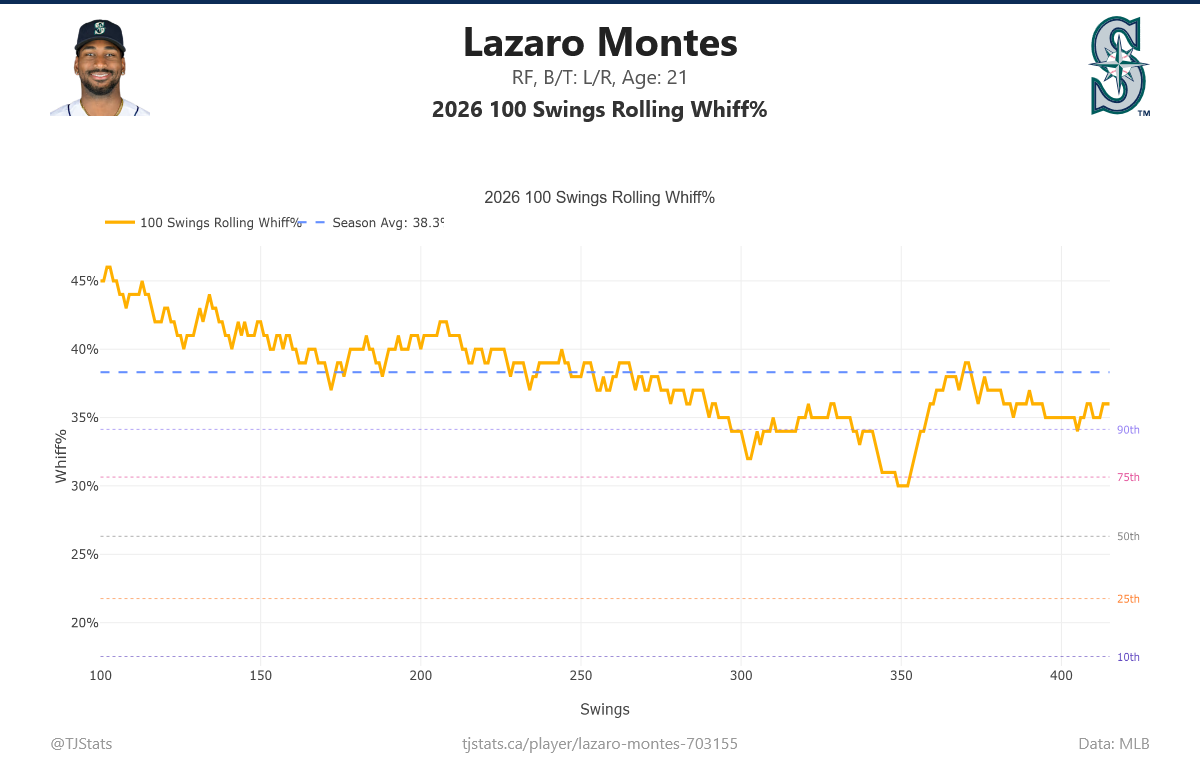
With a hitter of Montes’ raw power, there is a world of difference between a 45% whiff rate and a 35% whiff rate. Anything lower than this range isn’t likely for his first month in the bigs, while anything higher than this range would indicate a harder than expected adjustment to major league hurlers.
According to Rainiers hitting coach Seth Mejias-Brean, who spoke with Emerald City Spectrum around the time Montes and fellow batting prospect Michael Arroyo played their first home games in Tacoma, a big idea in training work for Montes was picking between his A swing when possible and his protection hacks when necessary.
“I think the last year is just kinda getting him to commit to a plan, sticking with it, and then just setting the right environments when it’s a big hack, or it’s light work,” Mejias-Brean said. “Just getting the velo in. But other than that, nothing too special.”
There is also the platoon question at hand for Montes. He struggled a ton against left-handers in Double-A, with a .266 weighted on base average (wOBA) against southpaws compared to .460 versus righties at that level, but upon getting the call-up to Tacoma, he began to even out his platoon splits. Although he hasn’t touched up anything 110 miles an hour or above against left-handers (compared to six such batted balls against righties), he still has a roughly even production split at the top level and even has a higher expected wOBA (xwOBA) against lefties than he does against righties during his time with the Rainiers.
Montes, of course, has been doing a lot of work to remedy his platoon splits during his Triple-A stint.
“All lefties facing lefties, it’s tough, right? Like, we don’t see them as much,” said Mejias-Brean. “I think like it’s becoming more of a thing now, I feel like we’re facing more lefties. I think it’s just finding the right environment - I know I’ve said that alot - but getting him to hit more angled from the left side, getting him more adjusted to, like, ‘alright, what are you looking for? where’s your tunnel? How are you gonna attack this guy? How’s this guy going to attack you?’ and then just understanding all that stuff.”
Ultimately, like all call-ups, it’s going to be sink or swim for Montes’ bat as he takes on MLB pitching for the first time. His profile is heavily dependent on his offense, though it’s clear to everyone who watches him swing that it’s an interaction between the elite power that raises him and the shaky contact that drags him back down.
[caption id="" align="alignnone" width="1465"]
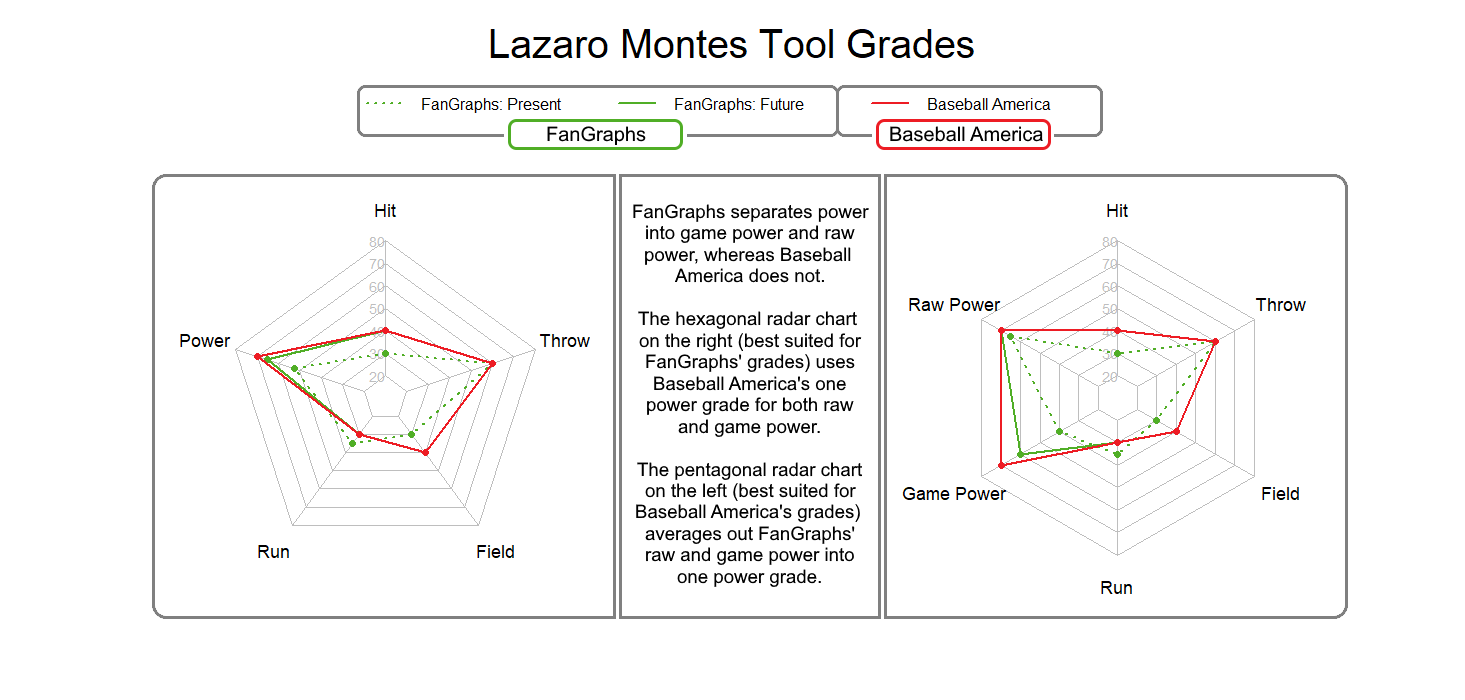
On the 20/80 scale - where 50 is league average and each increment of 10 is a standard deviation - Montes is most notable for a 70 grade (raw) power, estimated to be better than roughly 97.5% of big leaguers. [/caption]
That’s not to say he doesn’t have any other skills, however. The right fielder’s arm has long been noted as above average, but despite unremarkable speed and glove grades for most of his career, his first games in Triple-A saw him track down some difficult fly balls and put his fielding on the map as something legitimate for the Mariners organization to work with.
“The truth is that I’ve worked extremely hard, like I [told] you, not just with the bat, but also on defense too,” Montes said. “Because, for me, improving myself on defense is something very, very, very important. I’m always working on my defense, because I feel like, just as I can create runs at the plate, I can also stop runs out there.”
Though Montes’ Tuesday debut will be as the DH, if he does get the right field start on Wednesday, it would also be a baptism by fire: Fenway Park’s semi-cavernous, oddly-shaped right field would make sure of that.
Regardless of the overall contours of Montes’ skillset - whether he has the chops for right field or not - there remains the question of timing. Was Sept. 1, 2026 too early for his debut? Should the team have waited out a month more in Triple-A in preparation for bringing him up in 2027? Like a lot of things, it will be decided retroactively in the end. If he hits six homers with a .350 OBP over the rest of the M’s season, he will have been evidently ready; if he strikes out in half his at-bats, he will have evidently been unready.
And there is the lockout that will begin with the expiration of the collective bargaining agreement (CBA) on Dec. 1. Will it eat a chunk of the season? Since Montes is a major league player now, he will be subject to any an all work stoppages between the MLB and MLBPA; losing potentially months of development wouldn’t be worth the tradeoff for 24 games for a team with a 64-74 record who is six games out of the weakest division lead in baseball history.
As for Montes’ skills themselves, it might have been more prudent for the Mariners to wait until his whiff rate dropped a few ticks further, to see if he is legitimately improving his contact or if his improvement over the past two months was ephemeral. It would also have allowed him to develop his skills further in an environment where Mariners prospects have actually been known to do so; the team’s recent track record of in-MLB hitting development is spotty on a good day.
Enough talking; now, it’s Montes’ turn.