Mariners Reportedly Go with Garver for Backup Catcher; Right or Wrong Move by Dipoto?

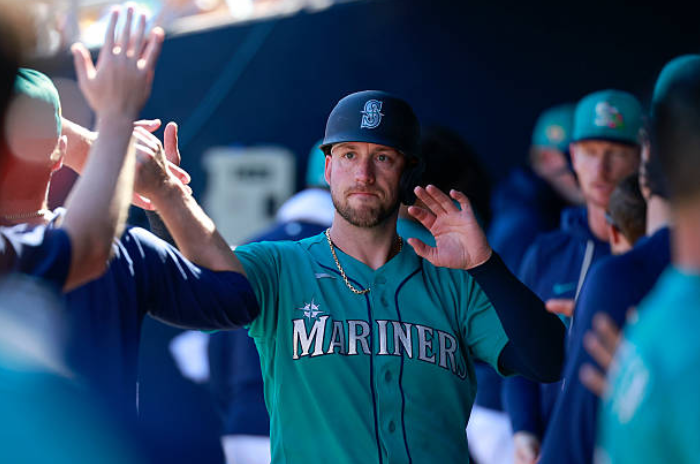
Mitch Garver already returned to the Mariners organization thanks to some advice from Cal Raleigh, but with Spring Training nearly in the rear-view mirror, it’s being reported that he’s going to make the jump back to the bigs for another year. With this decision, it’s likely that Andrew Knizner - who signed a $1 million guaranteed contract in the offseason - will be designated for assignment, though he can be outrighted to Triple-A if he clears waivers. Jhonny Pereda, who is on the 40-man roster, will probably also return to Triple-A to start the season, though this would mark his last minor league option.
Garver was quite appreciative of Raleigh’s efforts to bring him back, according to MLB.com’s Daniel Kramer.
"It means a lot that he would want me to come back and be there for him whenever he needs to take a breather,” Garver said. “So, I'm happy to do it. Happy to just put on the gear and catch guys when they need me the most and couldn't be [happier] to be where we're at."
Bringing Garver up was a $2.25 million dollar decision, financially, as that’s what Garver was guaranteed to make if he made the MLB roster at any point. So what went into the decision to bring him back for another year?
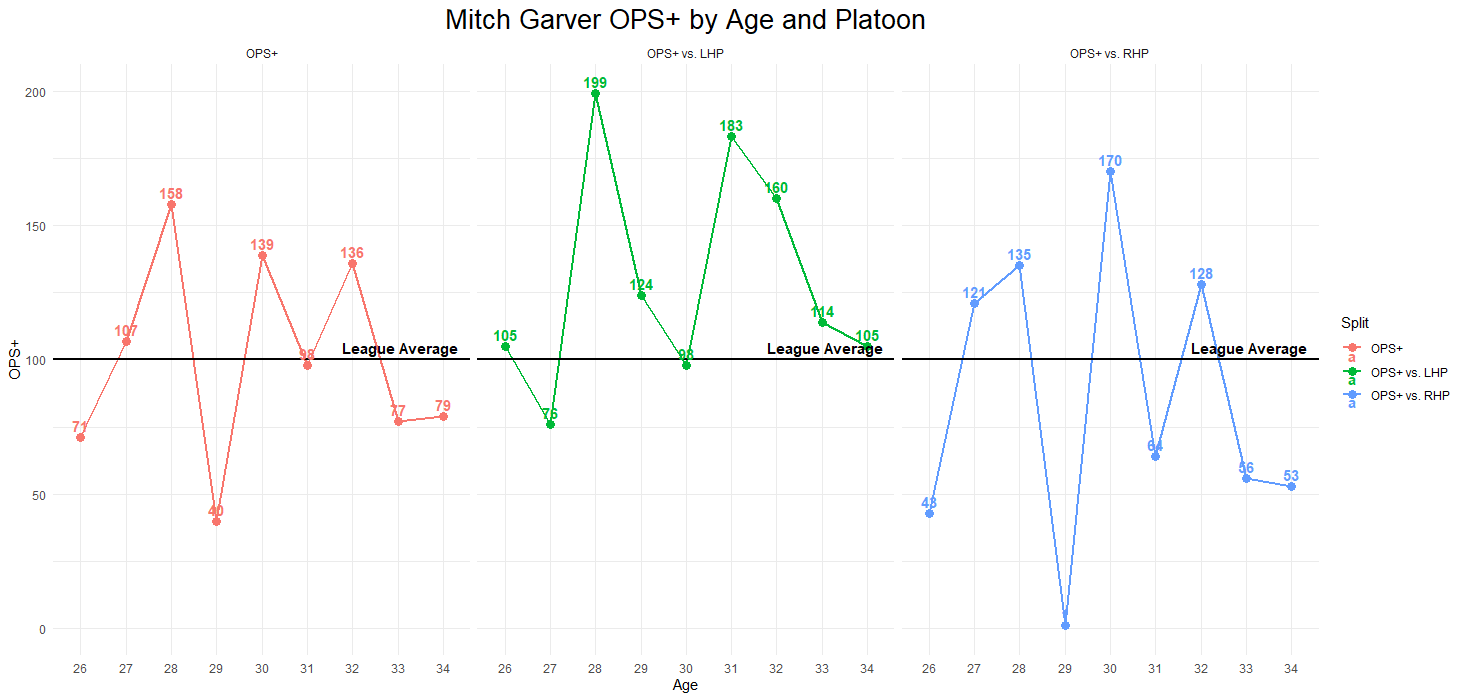
It’s not like backup catcher is the most pressing matter for the Mariners, but based on previous performances, the M’s are going with Garver’s better offense and connection with Seattle’s pitching staff over Knizner’s better defense. Although Garver seriously declined after 2023, he still had a slightly above league average bat against lefties in 2025 (.718 OPS and 105 OPS+ where 100 is league average) whereas Knizner had a .598 OPS overall and .680 against lefties. Pereda, meanwhile, had a .658 OPS over 78 plate appearances last year and a reverse split where the right-handed Athletic and Twin hit better against right-handers than southpaws.
[caption id="" align="alignnone" width="1465"]
Data sourced from Baseball-Reference.com and compiled using RStudio. [/caption]
I’m something of a Mitch Garver apologist as compared to the rest of the Mariners media ecosystem, and his continued success against lefties is why. It allows the M’s to spread out his starts when there’s a lefty on the mound and squeeze the most value they can from a guy who is very much over the hump, and when backup catchers are concerned, “good” is not exactly the goal. “Mediocre with upside” will do just fine.
It can be hard to draw top-line conclusions from backup backstops with less than 100 plate appearances in a season, however, so let’s take a look at some underlying stats to try and adequately compare Garver, Pereda, and Knizner.
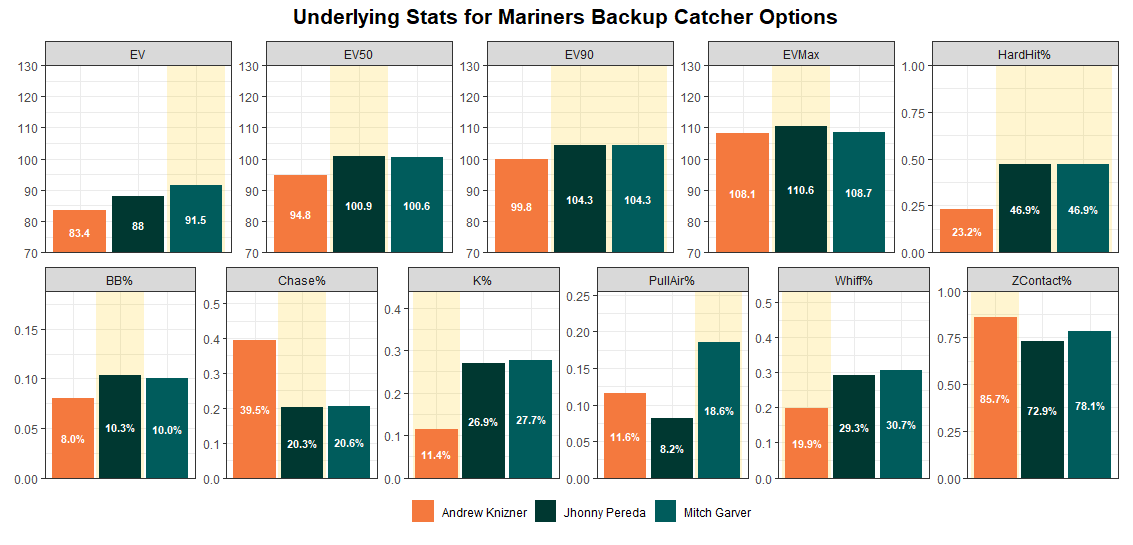
When it comes to how hard or forcefully each batter hits the ball, the contest is clearly between Pereda and Garver. Average exit velocity, although not the best hit quality metric, has Garver ahead 91.5 miles an hour to Pereda’s 88 miles an hour. Pereda, however, had the hardest hit ball of the three in 2025 at 110.6 miles an hour. The emerging consensus metrics of EV90 (the exact exit velocity of the 90th percentile batted ball) and EV50 (the average exit velocity of the top 50% of batted balls) have the two in a virtual tie, with both at 104.3 mile per hour EV90 and Pereda eking out a 100.9 mile per hour EV50 over Garver’s 100.6.
The reason these two are becoming such consensus metrics is because a player’s weakly hit balls are less indicative of his bat strength than his strongly hit balls; anyone in the Show can dink-and-dunk some 70 mile an hour floaters every now and then, but only a few can rake in big-time hotshots with consistency. This FanGraphs article delves deeper into the topic, though as is obvious from the title, none of these stats are perfect, and each team’s analytics department uses slightly different variations - but the general thrust of these ideas is pretty universal league-wide.
As always, I’ll caveat the hard-hit metrics by saying that they can only be so useful. After all, a floater to no-man’s land is better than a hotshot to a glove. But generally speaking, harder hit balls are better because they travel farther and give fielders less time to make a play. Of course, the real world is dominated by tradeoffs [1], and if a hitter could hit the ball marginally harder but would give up enough bat control and discipline to neutralize any gains, he and his coaches would be wise to keep things as is.
At roughly 95 miles an hour, though, the impact of exit velocity increases jump significantly. This is the reason behind hard hit rate, which measures the percentage of batted balls at 95 miles an hour or above. Here, too, Garver and Pereda are tied at 46.9% while Knizner lags behind at 23.2%.
When it comes to preventing strikeouts, however, it’s a different story. Pereda and Garver walk the most of the three and chase the least, but Knizner swings and misses so much less often that his strikeout rate was one of the best in the business last year at 11.4%. Compared to Pereda and Garver, who got punched out quite a bit, this is notable. Perhaps if Knizner could knock down his chase rate, he could start walking a ton and become a pesky Leo Rivas-esque hitter.
[caption id="" align="alignnone" width="1133"]
Data sourced from TJStats and Baseball Savant (using TJStats’ version of Pull-Air%) and compiled using RStudio. Bars inset in light yellow indicate that a player has the best stat of the three. [/caption]
It’s worth noting that because Garver has a clear platoon split where nearly all his stats - both top-level and underlying - are better against left-handed pitchers, this juices Garver’s case with the bat and gives him the edge over Pereda where the contact quality is concerned. Both Garver and Pereda have issues with whiffing in the zone, but Pereda has the short end of that stick.
With all this in mind, however, there is still good reason to consider Pereda over Garver. Defense is famously a lot harder to measure for catchers, though FanGraphs’ defensive runs over adjustment can give a little bit of insight with Garver at -4.2 last year, Pereda at -0.3, and Knizner at 2.5. There is also Baseball Savant’s fielding run value (FRV), where Garver had -4 last year, Pereda -2, and Knizner a flat zero.
But if advanced batting metrics are flawed, than advanced catching metrics are closer to blindly examining an elephant than to being a science: more useful as directional indicators than any kind of exact measurement. They also don’t say anything about pitch calling or relationship with a pitching staff, though both those things are probably like coaching where it’s only evident when someone is either bad at it or really, really good at it. The eye test and the good old metric of “what do his pitchers say?” are pretty important for evaluating this stuff.
Garver isn’t a great defender. That’s something that the M’s had to contend with last year: 32 of 38 attempted base-stealers made it against his arm, he wasn’t an especially good framer, and some of the Mariners’ craftier hurlers run into the problem of Garver being unable to keep their pitches from going to the backstop (though it’s worth noting Raleigh wasn’t an especially good blocker either). Both Mariners catchers had issues making tags at the plate, though that became an issue probably less than 20 times overall [2]. Neither were Pereda or Knizner amazing fielders in their own right, but they weren’t as bad as Garver behind the dish.
Where Garver edged out Pereda - beyond a much higher Pull-Air% that gives him more bang for his buck on contact - was in his pitcher management and relationships with said pitchers. He has built up a good rapport with Seattle’s pitching staff over the last two years, enough of a clubhouse presence that Raleigh facilitated his return. It’s well-known that George Kirby prefers throwing to him over Raleigh, and “keep Furious George happy” is probably fairly high on the list of clubhouse priorities.
The Mariners’ once and future backup catcher evidently reacted well to the news, blasting a homer and sacrifice fly during the Mariners’ 4-2 Spring Training win over the White Sox on Sunday. It was enough to increase his Cactus League OPS from .535 to .685, though he has still struck out 12 times in 29 plate appearances. It’s worth noting that he 26 of these plate appearances have been against righties, a case of affairs that will almost certainly not be true in the regular season.
Garver’s age and his iffy-at-best Spring mean there’s a fair likelihood that the M’s will call upon Pereda or Knizner at some point in the season. But until his upside against lefties vanishes enough to negate his rapport with the pitching staff, calling him back up for another season was probably the right choice. If the decision turns out badly, though (and it very well might!), Mariners brass should do what they did with Knizner’s contract and ignore the sunk cost.
For now, though, the backup backstop role is Mitch Garver’s once more.
[1] This is one of the driving forces behind the relentless seesaw of analytics (the other being the search for the lowest unpicked fruit): statistical analysis shows that one thing is better than another in a vacuum, teams aggressively seek out that one thing, but its unseen tradeoffs become obvious and allow other teams to exploit those weaknesses. The risk of chasing down a statistical mirage becomes greater as the lowest fruit are picked.
[2] Still, a tag at the plate is the highest-stakes defensive play, with a missed easy tag being roughly equivalent to one run lost and a completed hard tag being roughly equivalent to one run saved.