Mariners Forget Fundamentals, Drop Saturday Game 8-3 to Nationals

[caption id="" align="alignnone" width="2048"]
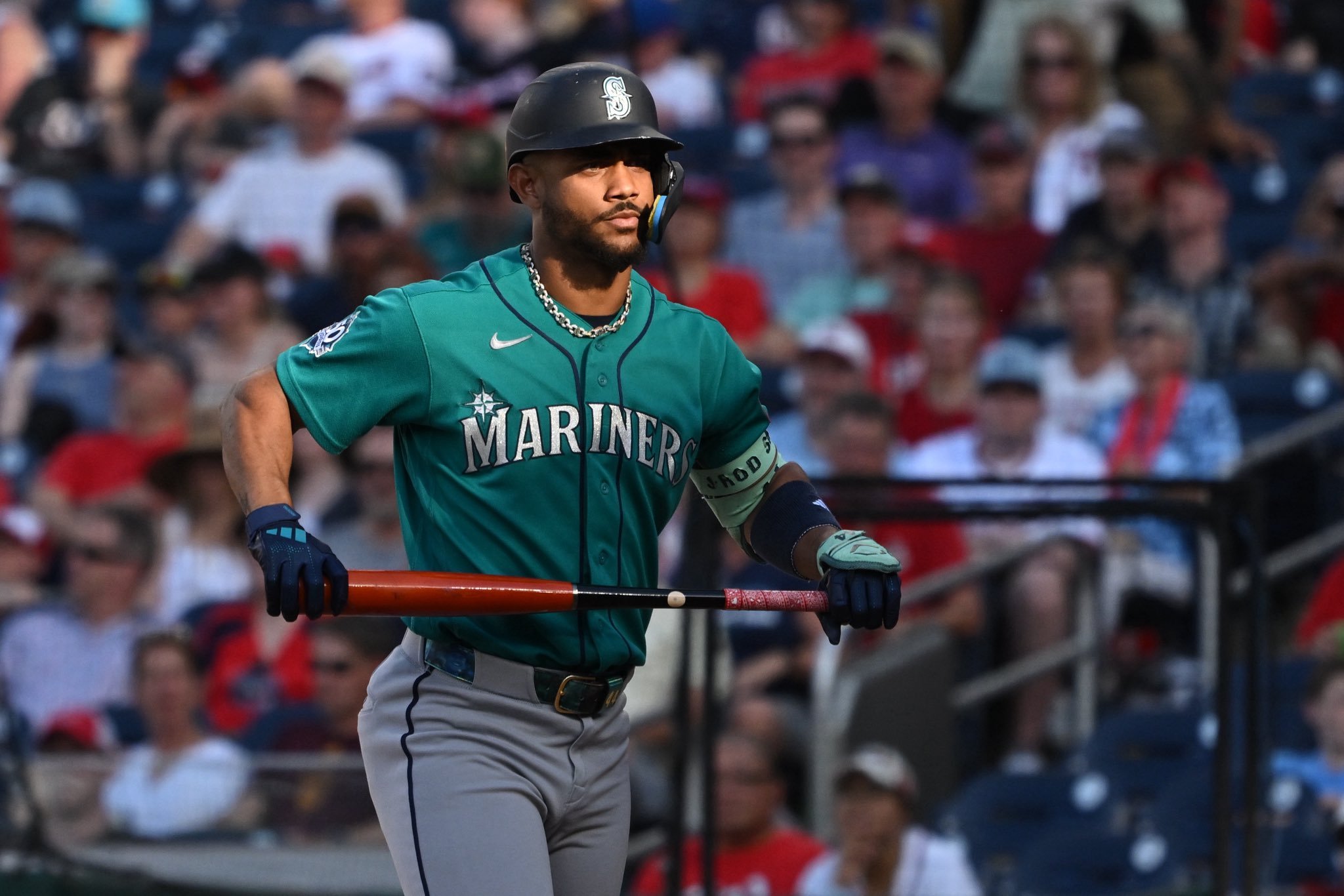
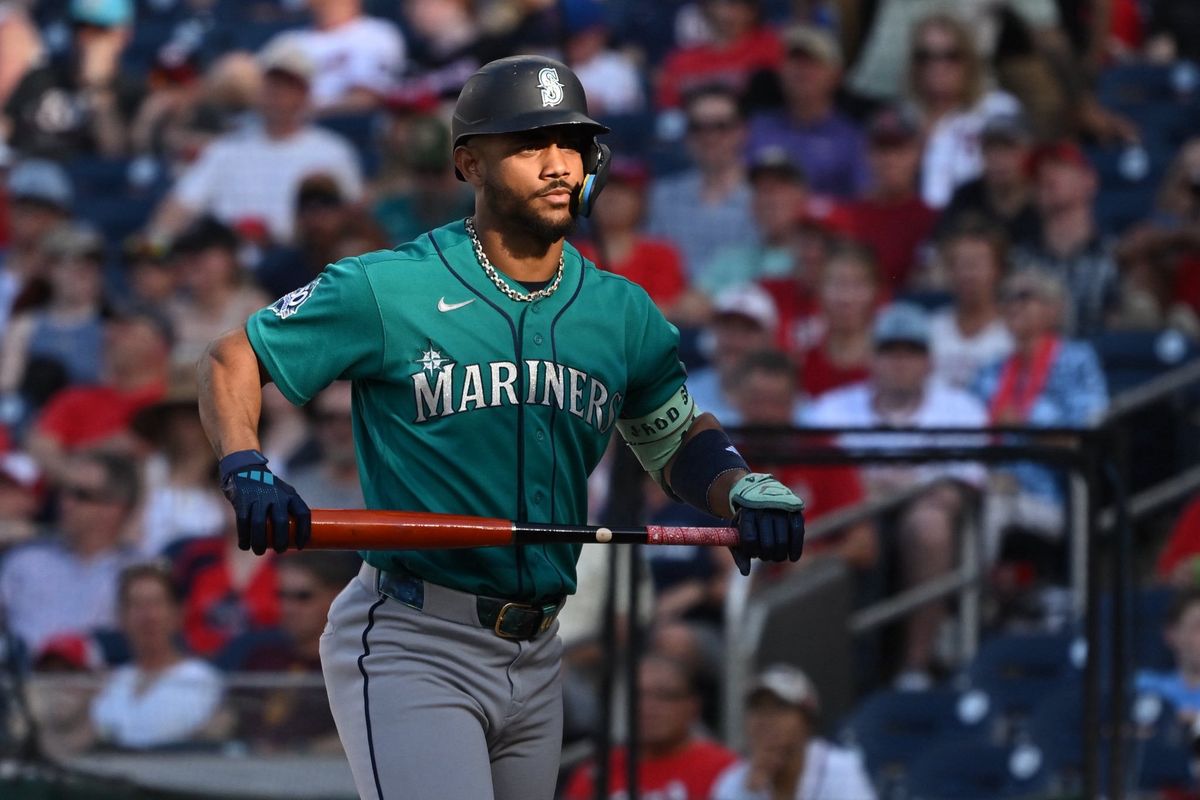
Seattle Mariners center fielder Julio Rodriguez (44) walks back to the dugout after striking out against the Washington Nationals during the seventh inning at Nationals Park. Mandatory Credit: Rafael Suanes-Imagn Images [/caption]
It seems the Mariners are yet to escape their consistent inconsistency. After having beaten the Washington Nationals 10-2 the previous day, with every starting Mariner position player getting a knock, the team lost 8-2 as the pitching slipped up and the offense took a big step back outside of the ever-impressive Colt Emerson.
But the biggest issue for the team was the defense, which was docked for three errors and looked quite shaky even outside of those official events on the scoresheet. The game served as an example of bad fundamental play across the board and a reason why the team has a losing record in one-run games and just one win after trailing in the seventh. They still have the luxury of playing in the division that they do, but they aren’t forming good habits for the playoffs and the lack of precision has turned what should be a lock in the weakest division in baseball into a 1 ½ game lead over a mediocre Athletics team.
Defensive miscues piled up early, and a would-be clean first became a three-spot for the Nats.
Josh Naylor didn’t have himself a very good game on Saturday, with big misses with the glove and stick. The former came first, with a bad throw in the bottom of the first allowing the Nationals to put together a two-out rally and tack three runs on Luis Castillo.
As a sidebar, the inning was a representation of the arguments about ERA as a stat, given how it defines fielding influence via the earned run. Castillo wasn’t charged with any earned runs thanks to the error, but he still made plenty of bad pitches to CJ Abrams, Daylen Lile, and Dylan Crews as the hits and runs piled up. Should those runs really not be charged to Castillo? Such is the advantage of a measure like RA/9, which is like ERA except using total runs instead of earned runs, completely incorporating fielders into the equation.
But should all of those runs be seen as Castillo’s to bear? With Abrams having knocked home the first run, Lile whacked a ball to deep right down the line. Víctor Robles took an in-between run towards the ball, beginning on a sprint but then letting up towards the wall, and Lile wound up with a triple. It wouldn’t have been an easy catch at all, but keeping him to a double could have held him at third when Crews’ liner went right to Raley. These counterfactuals can be hard to parse out, but another approach is to take out everything in the field and just look at the stuff pitchers have the most control over: strikeouts, walks, and homers; this yields fielding independent pitching (FIP).
In truth, all these metrics tell you something. There is skill-interactive ERA (SIERA), which incorporates the types of contact into its calculation. There is expected FIP (xFIP), which replaces the home run component of FIP with fly balls to account for pitchers’ lack of control over the rate at which fly balls become homers. The convention with all except RA/9 is to scale these advanced metrics to ERA.
And for Castillo, the top-line numbers don’t say great things, but though these numbers directionally agree, there are differences. Going into the game, he had a 5.16 ERA, 4.19 FIP, 4.28 xFIP, and 4.07 SIERA, with these advanced stats indicating hope of some positive regression. And his ERA indeed decreased on Saturday to 5.00, though he had some incontrovertibly earned runs in the bottom of the fifth as Luis García Jr tacked on a two-run jack.
Despite the rough defense behind him, Castillo had a mixed game on the underlying merits. Of 43 swings the hosts took against him, they missed just seven times, a paltry 16.3% whiff rate. But he also kept the Nats to a 20% hard hit rate as he found the weak sides of the bats for most of the game and largely breezed from the second through fourth innings.
There came a time when Castillo had to leave, however, and it was before he could complete a sixth inning as he walked Nasim Nuñez with a man on second and two outs, his misses well off the plate and his strikes down the pipe.
The five runs he yielded were enough to secure the loss thanks to a step back for the bats.
Colt Emerson had a good day at the plate, but with the rest of the offense suffering a down day, the M’s only put up three runs.
Although the M’s had put a 10-spot on the Nats on Friday, the game came with a casualty of uncertain duration as Randy Arozarena tweaked something in his hamstring upon coming down strangely on first base during a run there. Mariners manager Dan Wilson downplayed concerns of a long-term problem, with imaging largely off the table.
“He’s okay. I think a little bit of a hamstring strain, or it might have been more of a spasm, or a cramp kind of a thing. It’s day-to-day at this point, and we’ll kinda assess a little bit more in the morning.”
Things were still about as clear as mud regarding his injury status on Saturday.
“Randy feeling better today, still day-to-day, still gonna monitor him closely,” Wilson said before the game. “But I think positive signs coming out of there today.”
Sometimes, these mysterious day-to-day knocks have become full IL stints for the Mariners, as with J.P. Crawford and Cal Raleigh. But although Colt Emerson ended up with a day-to-day back injury of his own during the road trip, he came back quickly and in force with a home run during the M’s Friday win and he built up on that performance on Saturday.
Emerson’s day started with a backwards K as he froze on a Cade Cavalli curveball that dropped back in the zone, but his second at-bat showed admirable growth in multiple directions as Mitch Garver stood on first with a run in during the inning for Seattle.
One bright spot in the at-bat was the fact that he kept going after tough pitches once falling to two strikes. This has been a consistent feature of his approach at the dish and a big reason why his prospect stock and early MLB play have both been stalwart, and he kept it up as he fouled off a curveball low and in to stay alive.
The big bright spot was, of course, the home run. But as for how the future is concerned, the fact that Emerson muscled the bomb (his sixth of the season) on an up-and-in fastball is probably the most encouraging thing. Fastballs have been his one major weakness at the plate both in the minors and the majors, and Cavalli surely had the book in mind as he found his spot.
Seattle had an opportunity to truly get back into the game in the top of the seventh, even with García’s homer in the fifth that put the Nats back up 5-3. Garver singled with one out and, although Emerson grounded into a force out that neutralized Garver, Cole Young put a runner in scoring position with a single and Julio Rodríguez walked the bases full.
Naylor got a hitter’s pitch right down the pipe on a 2-0 count but shanked the ball to medium-depth center field for a routine out number three. Seattle had another unfulfilled opportunity in the top of the eighth, but by that point, things had gone far more out of control on the defensive front.
Jose A. Ferrer had a down game, but the M’s defense had its worst inning yet as Washington tacked on three more.
The East Coast road trip hasn’t been especially kind on the bullpen, with Andrés Muñoz blowing a save in Detroit and both Cooper Criswell and Matt Brash going to the IL. The relievers got a game of rest on Friday as Bryce Miller tore up the rubber for eight innings, but it was back to scheduled programming as soon as Castillo exited the game in the sixth. Gabe Speier held down the fort to get the one out in that frame, but as the inning turned over, the ball went to Jose A. Ferrer.
A former National, Ferrer has been one of the biggest revelations for Seattle’s bullpen in the first couple months of the season, with 30 innings under his belt in 33 appearances during the team’s first 71 games.
Perhaps that usage showed in Ferrer’s play on Saturday, as he plated a first-pitch heater to Andrés Chaparro that became a leadoff double and set a bad tone for the inning. His pitches to Curtis Mead were either down the chute or well off the plate for a walk and Abrams smothered an opening sinker for a run-scoring single. Ferrer was able to get one out on a grounder to the right side, but as both runners moved up, Wilson went to bring in Eduard Bazardo and salvage a three-run deficit. Emerson made a phenomenal sliding play and throw to get the lead runner at home on a fielder’s choice for the second out, but sometimes, it’s the simplest of things that kill a team.
Bazardo attempted a pickoff to first and threw it away, allowing one runner to score and the other to second. José Tena promptly whacked a grounder up the middle to get the third runner across the board and expand Washington’s lead to 8-3, where it remained for the rest of the game.
On Deck
The M’s have one more contest in the Nationals series and in their 10-game road trip. Seattle has gone 4-5 over the trip, with two losses each to the Tigers and O’s and now one loss to the Nationals. They can salvage a .500 road trip across three cities with a win on Sunday, but they’ll have to be far more clinical in their play.
Emerson Hancock will be on the mound for the Mariners on Sunday while Miles Mikolas suits up for Washington.