Five Mariners Homers Overcome Heavy-Hitting Dodgers in Chavez Ravine Thriller

The Mariners’ disastrous series against the Rangers finally put to rest the notion of the team as the AL West favorite, with a 52-55 record and a two and a half game deficit in the division with a month-long gauntlet fast approaching. What had been true for the whole season was now eminently evident to the entirety of the dugout: that both greater commitment and greater precision are needed in order to return to the playoffs, much less to the precipice of the pennant.
Iron, as they say, sharpens iron; who better to face than the two-time defending champion Dodgers? They immediately displayed why their offense is one of the best in baseball, working to quickly punish whatever Luis Castillo pitches leaked out over the plate. But the Mariners, needing a win to keep pace with the Rangers and Astros ahead of them, managed to put together a thrilling 7-6 victory on the backs of five home runs and some high-stress relief pitching.
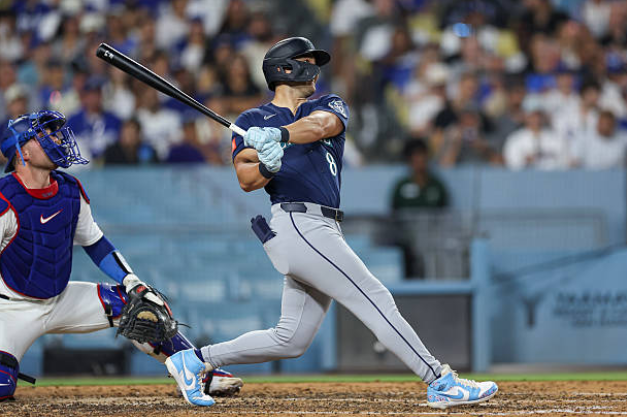
It was the first Mariners win against the Dodgers since April 19, 2021. It was the first Mariners win in Dodger Stadium since June 28, 2009. To put it another way: the last time the M’s beat the Dodgers in the City of Angels, Rob Refsnyder was 18, Cal Raleigh was 12, Dominic Canzone was 11, and Julio Rodríguez was eight. Those were the four M’s to go deep on Tuesday.
Cal Raleigh and Julio Rodriguez hit a homer in the same game for the first time since April.
Before the season began, the duo of Rodríguez and Raleigh were projected to accrue between five and six wins above replacement (WAR) each. With 55 games left in the season, Rodríguez had 1.8 FanGraphs WAR (fWAR) and Raleigh 0.5, each reflective of injury-shortened years with significant struggles - especially in the case of Raleigh, who had a .165/.269/.300 slash line going into Tuesday.
The struggling catcher found himself on the IL for roughly a month-long stretch of time straddling May and June, but he appeared set to roar back on the scene after a homer-studded rehab assignment in Tacoma. That ended up being a mirage; Raleigh had a .170/.304/.277 slash line between his return on June 16 and the end of the Rangers series on July 27. The power stroke was especially absent, as he had just three homers during these 33 games.
Rodríguez, meanwhile, had seen peaks and valleys during his season, with 10 homers in May but just six outside of May going into Tuesday’s game. There hadn’t been a game with both stars going deep since April 11.
Raleigh was the first of the duo to leave the yard on Tuesday, crushing the first pitch he saw from Justin Wrobleski in the top of the second. The blast tied the game in response to a Shohei Ohtani deep fly in the bottom of the first, but as things would turn out, the M’s would need a lot more production to keep above water.
When the fourth inning began, the M’s had once again slipped to a 2-1 deficit. Rodríguez fell behind 0-2 and swung at a slider on the lower edge of the plate, but as the pitch hooked inward towards the Mariners center fielder, Rodríguez was able to crush it over the left field wall to tie the game.
Seattle’s first lead, however, would come courtesy of someone whose stinging slump had been one of the bleakest parts of the team’s demoralizing mediocrity.
Rob Refsnyder went 2-4 in his return from knee rehab.
Tuesday was Refsnyder’s first day back from injury, having played seven games for the Triple-A Tacoma Rainiers as part of his rehab, where he slashed .207/.281/.310. His right knee - the back knee for the right-handed hitter - had been long bothering him during the year, messing with his swing mechanics and timing and turning someone who had an OPS of .804 during his previous four seasons into a hitter with a .422 OPS with starkly negative value.
The mental toll of such failures had clearly gotten to Refsnyder, and he went out of his way to emphasize how he could have done better himself at points earlier in the season.
“I really don’t wanna make excuses. My body is my body, I should have made those adjustments and had more success early on,” Refsnyder said before the game. “I just haven't, but there’s no excuses.”
Refsnyder made some adjustments during his rehab, such as turning his back foot out a little more to reduce the pressure on that knee. His mechanics, he said, had suffered greatly over the course of the season.
“My swing got super steep, kinda down and across, some other things. I mean, I could go on and on, it was just a really bad swing,” Refsnyder said. “We felt like the approach was there, I was recognizing pitches, I just wasn’t able to put a good swing on it. That’s all on me, though.”
Ultimately, the only thing that could truly renew Refsnyder’s confidence and the confidence of the organization would be to start producing. He described his approach going forward as being to get on base for his team and not trying to do everything at once.
On an eight-pitch at-bat against Wrobleski, Refsnyder displayed a lot - almost too much - patience, taking two 2-0 secondaries right over the heart of the plate. But he dialed in enough to foul off some high heaters, took a changeup beneath the zone, and when Wrobleski threw him a third fastball in the same spot as his earlier pair, Refsnyder pounced. Had his swing mechanics been unchanged from earlier in the year, it would have been a strikeout; with an ability to flatten out his swing, he torched the ball off the foul pole.
Given that Josh Naylor was already on base, it was a two-run homer for the struggling righty. Like all the runs the Mariners got on Tuesday, it proved the difference between winning and losing against the defending champs. Refsnyder also struck out twice, but a roaring double in the ninth gave him a 2-4 day and increased his OPS from .422 to .479.
That’s not a good figure now, but Refsnyder and the Mariners hope it’s the first step in a long process of building back into a productive hitter. In a way, it’s a microcosm of the way the Mariners need to approach building back up to a division lead.
“It’s hard not to look at the bigger picture, right? Especially with the expectations and how they did last year,” Refsnyder said. “But we can kind of keep it small, just try to win series, hopefully the thing will kinda take care of itself.”
The Dodgers consistently got to Luis Castillo, who had to battle to complete five innings.
Going into Tuesday’s game, it had been something of a tale of two seasons for Castillo. In his first 10 outings (one of which was the final three frames of a piggyback), he had accrued an ugly 6.41 ERA, a massive drop-off from his previous seasons with the M’s. His 4.54 FIP suggested a degree of bad luck, but he was still giving up tons of hard contact and falling into some bad innings.
Over the following nine appearances, things were on the up-and-up for Castillo, with a 3.35 ERA in those outings and far fewer crooked numbers. Part of it was also luck swinging the other way (see his 4.21 FIP during this time), but there were good reasons why contact wasn’t as dangerous then: his opposing hard-hit rate dropped from 51% in his first 10 outings to 31.3% in his following nine (per TJStats) and his ground ball rate ticked up.
A big part of Castillo’s improvement was his changeup coming into use more often, giving him the opportunity to mix things up more effectively. But he still needed to play in the zone plenty to get him a chance to succeed, and against the Dodgers, this was a bad recipe.
The Dodgers’ world-beating offense is built on a simple, workmanlike, and incredibly effective core: mashing meatballs. The team will kill mistake pitches, oftentimes swinging at the first middle-middle pitch of an at-bat. This works because they are so effective at pummeling such offerings; for a team like the Mariners - who often struggle in the middle of the zone thanks to falling into an in-between approach - taking 3-0, 2-0, or even 3-1 can have better expected value at times.
Everything else falls into place for the hitter when a pitcher knows he can’t cheat one over the heart no matter the count. Trying to nick the edges perfectly requires stone-cold precision under such pressure lest a hurler oscillate between ball and meatball.
Ohtani was the first to get the Dodgers party started, getting a beat on a 2-2 low-edge slider from Castillo and sending it roaring over the fence. Like Rodríguez’ longball a few innings later, it hooked inward towards the batter and stayed in the strike zone, catnip to a power hitter like Ohtani or Rodríguez.
Castillo got through the frame, though, as some deep flyouts fell into gloves at the warning track. A double play in the second allowed “the Rock” to face the minimum, but things got dicey quickly in the third.
Dalton Rushing led off with a double to right, and once Castillo fell behind Ohtani 3-0, he intentionally put him aboard to face Andy Pages. But the Dodgers center fielder sent a one-hopper to his counterpart (it would have been an RBI had Rushing read the liner correctly) to load the bases with nobody out.
Freddie Freeman grounded into a run-scoring double play, getting the hosts their second run of the game, but the two outs allowed Castillo to limit the damage. And despite five runs allowed in five innings, he kept a lid on each individual frame before the Dodgers could hang up a three- or four-spot.
The fourth was the most dangerous. Refsnyder’s homer had given the M’s the lead, but a Mookie Betts single and Tommy Edman double led to a quick run before an out had been recorded. A walk, out, and single loaded the bases for Ohtani to get everyone station-to-station with a single of his own to tie the ballgame, and though Pages struck out, Freeman got a hold of one and drilled it 100.9 miles an hour to deep left field.
It was a fraction of an inch on the bat from being a game-calling grand slam, but as it left Freeman’s lumber at 41 degrees, it ended up being too high for anything but an inning-ending flyout.
Still, Castillo was on 78 pitches by the end of the fourth. Were the Mariners bullpen fully healthy, he may not have gone out for the fifth, but he wound up finishing that inning - but not before a solo homer from Max Muncy gave the Dodgers a 5-4 lead.
Two homers from Dominic Canzone gave Seattle their final three runs, with both coming against southpaws.
Going into the year, the Mariners viewed Canzone as a platoon hitter, only fit for facing off against righties while Refsnyder would slide in as the other half of a DH platoon.
Refsnyder’s struggles and injuries elsewhere resulted in Canzone eventually getting opportunities against same-sided pitching. Rather quickly, he proved his abilities once more (having already hit well against lefties in 2025) versus both halves of the mound, and he became a full-time player by July.
Canzone’s breakout was already clear before Tuesday’s game started, as he entered the contest with a .260/.331/.508 slash line, 16 homers, 15 doubles, and a triple. With a slugging percentage that high, it was no wonder he batted cleanup on Tuesday, but his first couple at-bats were uneventful.
In the top of the sixth, though, Canzone found his power stroke, blasting a homer off Wrobleski to tie the game back up for the Mariners. The real fireworks were saved for the eighth.
Rodríguez led off the inning with a single and stole second during Canzone’s at-bat, putting one Mariner in scoring position. To this point, no run for Seattle in the game had been scored off anything but the longball, and that wasn’t about to change.
Dominic Canzone goes deep for the second time tonight 🔱 pic.twitter.com/h6XFDAZO4L— MLB (@MLB) July 29, 2026
According to Canzone, the biggest thing that changed from the beginning of the year to then was the way the organization saw him.
“I think just the confidence that the organization has given me just to try be an everyday player and put good at-bats together,” Canzone told Mariners TV’s Brad Adam immediately after the game.
Of course, that increased belief in Canzone permeated throughout the organization, right down to the man himself.
“Definitely a lot higher than it was a couple years ago,” Canzone said about his own confidence in the postgame presser. “But again, getting the consistent playing time, getting to be an everyday player, you never take those days for granted.”
Seattle led 7-5 after the dramatic two-run blast, and though things got hectic in the bottom of the ninth, the Mariners won a much-needed contest. They didn’t gain anything in the divisional race, but they proved to themselves the capabilities they have.
“Just everybody kind of coming through, and that’s the type of baseball that we can play,” Canzone said. “Top-to-bottom in the lineup tonight was unreal. So, those are the at-bats that we can put together, and that’s the type of talent that we have.”
Seattle got the save by the slimmest of margins.
Each available high-leverage arm for Seattle trotted out to the mound in their turn. Gabe Speier had the sixth and worked the first 1-2-3 inning from a Mariners pitcher in Tuesday’s game, while Jose A. Ferrer’s seventh went quickly due to a double play and Eduard Bazardo breezed through the eighth. Whereas the Dodgers had been all over Castillo, they were on a clear back foot once the Mariners bullpen worked into the game.
Andrés Muñoz wasn’t so lucky. Rushing chopped a grounder up the middle that J.P. Crawford - playing short thanks to a late scratch on Colt Emerson - could stop but couldn’t handle. Ohtani ripped a double into the right center gap to bring Rushing home and an error from Victor Robles (who was in as a defensive replacement for Canzone in right) allowed Ohtani to third. All of a sudden, it was crunch time for Muñoz.
To say the Mariners closer turned up the heat is a little inaccurate; to say he turned his right arm into a .50 caliber rifle is probably closer to the truth. Twice in the following four batters did Muñoz reach 103 miles an hour, and with his slider in tow, he managed to strike Pages out on three pitches and get a weak grounder from Freeman that Naylor snared for the second out.
“At that point, the mentality was: attack the zone, throw as hard as I can,” Muñoz said after the game. “That was the mentality I had every pitch.”
Muñoz began to lose a bit of control as he faced Muncy, who worked a nine-pitch walk and then stole second base. A single from Betts would mean almost certain doom for Seattle’s chances on Tuesday. To make matters worse, Muñoz fell behind 2-0 as he had to find his bearings once more.
Interchanging heaters and sliders, Muñoz eventually found a full count against Betts, and as Betts shanked a 102.2 mile an hour fastball directly to Crawford, the visitors could finally breathe a sigh of relief.
The danger, of course, had been much greater with no outs and Ohtani at third. Teams scored at least a run a little over 80% of the time from that situation in 2025, and if Muñoz didn’t manage to slow the game down then, the best the M’s could hope for was extra innings. The closer credited his breathing exercises for helping him through that situation.
“To be honest, I have to give a lot of credit to the breathing work that I am doing,” Muñoz said. “That was able to calm me down in that situation … in those situations of pressure, you need to be able to control yourself and calm yourself down a little bit.”
On Deck
As thrilling as the team’s victory on Tuesday was, a win in the first game of a series hasn’t been uncommon for Seattle. Over the 34 series the Mariners had played going into Tuesday, they had won the first game 19 times (roughly 56%). But of those 19 series that began with a win, they have only won 10 of them, losing eight and tying one four-game set.
Emerson Hancock and Bryce Miller will be on the mound for Seattle in the following two games of the series, while Eric Lauer and Roki Sasaki will be pitching for the Dodgers.