Bullpen Locks Down Four Frames, Mariners Eke Out 3-1 Win in Houston

[caption id="" align="alignnone" width="4786"]
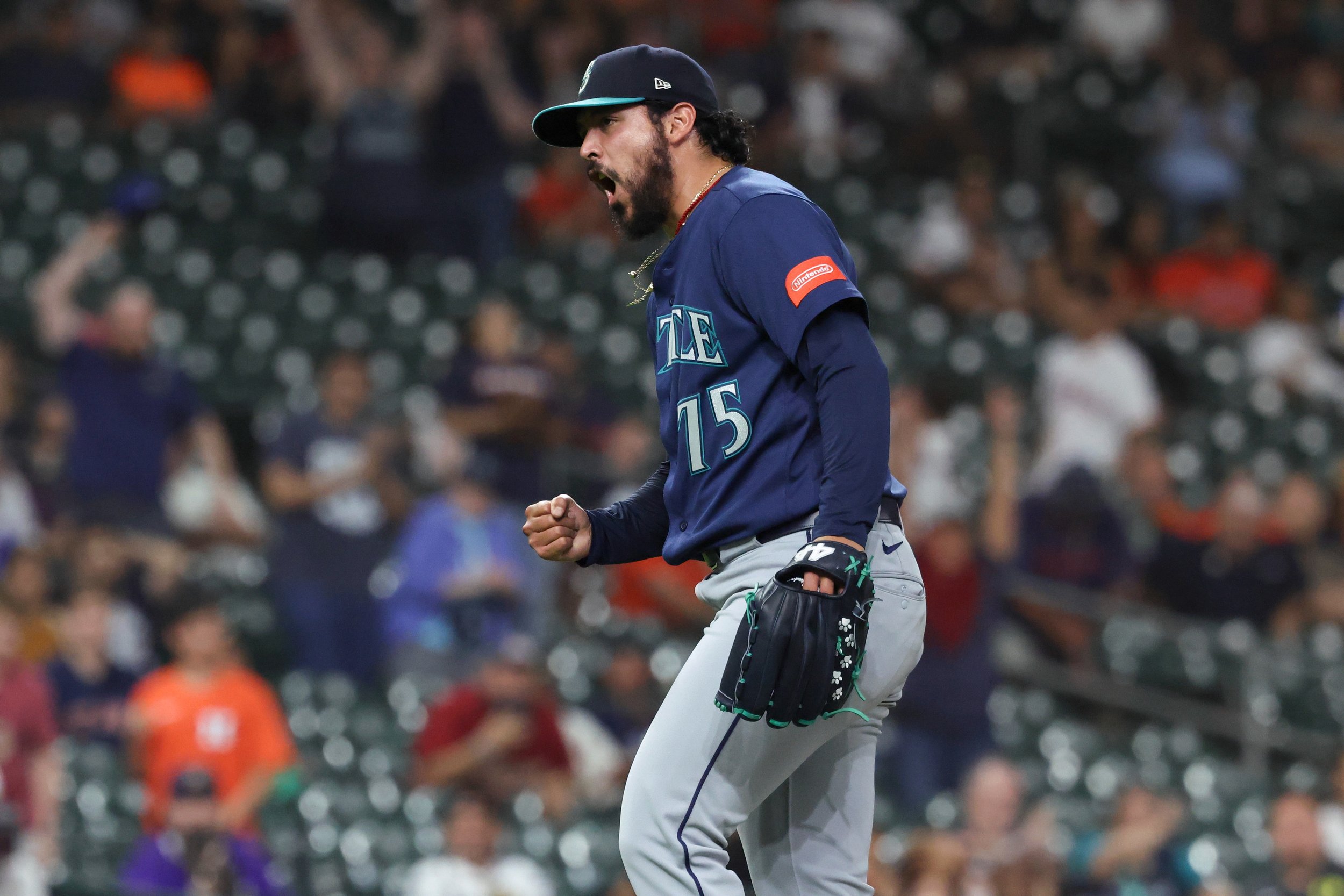
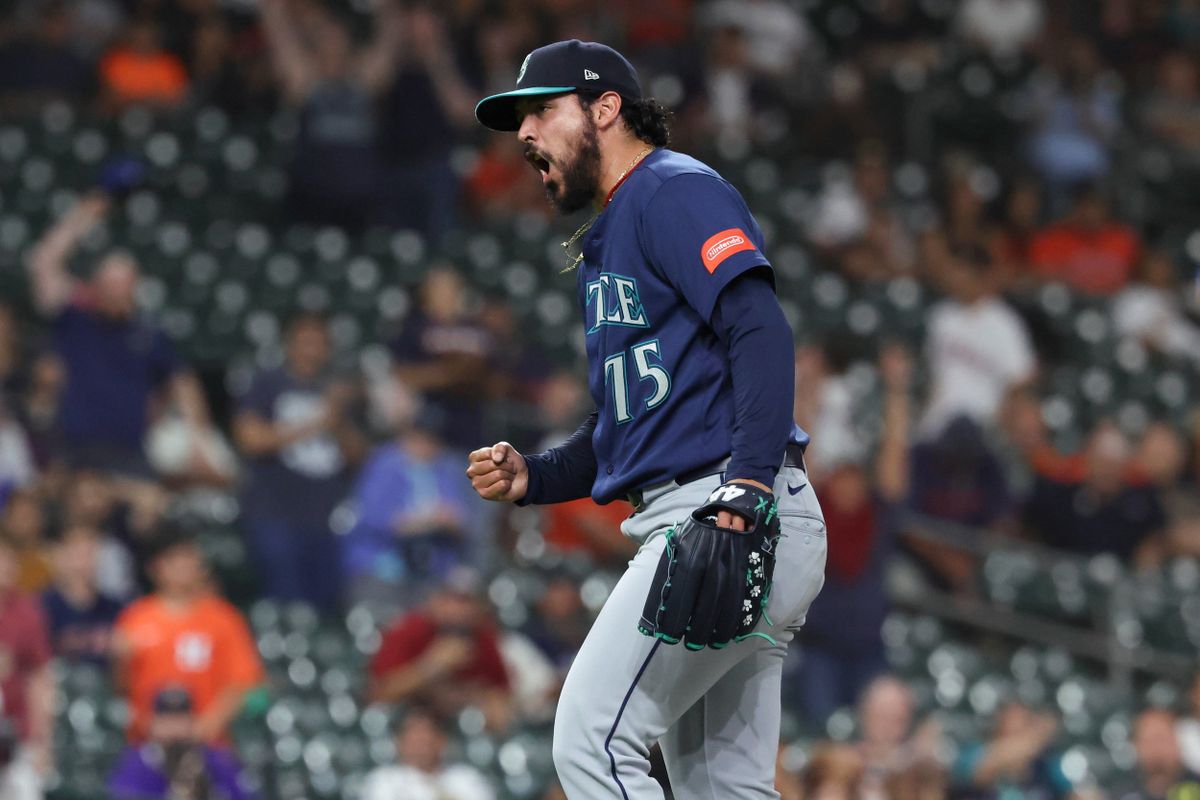
Seattle Mariners pitcher Andres Munoz (75) celebrates after getting the final out during the ninth inning against the Houston Astros at Daikin Park. Mandatory Credit: Troy Taormina-Imagn Images [/caption]
It was power on power in the bottom of the ninth. Mariners closer Andrés Muñoz, who had reached 101.3 miles an hour two pitches earlier, had a 2-2 count against Yordan Alvarez himself. Alvarez represented the tying run, and with 13 home runs already this season, he was a real threat to knot the game.
Muñoz tossed his rarest pitch, a 93.2 mile an hour changeup that tailed away from Alvarez. Expecting either a roaring fastball up or a slider along the lower edges, he was completely flummoxed; the Mariners won 3-1 as Alvarez struck out.
For a team desperately in need of a hot streak, getting any win on the board against Houston was a plus. George Kirby didn’t go as deep into the game as the M’s would have hoped and the bats fell silent for nearly the entire game, but they got just enough production while Kirby and every other arm stepped up enough run-prevention wise to notch Seattle’s 20th victory.
Mariners hitters put three early runs on the board but fell familiarly silent as the game wore on.
The second inning was fruitful for Seattle. Randy Arozarena knocked a one-out single into right and Luke Raley walked to set a two-runner table, and with two outs, both Dominic Canzone and Cole Young found the outfield for an RBI each. Julio Rodríguez rocked a towering homer to begin the third.
And then 20 of the next 23 batters made outs.
Those next 23 batters had a combined expected batting average on contact (tastily shortened to xBACON) of .203, with a combined total expected batting average of .154. Just five of 17 (29.4%) of batted balls were 95 miles an hour or more. They didn’t work the opposing pitchers for nearly seven innings, swinging at stuff they weren’t going to handle and allowing Houston starter Peter Lambert to complete the seventh inning. Even when the truly awful Astros bullpen took the mound, Seattle couldn’t add on to their lead.
The three hits for the rest of the game consisted entirely of singles: one by Randy Arozarena in the third, one by Rodríguez in the fifth (that was neutered by a Josh Naylor double play on the very next pitch), and a pinch-hit Rob Refsnyder knock in the ninth.
The pitchers would have to carry the rest of the game for Seattle.
A rough miss to J.P. Crawford’s right resulted in the only earned run of Kirby’s start, though it had been a battle for the starter.
George Kirby battled through five innings on Monday night. It wasn’t necessarily because of any one tough inning that the Astros managed to drive up his pitch count; rather, it was attrition. Astros hitters would go up and hunt pitches over the plate while fouling off and laying off stuff they couldn’t handle.
That is often the case when hitters go to the dish against the renowned Mariners starter, but unlike most of his outings, Kirby fought his own limited arsenal. He plainly didn’t have a feel for the changeup, curveball, or cutter, barely incorporating those pitches into his routine and throwing them all out of goose when he did. All he had to rely on were four-seamers, sinkers, and sweepers.
And Kirby powered through it. Houston didn’t bite at early balls, so he had to work back into a fair number of counts and dance around two free passes in the five frames. The Astros found plenty of holes in the field for hits on Monday, and usually, when a pitcher gives up both walks and hits, things go wrong.
Not for Kirby. A double play helped him out in the first, and while the second inning took 25 pitches thanks to Cam Smith drawing a nine-pitch walk, Kirby struck out two other batters in the frame and got an inning-ending flyout to strand Smith at second. Both Cristian Vázquez and Isaac Paredes cracked high sinkers into the outfield in the third; again, Kirby worked around it with some strikeouts: one each to Jose Altuve, Yordan Alvarez, and Christian Walker.
Although Kirby worked through the lone walk of the fourth, the fifth inning saw Houston put some more traffic on the bases. Altuve and Alvarez seared some outside pitches into the outfield for one-out singles to bring up Paredes.
The Astros third baseman knocked the ball on the ground to the left side. Mariners shortstop J.P. Crawford had to range to his right (the side he has struggled to cover all season long) and try to backhand the ball, but he took a late jump to the ball and wasn’t able to get a glove on it even with a dive. What would have been one out (with Altuve scoring from third) with a solid defender or a double play with a great defender became a run-scoring single to left.
Luckily for the Mariners, Christian Walker chopped a slow grounder to Crawford for the one force out at second and Zach Cole grounded out to second to finish the inning. Seattle had a two-run lead, but would need four clean innings against the Houston Astros with just two proven leverage arms available.
Nick Davila and (especially) Cooper Criswell showed strong chops in the middle innings.
Monday night was Nick Davila’s third career appearance. Although he’s a slider-sinker guy who throws the former much more than the latter, his arsenal is a bit more nuanced than that given that the slider drops far more than it hooks - and he uses it more often against opposite-sided lefties rather than the norm for sliders.
Davila’s profile is, like a lot of the pitchers Seattle has recently lifted out of other organizations to fill out the back end of the bullpen, built around getting grounders at a high rate, with a 56.1% ground ball rate in Double-A last year. While he got Brice Matthews to look at the most borderline of strike threes for one of his outs, two of the three batted balls he gave up were indeed grounders (though one of them was a hit). Cooper Criswell began to warm in the bullpen as he faced his fourth batter, but a soft liner ended the inning and allowed Criswell to work the following one.
Criswell has perhaps been an undernoticed development in the Mariners bullpen. Despite a bad hard hit rate meaning that the contact hitters do make against his pitches can be quite dangerous, he has found a way to make his four-pitch arsenal work almost entirely based on movement and location. Hitters chase his pitches a lot and swing and miss a lot, leading to an 80th percentile strike rate despite a 16th percentile zone rate before Monday (per TJStats). He also gets a lot of ground ball contact, something that limits the damage from the hard contact he gives up.
Like he has been many times before in middle relief, Criswell worked his magic in the seventh. His inning was the only one in the entire game where Houston failed to reach base once, though he got some help from a nifty Brendan Donovan play at third. Despite so many potential pitfalls, the M’s had the game to their two best relievers with two innings left.
Eduard Bazardo and Andrés Muñoz finished the game and gave Seattle the win despite the quiet bats.
The most explosive energy anyone on Seattle showed (somehow fiercer than Muñoz’ shout after finishing the save) came from Eduard Bazardo after he caught Brice Matthews looking to end the eighth, as he roared at the ground in excitement. There are many places where a man doing that would not be the ideal sight; for a reliever, that is about the best thing for sore eyes. He kept his opponents off the board and looked quite frightening for the opposing team after the fact.
Bazardo had struck out the previous two as well, but he had done so under the specter of a walk to open the inning and on the heels of a two-run blown hold against the White Sox on the day prior. The reliever’s mental fortitude is a trait that has been clear for those who look for it, given how an effectively season-ending late home run like George Springer’s in 2025 can often derail a pitcher for the following year.
Muñoz got the first two outs quickly in the ninth, but as the top of the order rolled around, things weren’t going to be easy. The Mariners closer got ahead of Altuve 2-0, but his fastball seemed to get away from him with two strikes, as one intended for the top of the zone ended up outside for a ball and another fell right over the plate. Altuve rocked the second one into center field.
And that brings us back to Alvarez. Muñoz began the slugger with slider, changeup, slider to work a 1-2 count (the changeup being the ball). Once again, the closer tried to blow one past Alvarez at the top of the zone, but once again, he let it travel over the heart of the plate. Had it been the 98 or 99 miles per hour he had been sitting, it might have been a blown save.
But Muñoz put absolutely everything into that fastball, flaming it in at 101.3 miles an hour. Alvarez barely got a piece of it. When the batter struck out on the following changeup, Muñoz only had enough energy for one ecstatic shout before shaking hands with Raleigh and letting the tension dissipate.
On Deck
The Seattle Mariners have played quite mediocre ball over the first month and a half of the season, but so has the rest of the Junior Circuit. Should the quality of play across the AL fail to improve in the coming months, that oft-sought energy abundance may yet be provided by Ban Johnson spinning in his grave.
All it means for the M’s is that a hot streak will set themselves up well. But even though all the pieces have shown what they are capable of, the team hasn’t been able to show any consistency. Perhaps they had some good auspices on Monday as the struggling part of the team on that day (the offense) found that they did not struggle enough to outweigh the good-playing half. That will need to happen more often, but the simpler item is for the team as a whole to get into a groove.