Hand Injury Sidelines Crawford as Mariners Drop Detroit Opener

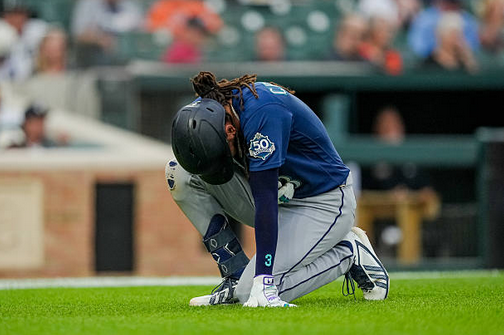
The ultimate meaning of Friday’s game in the Motor City will depend quite a bit on the health of J.P. Crawford: if he is out for a significant stretch of time (or if his abilities get all out of goose should he try to play through something serious), then an errant - it may have been Framber Valdez, but it certainly seemed to have been an accident in this case - full count sinker may end up being more pivotal than an otherwise unremarkable 7-3 loss would indicate. Should the Mariners recover to put some more wins back together and Crawford recover back to the way he had been playing, then the game might truly become a footnote.
Of course, if a veritable skid begins for the Mariners, with or without Crawford, then the momentum of Friday’s action may end up important for much larger reasons.
The M’s went back to familiar ways with runners in scoring position, with runs drying up in Detroit.
Friday was Valdez’ 20th career appearance and 18th start against the Seattle Mariners, during which he had gone 7-4 with a 3.50 ERA and 1.320 WHIP. The M’s, of course, were codivisional with Valdez during his eight years with the Astros, but the team he faced on Friday was one that had spent most of the year flailing against lefties.
Seattle saw the ghost of stranded baserunners past in the first inning, with opposite field singles by J.P. Crawford and Julio Rodríguez followed by three-pitch punchouts for both Randy Arozarena and Josh Naylor. Rob Refsnyder, a man with a .114 average and some of the worst WAR figures in the game [1], was the only hitter remaining who could scratch a run across. Valdez got him to a 2-2 count.
Refsnyder shot it the other way and found the outfield grass in front of Tigers right fielder Kerry Carpenter. With two outs, Crawford was putting everything into his dash home, but the throw was on the money. For a split second, it seemed like the hit would be in vain, but as the ball bounced out of the glove of Detroit catcher Dillon Dingler, Seattle had a 1-0 lead.
That was the only true hit with runners in scoring position the team had all game, though the complete figure was 2-14 thanks to a pop-up that dropped into right field due to some lapses in concentration on Detroit’s side. A Naylor bunt single and a Refsnyder infield single gave Seattle another inning with two men on and nobody out in the fourth, but three weak fly balls due to plenty of out-of-zone swings meant that not one scored. Rodríguez and Arozarena both reached base with two outs in the fifth and executed a double steal only for Naylor to poke his bat out on full-count junk for a weak groundout to second.
Colt Emerson cracked a home run down the left field line in the top of the seventh for another run and Naylor came around to score after a leadoff double thanks to the aforementioned floater from Garver, but that was far less than what was needed thanks to all that transpired on the other side.
J.P. Crawford exited with a hand injury, and although nothing seems to be broken, the severity is unknown.
The Mariners shortstop showed visible weariness in his face upon scoring the first run. But perhaps ever since his shortstop job got into imminent jeopardy, Crawford had been fighting on the field with all the energy he could summon.
Crawford’s extra edge and vigor showed again in the bottom of the second with a man on first and nobody out. Spencer Torkelson chopped a grounder towards the hole between third and short, exactly where Crawford’s defensive decline has been harshest, but the visiting shortstop laid it all out and snared the ball. With almost no energy remaining, he lobbed the ball toward Cole Young for the force.
Just like his scoring dash in the top of the first, it initially appeared like the effort was in vain, as second base umpire Laz Diaz called the runner safe; replay review, on the other hand, showed that second baseman Cole Young had caught the ball just in time.
Although the proverbial “dog days” are not for another month at least, Crawford continued having quite the individual dog day, getting hit on the wrist by a 3-2 pitch in the third. That moment finally sapped his ability to play, and although he stayed on the basepaths in that half inning (until being erased by a following double play), the Mariners subbed him out for the bottom of the third: Patrick Wisdom went in for him and moved to third while Colt Emerson went over to shortstop.
“It looked bad, there was a lot of swelling right away, there was some black and blue, and the strength wasn’t quite there,” manager Dan Wilson said. “So it was an opportunity where we thought, ‘let’s go get this looked at,’ we’re just really glad that nothing is too serious at this point.”
According to Crawford, the pain on the hit by pitch was initially comparable to when he broke his pinky in 2024, but it subsided soon after; imaging on the hand didn’t show any breaks and so the shortstop is day-to-day.
“As time went by, still hurt, but not as much as when I broke it,” Crawford said. “So I knew we were all good.”
Bryan Woo pitched into the seventh, but was unable to prevent the Tigers from tacking on five earned runs.
Just like George Kirby got knocked around by some inside-out swings and singles galore in the last game against the Mets, Bryan Woo fell to the same bugbear in the Mariners’ opener against Detroit.
Batted ball luck played a part in Kirby’s bad outing on Wednesday and so too was it a factor for Woo on Friday. The runner in the first wasn’t much of a threat, and thanks to Crawford’s heroics in the second, Woo was able to work pretty quickly through that frame, too. A painted sinker brought down Zack Short to begin the third, marking Woo’s fourth punchout, but the Tigers quickly caught on to Woo’s penchant for the bottom edge of the zone. Gleyber Torres and Kevin McGonigle both attacked early strikes at that lower border and shot them into the outfield to put runners on the corners for Dingler.
Had Julio Rodríguez been able to snare Dingler’s weak flare to shallow center, the Tigers might have been kept off the board for at least a little while longer. But it seemed he wasn’t entirely confident in a shoestring or diving catch, so he instead went for the far rarer but more likely 8-4 putout. This worked, conceding a run in exchange for an out, but the game was tied 1-1.
The Tigers, however, were still keyed in on Woo’s low locations. Carpenter, who feasts on low secondaries, took prime advantage of a slider at the bottom of the zone to blast a two-run homer about two feet over the wall. It was probably robbable with a better leap from Víctor Robles in right, but such a play would have been quite tough in any case and Detroit had a two-run lead.
Woo finally worked a baserunner-free inning in the bottom of the fourth, the first one Mariners pitching had thrown since Tuesday. It began a mini-groove for the starter, with the Tigers falling quickly in the fifth and sixth before he had reached 90 pitches. He had six total strikeouts by the time that inning ended and, just like in the third, he began the seventh with another K.
And just like the third, things got hairy immediately. This time it was the Tigers’ aggression on four-seamers and sinkers as three consecutive hitters found holes in the infield to load the bases. Wilson yanked Woo out of the game and brought in Eduard Bazardo to try to get out of the inning, but as Torres lifted the ball to right center, that went out the window. Robles wasn’t able to time the ball up in time and Detroit had their fourth and fifth runs. Bazardo wrapped it up quickly, but the damage was done.
The feeling in the Mariners dugout was that Woo had suffered from bad luck. Both Woo and Wilson described the pitch that Carpenter homered on as a good one, and with Detroit having a .426 batting average on balls in play, there clearly wasn’t a sense that Woo’s issues came from anything relating to his process itself.
“I feel like I threw the ball better than what the scoreboard showed,” Woo said. “Kind of got singled to death, but you gotta give ‘em credit, they hit a lot of good pitches and definitely made me work for it. Just couldn’t get out of a couple situations.”
But like a lot of the Mariners pitching issues this season, the element of predictability was the difference. Seattle doesn’t have starters that have an elite tool (no Jacob Misiorowski with a triple-digit heater, for example), rather, their starters are all built around throwing a lot of strikes, relying on strong-but-not-otherworldly fastballs and an assortment of secondaries, and using that as their foundation. Pitch sequencing and predictability, however, are the biggest blind spots; this may be most glaringly apparent with Logan Gilbert, but other Mariners starters suffer from this, too.
Being too rigid and formulaic is perhaps a baked-in organizational weakness. The entire structure of the roster is built around well-established StatCast-era conventions, but the team doesn’t seem especially innovative in examining those conventions to create new advantages. This leaves them open to exploitation by teams that are looking to do so; this is something that they will just have to deal with.
In Woo’s case on Friday and in Kirby’s case more generally, it is true that the pitchers’ loathing of walks does cause worse outcomes when too many strikes are thrown. Sometimes, when a hitting team is clearly in first-pitch-swing mode, a pitcher has to sail one five inches over the zone to throw them off balance. It is also true, on the other hand, that some of what Woo on Friday and Kirby on Wednesday dealt with was the luck of the draw. In any case, it’s beneficial for a pitcher to have a clear head and focus on the things he can control, and whether a 90-ish mile an hour flare falls in or not is very much outside of the pitcher’s control.
Is it time for Alex Hoppe to return to Triple-A?
Dan Wilson went to his low-leverage arm for the eighth, with Alex Hoppe making his 13th appearance. For the third straight time, the problem inning began with a strikeout followed by a single, but this time, the damage was simpler: Spencer Torkelson ripped a 1-2 slider over the left field wall to make it 7-3. In a vacuum, the slider wasn’t in a terrible location, but Hoppe hadn’t mixed things up east-west and Torkelson was all over it.
It marked the fourth of the past six outings where Hoppe had given up at least one earned run. Now, his fielding-independent pitching (FIP) is still 3.24, but his elevated ERA of 6.46 in 15 ⅓ innings perhaps tells us something else that isn’t seen in the stats.
That thing is seen in his eyes. Woo often talks with the media about the importance of confidence as a pitcher, with the same things that stymie a hitter getting torched when a hurler isn’t feeling it; and the fear in Hoppe’s eyes is unfortunately quite apparent as he takes the mound in the majors.
His 1.435 WHIP isn’t exactly elevated by weak contact reaching play all the time, as his opposing BABIP of .311, while perhaps due for some regression, isn’t all that much higher than the standard .290 benchmark. Hitters knock line drives off of Hoppe when they face him even if those liners aren’t especially hard, perhaps indicative that they have some sort of instinctual jump on the rookie. Perhaps, then, a spell in Triple-A would help Hoppe trust his stuff more and gain that X-factor confidence that a hurler needs in the bigs.
But while the Mariners have guys like Nick Davila and Josh Simpson in the minors available for a call-up, Davila is far wilder and also has issues with line drives (and seldom gets whiffs) while Simpson has a knack for giving up lots of hard contact and homers. Robinson Ortiz might have significant upside at some point, but he is clearly not quite MLB-ready either.
And it’s also possible for Hoppe to gain that confidence in the majors. Even while giving up two runs, he elicited plenty of swing-and-miss and struck out three batters. Torkelson’s homer was just the second barrel anyone has hit against Hoppe all year. The potential is clearly there with his stuff, though his current run of form is why he is in the low-leverage role. In that case, it would also make sense for Hoppe to stay up with the big league roster.
On Deck
With the Texas Rangers’ victory in their Friday night game against Cleveland, the Mariners’ lead on the division is now 1 ½ games. A race between these two clubs seems to be the most likely divisional battle to shape up at the current moment, though an 11th-hour Astros surge or another A’s hot streak are also possibilities.
Bryce Miller (1.71 ERA, 2.87 FIP) will get his first full start since his first game back, with the six-man rotation in use this go around during Seattle’s long road trip. Up on the mound for Detroit will be right-hander Keider Montero (3.69 ERA, 3.98 FIP).
[1] -0.8 Baseball-Reference WAR and -0.9 FanGraphs WAR.