“We Can’t Get Satisfied With One Win”: Mariners Fall Below .500, Below First Place with Cuyahoga Collapse

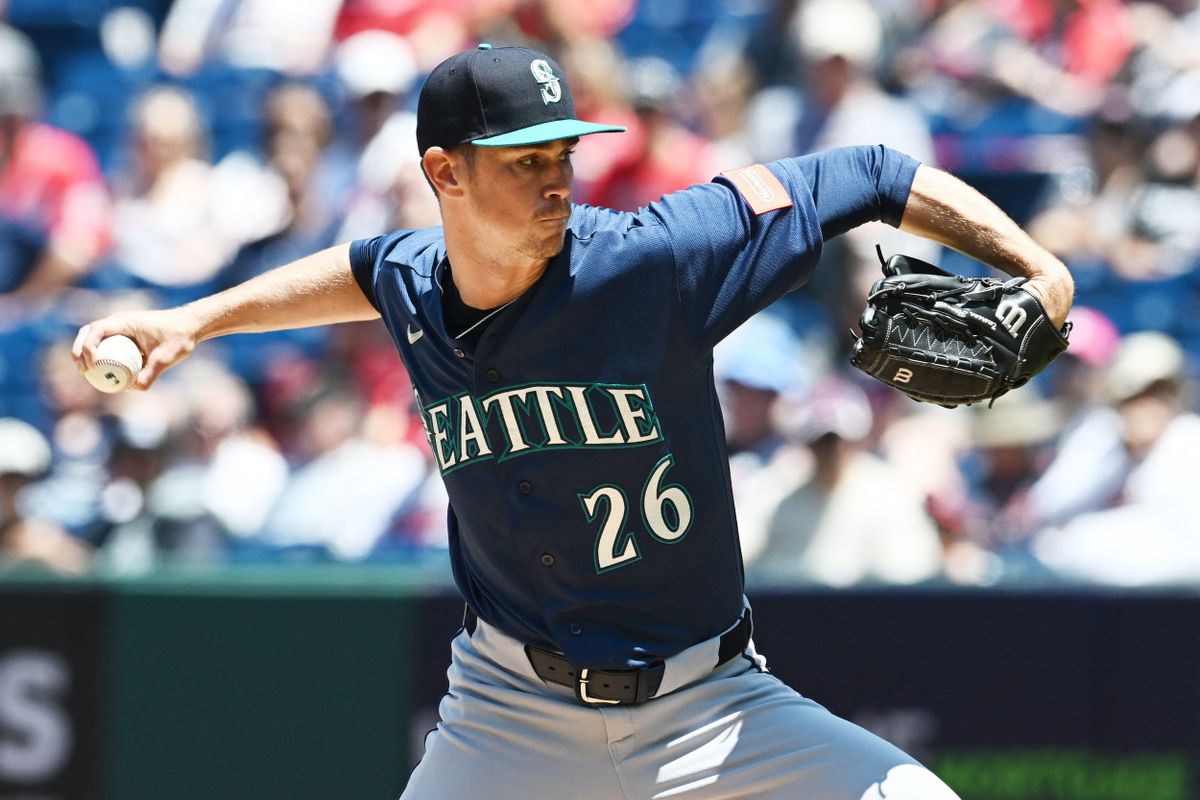
[caption id="" align="alignnone" width="4315"]
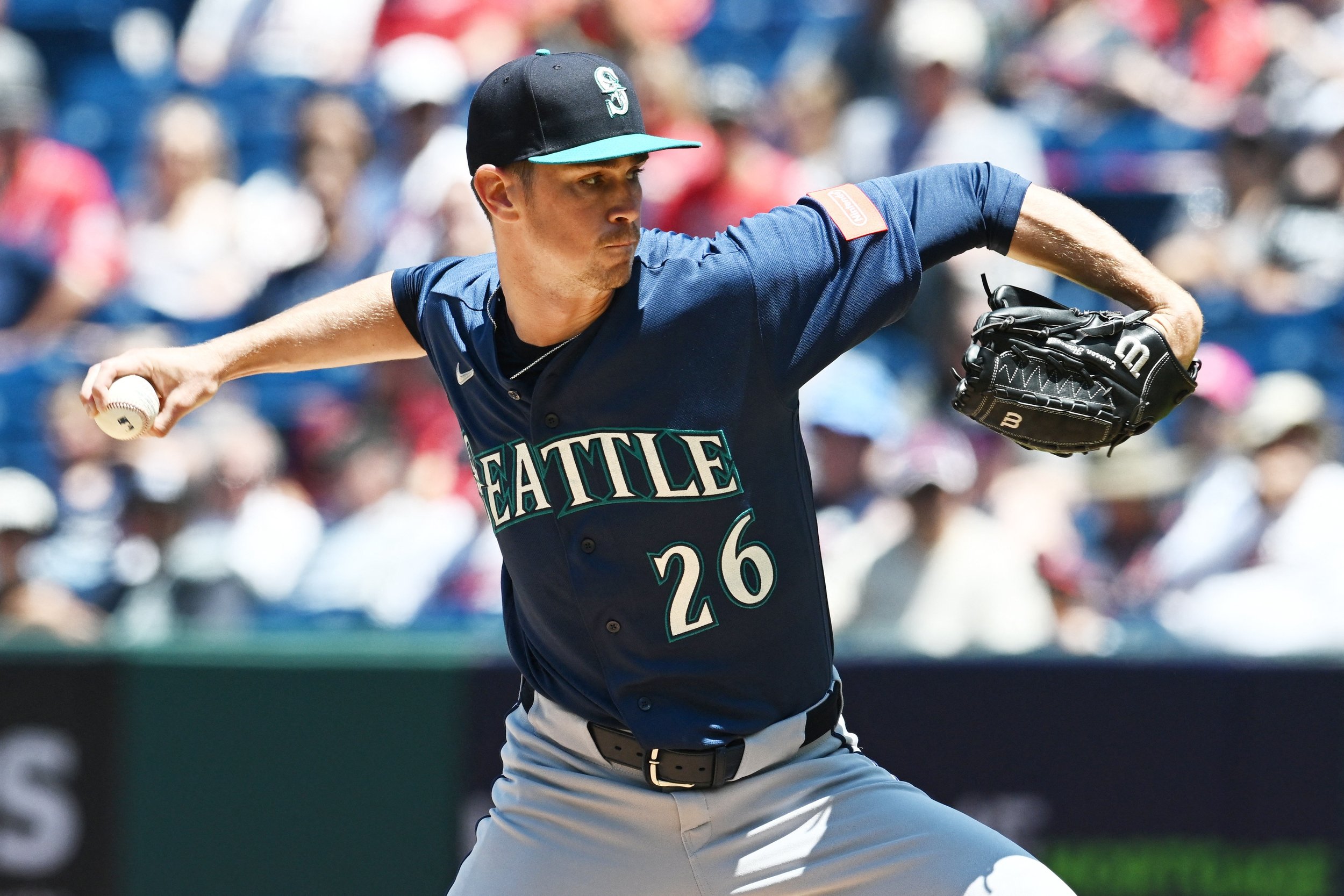
Seattle Mariners pitcher Emerson Hancock (26) throws a pitch during the first inning against the Cleveland Guardians at Progressive Field. Mandatory Credit: Ken Blaze-Imagn Images [/caption]
Mariners manager Dan Wilson didn’t appear to treat Sunday’s game like a must-win contest. This was despite the fact that the team’s AL West lead had all but evaporated and that the game directly determined a tiebreaker between the M’s and Cleveland Guardians, one that could in turn be the difference between the Mariners getting a first round bye or not. The guidelines of long-term player management were all but catechisms for Wilson even as his team’s 4-1 lead fell into the dust.
“Our guys, they want the ball, and we'll give them the ball when we can, and when they want it, and some guys are available for one-pluses and some aren't, and we make adjustments as we go,” Wilson said after his team’s 6-5 loss. “And that's just where we're at right now.”
There was no willingness on Wilson’s part to stretch anyone beyond their usual usage. No reliever up-downs would be allowed and no starter could surpass 100 pitches; in short, there would be no second wind for his team. By the time such second winds are allowed in September, it may be too late, just as it was in 2024 (and before Wilson’s tenure, in 2023, too). Such is the peril and just dessert of treating the first five months of the season like extended Spring Training.
They fell out of first place, under .500, dropped the series and the season series, and yet again let an opening win go unfulfilled in the final two games as they took their foot off the gas.
The Mariners, injury-conscious given the circumstances, committed to reliance on Michael Rucker and Josh Simpson.
Starter Emerson Hancock worked into the sixth inning, but with 98 pitches and a heap of armside misses to Cooper Ingle with two outs, Wilson went to the bullpen and called upon Eduard Bazardo. It took a bit for him to settle in, as he gave up a double, but his punchout of Patrick Bailey sealed the deal for that frame.
A series of left-handers made for the Mariners to go to Gabe Speier in the seventh, and though he worked around a pair of two-out hits to punch in another clean frame, his usage marked the last quality arm before closer Andrés Muñoz. Jose A. Ferrer had pitched in both previous games, and with his 39 season appearances, perhaps the two-on, one-off guideline was the best one to treat like a catechism.
But with that in mind, the team was also unwilling to have a guy go through an up-down and unwilling to sacrifice the lefty-righty matchups in order to have the better pitcher, and that meant that they were basically playing hope chess in the eighth inning.
“Jose was down today, and with where it landed and getting Bazardo in the game [in the sixth], it was time to get Speier in there [in the seventh], and that made it a little difficult there in the eighth,” Wilson said.
A chain is only as strong as its weakest link, and when Michael Rucker couldn’t find the strike zone in the bottom of the eighth, the chain broke.
Mitch Garver, Michael Rucker, and Josh Simpson combined for a game-losing eighth inning.
Catcher Mitch Garver came into the eighth with a solid defensive game going, having run a guy back to third to get the runner going from second during a jam in the bottom of the second and having challenged a 3-2 called ball to end the fourth on a strikeout. His game didn’t end there, as he had driven in one of the team’s four runs to that point in the game.
But if there’s one lesson that appears time and time again with the ABS challenge system, it’s that both batters and catchers should challenge more full count calls than they already do, especially with both challenges remaining. The downside risk of losing a challenge is far less than the upside of erasing a baserunner and getting an out (from the catcher’s perspective) or erasing an out and getting a baserunner (from the batter’s perspective).
Brayan Rocchio led off the frame with a single, and though Rucker threw several strikes to Cooper Ingle, they weren’t especially competitive ones and he fouled plenty off before taking ball four on the low-and-in corner. Perhaps Garver neglected to challenge due to Rucker missing his low-and-outside spot, but the ball was very much in the zone. What would have been a strikeout to keep the inning at a very manageable state became a walk to put two men on with nobody out.
Daniel Schneemann took a middle-middle 2-2 fastball and did what many opposing batters over the past month - almost enough to call into question the catechism that spray angle can’t be controlled finely enough to accurately find holes between fielders (the key word is still almost) - have done and perfectly split the shade between second and short, scoring Rocchio from second.
Bailey bunted the two runners over to second and Steven Kwan - who despite his sub-.600 OPS still struck Rucker with fear thanks to his contact skill - took an easy walk. Wilson brought in Josh Simpson to face a glut of continuing lefties. The move was perhaps a batter too late, but Simpson got a pop-up from Travis Bazzana.
The immediately apparent problem with the move to Simpson was Chase DeLauter, one of the few Guardians with relevant home run pop against a hurler with longstanding home run issues. With two outs and no double play available, DeLauter was due up when Wilson took out Rucker, but there was still not to be an Andrés Muñoz ex machina after Kwan’s walk.
“Muny's more of our ninth inning guy, and we want to get him there,” Wilson said. “And we just weren't able to, like I said, weren't able to get the door closed on that eighth inning, and you know, it's tough.”
Of course, once Simpson entered the game, the three-batter minimum meant that he would have to face DeLauter. The Guardians rookie found the exact same hole that Schneemann did, and just like that, the game was tied.
The right-handed Rhys Hoskins called game as he corked a 1-1 fastball down the line. It was barely fair for the one easy run, but with DeLauter gluttonously rounding third, the M’s had a chance for a free out. Garver got the ball well before DeLauter reached the base, but he seemed to get stuck in an in-between tagging stance and lost the ball out of his glove on contact anyway. The M’s challenged both the foul ball and the safe call at the plate (the argument in the latter case being that the drop happened after the tag and not during) but both calls stood.
Had Garver made the earlier challenge, the Mariners may have already been out of that inning. Had Rucker and Simpson made better pitches, Seattle would have held onto their lead. And had Garver made a clean tag, they would have been only trailing by one.
The M’s trailed 6-4. Had their offense been truly clinical, the disastrous inning may not have even mattered.
Seattle finally scored a fourth run on Sunday, but they left quite a bit more on the table as premature satisfaction set in.
The Mariners’ 13-game streak of scoring three or less runs going into Sunday tied an ignominious team record, and the ‘26 M’s became the 23rd team to have such a streak in the live ball era (there were 17 other instances of this before 1920).
For the M’s, it had begun the day after a 10-1 victory over the Washington Nationals, with the team dropping the final two games of that series. The contests piled up as the offense submerged themselves in liquid nitrogen and seemingly refused to escape from that bleak, cold vat for weeks on end. They managed to go 5-8 over that stretch of time thanks to a few solid pitching performances, but the team’s record was quickly slipping and the team needed its bats to wake up.
Things initially looked quite solid for the Mariners. Cal Raleigh (DHing on Sunday) led off the second with a single, got to second base on a groundout, and scored on Garver’s single. Josh Naylor doubled home a Julio Rodríguez walk and happened to be in the right place at the right time to faze Rocchio at short on a following grounder, something that resulted in him airmailing the throw to first and letting Naylor score. Seattle was up 3-0.
But it seems that the team grew content with the runs they had. The Mariners got at least one runner in scoring position in every remaining inning, yet bad follow-up at-bats meant that only one of them scored before the ninth, and that was only after Victor Robles stole second and third on two consecutive pitches and scampered home on a two-out infield single from Julio Rodríguez.
Overall, the M’s went 2-14 with runners in scoring position. They got close to a fifth run in the top of the eighth with runners on the corners and one out, but as Randy Arozarena grounded to short and barely lost the race for the third out at first, the double-up ended the inning. They ended up scoring a fifth run in the ninth on an error that allowed Cole Young home and put runners on second and third with often-times hero J.P. Crawford at the dish, but the very first pitch he saw wound up in Rocchio’s glove for out number three.
“We can’t get satisfied with one win or with a couple good innings,” Raleigh said after the game. “we have to keep pushing on the gas and keep going until you don’t got any more to give. I think this group is very capable of that, I’ve seen it before.”
The question then becomes why. Why is the team so easily getting themselves out of the game, growing content after some early runs or a win early in a series, and losing their discipline? What changed between the tailwind in 2025 and the endless doldrums of 2026?
It’s probably a lot of things, but it’s easy (and maybe not wholly incorrect) to set some of the failure at the feet of leadership. It is beyond the mathematical halfway point in the season and Wilson is still uncomfortable at best and unwilling at worst to ask more of his team than the baseline the organization set up at the beginning of the year. The team hasn’t bitten the bullet and committed to a set of five starters, leading to reliever shortages time and time again.
“Frustrating, but we just gotta be better, myself included, we all gotta do a better job of just executing with people on base and being mentally disciplined, mentally tough enough to come through in those moments,” Raleigh said.
The catcher and captain talked about the need to play a full game and a full series, something the team is lacking. He, unlike the manager, put some of the onus on himself for the way things turned out.
And if things keep going the way they have been going, the oft-touted relationship between manager and clubhouse is going to fray. Winning is above all; when a team is consistently falling into the same traps and failing to get the engine started day after day, murmurs begin to ring along from the top step to the lockers. Once a manager loses the trust of his players, it becomes very difficult to regain.
But if the team can find it within themselves to lock in for the entirety of their games, or if Wilson can find it within himself to bring his players along the extra mile, they might have the chance to make their current skid a mere footnote in the grand story of the season.
As things stand right now, however, the Rangers lead the division by a half a game. A half game further behind the Mariners are the Astros, and a game behind them are the Athletics. A fourth-place finish in the West is also in the cards.
“We gotta keep the foot on the gas, I think that’s the story of the game there,” Raleigh said. “Can’t let off. I think we gotta play a full nine, come to the field ready to compete for two to three hours a day and not an hour and a half.”