Welcome to the Show: Colt Emerson Whacks Big Jack for First Career Hit, M’s Top White Sox 6-1

[caption id="" align="alignnone" width="2048"]
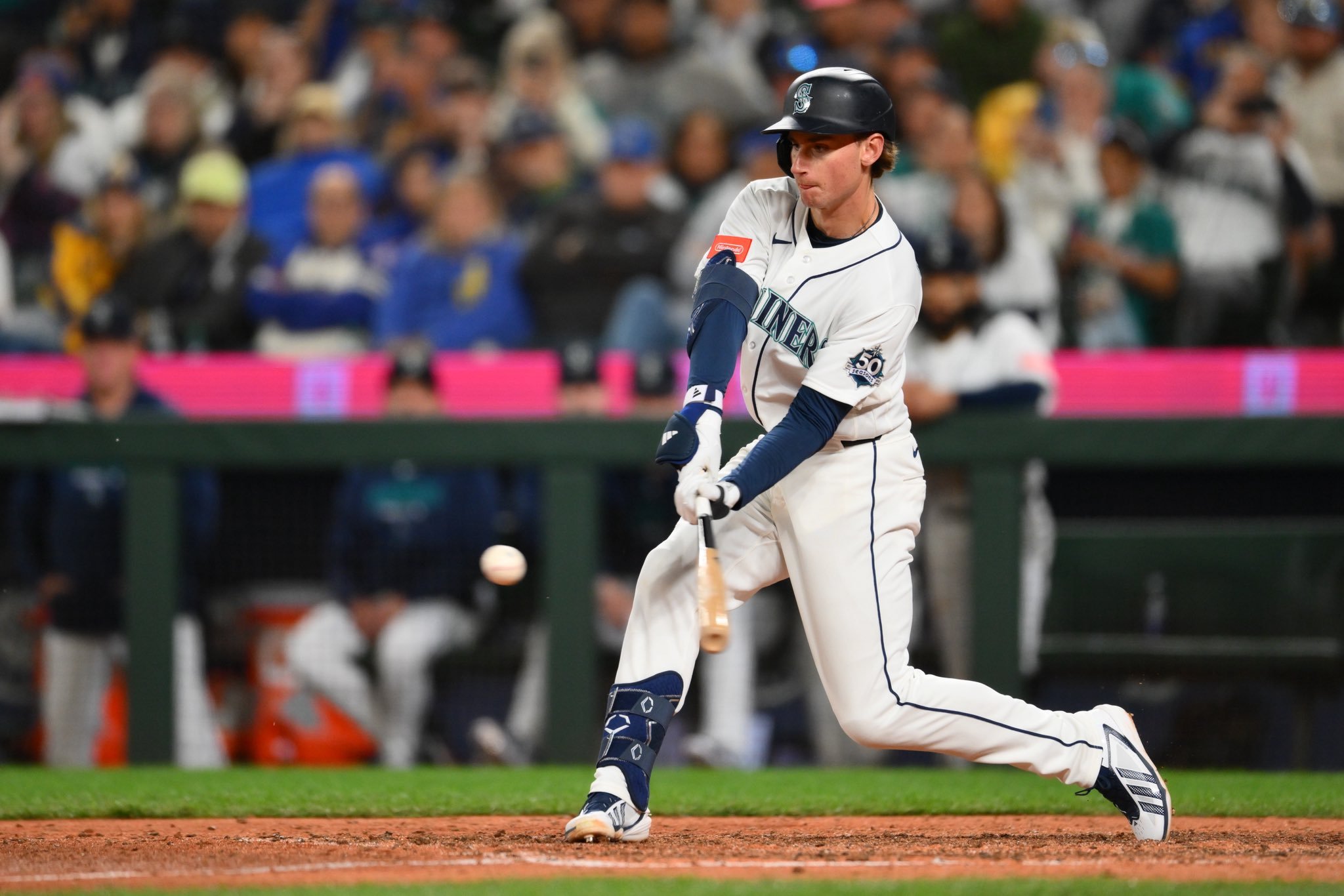
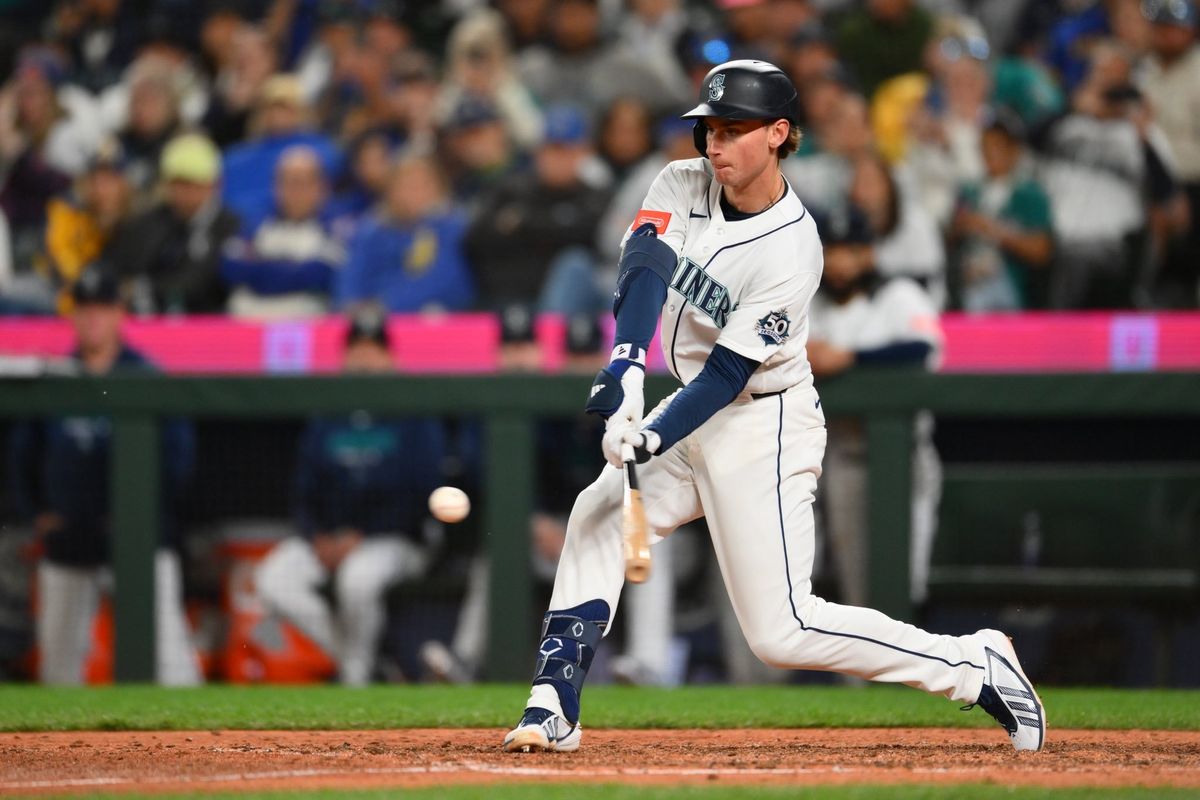
Seattle Mariners third baseman Colt Emerson (4) hits a 3-run home run and his first MLB hit against the Chicago White Sox during the eighth inning at T-Mobile Park. Mandatory Credit: Steven Bisig-Imagn Images [/caption]
On Sunday morning, the Mariners brass was faced with a decision. Brendan Donovan had re-injured his groin during a game against the Astros, and with Leo Rivas’ struggles continuing unabated and an unclear timeline for Patrick Wisdom (though he was evidently taken off the IL the following day), the time was arriving for 20-year-old top prospect Colt Emerson. At least, that’s the decision that the front office made.
“We think he’s the best option,” Hollander said about Emerson on Sunday. “This period will give him some runway; this is not a 15 at-bat or a 20 at-bat tryout to see if he’s capable of taking the job and running with it for the rest of the year.”
One key homer does not a good player make, but when Emerson sent a low liner a hair’s breadth above the yellow crown of T-Mobile park’s right field wall in the bottom of the eighth - a shot that put the M’s up by the 6-1 score that would prove final - Seattle got a glimpse of things that may be.
Colt Emerson’s first major league hit was a three-run homer to turn a close lead into a comfortable one.
When Emerson went up to the dish, the momentum of the game had left a growing pit in many stomachs across the Northwest. Seattle had scored one run on a Julio Rodríguez bomb in the first, another on a third inning Randy Arozarena RBI double that was more memorable for what happened between second and third, and a run-scoring Josh Naylor single in the sixth.
But despite an electric double steal growing the inning into a second-and-third, one out opportunity, neither Cole Young nor Emerson had cashed in, and a homer followed by a bunch of stranded traffic had put the wind at the White Sox’ back.
Emerson had taken his own brief odyssey to get there. Sunday’s promotion came as such a shock and so late in the day that his family wasn’t able to see his debut, having to fly in from Ohio. He filled in at third base for Leo Rivas, who the M’s scratched out of the lineup (and demoted to Triple-A the next day).
It wasn’t quite clear whether Emerson was ready or not. Over 169 plate appearances in 38 Triple-A games, Emerson slashed .255/.347/.469 with eight doubles, seven homers, and a triple. He struck out 27.2% of the time and walked 10% of the time. While his walk rate was a slight increase from the one he had in Double-A last year (8.7%), the strikeout rate was a large jump from a 19.3% rate for the Travelers. He chased at a third of balls outside the strike zone, a worse chase rate than 79% of Triple-A ballplayers.
While he didn’t get a hit on Sunday, Emerson showed some good patience, drawing a walk, and he was barely behind a fastball on a sixth inning fly ball to right, hitting it a little too far down the neck of the bat.
The fastball was the clearest weak spot of Emerson’s profile in Triple-A, with a 34.8% whiff rate against the pitch compared to a 21.6% whiff rate across that level. Sox starter Noah Schultz saved it for a two-strike count the first time he faced Emerson on Monday - this time with the Emersons, plural, in attendance - but as his sinker backed up over the plate, Emerson whacked it the other way. Third baseman Miguel Vargas snared the liner without moving a step. Schultz went with a lot more sinkers and four-seamers the second time he saw Emerson, getting the rookie to strike out on the fastball thanks to a quite unusual foul tip that bounced off catcher Drew Romo’s glove yet floated up in the air long enough for him to recover and land his mitt on it.
With runners on second and third and two away in the bottom of the sixth, Emerson had his third chance to notch hit number one, this time against reliever Brandon Eisert. The rookie infielder fouled off a couple of close pitches to begin the at-bat, but any jitters that might have been there dissipated as he worked the count full, laying off a two-strike fastball-changeup sequence that was primed to attack his profile. But Eisert’s sinker inside found the handle of Emerson’s bat and the man would have to wait once more, this time stranding two runners on in a close game.
“This team, they preach ‘don’t be an easy out,’ y’know?” Emerson said about his approach after Monday’s game. “You can see it with all the guys on the team, they’re not an easy out. So, me being in the eight hole, nine hole, seeing that ahead of me, you do what you see, and nobody else is an easy out. For me, wanted to be the same thing, just a competitor, never going to give it away.”
Perhaps describing the other Mariners in such terms is more aspirational - at least at the current moment - than descriptive, but Emerson certainly wasn’t an easy out for White Sox pitching on Monday. He wasn’t easy for Chicago reliever Trevor Richards, who got two strikes quickly on him but fell out of the zone on a fastball and then a changeup (the strategy against Emerson being clear, trying to get him on the heat that he is relatively weaker on and then playing off that heat on the next pitch) and then getting two foul balls on that sequence in reverse.
“The caliber of player that (Emerson) is already, to grind out some of the at-bats, falling behind a lot of the at-bats, he’s grinding ‘em out,” Mariners starter Bryan Woo said of his new teammate. “A lot of good at-bats and a lot of good stuff coming from them, whether they resulted in hits or not.”
This brings us back to Emerson’s first big league knock. Richards threw a pitcher’s pitch, a changeup about an inch and a half below the zone, yet Emerson swung and cracked a hard liner down the right field line, clearly a hit off the bat and a home run as it peeked over the wall. His hands were quick to whirl the bat around and make contact, with his eyes clearly tracking where the ball was headed, both good signs for the hitter’s process.
Chicago’s right fielder, none other than Jarred Kelenic - the last Mariner to have gotten a home run as his first hit - watched it sail above his head. Kelenic, of course, would go on to slash .204/.283/.373 in a Mariners uniform and be unceremoniously sent to the Braves after the 2023 season as part of unloading Evan White’s contract; in return Atlanta sent a package consisting of reliever project Jackson Kowar and a pitcher named Cole Phillips who has yet to throw an inning of minor league ball [1].
Even for a prospect as high-floor as Emerson, there is no guarantee of how he will perform in MLB. The times are certainly a-changin’, however, as exemplified by the walk Emerson took on Sunday, when a 3-1 pitch on the edge of the plate was called ball four. No rookie (especially not a highly anticipated one) would have gotten such a favorable call even a half dozen years ago. Perhaps those shifting winds have bequeathed the Mariners a longtime hero.
The irony, of course, is that Emerson cannot begin to think of himself as such if that is to happen. His team-focused approach, the one that has landed him the vaunted mature as a byword descriptor, is what can make him into a standout with Seattle.
Emerson has all-around solid tools. Whether he will be a stalwart of the franchise is, of course, beyond the fog of mortal sight. He got all the accolades on Monday, however, and it was a moment as magical as could be for the 20-year-old infielder.
“I can’t believe it happened when they were here,” Emerson said in amazement, referring to his many family members in attendance on Monday. “It’s special, it really is. Honestly, I’m speechless. I joked with them yesterday, I was like, ‘just saving the first hit until you’re here.’ Obviously not, but I wouldn’t want it any other way.”
Come to the ballpark, and you’re going to see something you’ve never seen before.
The proverbial baseball gods are strange forces indeed. Sometimes, a baseball game is about as predictable as a Hallmark movie; other times, strange stuff keeps piling up that makes people draw out the rulebook. Even if it’s not a particular rule that gets invoked, it’s something that will stick in the minds of those watching the game for quite some time after.
Such moments were a dime a dozen in the early innings of Monday’s game. It started in the top of the first, with Bryan Woo giving up a single to the leadoff Sam Antonacci and promptly failing to paint the corners against Munetaka Murakami. Ball four came in and Murakami duly went to first, but as Antonacci saw rookie third baseman Colt Emerson a bit off his guard and a fair bit away from third base, the White Sox second baseman bolted around second and went for third.
Emerson quickly realized what was going on and darted to third, receiving the ball in time to apply the tag on Antonacci and give Woo what would end up being a big first out. Woo would take some time to settle down (more on that later), but the odd moments picked back up in the bottom of the third.
White Sox starter Schultz, although he didn’t issue any walks to Seattle, gave Jhonny Pereda a free pass with a leadoff hit by pitch. J.P. Crawford popped out without much fanfare, but as Rodríguez lined one off of Antonacci’s glove, it looked like Schultz had completed an unremarkable inning with a 4-6-3 double play. And yet as second base umpire Mike Muchlinski sprung into action and pointed Pereda back to first, the Mariners got a lifeline; Antonacci had intentionally failed to make the catch and it was ruled just one out.
That brought up Randy Arozarena, who cracked a line drive into the left field corner. Pereda rounded second and bumped into Antonacci, who was watching the play unfold and waiting to potentially be the cutoff man. The catcher then bolted home, sent in by third base coach Carlos Cardoza, despite having been slowed by the impact and ending up beaten to the plate by about 30 feet.
Cardoza’s send was quite headsy. He realized that Antonacci would be charged with obstruction and that the worst that could happen would be Pereda being sent back to third; in any event, no out could be charged. The umpires huddled around and decided that Pereda would be awarded home, a ruling that drew Sox manager Will Venable out in an argument that evidently got heated enough to warrant his ejection.
Here's a birds-eye view of how that chaotic sequence played out... pic.twitter.com/ZfFrCaZON4— Daniel Kramer (@DKramer_) May 19, 2026
Seattle scored a run in quite an unusual way, that much is certain. On the other side of the ball, things were much more normal for Woo.
Bryan Woo pitched six shutout innings despite a rough first frame, helped out in part by Antonacci’s first miscue.
The league has adjusted to Bryan Woo’s heater, and Woo has had to make a pertinent counteradjustment; he now pitches plenty of hitters backwards earlier in games in order to make himself less predictable. There were some sweepers and changeups peppered around, but in practice, Woo had a feel for the slider on Monday and went with that for most of his secondary work.
Before establishing that feel, however, the Sox put together an opportunity in the first. Even though Antonacci all but threw himself out and Vargas grounded into a force out at second, another walk put runners on first and second with two away in that frame.
Andrew Benintendi saw the type of sequence that would define the rest of the game as Woo started him off and finished him off with the slider while pitching two heaters in between the spinners. The inning still took 25 pitches, but at that point, the ace Woo had returned.
Woo didn’t budge for the rest of the game, working cleanly through five more frames without another walk but with seven more punchouts. Just one inning beyond that point, the third, took more than 20 pitches. Antonacci and Murakami both knocked singles with one out in that frame, but Woo pitched backward to both Vargas and Colson Montgomery and struck both of them out.
The seas weren’t very angry in the fourth, but Woo sent all three batters away like an old man turning back soup in a deli. This time, he incorporated the occasional changeup and sweeper, and with much greater feel for those pitches than in the first, there was little the Sox could do. The fifth and sixth were similar, if with a few less strikeouts.
Seattle’s bullpen was quite a bit shakier than Woo, but they still held down the fort enough to close out the win. Eduard Bazardo gave up a two-out homer to Tristan Peters in the seventh, caught the bad end of a bloop, and then lost his command against Chase Meidroth as he sent the Sox pinch-hitter ball four like a giant rescuing eagle. Jose A. Ferrer had to put out the two-on, two-out fire before dealing with a runner on second that got there thanks to a Crawford error and a wild pitch by the pitcher himself.
Once Emerson blasted three more runs on the board, however, all the energy drained from the visiting dugout. Andrés Muñoz had already been warming, so he entered the game, and the non-save went without a hiccup.
The Mariners made some badly-needed adjustments going into Monday’s game.
For the first month and a half of the 2026 season, Rob Refsnyder took the leadoff spot in the lineup whenever the Mariners went up against a left-handed starter. Across his first 66 plate appearances, however, he slashed .123/.197/.228 with a slightly worse line against the southpaws he was brought in to slug.
Now, a bad slump over less than 100 plate appearances doesn’t mean a team should give up on a guy. Descriptive metrics of both the old and new schools all agree that his struggles have been quite bad, but utilizing some inchoate predictive metrics [1] - in other words, seeing how often he skies a hard shot that would have been dangerous at a more ideal angle - there is reason to believe his results on contact should improve.
But with a hitter in that bad of a rut, a team can’t rely on production; it behooves the manager to give him some lower-importance situations. This isn’t easy when a hitter’s role relies on pinch-hitting as much as anybody, but lowering Refnsyder in the lineup was a clear call by this point. He hit fifth on Monday.
Refsnyder, like many slumping hitters, didn’t catch much of a break (though he also didn’t do enough to create that kind of luck for himself). He seemed to be in a clearer headspace in his first two at-bats, getting slightly under one for a first inning popout before rocking a loud out in the gap that was kept from being a double by Peters’ swift glove. He had been swinging at the right pitches, though, which was more than could be said of his slump-affected decision making in other recent performances.
Eisert didn’t throw anything over the heart of the plate in the sixth. However, with a 3-2 count and the slump on his mind, he was clearly suffering from a form of walk-lust, selling out active plate coverage in the hopes of preventing a swing and miss and getting a free pass. But it seemed to be a passive form of the affliction, for when he got a ball down and in that was called strike three, he simply walked back to the dugout.
The difference in run expectancy between bases loaded with nobody out and second and third with on; out is so great that Refsnyder would have only needed to be 17% sure of an overturn in order for challenging the call to be a break-even move. The M’s didn’t score in that frame, and there is still work to be done until the struggling righty can break his slump. Whether he will do so with the Mariners is an open question.
[1] That is the correct tense there. Phillips got selected by the Brewers in the Triple-A round of the 2025 Rule 5 draft and is currently on the 60-day IL once again, having never thrown a pitch in the Braves, Mariners, or Brewers organizations to this date.
[2] The basic concept is that, while both first-order results (like batting average, OPS, and wOBA) and second-order expected results (xBA, xwOBA, etc.) recognize the clear differences in production between a drilled popup and a drilled homer, from the hitter’s perspective, it’s a fraction of an inch in bat placement that separates the two. This kind of stuff ends up being a statistically better predictor of future performance than even stuff like xBA and xwOBA.