Mariners Cement Losing Season, Drop Another Game to Angels

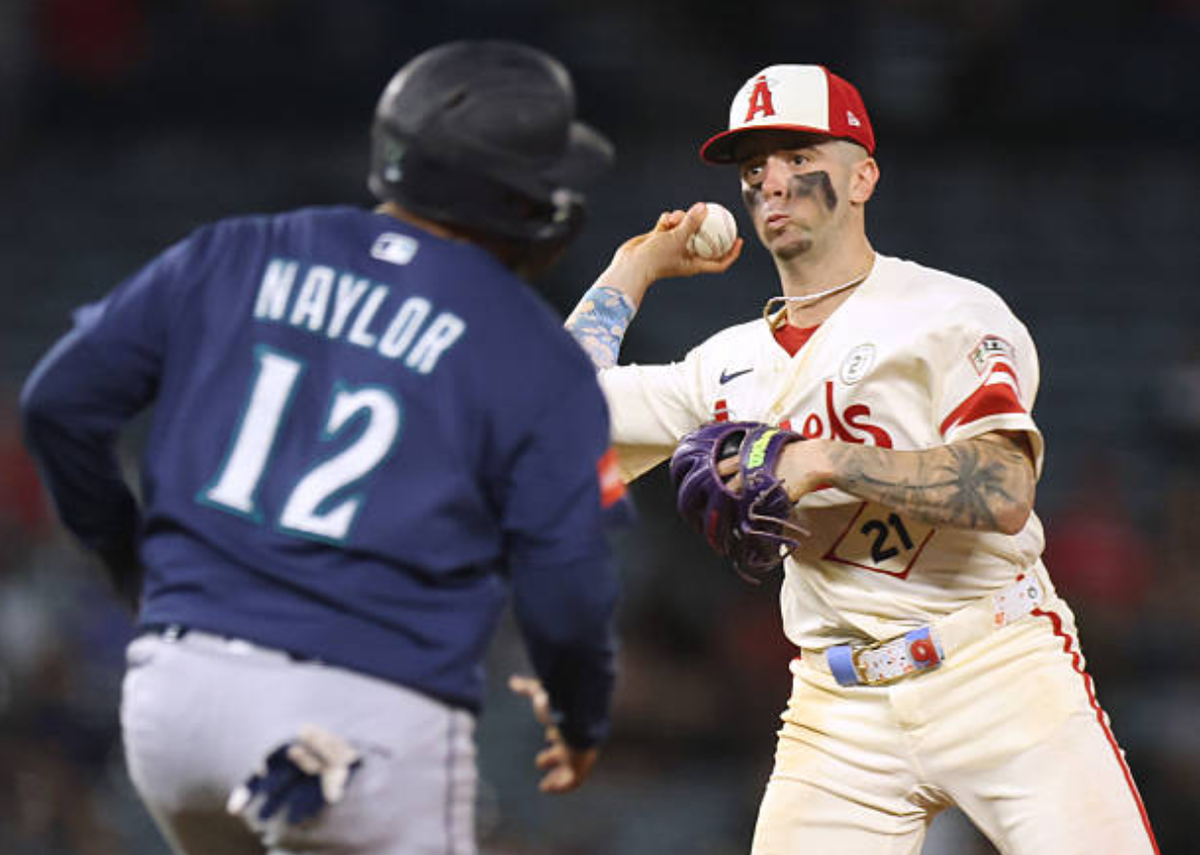
When Cole Young rolled one over weakly to second for a game-ending double play on Tuesday, a grim reality that had been all but assured for weeks became official: the 2026 Mariners are a losing team.
Seattle’s 2-1 loss to the Angels dropped the team to a 70-82 record with 10 games left to play. The playoff picture, which became even uglier as the Astros and Rangers both won, is now hardly worth thinking about.
Tuesday’s step into the abyss, like all 81 before them, had a little bit of symbolism. Dan Wilson, surrounded by smoke that he will step down when this year is done, took out one of the team’s top prospects in favor of their half-measure rental.
As any individual game goes, however, Tuesday’s was unremarkable. Logan Gilbert pitched well but got saddled with a loss because the offense died down aside from one run. The team squandered its chances with runners in scoring position. From the 10-foot view, it isn’t meaningfully different from the other losses; in the story of how the M’s went from one to 82, it is only valuable as a milestone.
The 10,000-foot view shows us that this was part of an inexorable pattern. The M’s would often chalk up such games to bad luck, but now there is no ignoring even for Wilson: it wasn’t bad luck.
“We were just waiting for it to turn around, and it never quite did,” Gilbert said. “It’s on us. At the end of the day, that’s the reality of it. We need to be accountable and know that we have to execute better. Things have to change. We have to have those conversations and figure it out.”
It is a lesson that turnarounds don’t happen on their own; players and teams must make them happen.
How long are the Mariners going to platoon Lazaro Montes?
With the right-handed Ryan Johnson on the mound for the Angels, the M’s had Lazaro Montes in the lineup but not Michael Arroyo. Now, the team had entered the contest down five and a half games with 11 to go, but Arroyo’s entry into the game would have to wait considering the team’s defensive concerns with playing him at third base.
Montes wound up getting the Mariners’ first hit of the game, a single with one out in the third. But although J.P. Crawford got hit by a pitch to put Montes in scoring position and Randy Arozarena reached on a cheap infield hit to load the bases, Dominic Canzone popped out to end the inning and squander Seattle’s best chance of the first five frames.
And as it turned out, he would only get one more chance with the bat, a strikeout with two on and two out in the fourth. Johnson got him to chase a cutter beneath the zone, but more impactful for his fellow rookie was that he challenged the 0-1 pitch during the at-bat. Randy Arozarena had already lost one challenge - though given that it was on a 3-2 count, that move was defensible - and Montes’ challenge meant that Seattle was at the whim of home plate umpire Brian Walsh for the rest of the game.
A more pressing immediate matter was that Wilson pinch-hit Taylor Ward for Montes in the top of the seventh. The left-handed Tayler Saucedo was on the hill, and in spite of the fact that they need to get Montes reps at this stage, Wilson opted for the righty-lefty split and the veteran he hoped could jumpstart his team.
There is some merit in a half-platoon of Montes, where he doesn’t start against lefty starters (but always pinch-hits) and plays the full game when there’s a righty on the hill - this is mostly due to defensive fit issues with Arroyo, who wound up playing second with Cole Young at short and J.P. Crawford at third once he went into the field - fully platooning him is a different story entirely.
Whatever improvement it would bring to pinch-hit Ward (which, to be sure, may be basically nonexistent given his .378 OPS with Seattle this year) is completely nullified by the fact that he has 10 more games with the M’s whereas Montes is 21 years old!
Arroyo, by all rights, earned a walk, but a 3-2 sweeper four inches off the plate was called strike three. The M’s didn’t get enough offense to bring either Ward or Arroyo up again on Tuesday.
Logan Gilbert tossed six innings of two-run ball, but he got the crushing loss all the same.
While the rest of the starting staff has been inconsistent at best and disastrous at worst during the second half of this year, the M’s have had one top-level arm in Logan Gilbert. It’s something of a reversal from 2025, when the rest of the staff was locking things down while Gilbert was stuck in five-and-dive ruts for extended periods of time.
The adjustment that seemed to get Gilbert back on track this year was a willingness to throw heaters in pitcher’s counts and, to a lesser degree, an ability to go to his secondaries early in counts. This greater unpredictability stymied his opponents, who had been reliant on anticipating his sequences, and there were a few more six-inning starts peppering his game logs in midsummer.
The efficiency took a dip on Aug. 19 against the Milwaukee Brewers - he logged only five innings that game and didn’t get six or more until Sept. 10 - but compared to his fellow M’s starters who had a 5.40 ERA during that time, he was going gangbusters.
And of all the Mariners on Tuesday, Gilbert could be said to have shouldered less of the blame than most. He put together a quality start, going six innings and allowing two runs, but because his team scored one, it was a loss.
Of course, whether a start is truly quality is a somewhat situational question. Gilbert took ownership of the bright red “L” on the scoresheet, with a recognition that while an average game might be a situation where two runs is a great opposing total, that particular game was not.
“I lost the game for us,” Gilbert emphasized. “We lost 2-1 in a game we should’ve won and I gave up the last run.”
Still, in an absolute sense, the M’s hurler was effective against the Halos. Of the 51 swings Los Angeles took against Gilbert, they missed 18 (35%); of all 96 pitches he tossed, 31 (32%) were called strikes or whiffs. He was particularly effective with the slider, which had a 41% whiff rate, and like he has for much of the summer, he used that pitch as his main secondary.
The hosts’ first run came in the bottom of the fifth. Despite getting the first two guys out, Gilbert gave up a seven-pitch single to Wade Meckler, setting up Vaughn Grissom with a man on. Grissom ripped a hanging slider past Brock Rodden at third and Meckler rolled around the bags to put the Angels up by a run.
Los Angeles’ second run was in the sixth, and it was far more simple: Josh Lowe sent a changeup over the center field wall with nobody on. Gilbert finished the outing with seven strikeouts and two walks, but that was a pitch he wanted back.
Dominic Canzone and Julio Rodríguez combined for the M’s only run as the team largely faltered in big spots.
The top of the sixth was the most promising of all the frames, getting jumpstarted with a bit of luck. Canzone launched a fly ball 403 feet to the deepest part of Angel Stadium, but that was a corner that should have contained the shot. Angels center fielder Mike Trout could have made that play in his sleep back in his glory days, but the 35-year-old “Fishman” mistimed an unneeded jump and the ball caromed around the outfield.
Canzone ended up at third with a leadoff triple, his fourth three-bagger of the year. But even before the run scored, the M’s were missing chances to make it a truly big inning, as Cal Raleigh took a first-pitch hack at a spinner right down the chute and popped it sky-high for the first out.
Julio Rodríguez logged Seattle’s only RBI as he lined a frozen rope into left center for a double. But Josh Naylor and Cole Young both squandered the chance to take the lead, and once Lowe launched his go-ahead bomb in the bottom half, the M’s found themselves trailing for the rest of the game.
A Naylor single in the top of the ninth was the last hit Seattle got, with Young’s double play ending things soon after.
On deck: 10 somber epilogues.
Perhaps the realization in the Mariners clubhouse took longer than one might expect. Perhaps it took less time for the team to see the truth. In all probability, it was probably both. Things fell apart in slow-motion and yet all at once, and though their public statements always aired on the side of optimism, they certainly knew deep down that things were going wrong.
Still, the outward belief never wavered. Even at the end, Gilbert talked about the fact that they had all seen nearly the same team be great.
But 2026 is a lesson. Nothing is given, everything is earned. As the earth turned around the sun many times earlier this decade and before, these players saw the Astros go through year after year where the season proverbially began in the ALCS. They didn’t see all the busywork and good habits that birthed that proverb.
And as is usual in T-Mobile Park, the Mariners learned that the hard way.