Party Like It’s 1999: Mariners Slugger Cal Raleigh Wins 2025 Home Run Derby

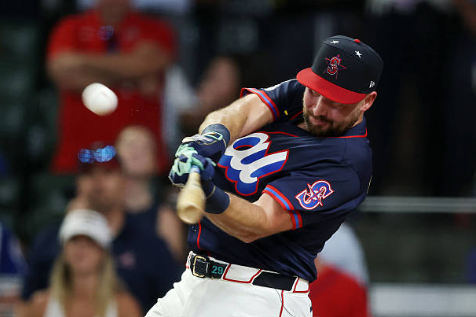
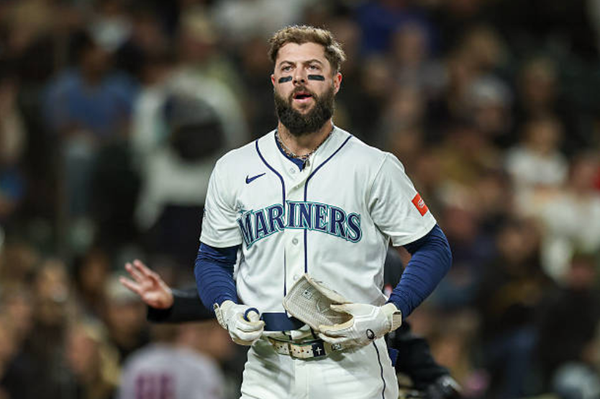
ATLANTA, Ga. – With a backwards hat on his head and complete amazement on his face, Cal Raleigh lifted the Home Run Derby trophy high above his head. He became the first Mariner since Ken Griffey Jr. in 1999 to win the beloved All-Star event. Now with grayed hairs on his crown and face, “The Kid” was on the field to watch a new Mariners superstar bedazzle America.
Raleigh knew who was passing him the baton. After it was all over, he wore his hat backwards in homage to Griffey's famous ‘90s style. His father Todd and his brother Todd Jr. – known as “T” – flanked him on either side, pride beaming from their eyes as Cal was covered in bling: trophy, chain, and belt.
It was Todd Sr. who pitched and Todd Jr. who caught during each of the three rounds in which Raleigh blasted bombs. The Mariner catcher was one of eight contestants and entered as the betting favorite due to his league-leading 38 home runs on the year.
Six players went before Raleigh in the first round. During this round, players first had three minutes to hit 40 pitches before going to an “outs” bonus period, where they had three outs – but could win a fourth with a 425-plus-foot homer during the round – to add on to their total.
The show’s beginning was punctuated by fireworks from one of the show’s other favorites: Oneil Cruz. Batting fourth, the Pirates outfielder more than lived up to his “Cruz Missile” nickname, hitting a truly Olympian blast that soared over dozens of rows of seating in right center all the way to the concourse, a full 513 feet.
By the time Raleigh came up, seventh out of eight, the scoreboard looked as such: Oneil Cruz at 21, Junior Caminero at 21, Byron Buxton at 20, Brent Rooker at 17, James Wood at 16, and Jazz Chisholm – the show’s final addition – with a paltry three.
Raleigh started off from the left side of the plate. 15 seconds in, he hit his first dinger. Then his second came, a mammoth bomb into the Chop House in right field. Soon after, he launched a cyclopean mountain of a shot onto the roof of said Chop House. Raleigh took his break with 1:22 remaining in the first round, eight home runs already hit at that point.
And then the Mariners catcher switched to the right hand side. He is only the second hitter to switch-hit at the Derby, coming after fellow catcher Adley Rutchman. And he proved why he’s such a threat, blasting seven from the right side into the left half of the stands.
But he was still two short of tying Rooker for the fourth spot, a tiebreaker which would be broken by distance of the longest home run. Seattle’s star switched to the left side. Two outs quickly came. It looked like Raleigh might be an early exit.
Crack! He launched one out to right center, far into the seats. Then he swung again and hit a skyscraping shot up into the air in right. It fell and landed past the fence for the tying homer. The next one was out, so it went to the tiebreaker.
Baseball is often times called a game of inches, but it was quite literally the case on Monday night. The analysis showed that Rooker’s furthest homer went 470 feet and six inches, while Raleigh’s furthest was 470 feet, seven inches.
I’ll be honest, I don’t know if the StatCast system can get that accurate. Perhaps a swing-off would have been better, and I’m sure Raleigh would have won that tiebreaker, anyway – no offense to Rooker. But with Matt Olson coming up just shy of either with fifteen, it was off to the second round for Raleigh.
He faced Cruz, the one-seed of the knockout rounds. He came in as the StatCast darling, and it’s not hard to see why: when he fully sells for power, as during a Home Run Derby, he hits some truly tape-measure homers.
Raleigh went first in the second round as the lower seed. In the second round, ties were to be broken with swing-offs and batters had two minutes to hit out 27 balls during the timed main round – but the bonus round worked the same way as the first round.
The seeding didn’t seem to matter. Raleigh put on an absolute clinic in the second round, getting in an early groove to tee off on eight homers during the first 55 seconds. After the time out, he picked up right where he left off crushing homer after homer, one of which again landed on the Chop House roof. When time ran out, he had 16. After the bonus round, 19.
But if anyone could make that chase, it was Cruz, the star of the first round. The Pirate again brought out the tape measure, hitting one 492 feet onto the surely now dented Chop House roof. But his pace was too slow, only hitting five before his break at 1:07. The clock buzzed with Cruz at 10 homers for the second round, needing nine to catch and force a swing-off.
It was too steep of a climb for Cruz, who came up with 13.
Heading to the final round, the same rules existed as the second, but it was Raleigh batting first and Junior Caminero batting last. Caminero had done well in the chase once before, blowing the doors off Byron Buxton and walking him off with a minute to spare in round two. Raleigh needed a big showing.
Raleigh started off with a couple shots 10 feet fair of the right field line before torching a ball into the center field fountain. He recorded seven homers before his break 56 seconds in and then kept up the pace in the second half, going for seven more before the final 10 seconds. Then with one second left, his father threw the last ball – and Cal swung as the buzzer blasted, scraping the ball over the fence with his 16th homer of the round.
Then came the bonus period. Once again, Raleigh had three. The breakout Tampa Bay Ray needed 18 home runs to tie and 19 to win.
Caminero looked ready to do just that. He stepped into the box donning a bat with a stylized rendering of his face on it. He started hitting. Ball after ball flew over the fence. He has seven homers by the time 49 seconds had passed and Caminero took a break.
He charged out of the break, getting to 12 home runs with 45 seconds left. But then he cooled off. In his last 45 seconds, he blasted only two – and now needed four shots in three outs to tie Seattle’s switch-hitting slugger.
The first swing was an out. Then Caminero teed off, sending a moonshot to center field for his bonus out. He chose his pitches very carefully, his groove disrupted and a seeming perfectionist mindset creeping in. If it wasn’t down the middle, Caminero wasn’t swinging. But when he connected, it wasn’t doing what he wanted. With one out left, he shanked a liner down the left field line onto the grass for the final out.
And that is how Cal Raleigh became the Home Run Derby champion, adding another milestone to a historic season thus far as the first catcher and first switch hitter ever to win the derby.
Seattle’s catcher was truly amazed after it. A look of awe in his eyes, exhaustion mixed with gratitude all over his face, he was presented with one heavy, shiny object after another. But he stood beside his family as he accepted the gifts, clearly happy to be spending time with them amongst all the chaos of the season.
“I could have hit zero home runs and I would have had just as much fun,” Raleigh said after the event.
It truly looks to be the season of the Big Dumper. With his incredible numbers and now his Home Run Derby championship, it is one that history will not forget.