Cal Raleigh Walks Off Yankees, Mariners Take One-Run Win Despite Missed Chances

The Mariners exited the weekend four-game set against the Guardians having scored nine more runs than their opponents but with just as many losses as wins. One-run games on Thursday and Saturday both went against the hosts, with the team seemingly figuring out how to deploy its roster in close matchups.
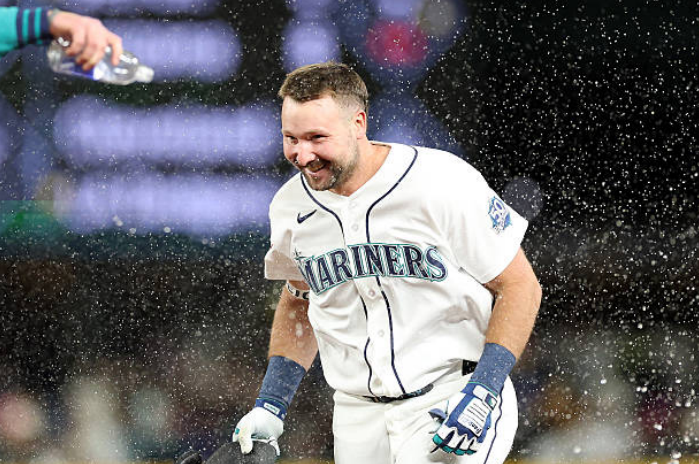
Seattle faced another one-run game against a 3-0 Yankees team on Monday night, and although the pitching was filthy, both the defense and offense seemed to have a bad case of the Mondays, letting several opportunities slip past at the dish and serving up a key non-out to New York in the seventh. But all’s well that ends well, and none other than Cal Raleigh knocked the winning run home in the bottom of the ninth to put all the night’s adversity behind them.
Luis Castillo notches his 1500th strikeout against Aaron Judge to cap off six shutout innings.
Mariners starter Luis Castillo isn’t the ace he once was. His once-elite grounder rate from his time with the Reds fell to around league average in his last few years with the Mariners, and his above average ratio of homers to fly balls in 2025 suggested he got on the good side of the Seattle marine layer. Still, his decline into his 30s has thus far been a graceful one, with a 3.54 ERA and 3.88 FIP last year.
When a pitcher does that well as his skills begin to fade, there are two ways to take it. One is that the pitcher is getting lucky and that a big drop is coming, the other is that he is making adjustments quickly as he ages and not trying to force his old style of pitching to work.
Castillo looked like he hadn’t declined at all when he came out of the gate on Monday. He touched 96 miles an hour on a couple of his fastballs, with his heater running like a train for plenty of swings and misses from the Yankee bats.
Seattle’s hurler worked quickly through a second inning error that put Jazz Chisholm on second, but his first real test came in the top of the third. Nine-hole shortstop Jose Caballero expertly used two challenges to overturn two strike calls and change his strikeout into a one-out walk. Castillo got an easy out from Trent Grisham, but nibbled around the edges of Aaron Judge’s strike zone and gave the 2025 AL leader in bases on balls his first free pass of the 2026 season.
Castillo attacked Cody Bellinger in the strike zone to put him on the back foot and got him to chase the high heat for a frame-ending strike three. That was the best chance the visitors produced against him, but even as he saw the order for the third time, he kept on top of the Bronx Bombers with just a four-seamer and slider.
That’s how good his command, sequencing, and movement all were: he could face a strong order more than twice while just throwing two pitches.
This still held as Castillo passed 90 pitches on the evening, with his 1,500th career punchout coming against Aaron Judge in the top of the sixth. It was his seventh strikeout of the evening and the second to last out of his six innings of work.
“Very cool moment in the dugout when he came out after the sixth and that 1,500th strikeout, to see all the guys, the starters in there hugging him and dapping him up,” Mariners manager Dan Wilson said after the game. “What a great moment to see that love they have for each other.”
Had Brendan Donovan not lost track of a Giancarlo Stanton popup in the fourth and Castillo cleanly fielded a swinging bunt from Caballero in the fifth, the Seattle starter might have gone back out for the seventh. That’s because those were the only two plays scored hits, without which Castillo would have been the second straight Mariner starter to go six innings of no-hit ball.
Or, maybe not. The fact it was his first start had probably made up Wilson’s mind by the time Castillo’s pitch count crossed 90.
“It was a no-brainer because we have the good bullpen to lean on, and so we were able to go to it there,” Wilson said about taking Castillo out in the seventh inning. “But our starters have been very consistent for us.”
Yankees display why comparatively aggressive challenging is the way to go … with caveats, of course.
Much of the media strategizing about the Automated Ball-Strike (ABS) system has been, to borrow from Jonah Hill in the film version of Moneyball, medieval. There’s a lot of talk about how teams have to be really careful and reserved with their challenges and that hitters should wait until the late innings before using them for fear of losing them for a big opportunity.
This attitude seems to stem from the idea that each challenge is very risky, and that you’re more likely to lose the challenge than win it, at least from a batting perspective. After all, hitters have been wrong more than they’ve been right with their challenges so far this season, so this might make sense on the surface.
It seems the Yankees think differently. Over the third and fourth innings, New York hitters used five challenges and won all of them. Caballero’s two challenges in the top of the third extended Castillo’s frame by nine pitches in the end, and while the visitors’ aggressive challenges didn’t lead to any runs in these early innings, the process and immediate results were sound.
A run in the first is worth the same as a run in the ninth. Sure, there’s a reason some innings tend to be higher leverage than others - you still have time to react to totals scored in the early frames - but each inning provides its own opportunities.
Each situation, down to the count, number of outs, and bases occupied has what is called a “run expectancy,” that being the average number of runs that are scored from that inning situation. It’s usually some number between zero and one, though exceptionally good situations produce more than a run on average: the highest, a 3-0 count with the bases loaded, has a run expectancy of 2.97 runs.
Note that this is not a measure of how likely it is for any runs to be scored, it is the average number of runs that are produced from a certain point.
According to Tom Tango of the Tangotiger blog, the average run expectancy increase for a successful challenge in Triple-A was 0.2 runs. The risk, then, of an unsuccessful challenge is losing a fifth of a run.
This means that you can balance the potential run expectancy gain against the -0.2 run expectancy loss from a missed challenge to figure out how confident in an overturn a player has to be in order for the probabilities to break even.
Of course, last time anybody checked, no one can score a fifth of a run in the game of baseball. These run expectancy numbers are entirely about informing a team’s process so that their average result is better. The Yankees gained 0.79 run expectancy with their midgame challenges, yet Luis Castillo made sure those challenges didn’t lead to a single run.
And it should be said that some of New York’s challenges were indeed quite aggressive. Chisholm’s 0-0 challenge with two outs and nobody on had an 88% break-even confidence level, meaning that Chisholm had to be at least 88% sure it was a ball in order for a challenge to be warranted. But it was three inches below the zone, and based on his reaction, he was as sure as could be.
The reason for these confidence levels being so important, of course, is that a challenge must be the first thing a player does upon the pitch being received - completely unlike a replay challenge from the dugout, where teams make decisions having already seen the footage - and so there’s no way for a hitter to know for sure. The exact numbers will change as players become more skilled in challenge-making, but the basic idea to use an expected value calculation to create minimum confidence levels for each situation is the way forward.
It’s worth keeping in mind how much not making a challenge can hurt a team! The Mariners had a perfect chance to make a challenge in the bottom of the second with Víctor Robles at the plate with a 2-2 count and runners on first and second. Yankees starter Ryan Weathers threw a fastball about two inches inside, but when home plate umpire Mike Estabrook called it a strike, Robles just walked back to the dugout. With runners on first and second, the difference in run expectancy between a 3-2 count with no outs and 0-0 count with one out is 1.28 runs; the break-even confidence level for an ABS challenge in that situation is 22%. It’s easy to say he should have challenged when you can see a strike zone on your screen, but even with the information at hand for Robles, he should have challenged even if he thought he only had a two in nine chance of overturning the call.
Obviously, managers won’t be expecting their players to memorize perfect ABS strategy tables to the percent, but instilling a zoomed-out version of that idea will help teams across the league make better challenge decisions.
Perhaps Robles would have reached base, perhaps he wouldn’t have, but his absence from the basepaths meant that Cole Young, one of the Mariners’ few strong hitters from the evening, only knocked in one. The Yanks might run the risk of being too aggressive with their challenges, but far more teams, including Seattle, aren’t being aggressive enough.
Young has a banner day at the plate while the heart of the order struggles, but it’s Cal Raleigh who delivers the winning honors.
The M’s put some traffic on the basepaths with six hits in the first eight innings, but those knocks were concentrated on the barrel of one specific player. Cole Young, heading into his sophomore campaign with a strong Spring Training already in the books, was 3-14 with a homer going into Monday’s game. There had been some bad at-bats in the first game, but beyond that point, Young had looked like the improved hitter he had been in Peoria.
Batting ninth, Young’s first at-bat was with two outs in the second and those same two runners Robles saw on the bags still standing there.
During much of 2025, Young would often play things too patiently, taking a lot of early strikes and being put on the back foot. But in that situation, he took the first good pitch Weathers threw him and lined it into right field, well deep enough for Arozarena to score and put Seattle ahead by a tally.
Another single in the fifth helped set the table after Leo Rivas led off with a single of his own, but although Brendan Donovan moved the runners over with a slow groundout, the attack sputtered against incoming reliever Fernando Cruz. Pinch-hitter Dominic Canzone chased far too many splitters spiked in the dirt and Julio Rodríguez, although facing more competitive stuff, did the same.
New York had already tied things up by the bottom of the seventh, taking advantage of an error from Donovan at third - he was playing too far in against Giancarlo Stanton [1] and an odd bounce ate him up - that allowed pinch-hitter Amed Rosario to knot the score with a one-out sacrifice fly.
Young again gave his teammates a golden opportunity in the bottom half, scorching a one-out double to right off Brent Headrick. Donovan chopped a single to left to bring runners on the corners for a pinch-hitting Cal Raleigh, but the main Mariners catcher continued his early-season slump with a meager punchout and Rodríguez grounded the inning to an end.
While Young complemented his outing at the dish with a strong charging play and pinpoint throw to make sure a ninth inning slow roller from Jazz Chisholm became an out with a man on second, he didn’t become the hero in the bottom half, lifting a can of corn Judge’s way for the first out with Rivas on.
That role was evidently reserved for Raleigh. Rivas had scampered to third on a Donovan single, but with a 2-16 performance thus far in the season, he had a world to prove. Paul Blackburn hung a 2-1 cutter down the pipe. Perhaps a zoned-in Raleigh would have clobbered it out of the yard, but even a slumping Raleigh did enough, drilling the ball down the line and past Ben Rice at first for the walk-off stroke.
“Trying to keep it simple, trying to square something up like Edgar (Martinez) always talks about, and Seitz [Mariners hitting coach Kevin Seitzer],” Raleigh said to a crowd still chanting “MVP” after the game. Even with their star struggling, the energetic home fans made sure to let their mind be known about the MVP voters’ decisions the year prior.
On Deck
Seattle has a winning record after five games played, with excellent starts from each man in the rotation offsetting rough patches for Raleigh, Rodríguez, and Josh Naylor. With Max Fried hurling for the Yanks on Tuesday, however, they might have to finally awaken if Seattle wants to keep the AL East juggernaut from tying the series.
Logan Gilbert will be climbing the bump for Seattle, looking to provide a deeper outing than his opening night performance with the M’s having used four relievers (Jose A. Ferrer, Eduard Bazardo, Gabe Speier, and Matt Brash) on Monday.
[1] When Stanton is batting, “too far in” for an infielder is anywhere ahead of the point where both shoes no longer touch a blade of outfield grass.