Bryce Miller Gem Gives M’s Sweep of Halos Despite Absent Offense

The last time the M’s and Angels faced each other, it was one of many disappointing series for the Mariners during the first half of the season. Seattle won the first game of the set, but as they would do several times in the following weeks and months, they dropped the final two and lost the series as their offense died and the pitching got ambushed.
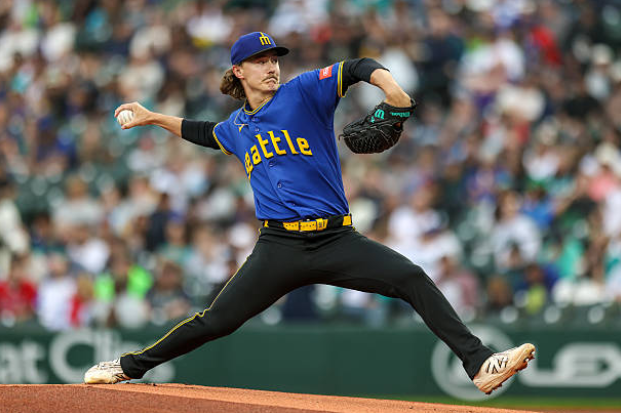
Seattle’s bats may have fallen incredibly silent on Thursday evening as the two squads finished their three-game series the day after both took a rest due to a 2026 World Cup game a block away, but Bryce Miller beared down once again as he utterly stymied the Angels’ hitters inning after inning on his way to seven frames of brilliance. That, more than anything, was the bedrock of the team’s 1-0 win.
Bryce Miller didn’t give up a hit in the first six innings as his excellent year continued.
Even with his innings being limited with the piggybacks, Miller had been one of the Mariners’ most fearsome pitchers since returning from the injured list. His expert mixture of a four-seamer, slider, splitter throughout his starts produced tough scenes for opposing hitters.
Miller had a bit of a tougher time in his previous outing against the Pirates, however. His three earned runs in 5 ⅔ innings were perhaps downstream of the fact that the slider was conspicuously absent from his workhorse usage, with the hurler reliant on just his four-seamer and splitter for 59% of his offerings.
And yet Miller did much the same against the Angels on Thursday to clearly better results. Halo hitters went down one after another as they couldn’t effectively differentiate between his two go-to offerings. The visitors had 10 whiffs and five strikeouts during the first three innings, with Miller at 35 pitches through those frames. A big part of this was the fact that he could control his splitter effectively once his (already minimal) opening jitters were over.
“A little bit early on, looked like a little bit of a tougher feel for the splitter, but then by the second, third inning, he (Miller) had a much better feel,” Mariners manager Dan Wilson said. “He was throwing up in the zone with it, getting the swing and miss when he needed it.”
Miller should have been out of the fourth after just six pitches, but as J.P. Crawford overthrew Naylor at first on a routine play, Denzer Guzman wound up at second. Yet he recovered quickly, punching out Jorge Soler to end that frame and breezed through the fifth. By this point in the game, the Angels were catching up, as most of the outs in these middle innings were on weak groundouts or flyouts. Josh Lowe nearly left the yard in the top of the sixth, but T-Mobile Park contained his high fly ball for a warning track flyout. By the end of the sixth inning, Miller had a no-hitter going with 69 pitches under his belt.
But events on the other side of the ball had more of a say in the length and nature of his outing than might have been expected beforehand.
Head and arm injuries sidelined Julio Rodríguez and Victor Robles.
The Mariners offense had put up loads of runs in each of their first games of the series against the Halos, but they did so two very different ways each time; Monday’s game saw a trio of homers account for half of Seattle’s six runs while Tuesday bore witness to 12 Mariners singles, one Mariners double, and eight Mariners runs.
Seattle had an opportunity in the bottom of the first, though it was a “no pain, no gain” type of chance, reliant on an errant Nolan Schanuel throw that hit Julio Rodríguez on the back of the head and a loose pitch from Walbert Ureña put a welt in Randy Arozarena’s tricep, but Josh Naylor bounced into a bases-loaded groundout and Seattle didn’t get any runs in that frame.
Ureña settled down quickly after that, only yielding one baserunner from the second through the fifth. The Mariners struggled mightily against his changeup, whiffing on 39% of their swings against the pitch while 41% of all his changeups were either called strikes or whiffs. Seattle’s only saving grace against the hurler was his wildness, but it would take a while for that to materialize into something useful for Seattle.
In the meantime, however, the team had to make two changes: Victor Robles in for Rodríguez thanks to the center fielder’s head knock and Weston Wilson in for Robles after the latter got hit in the forearm by an errant Ureña fastball. Wilson switched over to right field and Luke Raley moved into center, with the team operating thin. The longer-term implications, obviously, weren’t immediately clear.
“Julio kinda going through the concussion protocol, we'll see how he is in the morning,” D. Wilson said after the game. “Same with Vic, X-Rays were negative on Vic, but he was in a lot of pain there in the forearm/wrist area.”
Seattle managed to get the first run of the ballgame, however. Crawford logged the game’s first hit, a double to right center to lead off the sixth, and walks from Dominic Canzone and Randy Arozarena filled the bases. But it was up to a struggling Cal Raleigh to either give the team the lead or squander a golden chance.
Things didn’t initially look good. Raleigh took a first-pitch changeup from Ureña down the pipe and fouled off a couple pitches off the inside corner, down in an 0-2 hole where a Raleigh in better form might have done some damage or at least gotten to 2-1. But Ureña promptly lost the last bit of control over his pitches, and with Raleigh fouling off enough stuff to stay alive, it was the visiting starter who cracked first: Raleigh walked in the only run either team had.
Luke Raley struck out against southpaw reliever Samy Natera Jr., but it turned out to be enough for the Mariners.
Weston Wilson let in the Angels’ first two hits with a pair of fielding mistakes, but Miller worked through the frame.
The whispers were surely beginning to fly around by the top of the seventh. Many likely guarded their tongues, spoke in code, or pre-empted their friends with a motion to silence. But everyone knew what was afoot: Miller had a no-hitter going.
But on an up-and-in fastball on an 0-2 count, Schanuel shanked a looper into shallow right field. Wilson and Cole Young both charged in, but it seemed the two of them had issues communicating, and the ball fell in between them for a single. From a Mariners perspective, it wasn’t clearly W. Wilson’s fault: Young also had a chance to get the ball before it fell, and in any case, Luke Raley’s range also likely stopped outside where the ball went as well. If anything, the lack of communication may have been exacerbated due to W. Wilson’s newness with the team, but he cannot be wholly blamed.
Still, a better fielder would have gotten to the ball. More pressingly for Miller’s all-important pitch count, W. Wilson dropped a far more routine fly ball from Guzman three pitches later and the Angels had runners on first and second with nobody out.
It was finally crunch time for a pitcher who had been in the rocking chair six innings through. A splitter and two fastballs dealt with Jorge Soler and he emptied the tank against Wade Meckler and Jo Adell to end the inning with a couple more pieces of weak contact.
With seven innings pitched, eight strikeouts, and no runs allowed, Miller reduced his ERA to 1.71 and put himself in line for the win. And yet the M’s would need to outlast one more flurry from the visitors in order to secure the sweep.
Seattle got some help from Zach Neto’s bad baserunning in the top of the ninth inning.
The Mariners had seemingly been considering bringing Miller out for the eighth, but the skipper decided to bring in the ‘pen for the final two frames.
“Kind of a tough decision there at 90 pitches, but he had given us seven strong, and with our guys down in the bullpen and the possible piggyback on Saturday, we thought we could be aggressive tonight,” D. Wilson said.
Eduard Bazardo came in for the eighth and worked the kind of clean inning that the Mariners are used to, only needing 11 pitches to mow through three Angels, two of them on strikeouts. But closer Andrés Muñoz had a much rougher go of it in the ninth.
Muñoz’ 4.75 ERA going into Thursday had largely been the result of his first 25 appearances, where he had made nine total saves, had blown five more opportunities, and had even blown a non-save situation against the Padres. But in the eight games since, he had turned things around, relying more on his fastball. The extra usage of the four-seamer had the compounding effect of keeping him in an aggressive headspace and adding a mile an hour or two to his velocity, further improving his outings.
But the wildness that had so haunted the closer earlier in the year returned in the top of the ninth on Thursday. Muñoz threw six consecutive balls to begin the inning, and he needed the help of a baserunning error to get the first out.
To Muñoz’ credit, he was the one who realized how far off the bag Zach Neto had been getting, and with a 2-1 count to Schanuel, he fired over to first and caught Neto between the bases. Naylor fired over to second to complete the pickoff.
That play wound up being sorely needed. Schanuel singled to center two pitches later and Jorge Soler rocked one into left with two away, a hit that likely would have tied the game with a man on second given Arozarena’s poor arm.
When Wade Meckler chopped a routine grounder to Colt Emerson at short, however, the Mariners completed their first sweep since the last three days of May. It marked the first winning streak of three games or more since their eight-game streak ended on June 2.
On Deck
Few would have predicted that the Mariners and Blue Jays - the two teams in last year’s ALCS - would be a combined 86-89 by the third day of July, and yet that is exactly what has happened over the first three full months of the season.
The two sides play each other over this upcoming weekend as Western Canada takes its yearly pilgrimage to the Emerald City, Mariners blue being traded in much of the stands for the Blue Jays’ shade of that color throughout much of T-Mobile Park. Beyond the divided grandstands, both sides have plenty of stakes in the series. For the Jays, it is a chance to save a season that is already on the brink (though a division title is likely already out of reach); for the Mariners, it is an opportunity to build upon these previous three contests and finally punch in some consistency.