Bats Go from Quiet to Silent, Mariners Drop Third Straight to Open Texas Series

[caption id="" align="alignnone" width="6468"]
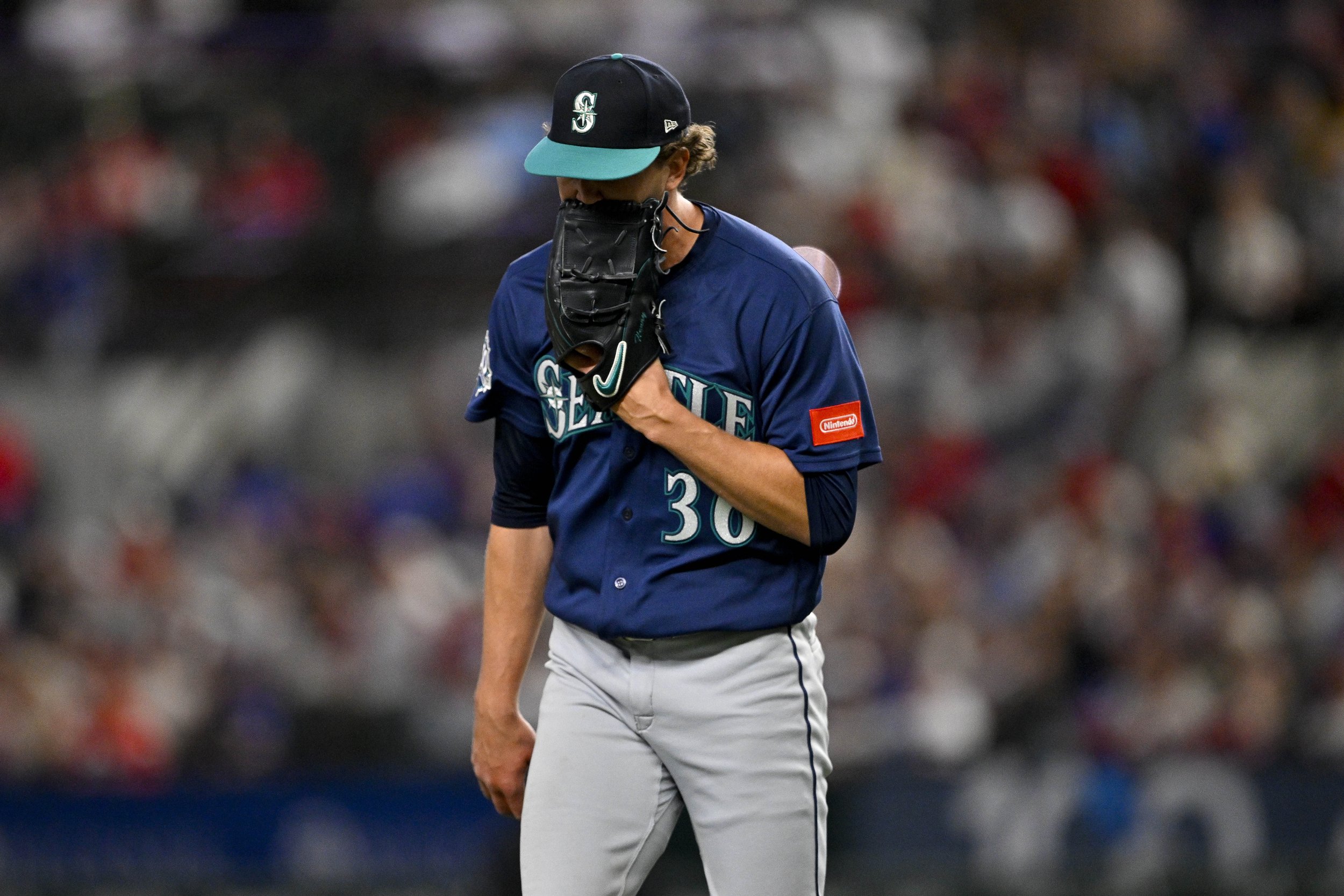
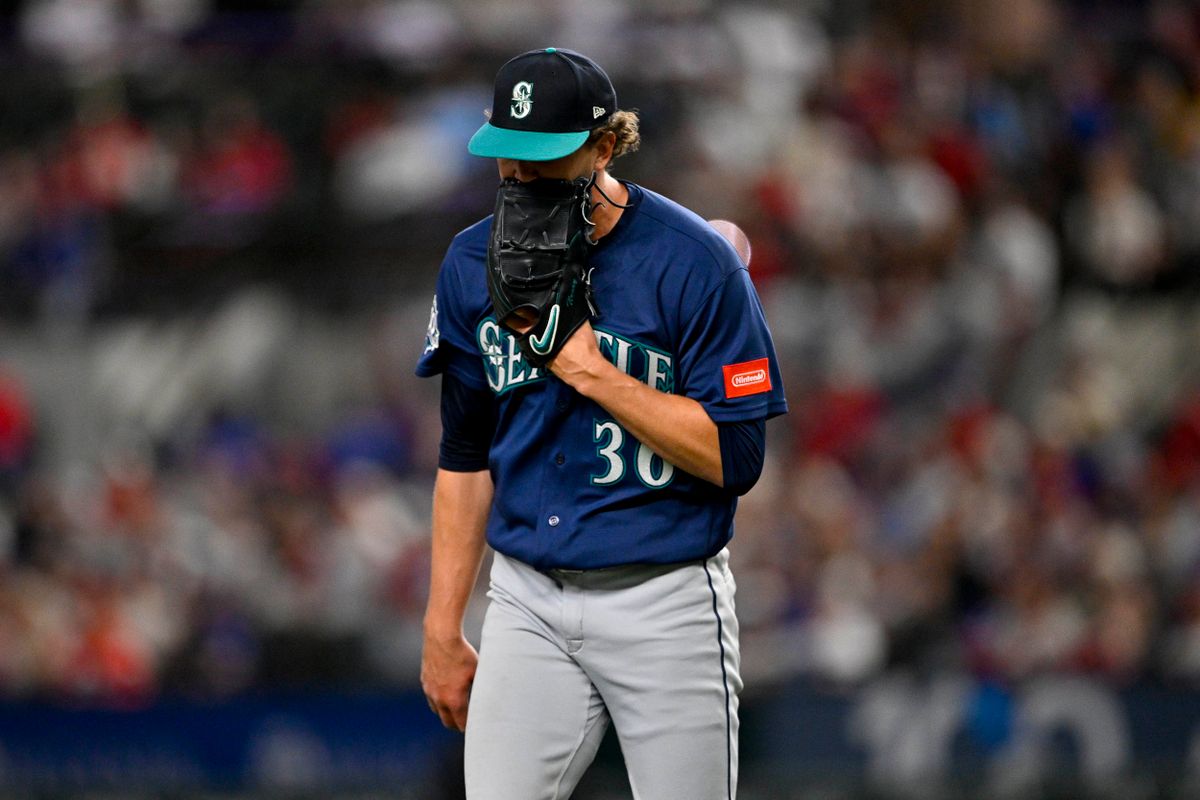
Seattle Mariners starting pitcher Logan Gilbert (36) yells into his glove as he leaves the field after giving up the go ahead run to the Texas Rangers during the sixth inning at Globe Life Field. Mandatory Credit: Jerome Miron-Imagn Images [/caption]
Sometimes, when a good team is in a rut of bad performance, it only takes one good break to open the floodgates and turn things around.
But when the M’s put up eight against the Guardians, or walked off the Yankees, or stole a theretofore scoreless match in extras from the Angels - or when Cal Raleigh launched one halfway into the upper deck on Monday night in Arlington, Texas - it was less like the great floodgates opening and releasing an overpowering torrent and more like little droplets of water gathering on the collection surface of a solar desalination plant: the tiny pellet of hydration was followed by yet more aridity.
Cal Raleigh finally found his stroke in his first at-bat of the game, torching a middle-middle Jacob DeGrom fastball 418 feet to right field.
What’s that old saying about the darkest time of the night? Well, the sun only shone for one at-bat in the top of the first and then quickly went away again (what’s the inverse of an eclipse?), but at least Cal Raleigh got himself into the .500s in OPS (talk about scarce droplets of water!) by the end of the night.
Going into the game, Raleigh had whiffed a full half of all his swings against fastballs over the heart of the plate, nine out of 18. Facing the hard-throwing Jacob DeGrom on the mound for the Rangers, he had to zone in on the pitch if he was to get anything going.
And Raleigh saw a lot of the fastballs in his very first at-bat. One was a called strike to begin the appearance, but all the rest save one were foul balls. Slider and changeups also peppered Rangers catcher Danny Jansen’s glove, but on the 12th pitch, Raleigh got a perfect middle-middle heater and hit it all the way to kingdom come.
Raleigh’s first home run of the year didn’t open any kind of mega-game for the Mariners catcher, but it was a good sign from a guy who hadn’t touched one up in a while.
Logan Gilbert threw his first quality start of the season, though he fell on some old habits at times and his cutter still didn’t impress.
Among the five healthy quality starters the Mariners have at the big league level, Logan Gilbert has been the one hurler who hasn’t gotten off to the best of starts (pun intended), with eight earned runs in 10 ⅔ innings over his first two starts. Despite working on a cutter over the course of the offseason, his issues putting batters away from 2025 still showed up in full over those first two outings.
While Gilbert tossed Rangers left fielder Wyatt Langford a decent 1-2 slider at the bottom of the zone, it still backed up enough over the plate for Langford to pelt it into left for a double. Corey Seager immediately tied the game with a hot grounder through the right side - torching up a cutter that didn’t have much of an edge at any point Monday - erasing the Mariners’ short-lived lead, but a double play brought a quick end to the frame after 15 pitches.
Gilbert’s splitter is an odd duckling of a pitch, and one where stuff models are appropriately split. FanGraphs’ Stuff+ model (fStuff+), which attempts to use a pitch’s physical characteristics to estimate a pitch’s effectiveness relative to other pitches (where league average is 100), estimates it as one of the best pitches in baseball with a score of 131 over Gilbert’s career and 136 in 2025. But TJStats’ alternate Stuff+ (fStuff+) model gives his splitter a 104, with a 107 through 2024 and a 99 since.
It’s worth noting that despite clustering around 100, the two models use a different scale. FStuff+ is an absolute scale while tjStuff+ adjusts the scale so that 10 is the standard deviation. FanGraphs’ PitchingBot tool does a similar thing to fStuff+ except that it automatically transfers those grades to the 20-80 scale, so that 50 is league average with a standard deviation of 10.
Those two walls of text basically mean that subtracting 50 from tjStuff+ gives a stuff grade on the 20-80 scale similar to PitchingBot’s stuff grade. For Logan Gilbert’s splitter, PitchingBot gave it a 63.6 stuff grade in 2023, 69.7 in 2024, and 64.6 in 2025. The tjStuff+ grades of 108 in 2023, 106 in 2024, and 98 in 2025 can be used to infer grades of 58, 56, and 48 in each year.
In plain English, we have one model giving plus to plus-plus stuff grades to Gilbert’s splitter year-in and year-out - while another describes a steady decline from plus to average. So which one is correct?
From what his hitters tell us with their swing decisions, perhaps tjStuff+ is closer to the truth. For whatever reason, hitters just stopped getting fooled by Gilbert’s splitter in 2025 and haven’t looked back, and Gilbert has taken a while to readjust. Although the splitter doesn’t get hit very well, it doesn’t get the chases that it used to get out of the zone and sees a lot more foul balls when it clips the bottom of the zone, leading to ballooning pitch counts.
This probably has a lot to do with how predictable Gilbert’s sequencing can get. When he gets to an 0-2 or 1-2 count, he all too often buries a splitter in the dirt, something each hitter probably knows is coming. But even when he uses it in an unpredictable way, they’re still not biting.
While Gilbert doesn’t quite have the curveball or slider control to avoid three-ball counts, he mixed his pitches quite well after the first and ended the game with essentially even usage of his four-seamer, splitter, curveball, and slider. An unchallenged tight strike zone in the second led to an eight-pitch groundout from center fielder Evan Carter and a Josh Naylor throwing error got a runner on third in the following frame, but Gilbert worked through those innings with 20 pitches each and no runs allowed before breezing through the fourth and fifth despite a bad route from Randy Arozarena leading .
While Gilbert had avoided forcing the buried splitter for the first five innings - going to it here and there but not going back to it when the hitter didn’t bite - a return to old habits bit him for a run in the sixth.
Seager’s two-out single started the action for Texas. After getting two quick strikes on Jake Burger, the Rangers cleanup man laid off a splitter in the dirt. Instead of changing it up, Gilbert threw another even further out of the zone and a third that kicked off Raleigh for a wild pitch. Unsurprisingly to everyone (except, evidently, the Mariners battery), Burger didn’t bite on any of the even junkier junk. Gilbert’s hanging curveball got sent out of Arozarena’s range for an RBI double.
This kind of situation has often formed the beginning of a crooked inning with Gilbert on the bump, but the M’s had the luxury of Joc Pederson coming to the plate and so Gilbert notched his fifth strikeout of the game.
Mariners hitting dies out after Raleigh’s homer, leading to the team’s third straight loss.
The M’s may be named after a seagoing sort of people, but they’ve already sailed past two (two and a half?) desert mirages in the young season, both at the end of series. The final game of the Cleveland series saw the team pump eight runs on the board, and even though the M’s defense blew away the opportunity, Sunday’s matchup against the Angels saw six runs put on the board in regulation.
All of those performances were followed up by a return to the norm - absent and dead offense - and Monday night in Texas was no different. DeGrom didn’t concede a hit for the rest of his five innings of work and the only Mariners knock came off Arozarena’s bat in the top of the seventh.
The middle of the Mariners order has begun the year in quite a rut, with each of Raleigh, Julio Rodríguez, and Naylor OPSing under .550 and both Rodríguez and Naylor under a .400 OPS. Rodríguez, a streaky hitter, has OPSed under .400 for 11 or more straight games once (Jun. 16-Jul. 5, 2024), while the fairly luck-reliant Naylor has had three such spans in his career.
Part of it has been bad luck, with a below league average team batting average on balls in play (BABIP) even on the road [1 2]. But when factoring in the quality of hits, they simply aren’t making good enough contact to expect lots of hits. Their actual OPS coming into the game was .631, but their StatCast expected OPS based on hit quality and angle was not much better at .694.
There wasn’t much life in the bats at any point, with the continued struggles of the heart of the order complemented by a quiet day from the rest. Despite Cole Young’s hot start, it would only take two 0-4 games to drop his OPS under .700 - for reference, if Rodríguez goes 4-6 with two walks, two homers, and two doubles in the next two games, he would still only be OPSing .679 - and a rut for just a couple games longer would put Young right back where he was in 2025. Luke Raley and Dominic Canzone are both nearing the Mendoza Line.
Aside from Brendan Donovan, a couple more games like Monday could put the entire Mariners order below said line. Donovan, for his part, went 0-4 in his return. An excellent inning from Jose A. Ferrer and a light Houdini job from Cooper Criswell went to waste as Naylor grounded into a game-ending double-play.
On Deck
If the M’s are going to take their first series win of the season in Texas, they’ll have to beat both Nathan Eovaldi and MacKenzie Gore on the mound in the upcoming two games. They’ll also have to be able to hold a lead for more than one half inning.
While the only two teams that have separated themselves from the pack have been the Yankees (7-2) and the Dodgers (8-2), the Mariners will follow up their series against the Rangers with a four-game set against the Astros that might determine the tone of much of the rest of the season. Granted, a real tone shift would only occur if the M’s get swept, but with the way they’ve been playing, that’s a real possibility.
[1] T-Mobile Park’s BABIP is consistently about .020 lower than league average, mostly due to the somewhat close dimensions meant to make up for the heavy air that have the by-product of making basically every fly ball at least somewhat catchable.
[2] It has only been a week and a half, so it’s a bit of an apples-to-oranges comparison, but the Mariners’ March and April BABIP of .241 has been the 12th lowest of any month for any team in the StatCast era (1890 such months), counting one month for each pair of March and April and September and October.