Lawrence Butler Walks Mariners Off, Engulfs Last M’s Playoff Hopes

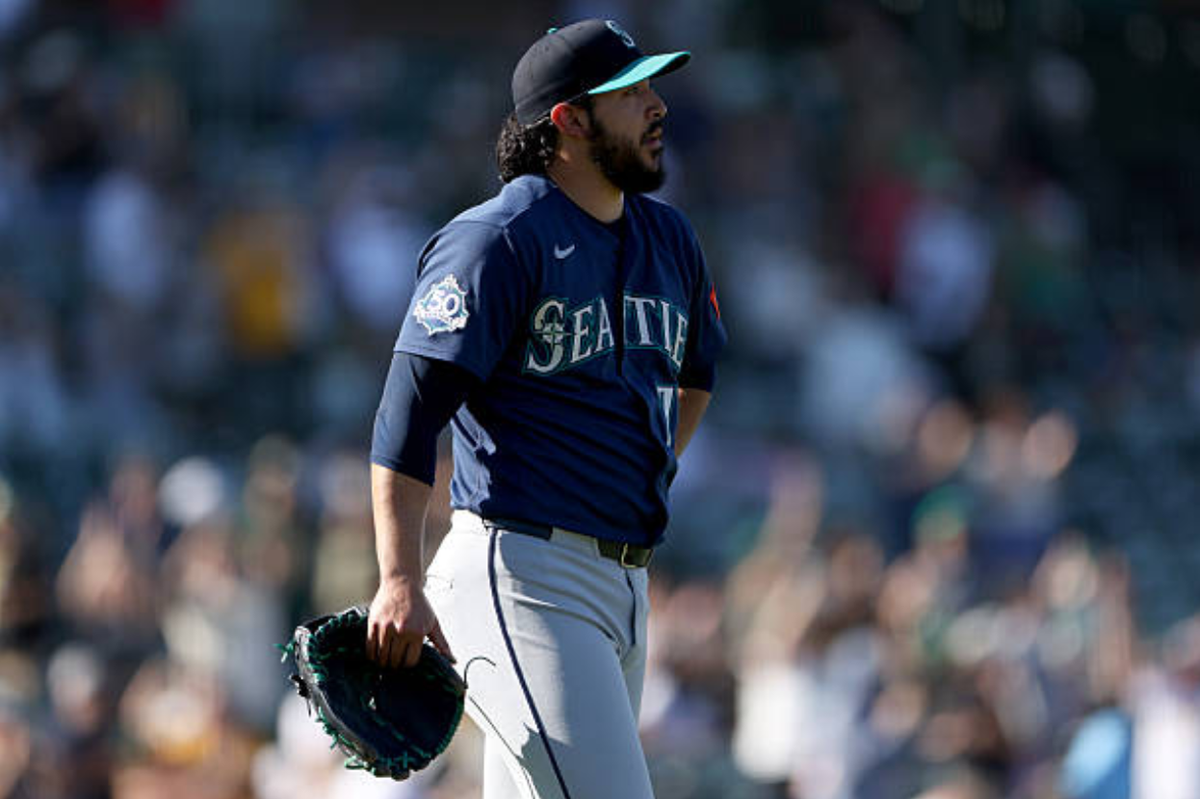
For years, the Mariners have relied on an ability to churn out relievers for pennies on the dollar, filling out a bullpen with just enough arms that are viable in a given year for the team to manage the innings required of a strong starting staff.
But the lack of relatively surefire options made the M’s weak to the impacts of a serious amount of injuries. The team lost Matt Brash, Cooper Criswell, and Carlos Vargas for extended periods of time, and the strain hence put on Eduard Bazardo and Jose Ferrer has turned what started as great seasons for both of them into second half catastrophes. The buck has thus fallen to lesser arms who have only inconsistently held up the bullpen’s standards, and with Sunday’s 8-7 loss, the final fruits of this were borne out in full.
The final deciding blow may have been Lawrence Butler’s walk-off two-run homer, but the fulcrum point of the game was the seventh inning. Had Carlos Vargas, who had already pitched a frame, managed to get one of the first two batters out, the A’s wouldn’t have approached Seattle’s tally. Had Gabe Speier, whose effectiveness as a reliever had been closer to his then-4.22 fielding independent pitching (FIP) and 4.36 expected FIP (xFIP) than his then-2.61 ERA, put out the fire with runners on, the A’s would have been down by three when the ninth began. And had Seranthony Domínguez either let Shea Langeliers’ grounder go to second or made a clean grab on the ball, a one-run lead would have continued apace.
“They’re all tough,” said Mariners manager Dan Wilson after the media pre-empted his usual “tough one” stock phrase.
This late in the season, and with more smoke than ever that this will be Wilson’s last as the M’s skipper, that phrase has ascended from being a verbal display of a manager going through the motions and become something of a meme, in both the Dawkinsian and Millennial senses of the word.
It’s tough because it’s a loss. It’s tough because of how avoidable this loss was. It’s tough because it is the final reminder that the Mariners did not do enough, whether in terms of the owners or the front office or the players themselves, to avenge their fallen selves from a year prior. And it’s tough because that word might be the only one given by the other 29 teams to Seattle’s self-sabotage.
Tough.
Randy Arozarena hit two homers to twice bring the Mariners back into the game.
There is a certain melancholy to the tear Randy Arozarena has embarked upon this year. Though his defense has left a lot to be desired, he has still been the most valuable Mariner on the 2026 roster, coming into the game with a .273/.371/.464 slash line, 4.7 Baseball-Reference WAR (bWAR), and 4.3 FanGraphs WAR (fWAR).
And yet this production becomes ever more inherently ephemeral to the Mariners’ long-term plans. 2026 is Arozarena’s contract year, after which he will go off somewhere for a big sum of money the Mariners won’t - and perhaps shouldn’t, given that he is 31 - pay. Unlike guys in contract years 12 moons ago, there is little hope of a World Series to etch their names in granite, or even a pennant to etch said names into one of the many pieces of glacial sediment that underlie most of Puget Sound.
That won’t stop the train from rolling, though. Although the A’s struck first and put the M’s in a two-run deficit after one inning, Arozarena knotted things with a two-run shot in the third. Hours later, once the Athletics had tied the game in the seventh, Arozarena put the M’s back out ahead with another home run, this time an eighth inning solo homer to bring the score to 7-6.
Had other things gone the Mariners’ way, either then on Sunday or during Seattle’s many, many opportunities earlier in the year to put together a good run of wins, perhaps such production would be emblematic of the team that the Mariners believed was going to be: the World Series contender, one of the best teams in the American League.
Those ideas had long since become nothing but wistful illusions, dreams of things that never were.
Michael Arroyo drew three walks and built upon his strong Saturday.
But there are players whose late-season production is hopeful. One of them is Colombian rookie Michael Arroyo, who was brought up in early September after a fairly good - if a little marred by overproduction - stint in Triple-A.
When it comes to the bat, there were two areas that Arroyo needed to improve upon coming into the majors: plate discipline and hard hits. He had already begun to improve his discipline in the last few weeks of his time with the Tacoma Rainiers, and the four missiles he launched off his bat on Saturday were about as encouraging a sign as he could have during his short 2026 stint.
Sunday’s game featured far more discipline, as Arroyo laid off plenty of balls and drew three walks. During his time in the minor leagues, he rarely took free passes, and this made his game a fair bit more dependent on batted ball luck than the Mariners would like.
The second of these free bases came in the fourth inning with one out and Josh Naylor on first. Weston Wilson singled the bases loaded and all three runs, including Arroyo, came around to score on a sequence of a sacrifice fly and two singles (the final one off Arozarena’s bat).
Arroyo’s current .500 on-base percentage is sure to decline quite a bit, but his early production has been a welcome sight for this beleaguered franchise.
Bryce Miller threw five innings of two-run ball, but a heap of walks prevented him from going deeper.
Despite only allowing two runs in five innings on Sunday, Bryce Miller’s outing was a little less encouraging. The hurler allowed two home runs in the first inning on back-to-back pitches, though the first was more because of an incredible swing by Zack Gelof to get to a high fastball. The second, however, was a plated cutter to lefty Lawrence Butler, and since Miller has made indications in the past that he at least somewhat lacks confidence in the cutter, it perhaps wasn’t the best pitch call on the heels of a homer.
In any case, the rest of the game went solidly for the Mariners hurler, especially considering his recent run of form (Miller had a 6.89 ERA in his last 10 starts). But this is somewhat of a disconnect between the top line and what actually went into the outing. Sure, he didn’t give up any runs after the first, but he walked five batters during his remaining four innings and hit another, giving up six total free passes compared to five strikeouts.
Miller thus had to work around serious traffic in multiple frames, stranding runners in scoring position twice and evading a third such inning by picking Henry Bolte off in the fifth. And by the time he finished the fifth inning, Miller had already thrown 91 pitches, enough for the manager Wilson to pull him in the sixth.
Carlos Vargas hurled a solid sixth but struggled in the seventh.
One of the many things that went wrong for the Mariners in 2026 was the team’s plans for Carlos Vargas’ development. Acquired in the 2023 offseason when Seattle traded Eugenio Suárez to the Diamondbacks, he spent 2024 in Triple-A before getting the call to the bigs at the beginning of the 2025 season.
Vargas was an uneasy reliever in 2025, with a 3.97 ERA, 4.59 FIP, and 1.351 WHIP. Despite a sinker than could scrape triple digits at times and a hard slider, he only had a 16.3% strikeout rate, and teams did plenty of damage with 10 home runs against him in his 77 innings of work.
The advanced numbers had some divergence, too; Vargas’ expected ERA (xERA) was a solid 3.61 while his xFIP was a much shakier 4.24. The team had been hoping to develop the 26-year-old from a somewhat shaky middle reliever into a true leverage arm during 2026, but he had a right lat strain at the beginning of the year and didn’t pitch in a big league game until Aug. 22.
When Sunday’s game began, Vargas sported a 3.09 ERA, 3.27 FIP, and 3.58 xFIP, but the quality of contact he had given up gave him a 4.12 xERA. Almost all of that had been racked up in low leverage, but as with any reliever a team tries to turn into a big arm, the M’s opted to try him out in medium leverage to begin the sixth.
With a four-run cushion (Jhonny Pereda had walked in another run in the fifth) Vargas pitched well enough in his first frame of work, though he had to work around a double from Donovan Walton to keep a clean sheet in the frame.
When Alika Williams belted a ground-rule double to begin the seventh, all hell broke loose.
The Mariners bullpen fell apart in the seventh and allowed the A’s to tie the game.
For years, the M’s have built teams around the strength of their bullpen pitching. It often didn’t require that huge sums of money be paid or big risks be taken; think of players like Kendall Graveman, Paul Sewald, JT Chargois, Erik Swanson, and Collin Snider.
But in the second half of the 2026 season, the Mariners’ bullpen line is more like a butcher’s bill when compared to other teams:
6.06 ERA (no. 30 in MLB);
4.47 xERA (no. 26);
4.49 FIP (no. 29);
-1.2 fWAR (no. 30);
64.8% left-on-base rate (no. 29);
1.87 home runs per nine innings (no. 30).
A big part of this ugly bill is a somewhat unsustainable level of home run production that other teams have put up on Mariners relievers. This can be seen in the fact that the Mariners’ bullpen xFIP during the second half has remained fairly solid - 3.72 - as xFIP swaps the homer component of FIP for a fly ball component under the (typically fairly robust) assumption that home run to fly ball rate is somewhat out of the pitchers’ hands.
But the team has also given up a lot of hits and runs the old fashioned way, and Sunday was no different. Vargas gave up the aforementioned ground-rule double and then hit Bolte to put two on with nobody out. Wilson pulled Vargas and put Gabe Speier in the game.
Now, this would usually be a situation for someone like Jose A. Ferrer or Eduard Bazardo, but the team had so overworked those two arms that both had lost much of their edge on the mound and the latter of the two had been utterly shattered with a blown 10th inning save on Friday.
The role fell to Gabe Speier. In 2025, this wouldn’t have been as much of an issue, but much of his 2026 ERA had been a result of unsustainable overproduction.
Some of what happened on Sunday was luck, with a dribbler single from Jeff McNeil loading the bases with nobody yet out.
But the lion’s share was the Mariners’ own doing. After going up 0-2 on Gelof, Speier danced around the zone pitch after pitch and walked in a run to make it 6-3. A productive out from Butler cut the score to 6-4. Seranthony Domínguez went in to cut down the fire, but Langeliers found the edge of his glove and the ball went into right field for a two-run single.
The game was now tied 6-6. Domínguez got out of the frame and began the eighth with the Arozarena-given newfound lead, but although he got one out, Williams doubled himself to third with the help of a Dominic Canzone error, and that was it for Speier’s night.
No five-out save was to be as the closer fell in the ninth.
Andrés Muñoz rode out on a light-colored horse for his first attempt at a five-out save in the Dan Wilson era. This was a significant departure from Wilson’s old school inning-role system, where Muñoz seldom pitches outside the ninth, but the situation called for extraordinary effort.
Muñoz’ proverbial horse appeared proverbially shining in that inning as he struck out Bolte on seven pitches and jammed McNeil to end the frame with no damage dealt to the scoreline.
But in the bottom of the ninth, the sheen wore off that proverbial steed; it turned out to be proverbially pale. Gelof singled to lead things off and, when Muñoz plated a 3-1 heater right down Broadway, Butler sent the Sacramento fans a going-off gift and in the process killed what was left of the Mariners’ hopes.
LAWRENCE BUTLER! His second homer of the day is a WALK-OFF SHOT! https://t.co/rXmHkKse8B— MLB (@MLB) September 13, 2026
The death of a dream: the 2026 Mariners will not achieve the impossible.
All of this served to drive home once again the harsh fact that this Mariners team is not up to the task. After Sunday’s game, the team is an ignominious 70-80, needing to win every single game to have a winning record and needing to go 11-1 to tie the Astros’ .500 pace. Seattle’s season concludes with six games on the road against the Angels and Rockies before they host a final six games against the Astros and Angels; those teams may be eminently beatable, but even a good team would struggle to win 11 of 12.
In a year many predicted the M’s to win 90 games or more, the actual fact of the team’s performance is an abject disappointment of the highest order.
The burden of this disappointment falls upon everyone. It falls upon the owners for their attempt to be both successful and spendthrifty simultaneously; it falls upon the front office for its persistent habit of putting all its eggs in one basket and somehow still approaching that basket with indecision; it falls upon the manager for the inordinate amount of time it takes for hard lessons to set in; and it falls upon the players for being unable to go the extra mile when called upon.
It is up to all of them whether they will take these hard things to heart during this long winter.