SEC Bats Aplenty: Analyzing Mariners’ First Six ‘26 Draft Picks

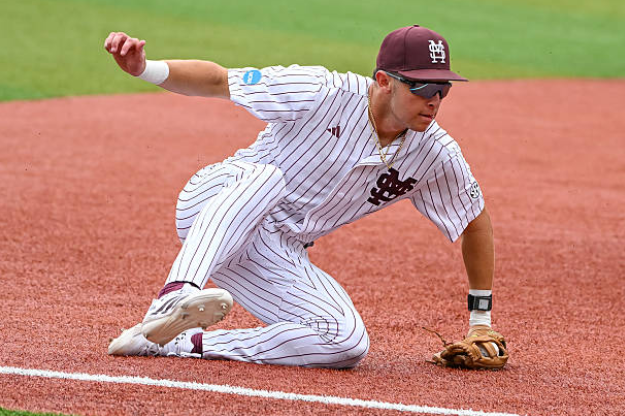
The Mariners had the luxury of an obvious first-round choice last year in the form of Kade Anderson, a relatively complete left-handed pitching prospect out of LSU, with the third pick of the draft. The team had no such clear option this year, however, as the thin crop of sure-thing prospects were already gone by the time the M’s had a pick.
But that is usually the case for any team making picks in this sport. The players the Mariners got are nowhere near sure things, all in need of development but all with defined profiles for the M’s to build upon. Of the first six picks the Mariners made - all four of Saturday’s picks and the first two (out of 16) of Sunday’s picks - five are hitters, four of the hitters are from an SEC school, and three of those hitters are (currently) third basemen. All six of these early picks are coming into the system from college.
Seattle certainly wasn’t bucking early trends with the hitting selections, as teams across the league tapped batting talent in the early rounds. But regardless of trends and overall initial valuation consensus, the M’s (like most teams) view their picks as big swings with big (even if unlikely) potential.
“As Jerry (Dipoto, Mariners president of baseball operations) told me when I first took this job: he says, ‘every draft, you just think it’s like a 3-1 count: if it’s there, swing; if it’s not, don’t,’ and we stayed the course with that,” said Mariners scouting director Scott Hunter.
What do these players bring with them to the Seattle farm system, and what might be expected of them as they begin their professional careers?
24th overall: 3B Ace Reese, 21 years old, Mississippi State, $3.5 million (under slot value) signing bonus.
Baseball America overall grades: 55, average risk, 45 adjusted.
Other future value (FV) estimations: 45, high risk (FanGraphs); 45 (Over-Slot).
[caption id="" align="alignnone" width="1500"]
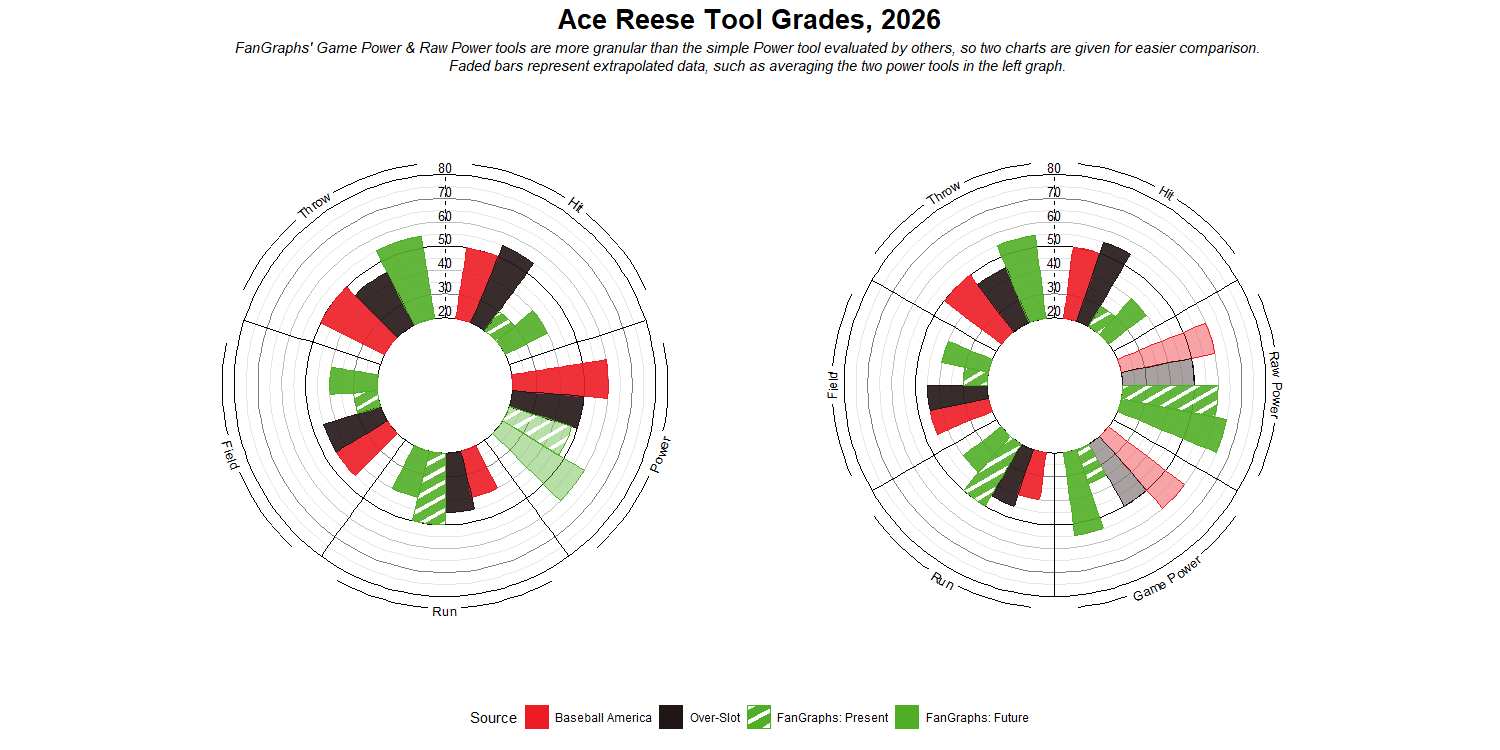
Ace Reese’s tool grades according to Baseball America, Over-Slot, and FanGraphs. Note that FanGraphs separates present and future grades along with distinguishing game power from raw power. [/caption]
Whatever the exact contours of his hitting profile, the Mariners drafted Ace Reese for his bat. He’s not particularly fast or a particularly exceptional fielder, but what he does have is an ability to hit. During his junior year at Mississippi State, he slashed .336/.432/.721 with 24 homers and 23 doubles over 292 plate appearances according to Baseball-Reference. He walked 14% of the time and struck out 21.6% of the time, and according to Over-Slot, he had a 99th percentile barrel rate and 99th percentile average exit velocity along with a 94th percentile EV90 (the exit velocity of the batted ball harder than 90% of a particular hitter’s batted balls). But his 24.3% whiff rate in college and 18.2% whiff rate in the strike zone during his NCAA season are indicative of an overaggression at the plate that he may have to rein in as he moves forward in the M’s organization.
Both FanGraphs and Baseball America grade Reese as a power-over-hit guy, with FanGraphs giving him a future raw power grade of 65 on the 20-80 scale, where 50 is MLB average and each increment of 10 representing roughly a standard deviation from the mean. Baseball America’s report describes him as having “an impressive power and contact combination”. But he displayed a better ability to make contact in 2025 than he did in 2026, and Open-Slot lists him with a 55 hit tool and 50 power tool.
Based on what Hunter said after the pick, the M’s view his power as the main asset.
“We feel [he] is one of the best pure college power bats in this draft … we’re very fortunate that he slipped to us at this part of the draft,” Hunter said.
It’s undeniable that Reese has power potential, standing at 6-4 and weighing 220 pounds. The team also feels that he is relatively developed, though Hunter didn’t give an exact timetable. Notably, they’re optimistic about his contact, attributing his decline in contact rates this year to a coaching swap that made Reese uncomfortable.
“They had a coaching change at Mississippi State this year and had a different hitting philosophy,” Hunter said “We talked with him about that in the combine meeting where early in the year he was trying to do some things that were different … I think Ace, about a month into the season, went in and said ‘this is really hard for me, I need to go back to my old routines and my old feel.’ And then he really saw some things start taking off for him.”
In the aggregate, it’s perhaps unsurprising that Reese went when he did. Baseball America had him graded as the 12th best prospect of the draft, while FanGraphs’ Eric Longenhagen had him going 12th in his second mock draft - but Longenhagen’s first mock had him going 25th and Joe Doyle of Over-Slot ranked him 31st on the board.
65th overall: OF Jake Brown, 21 years old, LSU, $1,382,600 (slot value) signing bonus.
Baseball America overall grades: 50, average risk, 40 adjusted.
Other FV estimations: 40, high risk (FanGraphs); 45 (Over-Slot).
[caption id="" align="alignnone" width="1500"]
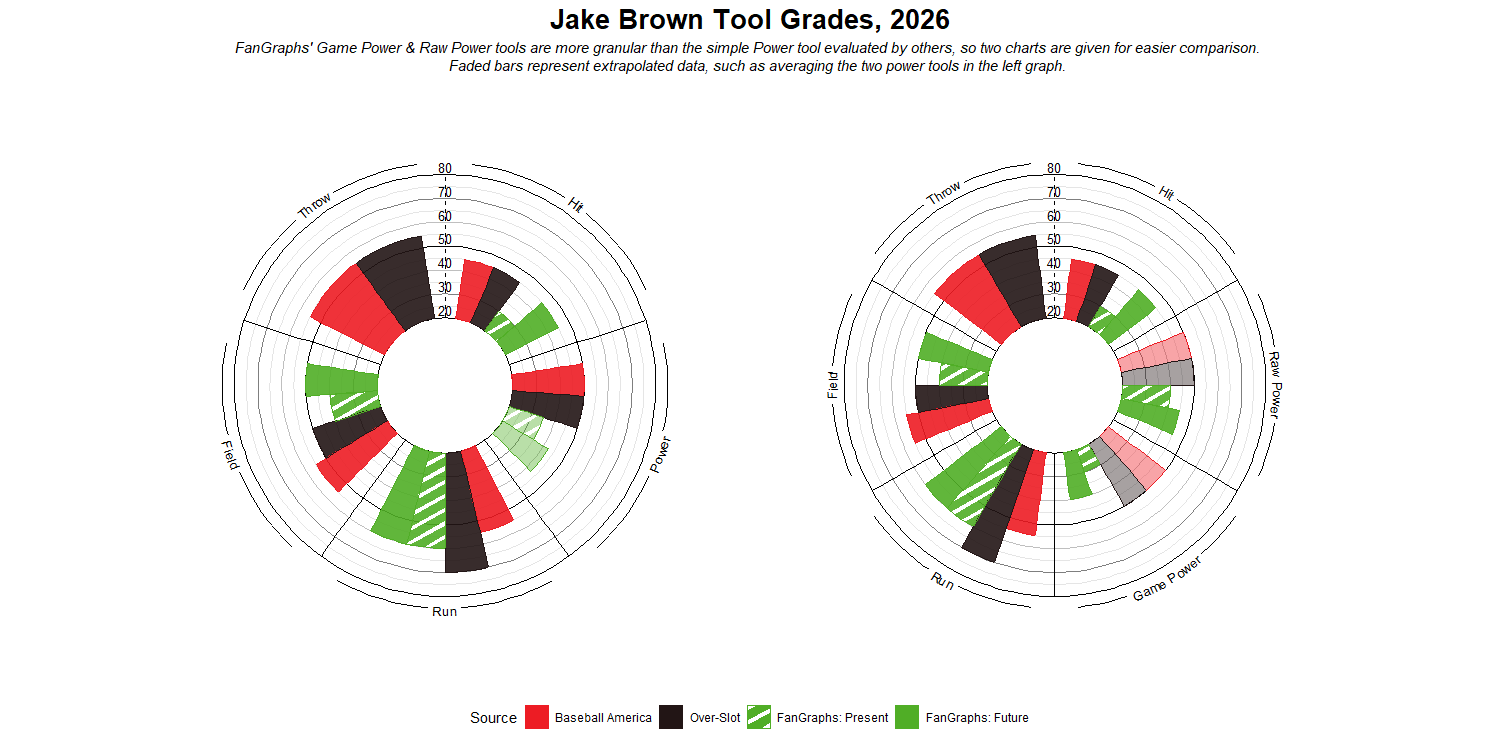
Jake Brown’s tool grades according to Baseball America, Over-Slot, and FanGraphs. Note that FanGraphs separates present and future grades along with distinguishing game power from raw power. [/caption]
Once a two-way prospect, Brown increased his slugging percentage each season of his collegiate career, going from .440 in his first year to .528 in his second and .642 in his third. His on-base percentage has stabilized a little over .400 in the past two years, with a 16.5% strikeout rate and 11.9% walk rate in 2026 and similar numbers in 2025. He did start chasing a slight bit more in 2026, but also began barreling the ball up more frequently.
The clear tools in Brown’s arsenal are his speed and arm with a potentially above-average glove, and it appears that the Mariners believe in his ability to become a center fielder despite potential hip stiffness issues. But the biggest question mark is his hit tool: although both Baseball America and Over-Slot specifically make note of his bat-to-ball skills, the lefty has issues against breaking balls and against left-handed pitching. And although the 6-2, 205-pound outfielder has the raw bat speed needed for an exceptional power profile, he hasn’t translated that five o-clock batting practice power into seven o-clock gametime power quite as much as some scouts have hoped.
A broken hamate bone ended his 2026 season in the middle of April, but he participated in the Draft Combine in June, likely meaning he will see playing time in the Mariners’ minor league system this year.
101st overall: RHP Nathan Taylor, 21 years old, University of Cincinnati, $778.2 thousand (slot value) signing bonus.
Baseball America overall grades: 45, average risk, 35 adjusted.
Other FV estimations: 45 (Over-Slot).
Hunter’s Mariners are no stranger to drafting tall starters with above average control, and Nathan Taylor is a 6-5, 230-pound righty with a 29.9% strikeout rate, 7% walk rate, and 55 control grade according to Baseball America.
There are other aspects of Taylor’s game that will be familiar to the Mariners pitching lab. He has mostly worked with a fastball and slider during his time in college (though he also throws a curveball) and his lengthy extension indicates that there might be some more in the velocity tank than the low- to mid-90s he usually sits in college.
Seattle believes in his ability as a starter, with Hunter praising multiple attributes of the young righty’s game, though perhaps there are shades of a one-size-fits-all mindset carried over from other pitching lab products.
“He’s big, he’s visible, he throws a ton of strikes, misses a ton of bats. He’s already got the feel to spin two breaking balls … we do feel he has more in the tank. We see him up to 96 or 97,” Hunter said. “He pitches more 93, 94, but we think that we can actually make him a more complete pitcher by just changing the way he uses his arsenal.”
The M’s want Taylor to use more heaters, Hunter explained, though there is reason to doubt the likelihood of this optimistic outcome. For one, the degree of improvement that they’re looking for in fastball velocity is quite stark, and the relatively nondescript shape of his heater means he might have less margin for error with the pitch than the guys they’re used to. His skyrocketing strikeouts are nearly all on the slider, with the fastball failing to miss consistent bats according to most sources I’ve found.
But then again, there’s the 3-1 approach that Hunter talked about when it came to draft picks in baseball. Most of these prospects have something there, and if Taylor develops like the Mariners hope, he could be a legitimate starting pitching option. If the heater doesn’t pan out that way, he could still have an MLB future as a three-pitch reliever.
129th overall: 3B Trevor Lucas, 21 years old, UNC Wilmington, $450 thousand (below slot value) signing bonus.
If what the Mariners see in Trevor Lucas pans out, he may be the prototype of a low-ranked draft prospect doing well in the pros. The M’s, somewhat bizarrely, picked him well above where anyone had him. Over-Slot ranked him 592nd overall and Baseball America had him 414th overall, expecting him to be more of a late-rounder. But the M’s, apparently, saw a big enough upside to draft him roughly 300 picks before expected.
Neither Baseball America nor Over-Slot list traditional tool grades for Lucas, but based on descriptions, it seems like he has a ceiling as a super-utility guy. He reportedly has solid defense and arm strength (hence his current role at third base) and lowered his whiff rate from 21.2% in 2025 to 16.7% in 2026 while maintaining a low 19.1% chase rate.
Still, despite his .312/.429/.556 slash line, 12 doubles, and 12 homers in 2026, it seems the scouting consensus is that the 6-0, 200-pound third baseman doesn’t have a lot of major-league raw power potential. Even still, there is a fallback in a potentially good hit tool: Lucas walked more than he struck out in his last season at UNC.
Hunter even directly noted a comparison to another Mariners-drafted pesky batter and good defender that now plays for the Tampa Bay Rays.
“Our scout in the field said, ‘he’s like Ben Williamson Lite,’ that kind of stuck with me a little bit,” Hunter said. “Makes good swing decisions. Makes tough contact. We do believe he’s a plus defender at third base, and there is some hope that he might be able to move around the field a little bit. And talking to our PD (player development) group, they believe they can add a little more bat speed and a little more impact.”
Until the player development crew can do so, however, it might be best to think of Lucas as a defense-first utility prospect with some hitting ability. But in the modern game, teams usually look for at least some pop, and an inability to hit for power can make pitchers unafraid and force a contact hitter to find holes or stagnate.
Seattle would jump back up to some higher-ranked guys at points during the second day of the draft, but their fifth pick wasn’t ranked by Baseball America, Over-Slot, or FanGraphs.
162nd overall: OF Hayden Yost, 21 years old, University of Florida, no signing bonus report ($429.1 thousand slot value).
Sometimes, a team’s scouts find a particular kid that they like that flies under other teams’ radar. Hayden Yost, a Gators outfielder nobody had ranked, was one such player, coming off an injury to begin 2026 but who went on a tear at the end of the season.
“The SEC programs, some of the bigger programs, it’s cutthroat. They are like major league clubs: if you have a bad weekend, you may not play the following weekend. And our area scouts stuck with those kids,” Hunter said. “Yost is a perfect example. Didn’t start the year as a starter, next thing you know, he gets an opportunity, he winds up riding the wave, making a swing adjustment with his hands, and then you look up, he’s had a really good year, he’s got plus tools, and we think that there’s more to come because of that.”
Yost finished the year with a .262/.369/.589 slash line, 10 homers, and five doubles, with most of his production coming in a late hot streak. In particular, his .589 slugging percentage was a notable jump from his .392 in the two previous years combined, and his barrel rate and pull-air rate all took big jumps from 2025 to 2026. His EV90 and average exit velocity also took jumps, though they were already above average for a college hitter.
While Yost’s chase rate and whiff rate both slightly decreased in 2026, he walked notably less this year, going from a 13.5% walk rate in 2025 to 9.1% in 2026. It does seem like he now profiles as a power-over-hit bat, but it’s unclear how much of that is, so to speak, “real”, and how much is simply the high water mark of a hot streak.
Seattle evidently hopes it’s the former.
191st overall: 3B/OF Henry Ford, 21 years old, University of Tennessee, no signing bonus report ($335.9 thousand slot value).
Baseball America overall grades: 45, average risk, 35 adjusted.
Other FV estimations: 45, low risk (FanGraphs), 45 (Over-Slot).
[caption id="" align="alignnone" width="1500"]
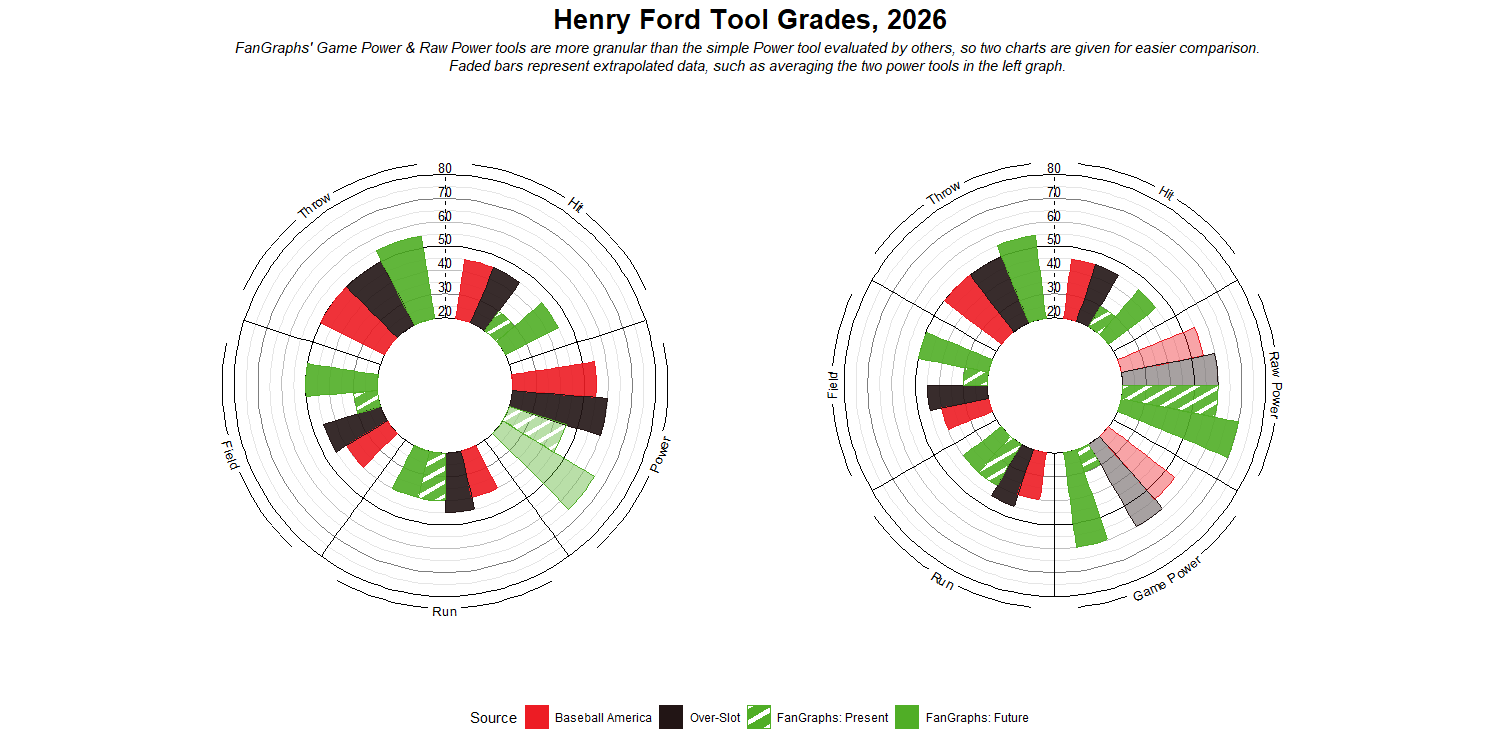
Henry Ford’s tool grades according to Baseball America, Over-Slot, and FanGraphs. Note that FanGraphs separates present and future grades along with distinguishing game power from raw power. [/caption]
As with most prospects taken below, say, fifth overall in a given year, Ford’s future depends on an “if”. Ford’s “if” is his contact: while he won’t be an outstanding fielder (likely in the corner outfield or first, though third isn’t out of the question if he notably improves his glovework), that isn’t likely to hinder him at this moment, and he has above average power by all accounts, slashing .293/.360/.603 with 20 homers and 15 doubles this year.
But Ford’s 14th percentile 29.7% chase rate, roughly NCAA-median strikeout rate (19.9%) and below-average walk rate (9.9%) indicate someone who will have to put plenty of work in to hit pro pitching. In previous years, better contact has come at the expense of most of his power, so it’s likely that some of this will carry with him for his whole career. But if he can at least keep the worst discipline excesses out of his swing while maintaining his power, he could go far.
Standing at 6-5 and weighing 225 pounds, FanGraphs notes a plus-plus frame and there is probably room to grow more muscle. Over-Slot also describes him as having “sneaky athleticism” and “good route-running ability”, but Baseball America’s grades suggest their scouts are more pessimistic on these questions.
Ford declared for the draft last year, though with a transfer commitment to Tennessee and no team willing to take an early, costly swing at him - or go for a later-round pick where he would be unlikely to sign - he wound up undrafted. Hunter said Ford “bet on himself a little bit”, and the Mariners saw some defensive improvement in addition to his power numbers, but his assessment diminished (by omission) the possibility of any sort of big athletic jump to center field.
“We [are] gonna send him out as a third baseman and probably a corner utility to start, and he’s gonna tell us how far his bat takes him and how far he works defensively will be the ultimate goal for him,” Hunter said. “But we do see him as being able to start at third base and play a little right field as well as first base.”
Still, Hunter found it “a little bit surprising” that Ford fell as far as he did in the draft, and he said the M’s were able to iron out a bonus with their draftee.