Analysis: How Seattle Kraken’s Expected Top Line Can Set Tone for 2025-26 Season

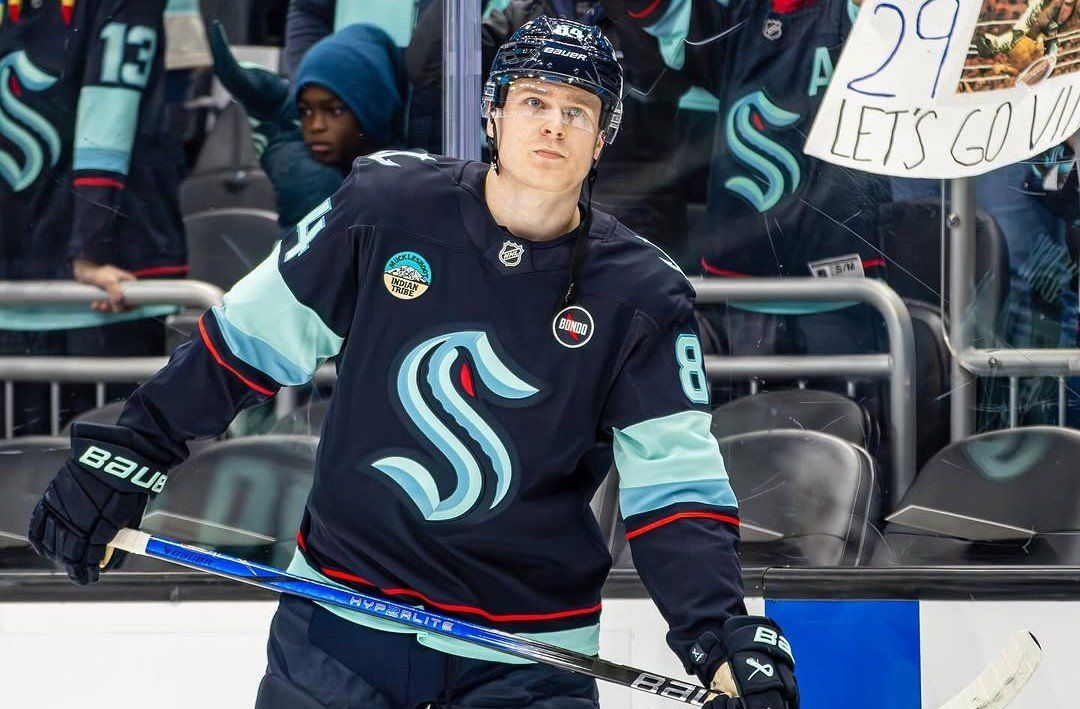
One month has passed since NHL free agency opened, and for the most part, each team knows which players they have to work with entering the 2025-26 season. Of course, roster battles will play out in training camp and trades could shake up the landscape at any time, but what you see on the Seattle Kraken’s roster entering August is more or less what you will get this season, particularly at the top of the lineup.
The Kraken added a couple names this offseason to help establish a tougher, defensively sound identity that falls in line with new coach Lane Lambert’s philosophies – signing defenseman Ryan Lindgren to a four-year, $18 million deal and acquiring forward Mason Marchment in a trade, to name a couple – but arguably the biggest determining factor in whether or not Seattle progresses will be the performance of its projected top line.
After signing restricted free agent Kaapo Kakko to a three-year, $13.575 million extension on July 22, Seattle returned all three members of its top line: Kakko, Matty Beniers and Jaden Schwartz.
The trio skated together for 458:31 minutes of 5-on-5 across 38 games last season, according to Natural Stat Trick, nearly 279 more on-ice minutes than the team’s second-most used line combination (Brandon Tanev, Yanni Gourde and Tye Kartye).
Looking at the splits from last season, the Schwartz-Beniers-Kakko line was more productive together than they were apart. They were on the ice together for as many ‘goals for’ at 5-on-5 as ‘goals against’ (24), but they generated a 53.47 Corsi For percentage, which indicates the trio had a slight edge in puck possession in the offensive zone compared to their opponents.
Every other combination involving Beniers, Kakko and Schwartz – two together without the third, each player without the other two, etc. – had a Corsi For percentage below 50. The trio also created slightly more scoring chances together than their opponents at 5-on-5 (216-201), and at a much better ratio than any other combination involving at least one of the three forwards.
Suffice it to say, with the handful of changes to the middle-six forward group, and with no high-end talent acquired this offseason, the Kraken will be relying on the Schwartz-Beniers-Kakko line to not only match last season’s production right away, but eventually exceed it if they want any hope of improving from last season’s seventh-place finish in the Pacific Division.
While the rest of the forward group takes shape below them, this season will also represent crucial development points for both Beniers and Kakko.
Since Beniers scored 57 points in his 2022-23 Calder Trophy-winning campaign, he has failed to match that level of production in the two seasons since. Of course, the Kraken were a playoff team in 2022-23, but Beniers – who turns 23 in November – will be relied on to take a big step forward in his production as he develops into the franchise forward Seattle envisioned when it selected him with the second overall pick of the 2021 Entry Draft.
Kakko, meanwhile, is another former second overall pick that struggled to meet expectations early in his career playing with the New York Rangers, but he seemed to benefit from a change of scenery following his trade to the Kraken on December 18. He scored 10 goals and 30 points in 49 games (0.61 points per game) with Seattle, and finished the season with career-highs in points (44) and assists (30).
The 24-year old Kakko’s performance in his first full season with the Kraken will be a big factor in determining not only his own long-term role as an NHL player, but the success of the 2025-26 Kraken as well.