Season in Review: Analyzing Gonzaga’s 2025-26 Campaign, Future of the Program


[caption id="" align="alignnone" width="3995"]
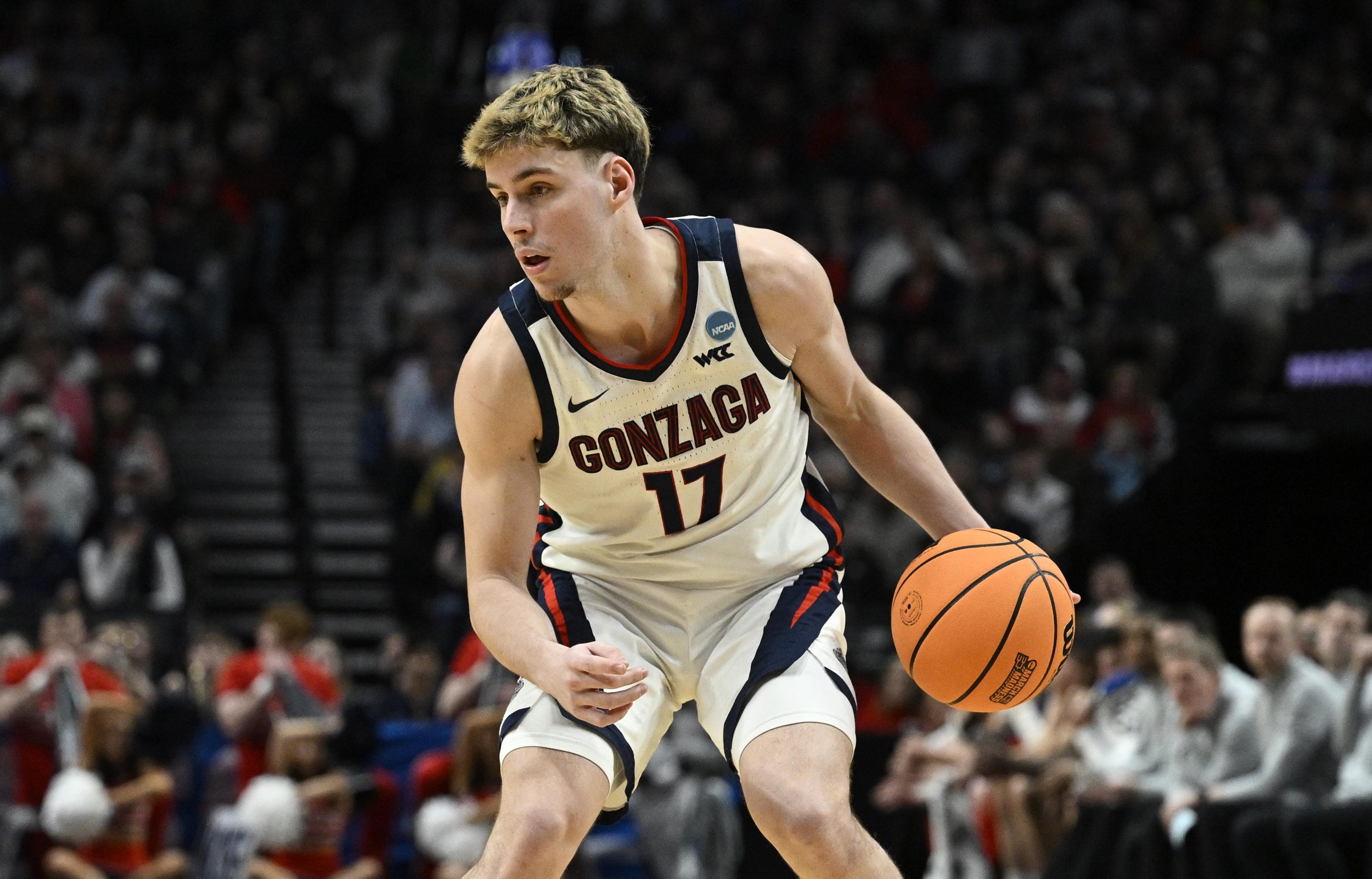
Gonzaga Bulldogs guard Mario Saint-Supery (17) dribbles against Texas Longhorns guard Jordan Pope (0) in the first half during a second round game of the men's 2026 NCAA Tournament at Moda Center. Mandatory Credit: Troy Wayrynen-Imagn Images [/caption]
A lot of the country will remember the end of the Gonzaga Bulldogs’ season as somewhat expected, not being particularly impressed with their season resume, and not necessarily floored when the 3-seed Zags were upset in the Round of 32 to 11-seed Texas.
But despite a disappointing conclusion, GU accomplished a lot this season. Finishing 31-4, the Bulldogs notched their ninth season of 30+ wins in program history, and their first since 2022-23. Forward Graham Ike received honors as a Third-Team All-American, with Drew Timme’s First-Team selection back in 2023 being the last Bulldog to accomplish the feat.
And they did it in such a different fashion than previous GU squads, with a stalwart defense that consistently stifled opponents. Combined with new heights of adversity for the program, Gonzaga still found a way to earn a share of the WCC regular-season title, win the conference tournament, and grab a victory in the NCAA tournament for the 27th consecutive year.
What was the path to another noble year for the Zags?
Depth Fuels Strong Non-Conference Regular Season
Albeit not as much of a gauntlet as the preseason projections stated of their opponents, Gonzaga won 13 of its 14 games prior to WCC play. Just five of those 14 teams competed in this year’s March Madness, but the Zags largely cruised through this portion of the schedule. They won each of their first seven games by at least 10 points, and seven of their wins in this span were by margins of 20 or more.
Of course, the Bulldogs’ lone blemish in non-con was being throttled by Michigan 101-61 in the Player’s Era Tournament championship game. The Wolverines embodied the blueprint to a tee for how to beat GU, by being able to guard Ike straight-up and attack them defensively, Gonzaga’s fiercest opponent of the year by far.
In this stretch, Ike cracked the 2,000th point threshold at the collegiate level, Mark Few collected his 750th win as head coach, Braden Huff shot uber-efficiently in the post, and Gonzaga deployed a deep rotation of 10, sending waves of versatile players who contributed to the wins in different ways.
Because of the array of options Few had, he experimented often with his starters. By season’s end, the Zags utilized 13 different starting lineups. From the flip-flopping of point guards Mario Saint-Supéry and Braeden Smith to the pertinent swapping of the team’s wings, Few was able to play matchups dependent on what he thought might be needed for a specific game, like offense or defense. Still, it left someone like freshman Davis Fogle on the outside looking in, who flashed serious talent in garbage time in the season’s early blowout wins, but he would surely earn opportunities later down the road.
Huff Injury Leads to Identity Shift
With the dominant tandem of Huff and Ike, GU also boasted a strong offense to pair with its already elite defense. But the duo took a major hit after the team’s fifth contest of WCC action.
Initially reported on January 15 to be out for four to eight weeks with a left knee injury, Huff’s ailment turned out to be of the utmost severity. Huff didn’t suit back up for the last two months of the season after his knee was discovered to be dislocated, even though he was ramping up to potentially play in the Sweet 16 if the Zags advanced that far.
Needing to make up for the 6-10 forward’s production, Gonzaga leaned more into the strength of its remaining personnel – defense.
With this, three-point specialist Steele Venters eventually fell out of the rotation entirely, with his 36.7% shooting from deep not making up for his lackluster play with his back to the basket. Similar could be said for Smith, as the freshman Saint-Supéry took the starting point guard job midway through the conference schedule, and outlogged Smith in minutes considerably the rest of the way due to his impact on both ends.
Standing out in their roles during Huff’s absence were the Bulldogs’ forwards. Already playing at the position when Huff went to the bench, 6-7 Jalen Warley was deployed as the starting ‘small-ball four’ due to his ability to guard players bigger than him. Warley shined, averaging 8.2 points, 4.5 rebounds, and 1.5 steals a game as the team’s swiss army-knife and a key cog on both sides of the ball. He ran actions as the ball-handler in spurts, took the ball coast-to-coast after grabbing defensive rebounds, and denied seven-footers from layups down low. He played to his strengths, the lone Zag in the rotation who never attempted a three, thriving in the dunker’s spot on offense and wherever on the court he was needed on defense.
Tyon Grant-Foster also experienced an uptick in production, qualifying as GU’s second-leading scorer (11.3 ppg) and rebounder (4.9 rpg) behind Ike. Not much of a shooter, Grant-Foster was his best when aggressive, taking the ball downhill and crashing the glass consistently. He also had a unique knack for not just blocking shots, but three-pointers, a quality that Few said he had never really seen before. There were times when he took poor-quality shots, like throwing up a three with his hand in his face or a contested turnaround fadeaway at the elbow, but his overall impact was a changeup from a lot of other players in the country.
But the 26-year-old’s final year of college basketball was nearly over before it started. The NCAA didn’t clear his waiver of eligibility, causing Grant-Foster to need an injunction hearing where his case was heard and cleared before a judge on October 27, a week before the first regular-season game. The entire debacle aside, he was definitely worth the offseason acquisition.
Emmaneul Innocenti was Gonzaga’s point-of-attack defender, taking on the opposing team’s best guard each night and defending at an elite level. He also picked up his play offensively down the stretch, maneuvering better as an off-ball cutter and constantly being around the ball. And although it was a forgettable year shooting-wise for expected sniper Adam Miller, he still found success with his floater inside and competed on the defensive end to start for most of the season.
These factors didn’t mesh together for the entirety of the WCC slate, though. GU experienced arguably its most embarrassing loss in program history at Portland 87-80, with Few calling the performance its ‘poorest effort all year’. And to cap off the regular season, Saint Mary’s exploded in the second half when the Bulldogs traveled to Moraga to hand them their third loss of the season.
For good measure, Ike missed three games with ankle soreness, and Warley was out for the final two WCC games with a thigh contusion as well. Regardless, the Zags went undefeated (14-0) at the McCarthey Athletic Center and won two games in Las Vegas by double digits, responding each time they were punched in the mouth.
Freshman Fuel in Final Stretch, Set Table For Future
Developing talent while attempting to compete is a fine needle to thread. It’s partly why Fogle didn’t play meaningful minutes despite looking to be capable of breaking into a very experienced rotation. Showcasing tough shot-making and loads of confidence, Few still wanted Fogle to display less tunnel vision, while being more of an additive defensively. He became an imperative piece off the bench once Huff went down, providing shot creation from someone who wasn’t named Ike.
And although he started half of the team’s games, the same sentiment could be had for Saint-Supéry. Few lamented his out-of-control playstyle at times, especially as the team’s primary ball-handler. Plus, the Spaniard dealt with the flu in the tail-end of non-conference play, playing through it even though it impacted his effectiveness drastically.
Still, the two first-year guards stepped up in the big moments down the stretch. Saint-Supéry scored a season-high 21 points in the WCC tournament-clinching over Santa Clara where he knocked down six threes, then dished out a season-high eight assists in the Round of 62 victory against Kennesaw State. On the other hand, Fogle logged 13 and 17 points, respectively, with just one turnover across those two games. The 6-4 Saint-Supéry added to his NBA draft stock that he accumulated playing professionally overseas, while the 6-7 Fogle threw his name into the pot as a potential choice at the next level.
Those two, like many of their teammates, struggled more in the season-ending loss to the Longhorns, but remain potential foundational pieces in the coming years. Their roles will only be enlarged if they return to Gonzaga next season, particularly in retaining two of the team’s better three-point shooters on a team lacking precision from distance. Possessing untapped ceilings, they could have much more in store with one year under their belts.
Ike’s utter dominance will be missed moving forward, especially with the Zags wishing they saw more of him and Huff on the floor together. But the fact that the Bulldogs got that far without a player as great as Huff is a testament to the team and the program overall. Still, the sting of missing the Sweet 16 for a second straight season hurts all the same, and the next steps should be to ensure it doesn’t happen again next year.