Sam Darnold, Seahawks Aiming to Stay Step Ahead of Patriots’ Evolving Defense in Super Bowl LX
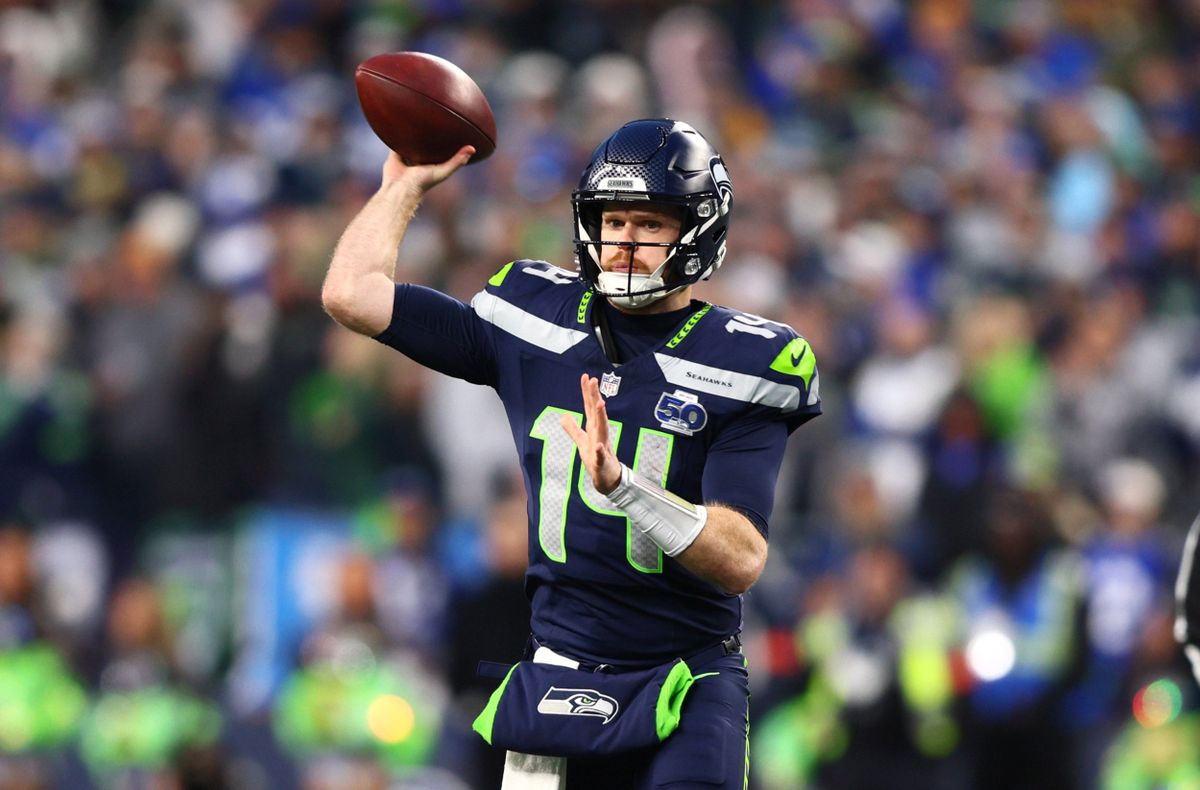
SAN JOSE, Calif. - Playing the quarterback position in the NFL has long been viewed as the most difficult job in professional sports, a fact that only has been magnified in recent years by the increasing complexity of defensive schemes around the league.
For decades, signal callers leaned heavily on half field reads post-snap to identify and attack coverages, providing a simplified approach that worked quite effectively against static defenses. However, in the modern NFL, while that approach has not been completely discarded and still has a time and place, the proliferation of well-disguised coverages has put a lot more on quarterback’s plates, making it far trickier to gauge whether an opposing defense is in man coverage, split-zone coverage with the middle of field open, or closed-zone coverage with the middle of the field occupied.
Early on his career, like all young quarterbacks who have to adapt and learn how to successfully attack complicated NFL defenses built around the art of - or at least the guise of - deception, Sam Darnold endured plenty of growing pains coming out of USC as a highly-touted top-five draft choice. In his first five seasons, which included three forgettable years with the Jets before being traded to the Panthers, he completed under 60% of his pass attempts with 61 touchdown passes and 55 interceptions, on the verge of posting an undesirable 1:1 ratio.
But two years before leading the Seattle Seahawks on an unexpected run to Super Bowl LX to face the New England Patriots on Sunday, Darnold’s career interestingly turned the corner without him being on the field when he joined the 49ers as a backup for Brock Purdy in 2023. Under the tutelage of coach Kyle Shanahan, Purdy, and then-pass game coordinator Klint Kubiak, the veteran went back to school to sharpen his craft, including getting a PhD on the trade of deciphering coverages and working through his progressions beyond the traditional half field reads of yesteryear.
“I would definitely say it helped a ton,” Darnold told reporters on Thursday. “I think I've hit on this quite a bit, talking about my time in San Francisco, but learning about defenses was huge for me to understand how we're attacking defenses, what schemes beat certain coverages. So it was a great experience for me and something that was, I think, crucial to me just growing as a player.”
In the midst of a career renaissance that started on the sidelines in San Francisco, nothing has been more vital to Darnold’s re-emergence than his indoctrination to Shanahan’s quarterback school, which has rightfully drawn praise as the league’s best landing spot for rehabilitating players at the hardest position to play in sports.
Since spending most of that season with a ball cap on while learning through observation, something he didn’t get to do in New York when he was thrust right into a starting job as a perceived savior for the franchise, Darnold has made history becoming the first quarterback in NFL history to win 14 or more games in consecutive seasons with two different teams. Following up a stunning 30-touchdown season in Minnesota, he tossed 25 touchdowns and averaged 8.5 yards per attempt running Kubiak’s offense in Seattle, coming full circle to an extent as he shook off the dreaded bust label and pushed himself within four quarters of hoisting the Lombardi Trophy.
At the center of that success, Darnold has become far more proficient executing through his progressions as a passer, no longer stymied if his initial read isn’t open as he was in the first several years of his career. The quarterback deserves props for his own contributions to those improvements, but he has received plenty of help to take the next step in that regard with the Seahawks, benefiting from a stellar coaching circle featuring Kubiak, quarterback coach Andrew Janocko, pass game coordinator Jake Peetz, and others along with a talented supporting cast anchored by All-Pro receiver Jaxon Smith-Njigba.
On the coaching front, Darnold didn’t receive the support needed to thrive out of the gate with the Jets, and the situation didn’t improve much with the Panthers, who fired Matt Rhule midway through his second season with the franchise. But the Seahawks knew he had all of the tools to shine in Kubiak’s offense, especially with the coach recommending him from their brief time together with the 49ers, and they assembled a strong staff with the pedigree and diverse coaching backgrounds necessary to elevate the quarterback to another level after his breakout year in Minnesota.
Look no further than quarterback coach Andrew Janocko, who had never worked with Darnold prior to the 2025 season. The rapidly ascending assistant had worked alongside Kubiak with the Vikings in the past, climbing his way up the coaching ladder by coaching the offensive line and receivers before eventually sliding into a quarterback coach role with the Bears.
Having worn so many different hats in a brief amount of time as an NFL coach, Janocko’s insight on every facet of the offense from the trenches to the receiving spots has paid major dividends working in tandem with Darnold. His knowledge on the inner workings along the offensive line provided an excellent foundation for the quarterback setting up pass protection calls in front of him, while his prior experience teaching wideouts helped sharpen up timing between the passer and his receivers, allowing everyone to hit the ground running and presenting invaluable cues to help the signal caller make the right reads.
“You try to do your best to present the quarterback with the most information possible,” Janocko explained. “Based on what we see, what we can pick up on tape, the little tells that we can pick up here and there, and then just giving him the most information possible and allowing him to go through his reads, his progression and play fast.”
Away from Janocko, Peetz brings his own tricks to the trade as Seattle’s pass game coordinator, possessing a wealth of skills from being a college play caller at LSU to coaching quarterbacks, running backs, and receivers at various stops in the NFL. Regularly seen on the practice field jumping in as a scout defensive back, his hands-on approach promotes a different energy between the lines, and he has his own unique perspective to offer Darnold and the wideouts from his diverse coaching experiences.
An admirer of Darnold dating back to his time at USC, Peetz always knew the quarterback had the skill set and mental fortitude to be a franchise quarterback in the league. But as is the case for many other players who struggle at the position, he landed in an environment that wasn’t conducive for success, as the Jets and Panthers changed coaches and coordinators numerous times with him under center and failed to provide much support with a dearth of talented players around him.
In Seattle, however, Darnold has built off of what he learned in San Francisco and Minnesota, two organizations that had far better support systems in place both on the field and in the team building. Peetz and the rest of the offensive staff have worked diligently to provide mechanisms for the quarterback to take some of the stressors of playing the position off his plate, using formations, personnel groupings, and pre-snap motions to create much-needed cues to help him define what coverage the opposition is actually running and be able to appropriately respond to it in progressions.
“These defensive coordinators are really smart and they're really creative kind of in the way they get to their coverages,” Darnold commented. “I think it's always important for a quarterback to just understand what we think might happen, what our read is, and then, if it goes to something else, not panicking and just getting through our progression. And as we like to say, listening to our feet is always huge.”
No longer being held back by subpar coaching and playing with confidence and conviction, Peetz has witnessed Darnold improve leaps and bounds decoding defenses and making the appropriate read after opponents switch things up coverage-wise post-snap, adding another feather to his cap by succeeding even when staring down a rusher ready to deliver a big hit on him as he did on multiple touchdown passes in a 31-27 NFC Championship Game win over the Rams.
“Defenses have been good at trying to hold looks for a while and that's part of playing the position and it's part of scheming a system,” Peetz said. “It's part of what I think makes Sam so good is he's had multiple ops in high leverage situation this season where he's been shown one thing and given another and he's responded, other players have made plays. It's been fun to see.”
Entering the biggest game of his football life, a revitalized and redeemed Darnold will face arguably his toughest test yet against a New England defense that has thrived with a combination of complementary talent at all three levels and both schematic complexity and unpredictability. The Patriots have given up less than nine points per game in three playoff victories, including holding Justin Herbert and the Chargers without a touchdown in the Wild Card round, turning a new leaf to generate those results in the process.
Through Week 9 of the regular season, per Tru Media, New England ran “split zone” schemes - Cover 2, Cover 4, and Cover 6 - with two deep safeties and the middle of the field open on 37% of their defensive snaps. That number dipped down to 32% from Week 10 through the end of the regular season, however, with defensive coordinator Terrell Williams implementing more disguised shells that shifted into single high, middle of field closed looks - Cover 1, Cover 3 - than he did in the first half of the season.
In the postseason, the Patriots have further evolved and adjusted, transforming into a more aggressive unit that has ramped up blitz rates to north of 40% and leaned more heavily on Cover 0 with no zone responsibilities and everyone manned up across the board. This has led to 12 sacks on opposing quarterbacks in three playoff games, showing the defense can shine by yet another method.
If there was one constant for New England, Williams did dial up man coverage more than most coaches at a 29% rate, ranking ninth in the NFL in the regular season and maintaining that same exact rate in three playoff games so far.
What’s the moral of the story? While it’s possible New England could stick with status quo and opt to stay aggressive sending five or more rushers after Darnold while sprinkling in stunts and sim pressures at a higher clip than it did in the regular season, Williams has demonstrated the ability to coordinate a disruptive defense without a clear pattern, shifting his approach when necessary with everything from how he calls coverages to how he designs pressures and most importantly, how he muddies up the overall picture for the quarterback.
All eyes will be on the quarterback, of course, in regard to how Darnold responds to how the Patriots try to defend the Seahawks early. But in the grand scheme of things, Smith-Njigba, Jake Bobo, and the rest of the receiving corps can help him out immensely in their role of diagnosing the actual coverage and being on time to mesh with the signal caller’s progression, especially if New England decides to continue implementing man coverage as a big part of the menu, something Seattle has cooked pretty good all season with a 0.29 EPA on targets against man, ranking ninth overall.
“Post snap reads are very important,” Smith-Njigba explained, later citing himself as an artist creating in space on the field. “It’s something I’ve grown in and learned since I was back in college [at Ohio State]. That’s what the league is today. So just being able to pick it up fast and make sure you’ve got the spot at the right time is very important. It’s something we’ve practiced and worked on this whole year.”
“I used to just run my route and if I’m open, I’m open. But this year, we've got to be a lot more tuned into kind of his progression, right?” Bobo added. “Because if I'm too early and I'm third in the progression, then I might be open right now. But when he comes to me, that window's closed. So nuances of playing receiver, it's not necessarily like half field stuff. We've got route adjustments based on what we're getting. With the progression as a receiver, you've got to be tuned in because if I'm too early or too late, you're not getting open.”
With a chance to etch his name in football immortality, Darnold will have to be prepared for anything and everything on Sunday. If the Patriots stay in attack mode, he will have to be quick unloading the football and willing to take his check downs. If they lay off on the blitzes and revert back to more split-field zone concepts as they did early on, he will have to demonstrate proficiency once again unwrapping the coverage with the mechanisms provided to him by Kubiak and the coaching staff and make the right choices based off of his reads.
Earlier in his career, that may have been a daunting task for Darnold, who infamously said that he was “seeing ghosts” against the Patriots during the 2019 season. Those two words clung to him glue as he bounced around with multiple teams, trying to get back on track.
But six years later, this isn’t the same player running the Seahawks’ high-octane offense. No longer ill-equipped to handle the kitchen sink that defenses try to throw at quarterbacks and supported by elite coaching and personnel around him, he has become an unflappable force, more than capable of taking punch after punch and coming back swinging, which should make Sunday’s matchup one hell of a high-stakes chess match at Levis Stadium.