One of the Biggest Reasons Mariners’ Cal Raleigh Has Gone From Great to Elite
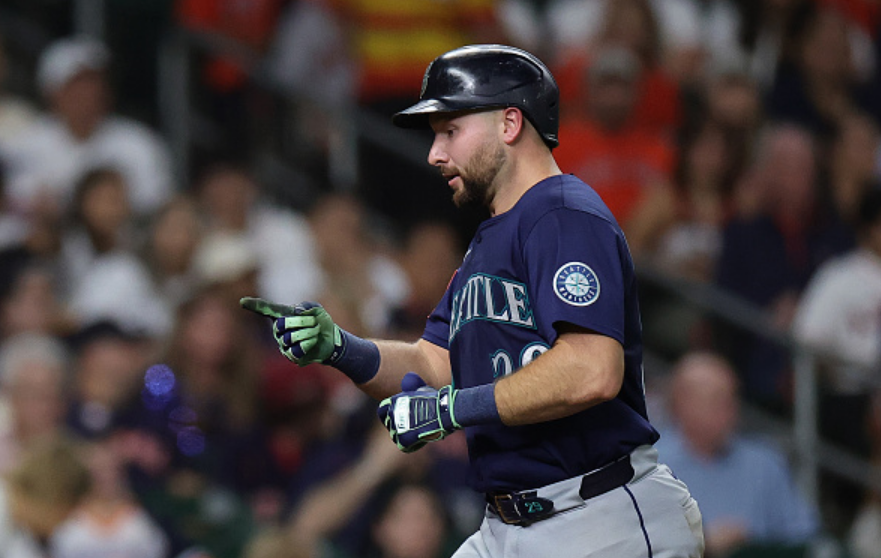
Donning the number 29 on the back of his jersey, Cal Raleigh secured the Mariners’ 29th win of the season on Friday night with a two-run moonshot of a home run, his 17th on the year to enter a four-way tie with Aaron Judge, Shohei Ohtani, and Kyle Schwarber for the major-league lead. Raleigh’s place among the most elite names baseball currently has to offer has been well-earned, and not just for how many pitches he’s sending over the wall, but for the level he’s raised his overall offensive profile in addition to his Platinum Glove-winning defense.
With the ink still drying on his freshly-signed six-year, $105 million contract extension, Seattle’s backstop has put together by far his best season at the plate up to this point. His .258 batting average, .373 on-base percentage, .593 slugging percentage, and 175 wRC+ are all well above his career highs in those categories and he’s only the second player in the American League to reach the 3.0 fWAR threshold so far. If it weren’t for Judge and his 4.4 fWAR already, Raleigh would be the early favorite to be the AL’s MVP.
With easy 30-homer power and elite defense, Raleigh arguably established himself as the best player at one of the game’s most premium positions a year ago. But now, he’s become one of baseball’s best in general.
How?
One of the biggest reasons for this is how much the switch-hitting Raleigh has improved from the right side of the plate. Heading into the 2025 campaign, Raleigh had a career .202/.271/.410 (94 wRC+) slash line as a right-handed hitter, often resulting in teams bringing in left-handed relievers to flip him to his weak side. Teams might want to rethink that strategy this year, however, as he’s been statistically better from the right side than the left in a few different categories. He’s still striking out a ton (32.3 percent) and isn’t walking (6.5 percent) nearly as much as he is from the left side (18.1 percent), but he’s been a .293/.339/.655 (184 wRC+) hitter from the right side, with on-base percentage being the only area in which he’s been better from the left side (.387).
The sample size is obviously much smaller (62 plate appearances on the right side to 155 on the left), but it’s also not insignificant and is accompanied by a noticeable change in how Raleigh is specifically timing up and driving the ball. Before this season, Raleigh as a right-handed hitter pulled the ball at a 47.3 percent clip and hit it up the middle 32.6 percent of the time, per FanGraphs. This year, those numbers have jumped up to 57.9 and 36.8 percent, respectively — perhaps a testament to the simplified, up-the-middle-oriented hitting philosophy of Edgar Martínez, Kevin Seitzer, and Bobby Magallanes.
“I think a great thing is they’re not constantly trying to tinker. They’re not constantly trying to find things wrong with you. … They’re not constantly changing the approach, changing what you do every single day,” Raleigh said of the Mariners’ new hitting coaches earlier this month, via 710 Seattle Sports. “Obviously if you’re struggling, like you can talk and maybe find a drill or two. But it’s not every day. It’s not come in, find it. It’s like consistently doing your prep, consistently working on your approach and just hammering it home every single day. … Sometimes the best coaching is not coaching, not trying to do too much and not trying to overdo it, and I think they’ve done a great job of just really hammering that stuff home and being consistent and really just keeping it simple. And at the end of the day, it is a simple game.”
Raleigh has more of an uppercut motion in his swing from the left side while his right-handed swing is a bit more level and conducive to hitting line drives, but getting to his pull side more as a righty has allowed him to drive the ball over the wall with more regularity. He had just seven home runs in 242 right-handed plate appearances from 2021 through 2023, but hit 13 in 2024 and already has six in 2025, which has him on pace for 19 by year’s end.
Essentially, Raleigh seems to have eliminated his biggest flaw as a player, at least for the time being. That’s partly why, barring injury, he appears to be a shoe-in to be the American League’s starting catcher in the All-Star Game this summer and a potential top-three vote-getter for the AL MVP.