Does O-Line Continuity Set Seahawks Up for Sustained Super Bowl Window?
Prior to their latest march to a Super Bowl victory last February, the Seattle Seahawks appeared to have a proverbial “peanut” allergy in regard to developing and maintaining continuity along the offensive line, particularly in the interior at the guard and center positions.
Consistently struggling to keep quarterbacks Russell Wilson and Geno Smith upright and at times failing to establish a reliable ground game under several different offensive coordinators over a nearly decade-long period, the Seahawks have had a different Week 1 starting center in six of the previous seven seasons dating back to Justin Britt’s final year with the team. The guard spots have not been that much more stable during that span, with the exception of Damien Lewis starting four years in a row from 2020 to 2023, sandwiched by games of musical chairs on the left and right side.
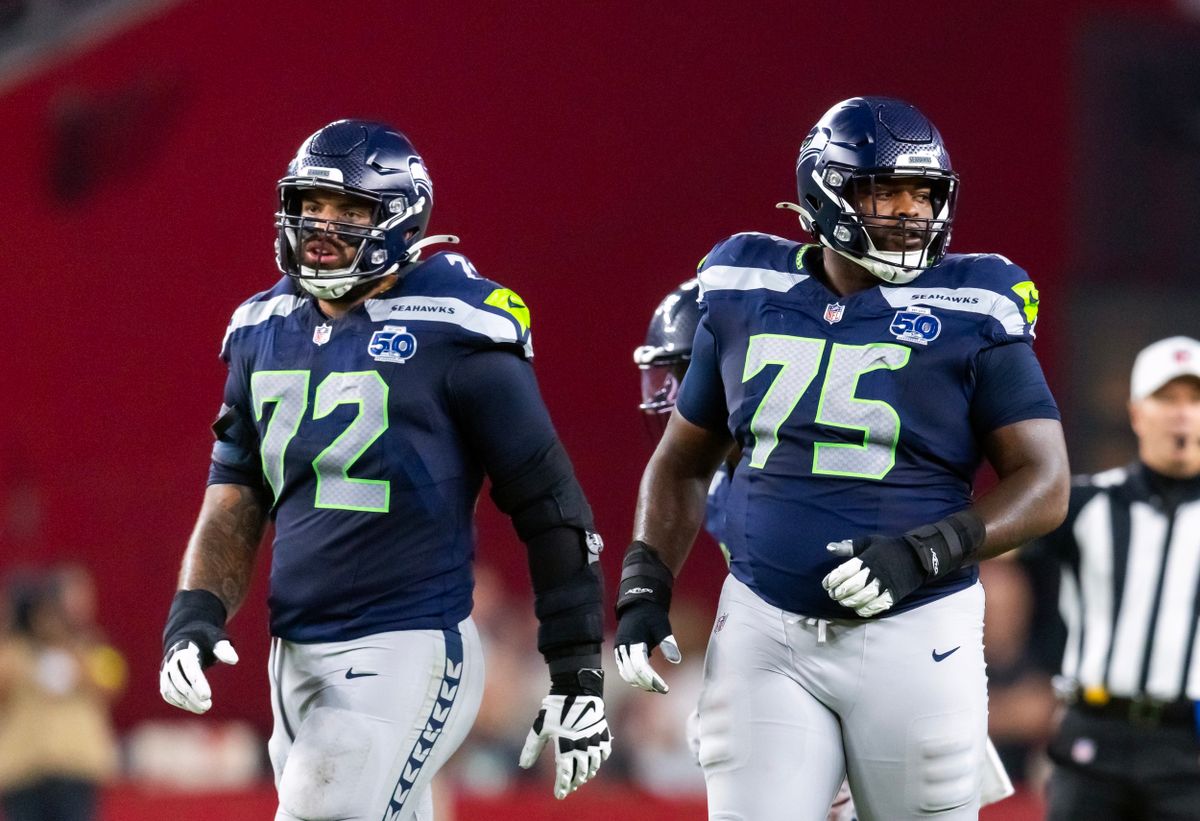
But the tides have truly turned in the Pacific Northwest for general manager John Schneider, coach Mike Macdonald, and company as they aim to run it forward, not ironically coinciding with arguably the best season in franchise history for the Seahawks. Anchored by tackles Charles Cross and Abraham Lucas along with standout rookie Grey Zabel, the offensive line improved leaps and bounds under the coaching of long-time NFL assistant John Benton in 2025, providing sterling protection for Sam Darnold and igniting a run game that got hot at the perfect time down the stretch and kept rolling into the playoffs, paving the way for a 17-3 record that culminated with hoisting the Lombardi Trophy.
Rounding out the line along the way, Seattle finally found a potential long-term solution at center with Jalen Sundell, a former undrafted signee out of North Dakota State. Forming an exciting young triad next to Sundell and Zabel, after two seasons of sporadic, up-and-down performance, former fourth round pick Anthony Bradford improved as much as any player under Benton’s tutelage at right guard for the eventual champs.
If there’s more reason for excitement in the trenches coming off the second Super Bowl win in team history, the Seahawks will welcome that entire starting lineup back for the title defense in 2026, incredibly marking the first time in the entire Schneider era where all five offensive line starters will return from the end of the prior season. From that group, Lucas has taken on the “elder” statesman role at 27 years old, while Cross, Zabel, and Bradford all are 25 years old or younger, giving Benton a still relatively unpolished ball of clay that can be molded into an even better unit, potentially with the ceiling to be an elite top-five caliber one.
“When you come in the league, you got to earn your stripes a bit,” Lucas said of growing into an expanded leadership role for a young Seattle line. “I've always tried to lead by example and just try to be a true professional about it. Fortunate enough to have really qualified veterans both on offense and defense during my career here. Really it's just about, for me, it's just about doing my job the best I can and leading in that way.”
Seattle hasn’t just retained its starters up front either. Investing as much draft capital as any team in the league in offensive linemen over the past five years with 12 selected since 2021, the team will also have all of their key reserves from last year’s title team back as well, including veteran swing tackle Josh Jones, second-year tackles Mason Richman and Amari Kight, center Olu Oluwatimi, and guards Christian Haynes and Bryce Cabeldue, who all received Super Bowl rings last week.
Further bolstering the group, the Seahawks also traded a future 2027 draft pick to add an intriguing fifth rounder in Iowa All-American guard Beau Stephens to the competition in April’s NFL Draft, which should make the battle for roster spots behind Zabel and Bradford an intense one with the rookie vying for reps against Haynes and Cabeldue.
How did Seattle’s oft-maligned offensive line suddenly become an area of strength? And what does the rare continuity mean for the team’s title window moving forward?
To Schneider’s credit, following years of dismal drafting/developing on the offensive line coupled with mostly misses in free agency, the reigning Executive of the Year and his front office cohorts have orchestrated substantial shifts in how the Seahawks handle everything from scouting to cap management and prioritization over the past couple of seasons as a means to correct the problem.
For one, after years of ranking near the bottom of the NFL in total cap investment along the offensive line and choosing to make greater financial commitments to other position groups instead, Seattle locked up Cross and Lucas on multi-year contract extensions over the past calendar year, ensuring those two franchise bookends would be under contract throughout Zabel’s rookie deal. But even with those deals, per OverTheCap.com, the team still ranks 23rd and 22nd in offensive line spending over the next two years, so while there’s been a much-needed shift to spend more retaining developed talent, it hasn’t been a full 180 degree turn either.
Draft-wise, Schneider and the scouting department haven’t simply picked more offensive linemen than any other NFL team. More importantly, they pivoted away from earlier trends where Seattle seemed to throw darts at athletic projects who failed to pan out much of the time, wisely starting to push for standout college prospects coming into the league with more refined skills and higher ceilings.
Illustrating that shift, Zabel became the first guard selected by the Seahawks in the first round since Hall of Famer Steve Hutchinson way back in 2001, a move that paid immediate dividends bringing a Day 1 starter with All-Pro upside into the fold. Three years earlier, Cross and Lucas came on board after being decorated multi-year starters and won Day 1 starting jobs themselves, while even Bradford started 10 games as a rookie and has been in the lineup for most of his three NFL seasons as a fourth round pick out of LSU.
Between those four players and Sundell, who arrived days before the start of training camp in 2024 as a late free agent signing and has since developed into a quality starter, the Seahawks have received a combined 158 starts from the homegrown talent that compromises their current offensive line. That number should only continue to rise with all five players returning for the upcoming season.
Away from the efforts made by Schneider and the front office, Macdonald deserves kudos for moving on swiftly from line coach Scott Huff, who was dismissed after one season and replaced by Benton before the 2025 campaign. After years of questionable coaching at the position, the respected Benton brought a workmanlike, blue collar approach to the equation that players took well to and his innate knowledge of the Shanahan zone-centric offensive scheme brought out the best in the young group.
Now, even with a new offensive coordinator in Brian Fleury replacing Klint Kubiak, who took over as head coach of the Raiders, Benton and his players will have the luxury of not having to start over or re-invent the wheel, which should set up favorably for the offensive line to take another big leap. With the system being very similar to the one Kubiak ran a year ago, Lucas, Zabel, and the rest of their teammates were able to focus more on refining their technique and on-field skills this offseason without having a new playbook or much new terminology to learn this time around.
“I'm excited about it,” Lucas said of the continuity in the line room. “Kind of feel bad for Beau [Stephens] a little bit, just being the only rook, but I mean, he's taken to everybody well and everybody likes him. So it's just nice to kind of like have the gang together, so to speak, and not have too much shuffling around or anything. And in that way we're able to really hit the ground running and it helps not having to learn a whole total new system this year, so we're all just kind of picking up where we left off and just continuing to go forward.”
“I think it's going to be great going from last year to this year because now there's not as much of a learning curve,” Zabel added. “Once you get into training camp, we kind of understand how everybody plays the different sets. People are going to take the different angles on the run scheme and it's great, but we constantly got to continue to improve.”
As Zabel pointed out, continuity can’t breed complacency, and Seattle’s offensive line has to stay hungry and motivated to fully meet the opportunity presented to them. But communication-wise, the value of being able to play with the same group of offensive linemen cannot be understated, and from Benton barking during drills to Bradford forklifting a one-man sled off the ground, nobody appeared to be coasting during OTAs and minicamp. Having the whole band back together should be a major advantage for the defending champions.
With that said, while the Seahawks themselves have not enjoyed much continuity over the years up front, having all five starters back from a Super Bowl winning squad isn’t all that rare. Over the past eight seasons, per Our Lads depth chart archives, four of the eight champions had the same starting offensive line on the field for the season opener as they had in the Super Bowl. Three of the other teams, including the Eagles in 2025, had four out of five starters returning.
From that recent collection of title winners, only the 2022 Rams - who sputtered to a 5-12 finish due to a litany of injuries on the roster and struggled to replace retired left tackle Andrew Whitworth - returned fewer than four offensive line starters from the preceding Super Bowl team.
But even with that Rams outlier, there’s a clear and positive correlation that comes with keeping an offensive line intact as much as possible coming off of a championship run, as each of the other seven teams returned to the playoffs the following season. The most recent to do so with the same five offensive line starters returning - the 2023 Chiefs - not only made it back to the Super Bowl, but hoisted the Lombardi Trophy as the NFL’s last repeat champion.
While that factoid does not ensure Seattle will replicate the feat - there’s a reason why the league has only had nine repeat Super Bowl champions in 60 years - having the entire offensive line back with a young nucleus primed to continue improving undoubtedly bolsters their chances of staying atop the NFL hierarchy. And looking beyond 2026, Schneider has positioned himself to maintain that continuity long term if he desires, as Cross, Lucas, and Zabel all will be under contract together for the next three years minimum and Sundell has two years of affordable club control remaining.
From the current line, only Bradford, who will be entering the final year of his rookie contract, remains a question mark for the future. Re-signing him to a second contract isn’t out of the question and even if he does end up leaving as a free agent, Schneider has planned accordingly with Cabeldue and Stephens now on the roster as a potential heir apparent that are strong scheme fits. The team also has 12 draft picks next year to work with, providing the ammunition to continue stockpiling talent to develop across the line.
As far as projecting how long the Seahawks may be in the midst of a title window, a myriad of other factors will come into play, including how Darnold performs in the future and how long Macdonald’s defense remains a top-five force. And, as always, injury luck has to be considered, as championship teams typically require good fortune on that front to be able to make deep playoff runs.
But winning at the line of scrimmage remains critical to the championship blueprint, as evidenced by Seattle’s own journey running the table last season. Though there’s no such thing as guarantees in the NFL, the modified playbook executed by Schneider and the front office to put the offensive line much higher on the priority pecking order undoubtedly should keep the franchise in the hunt as a viable contender for the next couple of years, if not longer.