Mirror Images: Seahawks, 49ers Rivalry Enhanced By Schematic Similarities

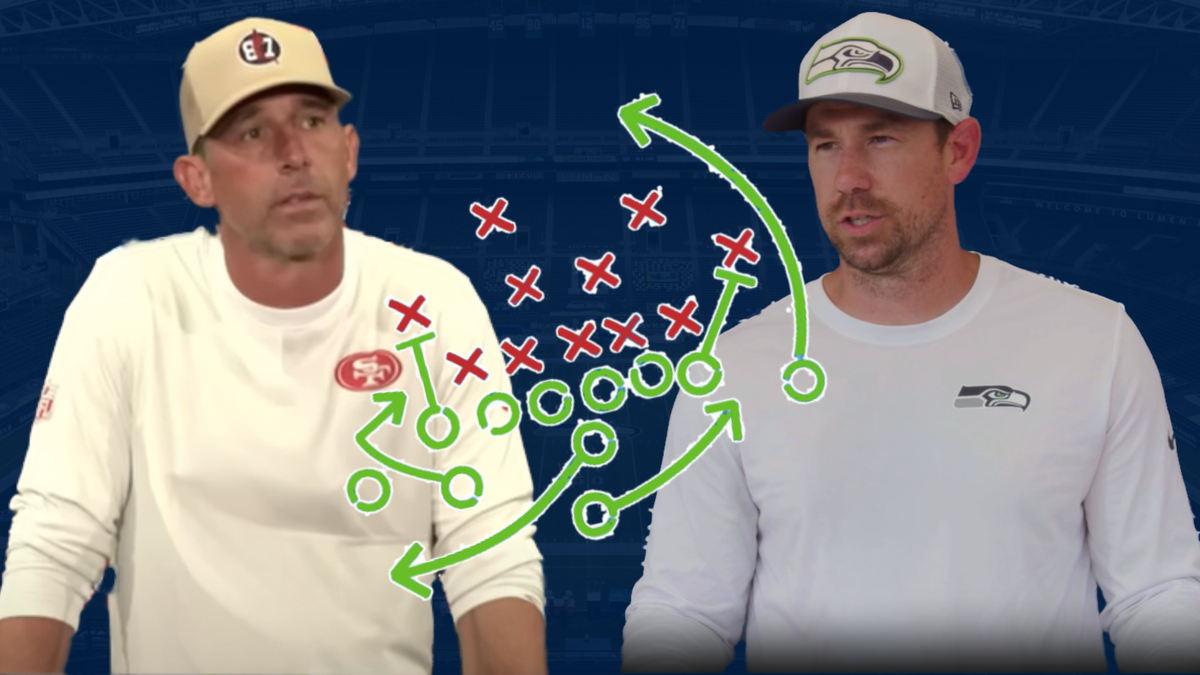
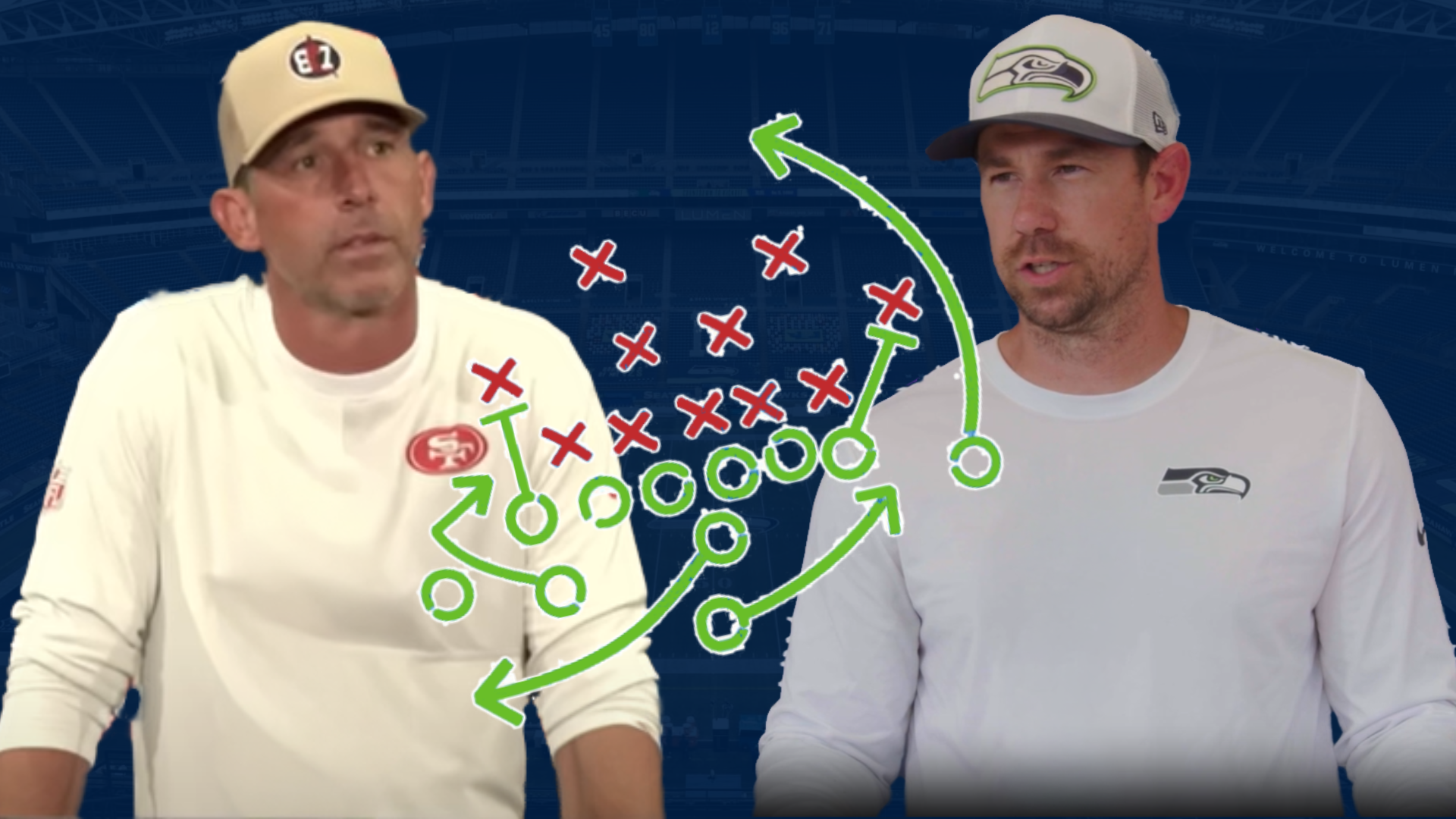
Growing up as sons of NFL head coaches and exposed to the game of football out of the womb, Kyle Shanahan and Klint Kubiak took similar pathways to carve out their own coaching journeys in the league, intertwined to an extent by their connections.
Learning from his father Mike, a renowned Super Bowl-winning coach for the Broncos, Shanahan played receiver for the Texas Longhorns before quickly jumping into coaching as a graduate assistant at UCLA in 2003. One year later, he jumped to the league with the Buccaneers and after stints in Tampa Bay and Houston, he reunited with his father as an offensive coordinator for the then-named Redskins from 2010 to 2013, putting his own spin on the West coast offense that had defined the success of the family business.
By 2017, after two highly successful seasons as a play caller in Atlanta, Shanahan landed his first coaching job with the 49ers, emerging as one of the top offensive minds in the entire NFL while leading the franchise to two Super Bowl appearances in eight seasons.
As for Kubiak, the son of long-time Texans and Broncos coach Gary Kubiak, he likewise played Division I football as a safety at Colorado State, earning an East-West Shrine Bowl invite after his senior season in Fort Collins. Without a shot to play in the NFL, he transitioned into coaching quickly as well, spending three years at Texas A&M before multiple stops with the Vikings and Broncos as a quarterback coach and offensive coordinator and most recently spending time on the 49ers and Saints’ staffs.
Now taking the reins as the Seahawks new offensive coordinator in 2024, Kubiak will test wits against Shanahan to kick off the 2025 season on Sunday at Lumen Field, pitting the apprentice against the mentor and adding another intriguing storyline to the latest matchup in a signature rivalry.
Though Kubiak only spent one season on the same staff with Shanahan as a pass game coordinator in San Francisco in 2023, the familiarity with the scheme runs far deeper for both coaches. Kubiak’s father Gary served as an offensive coordinator for Mike Shanahan for 11 years in Denver, including on both Super Bowl title teams in 1997 and 1998, playing an integral role in building a system that became a staple across the league. Kyle Shanahan then worked as an offensive coordinator in Houston for Kubiak, who had taken over as the franchise’s head coach in 2006, beginning to incorporate his own innovations into his father’s scheme.
Fast forwarding to the present, as veteran tight end Eric Saubert - who played for both coaches prior to signing with the Seahawks in March - indicated during training camp last month, Kubiak and Shanahan have assembled their own schemes that aren’t necessarily clones. Each has left their own imprint on the system with different verbiage while sticking to many of the core principles.
“Klint’s got a lot of his own little wrinkles in the offense that make it his,” Saubert said. “There's a lot of similarities predicated on outside zone, that is the basis of what we do, stretching defenses and creating misdirection. It's a lot of similarities, but like I said, we're kind of honing it in the playmakers we got, and things are looking good.”
Backing up Saubert’s comments, the Shanahan-style offense has always been built around wide zone, the bread-and-butter run play that seemingly turned any running back with healthy legs into a 1,000-yard rusher in Denver during the 2000s. Kubiak and Shanahan have maintained that philosophy in their own respective offenses, as both play callers dialed up zone schemes on north of 72 percent of their run plays last season and more than 37 percent of their run plays went off tackle, according to Pro Football Focus charting.
Compared to the rest of the league, Kubiak and Shanahan had their quarterbacks under center significantly more than the NFL average last year. In New Orleans, the Saints had their signal callers under center more than 44 percent of the time, while San Francisco had nearly the same rate at 42.9 percent. Both teams ranked in the top 10, finishing seventh and ninth respectively for under center rate.
Harkening back to Mike Shanahan’s impressive tenure in the Mile High City, zigging while most other teams zag, Kubiak and Shanahan also rely heavily on fullbacks and two-back personnel groupings. In 2024, the Saints and 49ers both ranked in the top five in the NFL in 21 and 22 personnel usage with multiple backs on the field, which led to the Seahawks making significant roster changes this spring to cater to that new need, including drafting fullback Robbie Ouzts out of Alabama in the fifth round.
Interestingly, despite the Shanahan system being predicated on a more balanced run/pass approach, neither Shanahan nor Kubiak employed play action at a top-15 rate last season. But both play callers were incredibly effective and efficient when they did mix in play fakes and bootleg calls, as New Orleans finished second in the NFL averaging 9.4 yards per play action pass and San Francisco came in just behind them averaging 9.3 yards per play action pass.
As Saubert noted, however, Kubiak and Shanahan have their own unique variations to their offense. Most specifically, Shanahan has seemed to branch out more towards the Sean McVay and Kevin O’Connell variant of his father’s system with the 49ers, utilizing significantly more 11 personnel with three receivers, one running back, and one tight end than the Saints did last season.
On the flip side, while San Francisco used 11 personnel 47.8 percent of the time compared to New Orleans at just 33 percent, Kubiak favored multi-tight end sets. The Saints ranked seventh in the NFL using 12 personnel with two tight ends on the field on 30 percent of their offensive snaps, a 23 percent higher rate than 49ers, who ranked 31st in that grouping. Kubiak’s offense also used extensive 13 personnel looks with three tight ends on the field, ranking fourth out of 32 teams while the 49ers only ran four plays total with that personnel.
As always, an argument can be made that these discrepancies may have more to do with the actual personnel on the roster than clear philosophical differences, especially considering the 49ers had a rash of injuries a year ago that altered what they could do schematically. But at the same time, even in preseason games last month, Kubiak employed a ton of multi-tight end formations with Saubert, AJ Barner, and Elijah Arroyo all seeing the field at the same time on several occasions, further suggesting that the two coaches are far from carbon copies with their own distinct styles.
When it comes to game planning and preparation, Week 1 will always be a crapshoot. Rosters have changed significantly since the previous season, including Seattle bringing a new quarterback on board in Darnold who played for both Shanahan and Kubiak in San Francisco in 2023, and while there’s value to watching old film, especially against a coach like Shanahan who has been one of the best in the business for a decade, there’s an obvious feeling out process for both teams when they take the field for regular season action for the first time that requires coaches to adapt as the game unfolds more so than any other time during the year.
But in the case of the latest Seahawks vs. 49ers clash coming up on Sunday, each rival should be better equipped in terms of knowing what to expect from the opposing offense due to the many similarities between Kubiak and Shanahan, who have been engrained in the intricacies of their offensive system since they were barely old enough to walk. With both teams aiming to make a statement out of the gate in the NFC West and well aware of what the opponent wants to accomplish offensively, everything will come down to execution and in-game adjustments in a battle between football lifers.